A Chromebook ships with a small internal drive, often 32GB or 64GB, and ChromeOS leans on the cloud to make that feel bigger. The moment you want offline movies for a flight, a photo library from a camera, or a student’s project files that must survive a bad Wi-Fi week, an SD card becomes a simple way to add room. The decision this keyword implies is less about raw speed and more about fit: does your Chromebook have a microSD slot, a full-size SD slot, or neither, and how much capacity do you actually need?
Most buyers here are students, travelers, and parents extending a budget laptop in 2026, plus photographers who want a quick way to check shots on a bigger screen. A card that is fast enough for Full HD playback and file transfer is plenty for most Chromebook jobs, while 4K recording or camera use pushes you toward higher-rated cards. The six cards below come from SanDisk, SIX, and Lexar, and the comparison relies on the capacity, format, and speed classes listed in each title. Two other items in the search results, a USB-C card reader and a tablet-specific card, were left out because one is an accessory and the other targets a different device.
Our Top Picks


Top 3 picks at a glance
Quick Picks
As an Amazon Associate we earn from qualifying purchases at no extra cost to you.



| Product | Best for | Key spec from the title |
|---|---|---|
| SanDisk 32GB Ultra SDHC | Full-size slot, light storage needs | Up to 100MB/s read, water-resistant, impact-resistant |
| SanDisk 128GB Ultra microSDXC | microSD slot, everyday storage | Up to 140MB/s, C10, U1, A1 |
| SanDisk 256GB Ultra microSD + Adapter | Maximum capacity | Up to 150MB/s read, adapter included, A1 |
| SanDisk 128GB Ultra SDXC | Full-size slot, more space | 100MB/s, C10, U1, Full HD |
| SIX M200 128GB microSD | 4K recording and heavy use | Up to 190MB/s, A2, U3, V30, adapter included |
| Lexar 128GB Silver SD | Camera-to-Chromebook workflows | 225MB/s read, V30, U3, UHS-I, 4K |
How to Choose
Check Your Chromebook’s Slot First
Many Chromebooks include a microSD slot, some include a full-size SD slot, and a number have neither. Look at the edge of the laptop or its spec sheet before you buy. A microSD card with an adapter covers both cases only if your slot is full-size, because a standard SD card never shrinks to fit a microSD slot. If your Chromebook has no slot, you will need a USB-C reader, which is a separate purchase. Ignore any listing that does not clearly state whether the card is microSD or full-size, and avoid assuming a card works because it is the same brand as your phone card.
Capacity: How Much Do You Actually Need
For documents, school files, and downloaded media, 64GB and 128GB are the practical zone. A 32GB card suits light use such as transferring photos or storing a few offline files. A 256GB card helps if you store movies, music, or large photo libraries. Remember that bigger cards are not automatically faster and that the cloud is still the safer home for irreplaceable files. Budget cards at very high capacities from unknown brands are where counterfeit and failure risks cluster, so stick with recognized names.
Speed Classes That Actually Matter
For a Chromebook, read speed matters for opening files and playing video from the card. UHS-I with Class 10 and U1 ratings is enough for Full HD playback and general storage. If you also record 4K video to the same card, look for U3 and V30. The A1 and A2 marks relate to app performance, which matters if you run Android apps from the card. Headline read speeds such as 140MB/s or 225MB/s are maximums that depend on the slot and USB bus, and many Chromebook slots will not reach them.
Formatting, Reliability, and What to Skip
ChromeOS reads common formats such as FAT32 and exFAT, and you can format a card from the Files app. Larger cards often arrive in exFAT, which works on Chromebooks and on most modern cameras. Keep important files backed up, since cards can fail and the physical card is easy to lose. Skip claims about “lifetime” durability from sellers you do not recognize. A water-resistant and impact-resistant card is useful, but it does not replace safe handling and regular backups.
The 6 Best Options
SanDisk 32GB Ultra SDHC
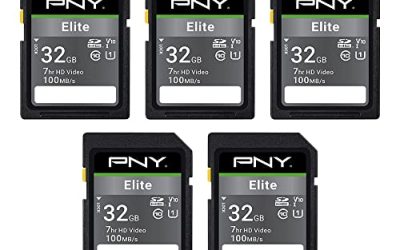
This is the simplest full-size option in the group: a 32GB SDHC card with up to 100MB/s read speed, plus a water-resistant, impact-resistant build. It suits Chromebooks with a full-size slot and users who only need a small amount of extra space, such as a classroom device that carries a few worksheets, a photo set, and some saved PDFs.
- Strength: A well-known brand with a straightforward 100MB/s listed read speed.
- Strength: Water-resistant and impact-resistant, helpful if it travels in a school bag.
- Trade-off: 32GB fills quickly if you store videos or large photo sets.
Skip it if your Chromebook only has a microSD slot or you want to store media libraries. It also makes a handy spare card to keep in a laptop bag for emergencies.
SanDisk 128GB Ultra microSDXC
This card is listed at up to 140MB/s with Class 10, U1, Full HD, and A1 marks. For a Chromebook with a microSD slot, 128GB is a comfortable amount that leaves room for school files, downloaded shows, and a handful of apps. It fits the person who wants dependable storage with a familiar name, such as a student who downloads lecture videos for a commute or a traveler who loads a few seasons of shows before a long trip.
- Strength: The A1 mark suits apps run from the card on Chromebooks that support Android apps.
- Strength: A fast listed read speed for everyday file opening and video playback.
- Trade-off: The title lists no adapter, so it will not fit a full-size SD slot.
Skip it if your laptop only has a full-size SD slot.
SanDisk 256GB Ultra microSD with Adapter
The 256GB option is for people who want the most space in a single card. It lists up to 150MB/s read speeds, UHS-I, Full HD, C10, U1, and A1, and an adapter is included. The adapter makes it flexible if you share the card between a Chromebook and a camera or tablet. It is also the pick for households that want one big card parked in the laptop as permanent extra storage while the internal drive stays clear for apps.
- Strength: 256GB gives the most room for movies, music, and photo libraries.
- Strength: The included adapter lets the card work in full-size SD slots.
- Trade-off: Putting that much data on one small card concentrates risk, so back it up.
Skip it if your needs are modest and you would rather split files across smaller cards, or if you tend to leave cards in a laptop that travels everywhere.
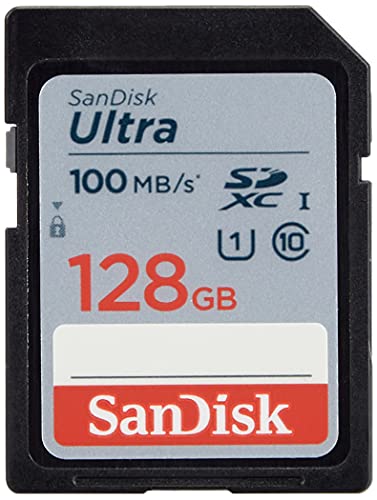
SanDisk 128GB Ultra SDXC
This is the full-size twin of the 128GB microSD, with 100MB/s listed speed and Class 10, U1, Full HD ratings. It is meant for Chromebooks that have a full-size SD slot or for people who share a card with a camera. Because the card leaves the slot easily, it also makes sense for sharing files between two laptops in a family or a small office.
- Strength: 128GB in the full-size format fits Chromebooks and many cameras alike.
- Strength: U1 and Class 10 cover Full HD playback and general storage.
- Trade-off: Full-size cards stick out of some laptop slots, depending on the design.
Skip it if you want 4K recording ratings or if your laptop uses microSD only.
SIX M200 128GB microSD
SIX markets this card at up to 190MB/s read with U3, V30, and A2 ratings, and 4K UHD continuous recording support. An adapter is included. It suits users who also record video on action cameras or drones and then bring the card to a Chromebook to look through footage. Its listed speeds are well above what basic storage needs, so it is a good fit when the same card will pull double duty.
- Strength: The U3 and V30 ratings suit 4K recording.
- Strength: A2 rating helps with app-heavy use.
- Trade-off: SIX is a less familiar name than SanDisk or Lexar, so buyers should verify the seller.
Skip it if brand recognition and long-standing support matter more to you than speed ratings.
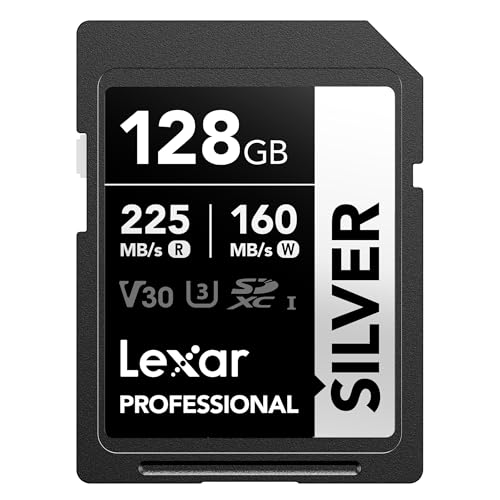
Lexar 128GB Silver SD
Lexar lists 225MB/s read speed, 4K support, V30, U3, and UHS-I, and notes compatibility with Canon, Sony, and Nikon cameras. It targets photographers and videographers, but it works well if you move large files from a camera to a Chromebook with a full-size slot. Wedding and event photographers who cull images on a laptop in the car between sessions will see the appeal.
- Strength: The highest listed read speed in the group.
- Strength: V30 and U3 support 4K video from compatible cameras.
- Trade-off: Chromebook slots are rarely fast enough to use the full 225MB/s.
Skip it if you only need basic storage, since you would be buying speed your laptop cannot use. If you never connect a camera, a cheaper card with lower speed ratings would serve the same purpose.
Which One Fits Your Situation
Your Chromebook Has a microSD Slot Only
Pick the SanDisk 128GB Ultra microSDXC. It matches the slot, offers solid capacity, and carries A1 marks for app use, which makes it the least complicated answer for most school laptops.
Your Chromebook Has a Full-Size SD Slot
The SanDisk 128GB Ultra SDXC is the straightforward match, and it doubles as a camera card if you ever need it.
You Want to Store Movies and Music Offline
Choose the SanDisk 256GB Ultra microSD with the included adapter. The extra space holds a larger library and the adapter widens slot compatibility.
You Shoot Photos or Video and Edit on the Chromebook
Go with the Lexar 128GB Silver SD. It is rated for 4K, and a full-size card moves easily between a camera and a Chromebook.
Common Mistakes
- Buying a full-size SD card for a Chromebook that only has a microSD slot.
- Buying ultra-high speeds when the slot cannot deliver them.
- Ignoring seller reputation and ending up with a counterfeit or relabeled card.
- Storing the only copy of important school or work files on a removable card.
- Leaving a full-size card half-seated, which can cause read errors or missing files.
Related guides
- How To Clean Quest 3 Lenses And Facial Interface
- Micro Sd Cards For Samsung Galaxy Phones
- Vr Facial Interfaces For Glasses Wearers
Frequently Asked Questions
Can any SD card work in a Chromebook?
Most will, as long as the card format matches the slot and the capacity is supported. Check the manufacturer’s notes if you plan to use very large cards, and confirm whether the slot is microSD or full-size before you shop.
Do I need an A1 or A2 card?
Only if you run Android apps from the card. For file storage and media playback, a standard Class 10 U1 card is sufficient.
How do I format the card on a Chromebook?
Open the Files app, right-click the card in the sidebar, and choose the format option. Copy off any files first, because formatting erases the card.
Is a bigger card always better?
No. Bigger cards hold more but concentrate more risk in one device. Choose the capacity you will use and keep a backup elsewhere, whether that is cloud storage or a second card stored at home.
Related guides
- How to Check VRAM Usage in Windows 11: Task Manager, Game Bar and Overlay Methods
- How Much VRAM for 4K Gaming: 8GB, 12GB or 16GB, and What Actually Fills It
- How Many VRM Phases Do You Need? Match Phase Count and Power Stage Rating to Your CPU
- Best Gaming PCs for VR: Seven Prebuilts Compared by Graphics Card, CPU and Memory (2026)