Our Short List of 3

- Best for: Slim prebuilt desktops that need a low profile card
- GPU: NVIDIA GeForce RTX 3050
- Boost clock: 1492 MHz
- Memory: 6GB GDDR6, 14 Gbps, 96-bit bus
- Outputs: 1 DisplayPort 1.4a, 2 HDMI 2.1a

- Best for: Compact PCs driving three or four monitors
- GPU: NVIDIA GeForce RTX 3050
- Core clock: 1477 MHz
- CUDA cores: 2,304
- Memory: 6GB GDDR6, 96-bit bus, 14,000 MHz memory clock

- Best for: Standard towers with weak power supplies and full height slots
- GPU: NVIDIA GeForce RTX 3050
- Boost clock: 1492 MHz
- CUDA cores: 2,304
- Memory: 6GB GDDR6, 14 Gbps, 96-bit bus
All 4 Picks at a Glance
| Product | Specs | Action |
|---|---|---|
| MSI Gaming GeForce RTX 3050 LP 6G OC |
| Check price on Amazon |
| Gigabyte GeForce RTX 3050 OC Low Profile 6G |
| Check price on Amazon |
| MSI Gaming RTX 3050 Ventus 2X 6G OC |
| Check price on Amazon |
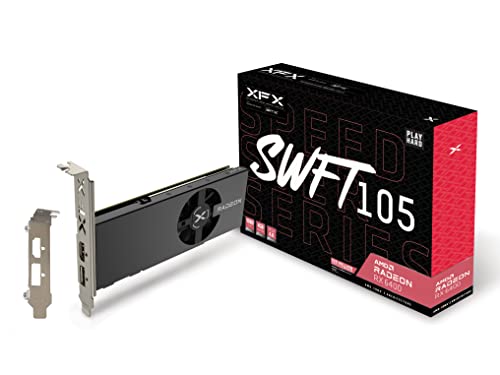 XFX Speedster SWFT105 Radeon RX 6400 |
| Check price on Amazon |
The real decision with a 75 watt graphics card is not chasing the highest frame rates. It is whether a discrete GPU upgrade can live entirely on the power the PCIe slot already delivers. Many prebuilt desktops and slim office towers ship with small power supplies and no spare graphics power cable at all, so a slot-powered card is often the only upgrade that drops in without opening up the power budget. The trade-off is a firm performance ceiling set by that 75 watt limit.
This guide is for owners of prebuilt desktops, small form factor PCs and older towers who want discrete graphics without swapping the power supply. The picks are current slot-powered models sold on Amazon: three GeForce RTX 3050 6GB cards from MSI and Gigabyte in low profile and full height forms, plus an XFX Radeon RX 6400 that draws even less power for single-slot cases.
Our Top Picks
Top 3 picks at a glance
Quick Picks
As an Amazon Associate we earn from qualifying purchases
| Product | Best for | Key spec from title |
|---|---|---|
| MSI Gaming GeForce RTX 3050 LP 6G OC | Slim low profile cases | 6GB GDDR6, 70W slot power |
| Gigabyte GeForce RTX 3050 OC Low Profile 6G | Four display setups | 6GB GDDR6, 2 DisplayPort and 2 HDMI |
| MSI Gaming RTX 3050 Ventus 2X 6G OC | Standard tower upgrades | 6GB GDDR6, dual fan full height |
| XFX Speedster SWFT105 Radeon RX 6400 | Single-slot builds | 4GB GDDR6, 53W TDP |
How to Choose
Confirm the Card Truly Needs No Power Connector
The defining trait of this class is that the card draws everything from the PCIe slot, which supplies up to 75 watts. Check the listing for a power connector field before ordering, because model names mislead: the 8GB version of the RTX 3050 typically needs an 8-pin connector, and some Arc A380 variants do too, even though their 6GB and low profile siblings do not. The listings below state power consumption figures such as 70 watts for the RTX 3050 6GB cards and a 53 watt TDP for the RX 6400, with no connector required.
Match the Form Factor to Your Case
Slot power solves the wiring problem, but physical fit is a separate check. Low profile cards stand about half the height of a standard card and ship with a short bracket for slim cases, while full height cards like the Ventus 2X need a normal expansion slot area. Slot width matters as well: the XFX RX 6400 is a true single-slot card, while the RTX 3050 models here occupy two slots. Measure card length against your drive cages too, since these picks range from about 155 to 189 millimeters long.
Weigh Memory Size and Bus Width
Every card in this power class makes memory compromises, and the listings show exactly where. The RTX 3050 6GB models pair 6GB of GDDR6 with a 96-bit bus at 14 Gbps, while the RX 6400 drops to 4GB on a 64-bit bus, partly offset by a faster 16 Gbps memory clock. More memory mainly buys headroom for higher texture settings at 1080p. Also note the PCIe link width: the RTX 3050 cards use an x8 link and the RX 6400 an x4 link, which matters more on older PCIe 3.0 motherboards.
Count the Display Outputs Your Desk Needs
Output layouts vary more in this class than buyers expect. The Gigabyte low profile card leads here with two DisplayPort 1.4a and two HDMI 2.1 sockets and support for four displays at once. Both MSI cards offer one DisplayPort and two HDMI ports for up to three monitors, while the single-slot XFX card keeps just one HDMI and one DisplayPort. If you run a triple monitor desk or a TV alongside a monitor, settle the output count from the listing before choosing, not after the card arrives.
The 4 Best Options
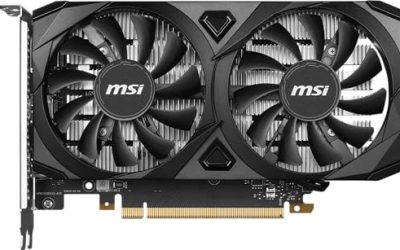
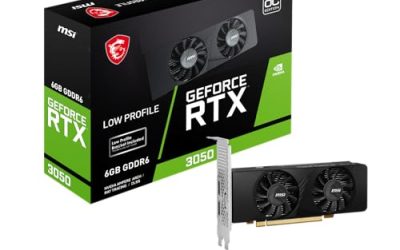
MSI Gaming GeForce RTX 3050 LP 6G OC
- Best for: Slim prebuilt desktops that need a low profile card
- GPU: NVIDIA GeForce RTX 3050
- Boost clock: 1492 MHz
- Memory: 6GB GDDR6, 14 Gbps, 96-bit bus
- Outputs: 1 DisplayPort 1.4a, 2 HDMI 2.1a
Slim prebuilt desktops that need a low profile card
Only one DisplayPort output, so DisplayPort-heavy monitor setups need adapters
This is the straightforward pick when the case is a slim prebuilt with a half-height slot and no power cable to spare. MSI rates the card at 70 watts with a 300 watt recommended power supply, so it fits the small units common in office desktops. The 6GB of GDDR6 and 1492 MHz boost clock bring hardware ray tracing and DLSS support from the Ampere generation into machines that would otherwise stay on integrated graphics, and the low profile bracket is included for narrow cases.
Gigabyte GeForce RTX 3050 OC Low Profile 6G
- Best for: Compact PCs driving three or four monitors
- GPU: NVIDIA GeForce RTX 3050
- Core clock: 1477 MHz
- CUDA cores: 2,304
- Memory: 6GB GDDR6, 96-bit bus, 14,000 MHz memory clock
Compact PCs driving three or four monitors
The 181 mm length is long for a low profile card, so check tight cases
Gigabyte’s low profile entry stands out for connectivity rather than clocks. Its 1477 MHz core clock and 2,304 CUDA cores match the class norm, but the bracket carries two DisplayPort and two HDMI sockets, the widest output set in this guide, and the listing rates it for four displays at once. At 181 millimeters long and 69 millimeters tall it stays within low profile limits, draws all power from the slot with no connector, and includes the LP bracket, making it a tidy fit for compact multi-monitor workstations.
MSI Gaming RTX 3050 Ventus 2X 6G OC
- Best for: Standard towers with weak power supplies and full height slots
- GPU: NVIDIA GeForce RTX 3050
- Boost clock: 1492 MHz
- CUDA cores: 2,304
- Memory: 6GB GDDR6, 14 Gbps, 96-bit bus
Standard towers with weak power supplies and full height slots
Full height and dual slot, so it will not fit slim or half-height cases
The Ventus 2X is the full height option for a standard tower whose power supply is too small or too basic for a connector-fed card. It uses the same RTX 3050 chip, 1492 MHz boost clock and 6GB of 96-bit GDDR6 as MSI’s low profile model, and MSI likewise rates it at 70 watts with a 300 watt recommended supply. The larger 189 millimeter dual fan cooler gives it more thermal mass than the half-height cards, which suits towers with room to spare where the low profile models would look lost.
XFX Speedster SWFT105 Radeon RX 6400
- Best for: Single-slot cases and the lowest power draw in this guide
- GPU: AMD Radeon RX 6400, RDNA 2 architecture
- Stream processors: 768
- Game clock: 1,923 MHz, boost clock up to 2,321 MHz
- Memory: 4GB GDDR6, 16 Gbps, 64-bit bus
Single-slot cases and the lowest power draw in this guide
4GB of memory and a 64-bit bus cap texture settings sooner than the 6GB cards
The XFX card is the pick when even a dual-slot low profile card is too much hardware. It is a genuine single-slot design, 155 millimeters long, with a 53 watt TDP that sits comfortably under the slot limit, and it still includes a low profile bracket in the box. The compromises are visible in the listing: 4GB of memory on a 64-bit bus, 768 stream processors and a PCIe 4.0 x4 link. For light gaming, media playback and everyday display duties in the tightest cases, that trade can be worth it.
Which One Fits Your Situation
You Are Upgrading a Slim Office Prebuilt
A half-height case with a small power supply is the classic use case for this class. The MSI low profile RTX 3050 fits that shape, draws 70 watts from the slot, and asks only for a 300 watt supply, which many office machines already meet. It turns a work desktop into a credible 1080p gaming and media machine without touching the wiring.
Your Tower Has Room but the Power Supply Is Weak
If the case is a normal mid tower, skip the cramped low profile designs and take the full height Ventus 2X. The dual fan cooler has more room to breathe, the specs match the low profile RTX 3050 cards, and the 70 watt slot-powered design means the existing supply stays in place even if it has no graphics power cable at all.
You Run Three or Four Monitors
Output count decides this one. The Gigabyte low profile card is the only pick here with four display sockets, split evenly between DisplayPort and HDMI, and a four display rating in its listing. The MSI cards stop at three displays and the XFX at two, so multi-monitor desks should start with the Gigabyte and only look elsewhere if its length causes a fit problem.
Your Case Has Exactly One Free Slot
Some compact and older small form factor cases leave a single usable slot, which rules out every dual-slot card in this guide. The XFX RX 6400 is the one true single-slot option, and its 53 watt TDP is also the gentlest load on a small power supply. Accept the 4GB memory limit as the price of that fit.
Common Mistakes
- Buying the 8GB RTX 3050 by mistake, since that version generally needs an 8-pin power connector the target PC does not have.
- Assuming every low profile card includes the short bracket, then finding the box holds only a full height bracket.
- Ignoring slot width, and discovering a dual-slot card blocks the only other expansion slot the build needs.
- Expecting high settings at 1440p from a 75 watt card, when this class is built around 1080p play.
- Forgetting the PCIe generation of an older motherboard, where an x4 or x8 card gives up more bandwidth on PCIe 3.0.
Frequently Asked Questions
Does a 75 watt graphics card need a separate power cable?
No. Cards in this class draw all their power from the PCIe slot, which is specified to deliver up to 75 watts, so there is no 6-pin or 8-pin connector on the card and nothing to plug in. That is exactly why they suit prebuilt desktops whose power supplies ship without a spare graphics cable.
Can these cards play modern games at 1080p?
Yes, within the limits of the class. The RTX 3050 6GB listings include dedicated ray tracing and Tensor cores, so DLSS upscaling is available in supported games, and 1080p at medium settings is the realistic target. The RX 6400, with 4GB of memory, suits lighter and older titles better than demanding new releases.
Will a 300 watt power supply run one of these cards?
For the RTX 3050 picks here, yes: both MSI listings and the Gigabyte listing state a 300 watt recommended power supply alongside power consumption figures of 70 watts or slot-only draw. The RX 6400, at a 53 watt TDP, asks even less. Always confirm the recommendation printed on the specific listing before ordering.
How is the RTX 3050 6GB different from the 8GB version?
The 6GB version is the slot-powered one in this guide: listings show a 96-bit memory bus, 14 Gbps GDDR6 and power consumption around 70 watts with no connector. The 8GB version uses a wider 128-bit bus and typically requires an 8-pin power connector, which removes it from the 75 watt class entirely.
Related guides
More from Amazon
Programs that pair well with the guide above. Offers and eligibility are set by Amazon and may change.
Free shipping on eligible items, Prime Video and more. Eligible new members can start with a free trial.
Start a Prime free trialAd-free music streaming. Eligible new subscribers can start with a free trial.
Try Music Unlimited freeA Prime membership for ages 18-24 with a trial period. Eligibility is set by Amazon.
See Prime for Young AdultsAudiobooks and podcasts to listen to on the go. Eligible new members can start with a free trial.
Try Audible freeAs an Amazon Associate we earn from qualifying purchases.