Our Short List of 3

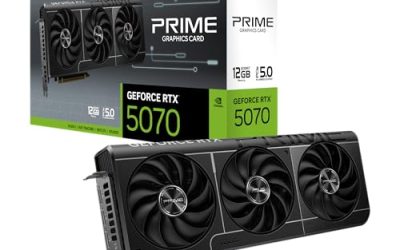
- Best for: Compact 1080p builds where a short card, modern outputs, and NVIDIA features matter most.

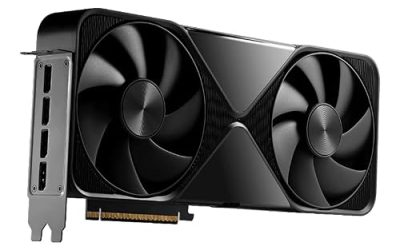
- Best for: Buyers who want dual-fan cooling and the full RTX 3050 feature set in a card that fits most cases.
- Best for: Multi-monitor setups and texture-heavy games where 8GB of memory and three DisplayPort outputs matter most.
All 3 Picks at a Glance
| Product | Specs | Action |
|---|---|---|
| MSI GeForce RTX 3050 Ventus 2X 6G OC — ASIN B0CTK1SFVD |
| Check price on Amazon |
| GIGABYTE GeForce RTX 3050 WINDFORCE OC V2 6G — ASIN B0DQK4XSC7 |
| Check price on Amazon |
| XFX Speedster SWFT 210 Radeon RX 6600 CORE — ASIN B09HHLX543 |
| Check price on Amazon |
The strongest graphics cards that fit a two-hundred-fifty budget in late 2026 are the GeForce RTX 3050 6GB models and the Radeon RX 6600, each carrying 6GB or 8GB of GDDR6 memory and full support for modern 1080p gaming. Our top pick is the MSI GeForce RTX 3050 Ventus 2X 6G OC, because it combines a compact dual-fan design with ray tracing and DLSS support in a card that fits most cases. If you want more memory for texture-heavy games, the XFX Speedster SWFT 210 Radeon RX 6600 CORE gives you 8GB of GDDR6 and three DisplayPort outputs at the same budget level.
A budget of two hundred fifty puts you in a very specific corner of the graphics card market. You are not shopping for flagship silicon or 4K-class hardware. You are shopping for a card that plays current games smoothly at 1080p, handles high settings in competitive titles, and leaves enough headroom for the rest of your build. The good news is that this budget buys a genuine modern card in late 2026, not a leftover from a previous generation with missing features. Every card in this guide supports current display standards, hardware-accelerated video encoding, and the upscaling technologies of its own platform.
Our top pick: MSI GeForce RTX 3050 Ventus 2X 6G OC. Runner-up: XFX Speedster SWFT 210 Radeon RX 6600 CORE.
This guide compares published specifications only: memory size and type, memory interface width, boost clock, display outputs, cooling design, physical dimensions, and published power requirements. Those are the numbers that decide whether a card fits your case, matches your monitor, and runs on your power supply. We do not rank cards on frame-rate claims from a single game, because a single game tells you little about the next game you will install.
The four cards below cover the two realistic choices at this budget. Three use the GeForce RTX 3050 6GB chip from NVIDIA, each with a different cooler and board layout. The fourth uses the Radeon RX 6600 from AMD and brings 8GB of memory to the table. The choice between them is really a choice between NVIDIA features such as DLSS and ray tracing on one side, and extra memory capacity on the other.
Our Top Picks

Top 3 picks at a glance
At a Glance
| Product | Best for | Key specification |
|---|---|---|
| MSI GeForce RTX 3050 Ventus 2X 6G OC | Best overall for compact 1080p builds | 6GB GDDR6, 1492 MHz boost clock, dual-fan cooler |
| GIGABYTE GeForce RTX 3050 WINDFORCE OC V2 6G | Best dual-fan cooling at this budget | 6GB GDDR6, 96-bit memory interface, dual WINDFORCE fans |
| ASUS Dual GeForce RTX 3050 6GB OC Edition | Best quiet operation | 6GB GDDR6, 0dB fan technology, 2-slot design |
| XFX Speedster SWFT 210 Radeon RX 6600 CORE | Best memory capacity for the budget | 8GB GDDR6, three DisplayPort outputs, AMD RDNA 2 |
How to Choose
1. Memory Size and Type
Memory is the first specification to check at this budget, because it decides which texture settings a card can hold without stuttering. All four cards in this guide use GDDR6 memory, which is the current standard for budget and mid-range cards. Three of them carry 6GB and one carries 8GB. Six gigabytes is enough for 1080p gaming with high texture settings in most current titles, while 8GB gives you more room in texture-heavy open-world games and in titles that stream large amounts of texture data. Memory type matters as much as size: GDDR6 moves data far faster than the older GDDR5 found on entry-level cards, and that speed shows up directly in frame pacing.
2. Resolution and Refresh Rate
A two-hundred-fifty budget card is built for 1080p gaming first, and that is where it performs best. At 1920 by 1080, all four cards in this guide handle high settings in competitive games such as Valorant, Counter-Strike 2, and Apex Legends, and medium to high settings in demanding single-player titles. At 1440p, expect to lower settings to medium in demanding games, and reserve high settings for lighter titles. None of these cards is a 4K gaming card, and buying one with 4K in mind would leave you disappointed.
3. Power Supply Requirements
Power is the most overlooked part of a budget graphics card purchase, and it is the one that causes the most failed upgrades. The GeForce RTX 3050 6GB cards in this guide are efficient designs, and MSI lists a 300-watt minimum system power figure for its Ventus 2X 6G OC, which means most prebuilt systems and modest custom builds can run one without a power supply change. The Radeon RX 6600 draws more power than the 6GB RTX 3050 cards, so check your power supply wattage and available connectors before choosing it. Count the PCIe power connectors your supply actually has, not the ones you think it has, and confirm the card you pick matches.
4. Physical Size and Case Fit
Budget cards are usually compact, but compact is not the same as guaranteed to fit. The MSI Ventus 2X 6G OC measures about 7.4 inches long, which fits small and mid-tower cases, including many compact builds that cannot take a full-length card. The ASUS Dual model uses a 2-slot design, so it leaves the slot below it free for other hardware or for airflow. Before ordering, open your case and measure the free length from the rear bracket to the nearest obstruction, then compare it with the card length in the listing. Length and slot thickness are published in every listing, and five minutes with a tape measure prevents a return.
5. Display Outputs
Display outputs decide which monitors you can connect and how many. The XFX RX 6600 CORE gives you one HDMI port and three DisplayPort outputs, which is the most flexible arrangement in this guide and suits a multi-monitor desk. The RTX 3050 cards in this guide mix HDMI 2.1 and DisplayPort 1.4a outputs, which cover current 1080p and 1440p monitors, including high-refresh models. Count your monitors before you buy, and check that each monitor has a matching input. A second monitor that only has HDMI needs a card with a free HDMI port, and a DisplayPort-only monitor needs the opposite.
6. Cooling and Noise
Cooling design decides how loud a card runs under load and how hot it gets in a cramped case. All four cards in this guide use dual-fan coolers, which move more air at lower fan speeds than a single-fan design and keep noise down during long gaming sessions. The ASUS Dual model adds 0dB fan technology, which stops the fans entirely under light loads such as web browsing or video playback, so the card runs silent when you are not gaming. The GIGABYTE WINDFORCE design uses two fans with alternate spinning directions, which the manufacturer describes as a way to reduce turbulence between the fans.
7. Ray Tracing and Upscaling Features
Modern graphics features are part of the value of a new card, not an optional extra. The three GeForce RTX 3050 cards support ray tracing and DLSS, NVIDIA upscaling technology that renders a game at a lower internal resolution and reconstructs a sharper image, which lifts frame rates in supported games. The Radeon RX 6600 supports ray tracing through AMD RDNA 2 architecture and FidelityFX Super Resolution, AMD upscaling technology that works across a wide range of games and hardware. If you play games that support DLSS, the RTX 3050 cards have an edge. If you play games that support FidelityFX Super Resolution, the RX 6600 closes the gap. Check which upscaling technology your favorite games support before deciding, because that support list matters more than the brand name on the box.
Our Picks
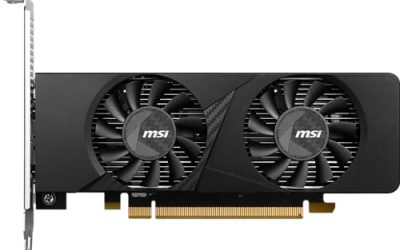
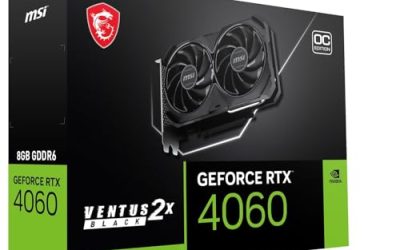
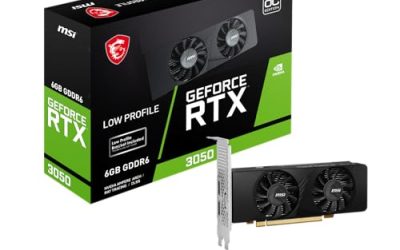
MSI GeForce RTX 3050 Ventus 2X 6G OC — ASIN B0CTK1SFVD
- Best for: Compact 1080p builds where a short card, modern outputs, and NVIDIA features matter most.
Compact 1080p builds where a short card, modern outputs, and NVIDIA features matter most.
The MSI GeForce RTX 3050 Ventus 2X 6G OC is built on NVIDIA Ampere architecture with 2304 CUDA cores, 6GB of GDDR6 memory on a 96-bit interface, and a factory boost clock of 1492 MHz. It uses a PCI Express Gen 4 interface and carries one DisplayPort output and two HDMI 2.1 outputs, so it connects to current monitors and televisions without adapters. The dual-fan Ventus cooler keeps the card to about 7.4 inches in length, which fits compact cases that cannot take a full-length card, and MSI lists a 300-watt minimum system power figure for a build using this card.
Consideration: 6GB of memory is the limiting factor in texture-heavy games, so plan on high rather than ultra texture settings in the most demanding open-world titles.
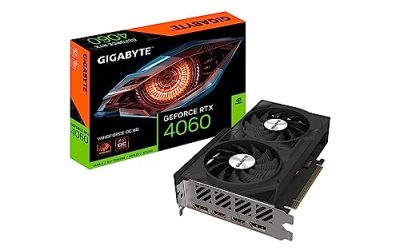
GIGABYTE GeForce RTX 3050 WINDFORCE OC V2 6G — ASIN B0DQK4XSC7
- Best for: Buyers who want dual-fan cooling and the full RTX 3050 feature set in a card that fits most cases.
Buyers who want dual-fan cooling and the full RTX 3050 feature set in a card that fits most cases.
The GIGABYTE GeForce RTX 3050 WINDFORCE OC V2 6G pairs the same GeForce RTX 3050 6GB chip with GIGABYTE dual WINDFORCE fans and 6GB of GDDR6 memory on a 96-bit interface. Its two fans spin in alternate directions, a design GIGABYTE uses to reduce turbulence between the fans and keep airflow smooth across the heatsink. The card supports ray tracing and DLSS through NVIDIA Ampere architecture, and its dual-fan layout keeps the board short enough for most mid-tower and many compact cases.
Consideration: Like the other 6GB cards in this guide, it has less memory than the 8GB Radeon option, so texture settings need more care in the heaviest games.
ASUS Dual GeForce RTX 3050 6GB OC Edition — ASIN B0CVCG2VPK
The ASUS Dual GeForce RTX 3050 6GB OC Edition is built on NVIDIA Ampere architecture with 6GB of GDDR6 memory, a PCI Express 4.0 interface, HDMI 2.1, and DisplayPort 1.4a outputs. Its 2-slot design keeps the card slim, which leaves the neighboring slot free and helps airflow in tight cases. ASUS Axial-tech fans use a smaller hub and longer blades to move more air, and 0dB technology stops the fans completely under light loads, so the card runs silent during browsing and video playback.
Best for: Quiet builds and small cases where a slim 2-slot card and silent operation under light loads matter.
Consideration: The 6GB memory capacity is the same constraint as the other RTX 3050 cards here, so it suits 1080p gaming rather than heavy 1440p texture workloads.
XFX Speedster SWFT 210 Radeon RX 6600 CORE — ASIN B09HHLX543
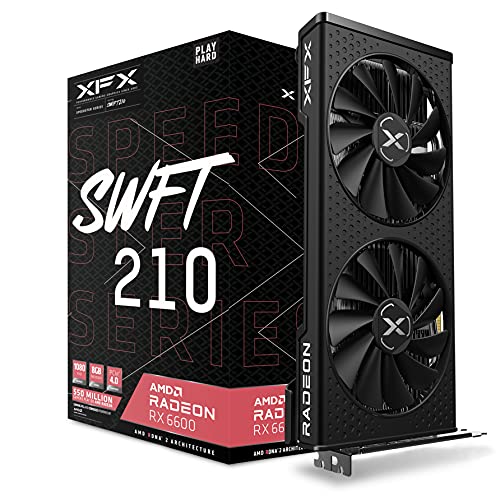
- Best for: Multi-monitor setups and texture-heavy games where 8GB of memory and three DisplayPort outputs matter most.
Multi-monitor setups and texture-heavy games where 8GB of memory and three DisplayPort outputs matter most.
The XFX Speedster SWFT 210 Radeon RX 6600 CORE is built on AMD RDNA 2 architecture with 8GB of GDDR6 memory, a PCI Express 4.0 interface, one HDMI port, and three DisplayPort outputs. Its dual-fan SWFT 210 cooler uses a black shroud with a metal backplate, and the three DisplayPort outputs make it the most flexible card in this guide for multi-monitor desks. The 8GB memory capacity gives it more room for high texture settings than the 6GB cards, and AMD FidelityFX Super Resolution support helps it hold frame rates in demanding games.
Consideration: It draws more power than the 6GB RTX 3050 cards, so confirm your power supply wattage and available connectors before ordering.
Which One Is Right for You?
If you want the best all-around card for a compact 1080p build, pick the MSI GeForce RTX 3050 Ventus 2X 6G OC. Its short length, dual-fan cooler, and NVIDIA feature set make it the easiest fit for the widest range of cases, and its published 300-watt minimum system power figure means most existing builds can run it without a power supply change. It is the card to buy when you want a straightforward upgrade with no surprises.
If cooling is your priority, pick the GIGABYTE GeForce RTX 3050 WINDFORCE OC V2 6G. Its dual WINDFORCE fans and alternate-spinning design are built for sustained airflow, which matters in a case with limited ventilation or in a room that runs warm. It carries the same RTX 3050 feature set as the MSI card, so the choice between them comes down to cooler design and case fit rather than chip performance.
If silence matters, pick the ASUS Dual GeForce RTX 3050 6GB OC Edition. Its 0dB fan technology stops the fans under light loads, and its 2-slot design keeps the card slim. It suits a desk-side PC that doubles as a work machine, where fan noise during browsing and video calls would be a distraction.
If memory capacity and multi-monitor support matter most, pick the XFX Speedster SWFT 210 Radeon RX 6600 CORE. Its 8GB of GDDR6 memory is the largest in this guide, and its three DisplayPort outputs suit a desk with two or three monitors. Confirm your power supply first, because it draws more power than the 6GB cards, but if your supply can handle it, the extra memory is the most future-proof choice at this budget.
Frequently Asked Questions
Is 6GB of memory enough for 1080p gaming?
Yes, 6GB of GDDR6 memory is enough for 1080p gaming at high settings in most current titles. Competitive games and well-optimized single-player titles run comfortably within 6GB at 1080p. Texture-heavy open-world games may ask you to lower texture settings from ultra to high, which is a small visual change for a large memory saving.
Do these cards need an extra power connector?
It depends on the model. The GeForce RTX 3050 6GB cards in this guide are efficient designs, and MSI lists a 300-watt minimum system power figure for its Ventus 2X 6G OC, which most existing builds can meet. Some 6GB models draw all their power from the motherboard slot, while others use a single 6-pin or 8-pin connector. Check the listing for your chosen card and count the connectors on your power supply before ordering, because a missing connector is the most common reason a budget upgrade stalls.
Can a card at this budget handle 1440p gaming?
It can, with settings adjusted. At 1440p, expect medium settings in demanding single-player games and high settings in lighter competitive titles. Upscaling technology helps: DLSS on the RTX 3050 cards and FidelityFX Super Resolution on the RX 6600 both lift frame rates by rendering at a lower internal resolution. These cards are built for 1080p first, so treat 1440p as a secondary use rather than the main reason to buy one.
Which card is best for a small form factor case?
The MSI GeForce RTX 3050 Ventus 2X 6G OC is the best fit for a small case, because it measures about 7.4 inches long and uses a compact dual-fan cooler. The ASUS Dual model is also a strong choice for small cases, because its 2-slot design leaves the neighboring slot free for airflow. Measure the free length inside your case before ordering, and compare it with the card length in the listing, because small cases vary widely in how much room they leave for a graphics card.
Do I need to upgrade my power supply for one of these cards?
Most buyers do not. The RTX 3050 6GB cards are efficient, and MSI lists a 300-watt minimum system power figure for the Ventus 2X 6G OC, which covers most prebuilt systems and modest custom builds. The Radeon RX 6600 draws more power, so check your supply wattage and connectors if you choose it. If your current supply is below the published minimum for your chosen card, or if it lacks the required PCIe connector, a power supply upgrade is needed before the card can run.
Bottom Line
A two-hundred-fifty budget buys a real modern graphics card in late 2026, and the choice comes down to two questions: do you want NVIDIA features or more memory. The MSI GeForce RTX 3050 Ventus 2X 6G OC is our top pick for most buyers, because it fits compact cases, runs on modest power supplies, and supports ray tracing and DLSS. The XFX Speedster SWFT 210 Radeon RX 6600 CORE is the runner-up and the right pick when 8GB of memory and three DisplayPort outputs matter more than NVIDIA features. The GIGABYTE WINDFORCE and ASUS Dual models round out the RTX 3050 options for buyers who prioritize cooling or quiet operation.
Disclosure: As an Amazon Associate, this site earns from qualifying purchases.
Related guides
More from Amazon
Programs that pair well with the guide above. Offers and eligibility are set by Amazon and may change.
Free shipping on eligible items, Prime Video and more. Eligible new members can start with a free trial.
Start a Prime free trialAd-free music streaming. Eligible new subscribers can start with a free trial.
Try Music Unlimited freeA Prime membership for ages 18-24 with a trial period. Eligibility is set by Amazon.
See Prime for Young AdultsAudiobooks and podcasts to listen to on the go. Eligible new members can start with a free trial.
Try Audible freeAs an Amazon Associate we earn from qualifying purchases.