Our Short List of 3
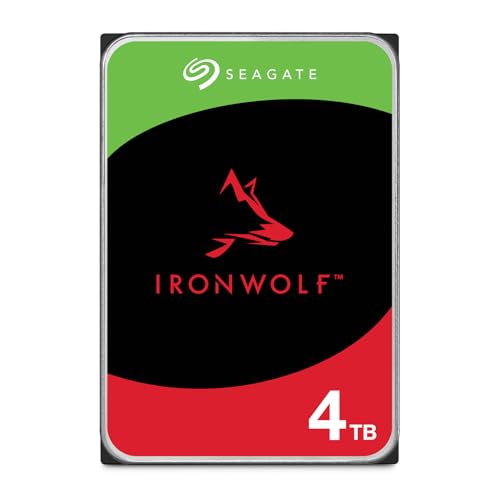
- Best for: a first NAS drive in a quiet home server.
- 4TB capacity
- 3.5-inch SATA 6Gb/s
- 5400 RPM
- CMR recording

- Best for: a proven 4TB revision for arrays with heavy concurrent access.
- 4TB capacity
- 3.5-inch SATA 6Gb/s
- 5900 RPM
- CMR recording

- Best for: a large home media array that needs one big drive instead of two.
- 8TB capacity
- 3.5-inch SATA 6Gb/s
- 7200 RPM
- 256MB cache
All 3 Picks at a Glance
| Product | Specs | Action |
|---|---|---|
| Seagate IronWolf 4TB ST4000VN006 |
| Check price on Amazon |
| Seagate IronWolf 4TB ST4000VN008 |
| Check price on Amazon |
| Seagate IronWolf 8TB ST8000VN004 |
| Check price on Amazon |
A NAS drive is not a desktop drive with a different label. It runs around the clock, shares a cramped enclosure with other spinning disks, and faces constant small reads and writes from every device on the network. Drives built for that life use conventional magnetic recording, carry vibration tolerance, and rate their workload for continuous use — and the wrong drive in a NAS bay will wear out early or drag the whole array down.
This guide covers NAS hard drives only: Seagate IronWolf drives built for network storage, chosen from their listing names and specifications on Amazon. The three picks below are two revisions of the 4TB IronWolf and the larger 8TB model, with cache figures checked against Seagate’s datasheet rather than the listing copy. If you need a drive for a desktop PC or a NAS enclosure itself, those are different products and this guide will not help you choose them.
Our Top Picks
Top 3 picks at a glance
Quick Picks
As an Amazon Associate we earn from qualifying purchases
| Product | Best for | Key spec from title |
|---|---|---|
| Seagate IronWolf 4TB ST4000VN006 | A first NAS drive | 4TB, CMR, 5400 RPM |
| Seagate IronWolf 4TB ST4000VN008 | A proven 4TB revision | 4TB, CMR, 5900 RPM |
| Seagate IronWolf 8TB ST8000VN004 | A large home media array | 8TB, CMR, 7200 RPM |
How to Choose
Insist on CMR, not SMR
The recording method decides whether a NAS drive survives array rebuilds and heavy writes. Conventional magnetic recording (CMR) writes data in clean, independent tracks, while shingled recording (SMR) overlaps tracks and rewrites neighbouring data on every write, which slows rebuilds to a crawl. Check the listing and the maker’s datasheet for the CMR label, and avoid any drive whose recording method the listing does not state — a cheap SMR drive is the most common NAS mistake. The IronWolf drives in this guide are all CMR, which is why they survive the constant small writes of a shared home server without the slowdowns that SMR drives suffer during rebuilds. NAS makers rate their drives for continuous operation.
Match the workload rating to the use
NAS drives carry a workload rating in terabytes per year, and the figure tells you how much traffic the drive is built to handle. A 180TB-per-year rating suits a home server that streams media, backs up several machines, and runs around the clock. Desktop drives carry no such rating and are built for a few hours of use a day, so putting one in a NAS bay means running it far outside its design. A home server that streams media to several rooms and backs up every machine in the house easily clears a desktop drive’s comfort zone, so the rating is not a marketing number but a real limit.
Read the cache figure from the datasheet
Cache figures on listings are unreliable, and the two 4TB IronWolf revisions in this guide prove it: one listing states 64MB where the datasheet says 256MB, and the other states 256MB in its title where the datasheet says 64MB. When a listing and the datasheet disagree, trust the datasheet and the model number, and never buy a drive on a cache figure the listing alone provides. The two 4TB picks in this guide show the problem clearly: each listing states a cache figure that the datasheet contradicts, and only the model number tells you which figure is right. The model number is the only reliable guide: the VN006 is 256MB and the VN008 is 64MB.
Check the model number, not just the capacity
Two drives with the same capacity and brand can be entirely different hardware. The IronWolf 4TB line includes the VN006 and VN008 revisions with different spindle speeds, and the 8TB line has several model codes that differ in speed and cache. Match the model number on the listing to the maker’s datasheet before ordering, and treat any listing that hides the model number as a warning sign. The 8TB IronWolf line is the worst case, with several model codes that differ in speed and cache, so a careless order can land you a slower drive than the one you compared. A listing that hides the model number is a warning sign.
The 3 Best Options
Seagate IronWolf 4TB ST4000VN006
- Best for: a first NAS drive in a quiet home server.
- 4TB capacity
- 3.5-inch SATA 6Gb/s
- 5400 RPM
- CMR recording
a first NAS drive in a quiet home server.
the listing states 64MB cache, but Seagate’s datasheet states 256MB for this model — trust the datasheet.
The VN006 is the newer revision of the 4TB IronWolf, spinning at 5400 RPM with CMR recording and a 180TB-per-year workload rating for continuous use. It is the quieter and cooler of the two 4TB picks, which suits a NAS box that sits in a living room or a home office. Its 5400 RPM spindle spins slower than the VN008, which keeps noise and heat down in a box that runs all day and night, and the three-year warranty with Rescue Data Recovery Services covers the data if the drive ever fails. A living-room server needs the quietest drive you can buy.
Seagate IronWolf 4TB ST4000VN008
- Best for: a proven 4TB revision for arrays with heavy concurrent access.
- 4TB capacity
- 3.5-inch SATA 6Gb/s
- 5900 RPM
- CMR recording
a proven 4TB revision for arrays with heavy concurrent access.
the listing title states 256MB cache while the About section states 64MB — the datasheet confirms 64MB for this model.
The VN008 is the earlier revision of the 4TB IronWolf, spinning faster at 5900 RPM with the same CMR recording and 180TB-per-year workload rating. It is the proven pick of the pair, with a longer track record in home NAS builds, and it suits arrays where the extra spindle speed helps with concurrent access. The two 4TB drives are revisions of the same model line, so choose between them on speed and availability rather than capacity. The extra spindle speed helps when several devices read and write at the same time, which suits a busy household server. Home NAS owners report good results with this revision over years of use.
Seagate IronWolf 8TB ST8000VN004
- Best for: a large home media array that needs one big drive instead of two.
- 8TB capacity
- 3.5-inch SATA 6Gb/s
- 7200 RPM
- 256MB cache
a large home media array that needs one big drive instead of two.
confirm on the product page that the label shows model ST8000VN004, since nearby model codes differ in speed.
The 8TB IronWolf doubles the capacity of the 4TB picks and spins at 7200 RPM, making it the pick for a home media array that keeps growing. Its 256MB cache and CMR recording handle large file transfers and multiple streams without the slowdowns that plague SMR drives, and the same 180TB-per-year workload rating covers round-the-clock use. It is the drive to buy when two 4TB drives would cost more and take two bays instead of one. For a media library that keeps growing, one 8TB drive is simpler than two 4TB drives, since it leaves a bay free for the next expansion.
Which One Fits Your Situation
You are building your first home NAS
Pick the Seagate IronWolf 4TB ST4000VN006. It is the newer revision, runs cooler and quieter at 5400 RPM, and 4TB is enough for backups and media for a household. Start with one drive and add a second later for redundancy, rather than buying capacity you will not fill in the first year. A second drive later adds redundancy without wasting capacity. Four terabytes covers backups and media for most households. It is the newer revision.
You want the proven revision with more speed
Pick the Seagate IronWolf 4TB ST4000VN008. Its 5900 RPM spindle and long track record suit arrays where several devices hit the NAS at once, and its price class makes it easy to buy two for a mirrored pair. Remember the cache is 64MB per the datasheet, not the 256MB the listing title claims. Buy two for a mirrored pair and the array survives a drive failure. It is the proven revision.
Your media library has outgrown 4TB
Pick the Seagate IronWolf 8TB ST8000VN004. One 8TB drive replaces two 4TB drives, frees a bay for future expansion, and its 7200 RPM spindle handles large transfers well. Check the model number on the listing before ordering, since the 8TB line has several nearby codes, and confirm the label shows ST8000VN004 rather than a nearby model code. The 7200 RPM spindle keeps large transfers fast. One drive leaves a bay free.
You want redundancy from day one
Buy two IronWolf 4TB drives and mirror them, so a single drive failure costs you nothing but a replacement. Mirroring halves your usable capacity, since two 4TB drives give you 4TB of protected storage, but it protects the backups and media that would hurt most to lose. Pick the VN006 for the quieter pair or the VN008 for the faster one, and keep a spare drive on the shelf.
Common Mistakes
- Buying an SMR desktop drive for a NAS because it is cheaper per terabyte — the rebuild slowdowns cost far more than the saving.
- Trusting the cache figure on the listing instead of the maker’s datasheet — the two 4TB picks here prove the listing can be wrong, so check the datasheet first.
- Ordering the wrong IronWolf revision by capacity alone and ignoring the model number — check the model code on the listing first.
- Filling a NAS with desktop drives rated for a few hours of use a day — they wear out early under round-the-clock small writes, so use NAS drives instead.
- Choosing a drive by price per terabyte without checking the workload rating — a cheap drive without a rating fails sooner.
Frequently Asked Questions
Can I use a regular desktop hard drive in a NAS?
You can physically install one, but it is a poor choice for anything beyond light use. Desktop drives lack the vibration tolerance and the 24×7 workload rating that NAS drives carry, and they wear out faster under constant small writes. For a NAS that runs around the clock, a CMR NAS drive is the right hardware. The NAS drive lasts far longer.
What is the difference between the VN006 and VN008 IronWolf 4TB drives?
They are two revisions of the same 4TB IronWolf line. The VN006 spins at 5400 RPM with 256MB of cache per the datasheet, while the VN008 spins at 5900 RPM with 64MB of cache per the datasheet. Both use CMR recording and carry the same workload rating, so the choice comes down to speed, noise, and availability. The VN006 is the newer revision. Both carry the same workload rating.
How much cache does a NAS drive need?
Cache helps with bursts of small reads and writes, but it is not the figure that decides NAS performance — the recording method, spindle speed, and workload rating matter more. A 64MB cache on a CMR drive outperforms a large cache on an SMR drive during array rebuilds, so do not buy on cache size alone. A large cache helps, but it never fixes an SMR drive.
Do NAS drives need a special enclosure?
NAS drives are standard 3.5-inch SATA drives, so they fit any NAS enclosure or desktop bay that takes that size. The “NAS” label refers to the firmware and build — vibration tolerance, error recovery tuned for RAID, and a 24×7 rating — not to a different physical connector. Any enclosure that takes a 3.5-inch SATA drive will accept a NAS drive. The drive fits any 3.5-inch SATA bay.
Related guides
More from Amazon
Programs that pair well with the guide above. Offers and eligibility are set by Amazon and may change.
Free shipping on eligible items, Prime Video and more. Eligible new members can start with a free trial.
Start a Prime free trialAd-free music streaming. Eligible new subscribers can start with a free trial.
Try Music Unlimited freeA Prime membership for ages 18-24 with a trial period. Eligibility is set by Amazon.
See Prime for Young AdultsAudiobooks and podcasts to listen to on the go. Eligible new members can start with a free trial.
Try Audible freeAs an Amazon Associate we earn from qualifying purchases.