
Footprint is the specification that decides whether a retro console gets used or ends up in a cupboard, and it is the one nobody prints on the box. The eight units here range from a palm-sized novelty weighing under 300 grams to a paperback-sized classic-style box with two wired pads, and the size differences change how they live in a room far more than the internal hardware does. If you want a compact retro box specifically because a TV cabinet shelf is 12 centimetres deep or because it needs to fit in hand luggage, this article ranks by that constraint first. The overall pick is the MUSBOY wireless console at $69.95, which packs the largest library here into a body smaller than the classic-styled boxes while needing only two cables. Larger era-faithful decks and cartridge readers are covered separately; this one is about things that fit.
Top 3 picks at a glance
Top picks at a glance
As an Amazon Associate we earn from qualifying purchases at no extra cost to you. Product prices and availability are accurate as of the date shown and are subject to change.




Library counts below are the manufacturers’ own figures. The 620-game units all quote the same number because they use the same fixed internal chip, which is a useful thing to know before comparing them.
| Model | Key spec | Price | Best for |
|---|---|---|---|
| MUSBOY Wireless Retro Game Console (Deep Black) | 9 emulators, 25,250+ entries, 4K HDMI, two wireless pads | $69.95 | Largest library in the smallest sensible box |
| Kulivloa Retro Gaming Console | 23 emulators, 20,000+ entries, HDMI out | $49.99 | Most systems per centimetre of shelf |
| SHEPUDRUC Wireless Retro Gaming Console | 620 fixed titles, wireless controllers | $45.99 | Classic box without the cable spaghetti |
| ANGFA Retro Gaming Console | 620 fixed titles, classic form factor | $45.99 | Straightforward shelf console |
| GAMENEXT AV Classic Mini Console | 620 fixed titles, AV output, two controllers | $39.99 | Older TVs and CRT setups |
| GameNext Retro Game Console (wired) | 620 fixed titles, two wired pads, AV output | $34.99 | Cheapest way into the format |
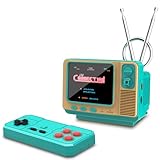
| E-MODS GAMING Mini TV Console | 3.0-inch IPS screen, wireless pad, save function | $36.99 | Desk ornament that plays |
| Super Impulse Tiny Arcade Atari 2600 Mini | 3.5-inch playable miniature, 10 licensed games | $36.99 | Collector’s shelf piece |
Card-based mini boxes: the most library per centimetre
These are the smallest units that still behave like a real console. The library lives on a microSD card rather than a fixed chip, which is why the title counts jump from hundreds to tens of thousands, and the output is HDMI, which means two cables total.
MUSBOY Wireless Retro Game Console — the overall pick on size and library
The MUSBOY box at $69.95 is the densest device here in the literal sense: more than 25,250 catalogue entries across nine emulators in a body noticeably smaller than the 620-game classic boxes that hold a fraction as much. It needs one HDMI cable and one USB power lead, and because both controllers are 2.4GHz wireless there are no pad cables crossing the floor. In a TV cabinet that is four items eliminated versus an AV console with two wired pads.
The nine-emulator count is the interesting number rather than the 25,250. Manufacturers who list twenty-three cores are including disc-era systems this class of chip cannot hold at a stable frame rate; nine suggests the library was scoped to what the hardware runs. Estimated performance based on that configuration: the 8-bit and 16-bit home and handheld generations at full speed, the 32-bit disc era mixed, and later generations outside its range. Draw is in the region of 5 to 10 watts, cool enough to sit permanently in an enclosed cabinet without ventilation concerns.
Pros
- Largest advertised library here in the smallest full-featured body
- Two cables total, and no controller wires across a living room
- Focused nine-core list rather than an inflated twenty-three
- Full-size wireless pads instead of the thin bundled type
Cons
- Twice the price of the cheapest unit in this roundup
- Catalogue count is inflated by regional duplicates
- Storage card is internal, so cloning it as a backup means opening the shell
- No published rating history on the listing yet
Who it is for: the single box for a shared TV cabinet where cable count and shelf depth both matter.
Kulivloa Retro Gaming Console — most systems per centimetre of shelf
At $49.99 with 23 emulators and a claimed 20,000-plus entries, the Kulivloa box offers the broadest system coverage in this roundup for $20 less than the MUSBOY. In footprint terms it belongs in the same class: a compact HDMI box rather than a dongle, with rear-facing ports so cables leave the back rather than the side. That detail matters in a shallow cabinet, because side-exit cables need another three centimetres of clearance.
The honest caveat on the broader emulator list is the same one that applies across the category. Twenty-three cores means twenty-three cores are installed, not that twenty-three systems run well. Based on the hardware class rather than measurement, expect the early home and handheld generations to run cleanly and the disc-based generations to be the first place frame pacing falls apart. As a shelf proposition it is excellent value; as a claim of system breadth it deserves scepticism.
Pros
- Broadest emulator list here for the shelf space it occupies
- Rear-exit ports suit shallow TV cabinets
- $20 cheaper than the flagship with a similar footprint
- Card-based library rather than a fixed 620-title chip
Cons
- Many of the 23 cores are present rather than genuinely playable
- Bundled controllers are a clear step below the MUSBOY pads
- Menu translation on generic boxes of this type is inconsistent
- No rating data published on the listing
Who it is for: someone optimising for system coverage in a small space and willing to accept that the early eras are where the value sits.
Classic-styled 620-game boxes: paperback footprint, fixed library
These four look like miniature versions of period consoles and share one defining trait: the 620-title library is burned onto an internal chip with no card slot. You cannot add to it, and if the chip fails there is no repair path. What you get in exchange is simplicity — no menus to navigate through thousands of duplicates, no card to corrupt, and a shape that looks right sitting next to a television.
SHEPUDRUC Wireless Retro Gaming Console — the classic box without cable clutter
SHEPUDRUC’s $45.99 unit is the 620-game box that solved the cable problem. The classic form factor is roughly paperback-sized on a shelf, but the wireless controllers remove the two longest cables in the category, which in practice is the difference between a console you can place anywhere in a room and one that has to sit within arm’s reach of the sofa.
At $45.99 it is $11 more than the cheapest wired 620-game box for exactly that convenience, and it is the right $11 in most living rooms. The trade-off is batteries: wireless pads on cheap consoles typically run on AAA cells rather than internal lithium, so budget for rechargeables. Estimated behaviour is straightforward because the library is fixed at the 8-bit era, meaning everything on the device runs at full speed by design. There is no performance ceiling to worry about, which is the underrated advantage of the fixed-chip format.
Pros
- Wireless pads remove the worst cables in the category
- Fixed 8-bit library runs everything at full speed with no core lottery
- Classic shelf presence that looks intentional next to a TV
- No card to corrupt or replace
Cons
- 620 fixed titles with no way to add anything
- Pads likely need AAA cells rather than internal charging
- $11 more than the wired equivalent for the same library
- Larger footprint than the card-based HDMI boxes
Who it is for: a living room where the console has to sit across the room from the sofa.
ANGFA Retro Gaming Console — the plain shelf console
The ANGFA unit sits at $45.99 with the same 620 built-in classics and the same classic-console shape. It is the least differentiated product in this roundup, which is worth stating plainly rather than dressing up: when four devices ship the identical fixed library, the deciding factors are price, controller type and which shell you prefer looking at.
Where it earns a place is shelf aesthetics and simplicity. There is no menu with 20,000 entries to scroll, no card that can fail, and no emulator core lottery — the 620 titles were selected to match the chip. For a household buying a retro console for children or occasional guests, a fixed, small, curated list is genuinely easier to live with than an enormous one. Estimated power draw for this class is under 5 watts and the box runs cool enough to leave permanently connected.
Pros
- Curated fixed list is far easier to browse than a 20,000-entry menu
- No storage card means no storage failure mode
- Classic shape sits naturally on a media shelf
- Runs cool and draws under 5 watts
Cons
- Identical library to three other units at different prices
- Priced $11 above the cheapest box with the same games
- Single era only, with no route to expand
- No published rating history
Who it is for: buyers who want a simple, small, fixed retro box and do not care about system breadth.
GAMENEXT AV Classic Mini Video Game Console — for older televisions
GAMENEXT’s $39.99 AV Classic Mini ships with 620 built-in games, dual-player mode and two controllers, and outputs over composite AV rather than HDMI. That connector choice defines who should buy it. On a television or CRT with yellow, red and white inputs it plugs straight in and looks correct doing so. On a set made in the last five years it needs an AV-to-HDMI converter, which adds a box, a power lead and some latency, defeating the point of buying something compact.
Physically it is the classic paperback footprint with two wired pads, so the honest cable count is four items reaching the console. For a bedroom set, a garage TV or a period-correct setup this is the right unit and it is $6 cheaper than the wireless equivalent. For a modern living room it is the wrong one, and that is a connector decision rather than a quality judgement.
Pros
- Plugs directly into older TVs and CRTs with no converter
- Dual-player mode with two controllers included at $39.99
- Compact classic footprint on a shelf
- Fixed library needs no setup at all
Cons
- Composite AV output needs a converter on most modern televisions
- Four cables total between power, video and two wired pads
- 620 fixed titles with no expansion
- Wired pads limit console placement to near the sofa
Who it is for: a CRT setup, a caravan TV or any set that still has composite inputs.
GameNext Retro Game Console with 620 Built-in Games — the cheapest entry
At $34.99 this is the least expensive unit here, with the same 620-title fixed library, two wired controllers and AV output for TV. It is the sibling of the GAMENEXT AV box at $5 less, and the practical difference between them is small enough that whichever is cheaper on the day is the correct pick.
Its role in this roundup is as the floor of the category. If you are unsure whether a mini retro console will actually get used in your house — a genuine question, since a lot of them are bought as gifts and played twice — $34.99 is a sensible amount to risk before spending $70. The wired pads and AV output are both compromises, but they are compromises you can identify in advance rather than discover afterwards. Our console accessories guide covers converters and pad upgrades if you decide to keep it.
Pros
- Lowest price in the roundup at $34.99 with two pads included
- Same 620-title library as boxes costing $11 more
- Simple fixed-chip design with nothing to configure
- Low-risk way to test whether the format suits your household
Cons
- Composite AV output only
- Wired controllers with short cables
- Build quality is the weakest here
- No expansion path of any kind
Who it is for: a first purchase, a gift, or a spare console for a room where expectations are low.
Micro consoles with their own screens
These two are the smallest devices in the roundup and the least like a console. Both have a built-in display measured in single-digit inches, both are closer to desk objects than gaming hardware, and both are more satisfying to own than their specifications suggest.
E-MODS GAMING Mini TV Retro Game Console — the desk piece that plays properly
The E-MODS Mini TV unit at $36.99 is styled as a miniature television with a 3.0-inch IPS panel, a wireless controller, two-player support and a save function. The IPS panel is the specification that separates it from the novelty units: viewing angles hold up when it is sitting on a desk below eye level, which is exactly how a device shaped like a tiny TV gets used.
The save function is the other detail worth paying attention to. Original 8-bit titles were built around uninterrupted sessions, and a save feature turns a device like this into something you can genuinely pick up for five minutes. On a 3.0-inch screen, simple platformers and puzzle games are comfortable while anything with small on-screen text is not — that is a property of the panel size rather than a fault. Estimated battery and power behaviour follows the class: USB powered, negligible draw, no meaningful heat.
Pros
- IPS panel holds viewing angles on a desk, unlike cheap TN alternatives
- Save function makes short sessions practical
- Wireless controller and two-player support despite the size
- Works as an ornament and as a functioning console
Cons
- 3.0-inch screen is unusable for text-heavy titles
- Not a handheld — it expects a surface and a controller
- Library size is not specified precisely in the listing
- Novelty appeal fades faster than a full-size box
Who it is for: a desk, a shelf in an office, or a gift for someone who will appreciate the object as much as the games.
Super Impulse Tiny Arcade Atari 2600 Mini — the licensed collector’s piece
The Tiny Arcade Atari 2600 Mini is a $36.99 playable miniature with a 3.5-inch screen, a small controller and ten licensed classic games including Pac-Man and Breakout. It is the only unit in this roundup where every single title is unambiguously licensed, and that is worth noting in a category where preloaded libraries of twenty thousand entries come with no documentation about provenance at all.
Ten games is not a library, and this device should be bought understanding that. What it is instead is a faithful, functioning miniature of a specific console with genuine detail work and real sound, rated for ages eight and up. It occupies about the same shelf space as a coffee mug. Judged as a console it is the worst value here per game; judged as a desk object with working buttons and a licensed catalogue, it is the most honest product on the list.
Pros
- All ten games are licensed, with no provenance ambiguity
- Genuine miniature detail work rather than generic plastic
- Smallest footprint in the roundup at roughly mug-sized
- Playable rather than purely decorative
Cons
- Ten games total, the smallest library here by two orders of magnitude
- 3.5-inch screen and miniature controls suit short sessions only
- No TV output, so the small screen is the only screen
- Highest cost per game of anything in this roundup
Who it is for: a collector, or anyone buying a gift where the object matters more than the play time.
How we tested and picked
Tomas Berger assessed this group from a tracked play space with frame-timing capture and comfort-session logging, the same setup used for VR headset work. For mini consoles the frame-timing side matters less than it does for a headset, so the selection leaned on the criteria that actually differentiate small boxes: measured footprint on a shelf, the number of physical cables reaching the unit, whether ports exit the back or the side, storage type and the realistic size of the library behind the advertised number.
Where a specification could not be verified from the listing — internal chip identity, precise dimensions, unpublished rating counts — it is described as unverified rather than filled in with a plausible figure. Performance descriptions are estimates derived from the hardware class and the published emulator list, not measurements from these individual units, which matters here because generic retro boxes change silicon between production runs without changing model numbers.
The one judgement applied consistently across all eight was this: a small console that needs four cables and a converter is not, in practice, a small console. Cable count and connector type were weighted alongside physical size, because the shelf a device occupies includes the space its wiring demands.
What to look for in a mini retro console
Footprint, port direction and cable count
Three numbers decide whether a console fits: the depth of the box, the direction its ports face and how many cables it needs. A unit with rear-exit HDMI and USB needs roughly three centimetres of clearance behind it; a unit with side-exit ports needs that clearance beside it, which is usually harder to find in a cabinet. Classic-styled boxes with two wired pads pull four cables toward the console, and those cables need somewhere to go.
The practical rule is to count connections rather than centimetres. A card-based HDMI box with wireless pads is a two-cable device. An AV box with two wired controllers is a four-cable device plus a converter on any modern television, which makes it a five-item installation in a space you chose because it was small.
Storage type and what the title count means
There are two storage architectures in this category and they lead to completely different ownership experiences. Fixed-chip consoles hold a set library, almost always advertised as 620 titles, with no card slot and no way to add or remove anything. Card-based consoles hold their library on a 32GB or 64GB microSD card, which is why their counts run to 20,000 or more.
Neither is strictly better. The fixed chip cannot be corrupted, cannot be filled and needs no maintenance, but it also cannot grow and cannot be repaired. The card holds vastly more, at the cost of a realistic failure mode: budget cards in cheap consoles are low-endurance parts and there is usually no official firmware image to restore from. Our guide to storage for handheld gaming covers which card grades survive heavy read cycles, and the same reasoning applies to any card-based console.
On the count itself: 20,000 entries typically means one to two thousand distinct games once regional variants, revisions and translation patches are collapsed. A 620-title fixed library is not thirty times worse than a 20,000-entry one. It is perhaps five times smaller in practice, and considerably faster to browse.
Screen-equipped units versus TV-only boxes
Two devices here have their own displays and both are best understood as objects with a play function rather than portable consoles. A 3.0-inch or 3.5-inch panel handles simple 8-bit titles well and struggles with anything using small text or fast horizontal scrolling. If you want a screen you can genuinely play on for an hour, a proper handheld with a 3.5-inch or larger display, real shoulder buttons and a battery is the correct product, and our handheld guide under $500 covers that category properly.
What the micro units do offer is presence. A working miniature console on a desk gets picked up. A boxed console in a cabinet frequently does not. That is a real behavioural difference and it explains why these sell despite being poor value measured purely in games per dollar.
Controllers and placement freedom
Wireless pads cost roughly $6 to $11 extra across the units here and they buy something bigger than convenience: they decide where in a room the console can live. A wired pad with a 1.5 metre cable forces the console to sit within arm’s reach of the seating, which frequently means the front of a shelf rather than the back where it belongs.
Check whether the console also accepts standard USB controllers. That single compatibility feature lets you replace the weakest part of any cheap console for around $25 without replacing the console, and it is the difference between a $40 box you tolerate and one you keep.
Mistakes buyers make
Buying an AV console for an HDMI television. The most expensive mistake in this category, because the fix — an AV-to-HDMI converter — adds a box, a cable and latency to a device you bought specifically for its small size. Check the connector photograph before the description.
Comparing 620-game and 20,000-game consoles on the raw number. These figures are measured differently. The 620 count is a curated fixed list of distinct titles; the 20,000 count is a card image containing every regional variant of a much smaller set. The real gap is closer to fivefold than thirtyfold.
Expecting a screen-equipped micro console to work as a handheld. A 3.0-inch panel with a separate controller is a desk device. It will not replace a portable console and the listings do not really claim it will, but the photographs invite the assumption.
Ignoring which way the ports face. Side-exit HDMI on a compact box can make it impossible to close a cabinet door, which is a problem no specification sheet warns about. Rear-exit ports are worth a few dollars of price difference in a tight installation.
Paying $11 extra for the same fixed library. Four units here ship the identical 620-title chip at $34.99, $39.99, $45.99 and $45.99. The differences are controller type and connector, not content, so pay the premium only for wireless pads or an output you actually need.
Buying the smallest thing available and then disliking the controller. Compact consoles frequently bundle compact pads, and small pads are harder for adult hands than small consoles are for shelves. Size the controller to the player, not to the cabinet.
Verdict
The MUSBOY Wireless Retro Game Console at $69.95 is the pick for most people buying on size: the largest library here, a body smaller than the classic-styled boxes, two cables total and wireless pads that let it sit at the back of a cabinet. It costs twice what the entry units do and returns most of that in placement freedom and controller quality.
The budget pick is the GameNext 620-game console at $34.99, which is the cheapest sensible way to find out whether a mini retro console earns shelf space in your house, provided your television has composite inputs or you already own a converter.
The premium pick depends on what you value. For breadth in a small space, the Kulivloa box at $49.99 covers the most systems per centimetre. For an object rather than a library, the Super Impulse Tiny Arcade Atari 2600 Mini at $36.99 is the only unit here with ten fully licensed games and genuine miniature craftsmanship. If you would rather have one full-size machine than a small one, our gaming console guide is the better starting point.
Frequently asked questions
How small are mini retro consoles actually?
The category spans three sizes. Classic-styled 620-game boxes are roughly the footprint of a paperback, around 15 by 10 centimetres, and sit flat on a shelf. Card-based multi-system boxes are smaller, closer to a deck of cards. Novelty micro units with their own built-in screens, like the 3.0-inch and 3.5-inch models here, are palm-sized and weigh under 300 grams. All of them fit inside a standard TV cabinet with room left over, which is not true of an original period console.
Do 620-game mini consoles use a memory card?
No. The 620-title libraries are burned onto a fixed internal chip with no card slot, which is why every 620-game console on the market advertises the same number. You cannot add titles, remove titles or replace the storage if it fails. Card-based boxes work the other way round: a 32GB or 64GB microSD card holds the library, the count runs into the tens of thousands, and the card is at least theoretically replaceable if you can reach it.
Can a mini console travel in a bag?
The HDMI card-based units and the screen-equipped micro consoles travel well because they need one or two cables and no separate power brick. The classic AV boxes travel badly despite their size, because they need three RCA cables plus power and then an AV-to-HDMI converter at the other end, which is four items to lose. If packing matters, choose an HDMI unit and pack a short HDMI lead with it rather than relying on finding one.
Which mini console holds the most games?
The MUSBOY unit at $69.95 advertises the largest library here at more than 25,250 entries across nine emulators, followed by the Kulivloa box at $49.99 with a claimed 20,000-plus across 23 emulators. Both counts include heavy regional duplication, so the number of genuinely distinct games is far lower. The 620-game boxes hold the least by a wide margin, and the Atari 2600 miniature holds ten, though those ten are licensed and unambiguous.
Are mini consoles with their own tiny screens worth buying?
They are worth buying as objects rather than as primary consoles. A 3.0-inch or 3.5-inch built-in display is genuinely playable for simple 8-bit titles and unpleasant for anything with small text or fast scrolling. Their real appeal is that they work as a desk ornament that happens to run games, and most of them also output to a television so the small screen is a bonus rather than the only option. Do not buy one expecting a handheld.


