Our Short List of 3


All 5 Picks at a Glance
| Product | Specs | Action |
|---|---|---|
| 1. ASUS ROG Rapture GT-BE98 Pro — Best Overall for Large, Device-Heavy Gaming Homes | Check price on Amazon | |
| 2. TP-Link Archer GE800 — Best Tri-Band Wi-Fi 7 Gaming Router for Busy Households | Check price on Amazon | |
| 3. ASUS ROG Rapture GT-AX11000 Pro — Best Tri-Band Wi-Fi 6 Gaming Router With Multi-Gig Wired Headroom | Check price on Amazon | |
 4. MSI Radix AXE6600 — Best Wi-Fi 6E Gaming Router for Multi-Device Homes | Check price on Amazon | |
 5. ASUS RT-AX86U Pro — Best Value Gaming Router for Many Devices | Check price on Amazon |
As an Amazon Associate I earn from qualifying purchases.
Our Top Picks
Top 3 picks at a glance
The Short Answer
The best routers for gaming and multiple devices keep latency low on your game while dozens of other gadgets stay connected at the same time. A gaming router built for a busy household needs more than a fast headline speed: enough wireless streams to serve many devices at once, a quality of service engine that puts game traffic first, and wired ports fast enough for a PC or console.
Start with the ASUS ROG Rapture GT-BE98 Pro if the household is large and the device count keeps growing. Its quad-band Wi-Fi 7 radios, dual 10G ports and triple-level game acceleration give a crowded home the most headroom. The TP-Link Archer GE800 is the tri-band Wi-Fi 7 alternative, and the ASUS RT-AX86U Pro is the sensible Wi-Fi 6 pick for homes that want strong gaming controls without paying for Wi-Fi 7.
Our Top Picks
- ASUS ROG Rapture GT-BE98 Pro — Best overall for large, device-heavy gaming homes. Quad-band Wi-Fi 7 with dual 10G ports.
- TP-Link Archer GE800 — Best tri-band Wi-Fi 7 gaming router for busy households. Dedicated gaming port and panel, 12-stream radios.
- ASUS ROG Rapture GT-AX11000 Pro — Best tri-band Wi-Fi 6 gaming router with multi-gig wired headroom. Tri-band AX11000 with a 10G port, triple-level game acceleration and AiMesh.
- MSI Radix AXE6600 — Best Wi-Fi 6E gaming router for multi-device homes. Tri-band with a 6 GHz band and AI QoS.
- ASUS RT-AX86U Pro — Best value gaming router for many devices. Dual-band Wi-Fi 6 with a 2.5G port and dedicated gaming port.
Quick Comparison
| Router | Wi-Fi | Bands | Speed Class | Wired Ports | Gaming Features |
|---|---|---|---|---|---|
| ASUS ROG Rapture GT-BE98 Pro | Wi-Fi 7 | Quad-band | BE30000 | 2 x 10G, 4 x 2.5G | Triple-level game acceleration, Mobile Game Mode, AiMesh |
| TP-Link Archer GE800 | Wi-Fi 7 | Tri-band | BE19000 | 2 x 10G, 4 x 2.5G | Turbo Acceleration, dedicated gaming port and panel, HomeShield |
| ASUS ROG Rapture GT-AX11000 Pro | Wi-Fi 6 | Tri-band | AX11000 | 1 x 10G, 1 x 2.5G, 4 x 1G | Triple-level game acceleration, RangeBoost Plus, AiMesh |
| MSI Radix AXE6600 | Wi-Fi 6E | Tri-band | AXE6600 | 1 x 2.5G, 4 x 1G | AI QoS, MU-MIMO, 8-stream radios |
| ASUS RT-AX86U Pro | Wi-Fi 6 | Dual-band | AX5700 | 1 x 2.5G, gaming port, 4 x 1G | Adaptive QoS, Mobile Game Mode, AiMesh |
How to Choose
Count the devices, then count the streams
A household with a gaming PC, two consoles, several phones, tablets, smart TVs, a doorbell camera and a pile of smart home gear can easily pass thirty connected devices. Tri-band and quad-band routers spread devices across more radios, so a video call on one band does not crowd the game on another. MU-MIMO and OFDMA let the router talk to several devices in the same window instead of serving them one at a time.
Bands are your traffic lanes
Dual-band routers give you a 2.4 GHz band for range and a 5 GHz band for speed. Tri-band adds a second 5 GHz band or a 6 GHz band — the single biggest upgrade for a multi-device gaming home, since you can reserve the cleanest band for gaming and let everything else share the rest. Wi-Fi 6E and Wi-Fi 7 routers add the 6 GHz band, which is wide, fast and usually far less crowded than 5 GHz.
Gaming QoS is not a gimmick when the house is busy
Every router in this guide has a gaming quality of service engine. When the network is loaded, game packets go first. Some engines learn which traffic is gaming traffic on their own, some let you tag a device or a port, and the most advanced ones let you pick which game server region you connect to.
Wired ports still win for the main rig
A wired connection is still the lowest-latency way to connect a gaming PC or console. A 2.5G port is the sweet spot for most homes today, and a 10G port is worth having if your internet plan or home network can use it. A dedicated gaming port is a useful touch: plug the main rig into it and the router gives that port priority automatically.
Wi-Fi 7, Wi-Fi 6E or Wi-Fi 6
Wi-Fi 7 brings the widest channels, the lowest-latency features and the most streams, and it is the right choice if you plan to keep the router for years. Wi-Fi 6E adds the 6 GHz band at a lower cost. Wi-Fi 6 routers are the value play: they handle many devices well through OFDMA and MU-MIMO, and they cost far less than the newest models. If your setup sits far from the modem, pick a router with mesh expansion so you can add a node later.
The Picks in Detail
1. ASUS ROG Rapture GT-BE98 Pro — Best Overall for Large, Device-Heavy Gaming Homes
The GT-BE98 Pro is the most capable router in this guide, and the one to pick when the household is large and the device count keeps growing. It is a quad-band Wi-Fi 7 gaming router with two separate 6 GHz bands alongside its 5 GHz and 2.4 GHz radios. That extra band is the whole point for a multi-device home: gaming traffic can sit on a clean band while phones, TVs, cameras and smart home gear share the others.
The combined wireless capacity is listed at BE30000 class, and the wired side is just as strong, with two 10G ports and four 2.5G ports — enough fast wired capacity for a gaming PC, a console and a network storage box at the same time. Triple-level game acceleration prioritizes game traffic end to end, and Mobile Game Mode extends it to phones. AiMesh support means you can add ASUS mesh nodes later, and the built-in network security carries no subscription.
Pros:
– Quad-band Wi-Fi 7 with two 6 GHz bands keeps gaming traffic clear of other devices
– Dual 10G ports plus four 2.5G ports for wired gaming rigs
– Triple-level game acceleration and Mobile Game Mode
– AiMesh expansion for larger homes
Cons:
– Large physical size needs shelf space and airflow
– Flagship feature set is more than a small household needs
2. TP-Link Archer GE800 — Best Tri-Band Wi-Fi 7 Gaming Router for Busy Households
The Archer GE800 is the tri-band Wi-Fi 7 gaming router in this guide, and the pick for a household that wants modern Wi-Fi 7 capacity without stepping up to a quad-band flagship. Its BE19000 class radios run 12 streams across 2.4 GHz, 5 GHz and 6 GHz, so many devices can stay connected at once while the 6 GHz band stays open for the traffic that needs low latency.
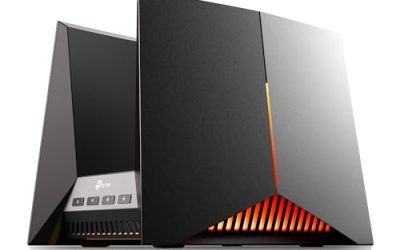
The wired layout matches the wireless ambition: two 10G ports and four 2.5G ports, plus a USB 3.0 port. One wired port is a dedicated gaming port, and the front of the router carries a gaming panel that shows network status at a glance. Turbo Acceleration is TP-Link’s gaming QoS engine, working alongside HomeShield network security. EasyMesh support allows mesh expansion later, and a separate IoT network isolates smart home gadgets from your main devices.
Pros:
– Tri-band Wi-Fi 7 with 12 streams for many simultaneous devices
– Two 10G ports and four 2.5G ports, plus a dedicated gaming port
– Separate IoT network for smart home devices
– EasyMesh support for future coverage expansion
Cons:
– Tri-band layout means one fewer band than the quad-band flagship
– Some owners report long-term reliability concerns — confirm on the listing
3. ASUS ROG Rapture GT-AX11000 Pro — Best Tri-Band Wi-Fi 6 Gaming Router With Multi-Gig Wired Headroom
ASUS ROG Rapture GT-AX11000 Pro
The GT-AX11000 Pro takes a different approach from the Wi-Fi 7 picks: instead of newer radios, it gives you more wired headroom and a proven tri-band layout. It is a tri-band Wi-Fi 6 gaming router with AX11000 class capacity across 2.4 GHz, two 5 GHz bands, so gaming traffic can sit on a clean band while phones, TVs, cameras and smart home gear share the others. Triple-level game acceleration prioritizes game traffic end to end, and RangeBoost Plus extends coverage across a larger home.
The wired side is the reason this pick earns its place: a 10G WAN/LAN port, a 2.5G WAN port and four gigabit LAN ports, so a gaming PC and a second high-speed device can both wire in at multi-gig speeds. AiMesh support means you can add ASUS mesh nodes later, and the built-in network security carries no subscription.
Pros:
– Tri-band Wi-Fi 6 with a dedicated gaming band for low-latency play
– 10G port plus a 2.5G port for multi-gig wired gaming rigs
– Triple-level game acceleration and RangeBoost Plus
– AiMesh expansion for larger homes
Cons:
– Wi-Fi 6 standard next to the Wi-Fi 7 picks
– Large physical size needs shelf space and airflow
4. MSI Radix AXE6600 — Best Wi-Fi 6E Gaming Router for Multi-Device Homes
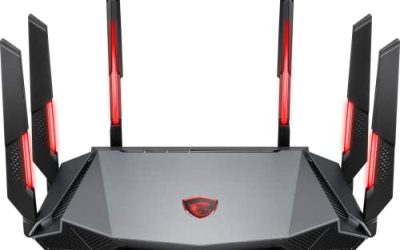
The Radix AXE6600 is the Wi-Fi 6E pick in this guide, and it earns its place by giving a gaming household the 6 GHz band at a lower step than Wi-Fi 7. Its tri-band radios run 2.4 GHz, 5 GHz and 6 GHz with eight streams and a combined AXE6600 class capacity, so the 6 GHz band can carry gaming and video calls while the other bands absorb the rest of the house.
MSI’s AI QoS engine learns which traffic is gaming traffic and prioritizes it, and MU-MIMO lets the router serve several devices in the same transmission window. The wired side has one 2.5G WAN/LAN port, one gigabit WAN/LAN port and three gigabit LAN ports, which covers a main PC and a console with room for a streaming box. One caution: MSI also sells the RadiX AX6600, a Wi-Fi 6 sibling without the 6 GHz band. Match the listing by ASIN B0BTQ637LJ and model RadiX AXE6600 (GRAXE66) so you get the Wi-Fi 6E version described here.
Pros:
– Tri-band Wi-Fi 6E with a 6 GHz band for clean, low-latency gaming
– AI QoS that learns gaming traffic on its own
– Eight-stream radios with MU-MIMO for many devices at once
– 2.5G port for a wired gaming PC
Cons:
– No mesh support, so coverage expansion means a different approach
– Fewer multi-gig ports than the Wi-Fi 7 picks
5. ASUS RT-AX86U Pro — Best Value Gaming Router for Many Devices
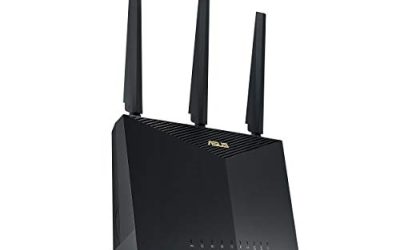
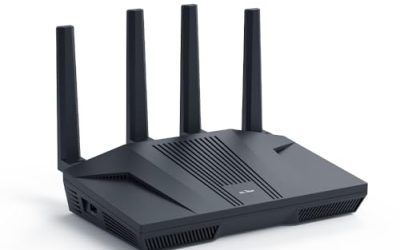
The RT-AX86U Pro is the value pick, and the one to buy when you want proper gaming controls without paying for Wi-Fi 7. It is a dual-band Wi-Fi 6 router with an AX5700 class capacity, a 2.0GHz quad-core processor, 1GB of memory and 4×4 MU-MIMO — a strong combination for a household with many devices, since the radios and the processor both have the headroom to keep up when phones, TVs and consoles all ask for bandwidth at once.
The wired layout is the highlight at this level: a 2.5G port, a dedicated gaming port, and gigabit LAN ports, so the main gaming rig gets both speed and priority. Adaptive QoS puts game traffic first, Mobile Game Mode covers phones, and AiProtection network security is included with no subscription. AiMesh support lets you add mesh nodes later.
Pros:
– Strong value for a gaming router with a 2.5G port and dedicated gaming port
– Adaptive QoS and Mobile Game Mode for low-latency play
– AiMesh support for future coverage expansion
– Subscription-free AiProtection security and VPN support
Cons:
– Dual-band Wi-Fi 6 has no 6 GHz band
– Fewer streams than the tri-band and quad-band picks
Who Should Choose What
- Large household, many devices, multi-gig internet: ASUS ROG Rapture GT-BE98 Pro. Quad-band Wi-Fi 7 and dual 10G ports give the most headroom.
- Busy household that wants Wi-Fi 7 gaming: TP-Link Archer GE800. Tri-band Wi-Fi 7, strong wired layout and a dedicated gaming port.
- Household that wants tri-band Wi-Fi 6 with multi-gig wired headroom: ASUS ROG Rapture GT-AX11000 Pro. Tri-band AX11000, a 10G port and triple-level game acceleration.
- Household that wants the 6 GHz band without Wi-Fi 7 cost: MSI Radix AXE6600. Tri-band Wi-Fi 6E with AI QoS.
- Best value for a full house of devices: ASUS RT-AX86U Pro. Wi-Fi 6 gaming controls, 2.5G port and AiMesh expansion.
If you are unsure, count the devices that will be online during your gaming sessions. Under twenty devices with one or two gamers, the RT-AX86U Pro is enough. Past that, or with several simultaneous gamers and streamers, step up to a tri-band pick. The quad-band GT-BE98 Pro is for homes where the network is genuinely crowded every evening.
Common Mistakes
Buying on headline speed alone. A combined speed figure adds up every band, and no single device ever reaches it. What matters for many devices is the number of streams, the band layout and the QoS engine — not the biggest number on the box.
Ignoring the wired layout. A router with one fast port cannot wire a PC, a console and a streaming box at full speed. Count the wired devices in your setup before you choose, and check for a 2.5G port if your internet plan or home network can use it.
Putting the router in a corner. Thick walls, metal shelves and a spot behind the TV all cut signal before it reaches your devices. Place the router centrally, out in the open, and at about chest height if you can.
Leaving QoS switched off. Gaming QoS only helps if it is turned on and told which device or traffic matters. Set the gaming device as a priority, and use the dedicated gaming port for the main rig when the router has one.
Mixing up lookalike models. Router families reuse similar names across Wi-Fi generations. The MSI RadiX AX6600 is not the AXE6600, and the TP-Link Archer BE800 is not the gaming-focused GE800. Match the listing by model number and ASIN before you buy.
FAQ
How many devices can a gaming router handle at once?
It depends on the router and on what the devices are doing. Tri-band and quad-band routers with more streams handle crowded households better, because they spread devices across more radios and serve several at once with MU-MIMO and OFDMA. Manufacturers do not always publish a maximum device count, so confirm on the listing and weigh the band layout and stream count rather than a single number.
Is Wi-Fi 7 worth it for gaming with many devices?
Wi-Fi 7 helps most in a crowded household: wider channels, the 6 GHz band and lower-latency features give gaming traffic more clean room. If you keep routers for years and your home keeps adding devices, Wi-Fi 7 is a sound step. If your household is smaller and your devices are mostly Wi-Fi 6, a Wi-Fi 6 or Wi-Fi 6E pick serves you well for less.
Do I need a tri-band router for multiple devices?
Not always, but it helps a lot. A tri-band router adds a second 5 GHz band or a 6 GHz band, which works like an extra traffic lane. A dual-band router such as the RT-AX86U Pro still handles busy households through MU-MIMO, OFDMA and QoS — it simply has fewer lanes to split the load across.
Does a gaming router lower ping by itself?
A gaming router cannot lower the ping to a distant server below what your internet connection allows, but it can stop your own household from adding to it. Gaming QoS puts game packets first, a dedicated gaming port prioritizes the main rig, and a wired connection removes wireless interference from the path.
Can I add mesh nodes to these routers later?
Several picks in this guide support it: the GT-BE98 Pro and the RT-AX86U Pro work with AiMesh, and the Archer GE800 works with EasyMesh. The Radix AXE6600 does not support mesh, so plan placement carefully if you choose it. Confirm mesh compatibility on the listing for the exact model you buy.
Conclusion
The best routers for gaming and multiple devices are the ones that treat a busy household as the normal case, not the exception. More bands, more streams, a QoS engine that puts games first and wired ports fast enough for the main rig — those four things decide whether your game stays smooth while the rest of the house stays online.
For most device-heavy gaming homes, the ASUS ROG Rapture GT-BE98 Pro is the strongest all-round pick, with the TP-Link Archer GE800 close behind as the tri-band Wi-Fi 7 choice. The ASUS ROG Rapture GT-AX11000 Pro brings tri-band Wi-Fi 6 with a 10G port for homes that want multi-gig wired headroom without paying for Wi-Fi 7, the MSI Radix AXE6600 brings the 6 GHz band to a Wi-Fi 6E budget, and the ASUS RT-AX86U Pro is the value pick that covers a full house without paying for Wi-Fi 7.
Count your devices, check the wired layout, turn on gaming QoS, and confirm the exact model and ASIN on the listing before you buy.
Related guides
More from Amazon
Programs that pair well with the guide above. Offers and eligibility are set by Amazon and may change.
Free shipping on eligible items, Prime Video and more. Eligible new members can start with a free trial.
Start a Prime free trialAd-free music streaming. Eligible new subscribers can start with a free trial.
Try Music Unlimited freeA Prime membership for ages 18-24 with a trial period. Eligibility is set by Amazon.
See Prime for Young AdultsAudiobooks and podcasts to listen to on the go. Eligible new members can start with a free trial.
Try Audible freeAs an Amazon Associate we earn from qualifying purchases.