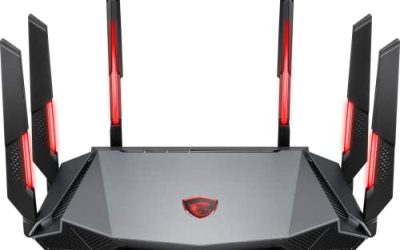
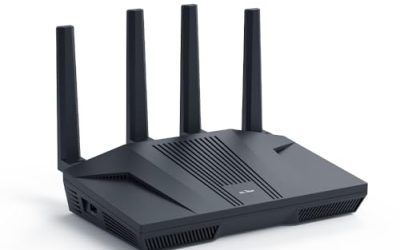
Our Short List of 3

- Best for: A first Wi-Fi 6 upgrade in a small home or apartment.
- Wi-Fi 6 (802.11ax), dual-band AX1800
- Up to 1.8 Gbps total: 1,201 Mbps on 5 GHz plus 574 Mbps on 2.4 GHz
- 4 external antennas
- Gigabit WAN and LAN ports

- Best for: Apartments and small houses with many connected devices.
- Wi-Fi 6 (802.11ax), dual-band AX3000
- Up to 3,000 Mbps combined across both bands
- 4 high-performance antennas
- USB 3.0 port for media and file sharing

- Best for: Larger homes where several rooms stream at the same time.
- Wi-Fi 6 (802.11ax), dual-band AX5400
- Up to 5,400 Mbps combined across both bands
- 6 high-performance antennas with beamforming
- 1.5 GHz triple-core CPU
All 5 Picks at a Glance
| Product | Specs | Action |
|---|---|---|
| TP-Link Archer AX21 |
| Check price on Amazon |
| TP-Link Archer AX55 |
| Check price on Amazon |
| TP-Link Archer AX73 |
| Check price on Amazon |
 NETGEAR Nighthawk RAX50 |
| Check price on Amazon |
 ASUS RT-AX86U |
| Check price on Amazon |
Buying an AX router is really a decision about congestion, not headline speed. Most homes already pay for an internet plan their old Wi-Fi 5 router cannot share properly: once a console downloads a game, two TVs stream, and phones, laptops and smart bulbs all compete, the older standard queues devices instead of talking to them together. Wi-Fi 6, the 802.11ax standard behind every model here, was built to fix exactly that queue.
This roundup is for gamers and streamers replacing an ageing router, and for households whose device count has quietly doubled. Every pick is a standalone dual-band Wi-Fi 6 router chosen from the names and specifications printed on its Amazon listing, spanning AX1800 starters to an AX5700 gaming model, so you can match the class to your floor plan rather than overspending.
Our Top Picks
Top 3 picks at a glance
Quick Picks
As an Amazon Associate we earn from qualifying purchases
| Product | Best for | Key spec from title |
|---|---|---|
| TP-Link Archer AX21 | A first Wi-Fi 6 step up from an old router | AX1800 dual-band, up to 1.8 Gbps |
| TP-Link Archer AX55 | Busy apartments with dozens of devices | AX3000 with USB 3.0 and EasyMesh |
| TP-Link Archer AX73 | Larger homes streaming in several rooms | AX5400, 6 antennas, 1.5 GHz triple-core CPU |
| NETGEAR Nighthawk RAX50 | Bigger floor plans planned around coverage | AX5400, title states 2,500 sq. ft. coverage |
| ASUS RT-AX86U | Competitive gaming with wired backhaul | AX5700 with 2.5G port and gaming port |
How to Choose
Read the AX number as a combined ceiling
The number after AX adds both bands together, so an AX3000 router cannot deliver 3,000 Mbps to one device; it splits that total between the 5 GHz and 2.4 GHz bands. What matters is the 5 GHz share, because that is where consoles, PCs and TVs connect. Match the class to your plan and load: AX1800 suits a modest plan and a handful of devices, AX3000 fits most apartments, and AX5400 classes make sense when several 4K streams and big downloads run at once on a fast plan.
Count wired ports before you need them
Wireless gets the attention, but ports decide how flexible the router stays. Every model here carries gigabit LAN ports for a PC, console or TV that should never touch Wi-Fi. Beyond that, differences appear: the RT-AX86U adds a 2.5G port for a fast NAS or a multi-gig internet plan, while the Archer AX55 and AX73 include USB 3.0 for sharing a drive on the network. If you plan to wire a gaming PC and a media box, count the devices first and leave one port spare.
Plan coverage around walls, not square metres alone
Antenna count and stated coverage are starting points, not guarantees, because brick, concrete and metal ducting eat signal that open-plan figures assume away. The practical question is whether the router can grow: TP-Link models here support EasyMesh and the ASUS supports AiMesh, so a compatible second unit can later cover a dead zone without replacing the main router. The Nighthawk RAX50 instead prints a coverage figure in its title, which helps if your home is wide and single-storey and one strong unit should do the job.
Check the processor and security model
Wi-Fi 6 features such as OFDMA and MU-MIMO only help when the processor keeps up; a triple-core or quad-core chip matters once dozens of devices, QoS rules and VPN traffic compete. Security is the other quiet difference. WPA3 is present across this list, but ongoing protection varies: ASUS bundles its AiProtection without a subscription, TP-Link uses its HomeShield service, and NETGEAR leans on its Armor platform. Check what stays free after setup so the router does not shrink in features a year later.
The 5 Best Options
TP-Link Archer AX21
- Best for: A first Wi-Fi 6 upgrade in a small home or apartment.
- Wi-Fi 6 (802.11ax), dual-band AX1800
- Up to 1.8 Gbps total: 1,201 Mbps on 5 GHz plus 574 Mbps on 2.4 GHz
- 4 external antennas
- Gigabit WAN and LAN ports
A first Wi-Fi 6 upgrade in a small home or apartment.
The AX1800 ceiling is shared across both bands, so a gigabit plan plus several heavy users will outgrow it faster than the AX3000 models below.
The Archer AX21 is the sensible first move off Wi-Fi 5. Its AX1800 rating is the lowest here, yet it still brings the two things that change daily feel: OFDMA-style sharing of airtime under Wi-Fi 6 and a 5 GHz band that reaches 1,201 Mbps on paper, enough for a console and a 4K TV at once. Four external antennas and full gigabit ports cover the typical apartment layout, and EasyMesh support means it can become the base of a small mesh setup later instead of being thrown away when the home grows.
TP-Link Archer AX55
- Best for: Apartments and small houses with many connected devices.
- Wi-Fi 6 (802.11ax), dual-band AX3000
- Up to 3,000 Mbps combined across both bands
- 4 high-performance antennas
- USB 3.0 port for media and file sharing
Apartments and small houses with many connected devices.
All wired ports are gigabit, so a multi-gig internet plan would be capped at the WAN port; step up to the RT-AX86U if that is your connection.
The Archer AX55 is where the list stops being about basics. The AX3000 class doubles the 5 GHz headroom of the AX21, and the listing adds the extras working households actually use: a USB 3.0 port for simple network storage, VPN client and server support, and TP-Link HomeShield for network-level checks. Four high-performance antennas and EasyMesh compatibility make it a strong single unit for an apartment now, with a clean path to a mesh node later. For most buyers comparing AX routers on specifications alone, this is the balanced point of the range.
TP-Link Archer AX73
- Best for: Larger homes where several rooms stream at the same time.
- Wi-Fi 6 (802.11ax), dual-band AX5400
- Up to 5,400 Mbps combined across both bands
- 6 high-performance antennas with beamforming
- 1.5 GHz triple-core CPU
Larger homes where several rooms stream at the same time.
There is no 2.5G port, so it cannot pass a faster-than-gigabit plan to a wired device; check your plan speed before choosing it over the ASUS.
Choose the Archer AX73 when the house, not the plan, is the problem. Six antennas push its AX5400 signal further across a larger floor plan, and the 1.5 GHz triple-core processor is there for the evenings when downloads, streams and video calls stack up. The listing emphasises long-range coverage and the capacity to keep many devices connected through OFDMA and MU-MIMO, which is the real-world test in a family home. It lacks a multi-gig port, but for a gigabit plan spread over several rooms it is the strongest TP-Link option in this roundup.
NETGEAR Nighthawk RAX50
- Best for: Wide single-storey homes that want one strong router, no mesh.
- Wi-Fi 6 (802.11ax), dual-band AX5400, 6-stream design
- Up to 5.4 Gbps combined wireless speed
- Coverage up to 2,500 sq. ft. as stated in the listing title
- 4 external antennas
Wide single-storey homes that want one strong router, no mesh.
Renewed units and a separate RAX54S bundle circulate under different codes, so confirm the listing is the new RAX50-100NAS before ordering.
The RAX50 is the pick for buyers who plan around a coverage figure, because its listing title states one plainly: up to 2,500 square feet. Behind that figure sits a 6-stream AX5400 design with four external antennas and four gigabit LAN ports, aimed at a wide, single-storey home where one router must reach the far bedrooms without a mesh kit. NETGEAR manages it through the Nighthawk app, and its Armor platform covers network security. It trades the ASUS model’s gaming extras for a simpler, coverage-first brief, which suits households more than hobbyists.
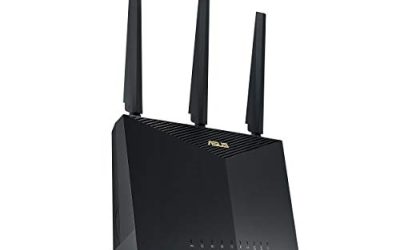
ASUS RT-AX86U
- Best for: Competitive gamers who wire the main PC or console.
- Wi-Fi 6 (802.11ax), dual-band AX5700
- Up to 5,700 Mbps combined wireless speed
- 2.5G port plus gigabit ports, dedicated gaming port
- 1.8 GHz quad-core processor
Competitive gamers who wire the main PC or console.
Special editions and a Pro version of this router sell under other listings and codes, so check the model name on the page matches the standard RT-AX86U.
The RT-AX86U is the gaming specialist of the five. Its AX5700 rating tops the list, and the hardware backs the positioning: a 2.5G port for a fast wired connection or future multi-gig plan, a dedicated gaming port that prioritises the device plugged into it, and Mobile Game Mode for phones. AiMesh support lets it anchor a wider ASUS network later, while AiProtection security is included without a subscription, and Instant Guard adds a one-tap VPN back home. If one wired machine matters more than anything else in the house, this is the router built around it.
Which One Fits Your Situation
A gamer in a small apartment
Take the Archer AX55. Its AX3000 class leaves headroom for a console, a PC and streaming on top of a typical apartment plan, the gigabit ports wire the machine that matters, and EasyMesh leaves a door open if a back bedroom turns into a dead zone later. It is also the cheapest class here that still feels current three years on.
A family house with several TVs
The Archer AX73 fits the house where three screens stream while someone works upstairs. Six antennas and the triple-core processor are aimed at exactly that pile-up, and its AX5400 rating keeps the 5 GHz band from becoming the evening bottleneck for the whole family when downloads and video calls land at the same hour every single weekday.
One router for a wide, single-storey home
Pick the Nighthawk RAX50 and plan around its stated 2,500 square feet of coverage. The 6-stream design and four antennas are built to reach far rooms from one central spot, which suits a ranch-style layout better than a gaming-focused model with extras you will not use or pay to keep switched on every month.
A competitive setup built around one wired machine
The RT-AX86U is the answer when the main PC or console gets priority. The gaming port favours that device, the 2.5G port leaves room for a faster plan or NAS, and AiMesh means the rest of the home can be covered later without replacing it or rethinking the whole network from scratch again.
Common Mistakes
- Comparing AX numbers as if one device receives the full total, when the figure always combines both bands.
- Placing the router inside a cabinet or behind the TV, then blaming the model for weak rooms.
- Buying a router with only gigabit ports for an internet plan faster than gigabit.
- Ignoring mesh compatibility, then replacing the whole router when one dead zone appears.
- Leaving the default admin password and skipping WPA3 during setup.
Frequently Asked Questions
Is an AX router worth it if my devices are older?
Mostly yes, with limits. Older Wi-Fi 5 devices still connect and benefit from a less congested network and better airtime scheduling, but they do not gain Wi-Fi 6 speeds themselves. The upgrade pays off fully as phones, laptops and consoles with Wi-Fi 6 join the network over time.
What is the difference between AX1800 and AX5400?
The number is the combined theoretical speed across both bands, so AX5400 models carry far more total capacity, mostly on the 5 GHz band. In practice the gap shows up when many devices are active at once, not when a single laptop runs a speed check next to the router.
Can one AX router replace a mesh system?
In a small or open-plan home, often yes, especially a model with several antennas placed centrally. In larger or multi-storey homes a single router still fades through floors and walls, which is why the EasyMesh and AiMesh support on several picks here matters for later expansion.
Do I need a new modem to use an AX router?
Usually not. These routers connect to your existing modem or fibre terminal through their WAN port and take over the wireless side. You only need new hardware on the modem side if your internet plan outgrows the modem itself, which is a separate check with your provider.
Related guides
More from Amazon
Programs that pair well with the guide above. Offers and eligibility are set by Amazon and may change.
Free shipping on eligible items, Prime Video and more. Eligible new members can start with a free trial.
Start a Prime free trialAd-free music streaming. Eligible new subscribers can start with a free trial.
Try Music Unlimited freeA Prime membership for ages 18-24 with a trial period. Eligibility is set by Amazon.
See Prime for Young AdultsAudiobooks and podcasts to listen to on the go. Eligible new members can start with a free trial.
Try Audible freeAs an Amazon Associate we earn from qualifying purchases.