Our Short List of 3

- Wi-Fi standard: Wi-Fi 6E (802.11ax), tri-band
- Speed class: AXE6600, up to 6.6 Gbps combined (574 Mbps + 4,804 Mbps + 1,201 Mbps)
- Processor: 1.8 GHz quad-core
- Ports: 1 x 2.5 Gbps WAN/LAN, 4 x gigabit LAN, 1 x USB 3.0

- Wi-Fi standard: Wi-Fi 7 (802.11be), dual-band
- Speed class: BE3600 (688 Mbps + 2,882 Mbps)
- Processor: 2.0 GHz quad-core, 1 GB RAM, 512 MB flash
- Ports: 1 x 2.5 Gbps WAN, 4 x gigabit LAN

- Wi-Fi standard: Wi-Fi 6 (802.11ax), dual-band
- Speed class: AX5400 (574 Mbps + 4,804 Mbps), 160 MHz channels
- Processor: 1.5 GHz tri-core, 512 MB RAM, 256 MB flash
- Ports: 1 x gigabit WAN, 4 x gigabit LAN, 1 x USB 3.2 Gen 1
All 4 Picks at a Glance
| Product | Specs | Action |
|---|---|---|
| 1. MSI RadiX AXE6600 |
| Check price on Amazon |
| 2. NETGEAR Nighthawk RS100 |
| Check price on Amazon |
| 3. ASUS RT-AX5400 |
| Check price on Amazon |
 4. TP-Link Archer AX55 Pro |
| Check price on Amazon |
A gaming router earns its place in a setup by doing three things well: keeping latency steady when the household is busy, giving game traffic priority over background downloads, and offering enough wired ports for the machines that matter most. None of that requires flagship hardware. The current value tier of routers covers Wi-Fi 6, Wi-Fi 6E and even Wi-Fi 7, and several models add multi-gig ports, proper quality-of-service controls and mesh expansion while leaving out the extras that push top-end models upward.
The five routers below suit different kinds of players. A tri-band Wi-Fi 6E model opens the 6 GHz band for wireless VR and busy apartments. Two Wi-Fi 6 workhorses deliver wide 160 MHz channels and strong dual-band throughput for consoles and PCs. A Wi-Fi 7 pick brings newer radio efficiency and a fast processor to smaller homes, and one compact TP-Link design stands out for wired connections, with two 2.5 Gbps ports at a tier where a single multi-gig port is more common. Every model supports modern security standards, app-based setup and the option to wire a console or PC directly for the most stable connection.
Disclosure: As an Amazon Associate, we earn from qualifying purchases made through links on this page, at no extra cost to you.
Our Top Picks
Top 3 picks at a glance
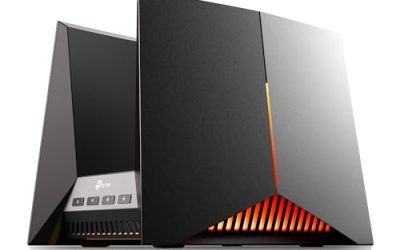
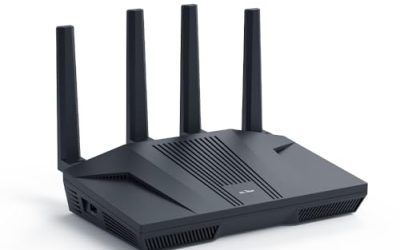
1. MSI RadiX AXE6600
- Wi-Fi standard: Wi-Fi 6E (802.11ax), tri-band
- Speed class: AXE6600, up to 6.6 Gbps combined (574 Mbps + 4,804 Mbps + 1,201 Mbps)
- Processor: 1.8 GHz quad-core
- Ports: 1 x 2.5 Gbps WAN/LAN, 4 x gigabit LAN, 1 x USB 3.0
The RadiX AXE6600 is the pick for players who want a dedicated lane for their most demanding device. Its tri-band Wi-Fi 6E layout adds a 6 GHz band on top of the familiar 2.4 GHz and 5 GHz radios, and that extra band is largely free of the congestion found on older networks. For wireless PC VR, where a headset such as a Quest streams rendered frames from a gaming PC, a quiet 6 GHz link is the closest thing to a cable without the cable. MSI builds the router around a 1.8 GHz quad-core processor, so the radio hardware is matched by enough processing headroom for busy households.
Gaming controls are central to the design. MSI’s AI QoS can prioritise game traffic automatically, and a dedicated game accelerator mode pushes recognised game data ahead of streaming and downloads. Wired players get a 2.5 Gbps port that can serve as the internet connection or as a fast link to a PC or network storage, alongside four gigabit LAN ports and a USB 3.0 port for sharing storage across the network. Six adjustable antennas with lighting accents complete a router that looks at home next to a gaming rig, while OFDMA and MU-MIMO keep many devices served at once.
2. NETGEAR Nighthawk RS100
- Wi-Fi standard: Wi-Fi 7 (802.11be), dual-band
- Speed class: BE3600 (688 Mbps + 2,882 Mbps)
- Processor: 2.0 GHz quad-core, 1 GB RAM, 512 MB flash
- Ports: 1 x 2.5 Gbps WAN, 4 x gigabit LAN
The Nighthawk RS100 brings Wi-Fi 7 to homes that do not need a sprawling mesh system. Its dual-band BE3600 radios combine 688 Mbps on 2.4 GHz with 2,882 Mbps on 5 GHz, and Wi-Fi 7 features such as wider effective channel use and improved puncturing help the 5 GHz band stay consistent in apartment blocks crowded with neighbouring networks. NETGEAR rates the router for coverage up to 2,000 square feet and as many as 50 connected devices, which suits flats and smaller houses where one well-placed unit covers every room.
Under the shell, a 2.0 GHz quad-core processor with 1 GB of memory keeps the interface responsive and handles quality-of-service rules without strain. The wired side offers a 2.5 Gbps internet port for faster fibre plans plus four gigabit LAN ports, so a console, a PC and a smart TV can all stay wired while phones and tablets use wireless. NETGEAR Armor adds network-level security scanning, Smart Parental Controls handle per-device scheduling, and WPA3 protects modern clients. Setup and day-to-day management run through the Nighthawk app, which also handles firmware updates and guest network access for visitors.
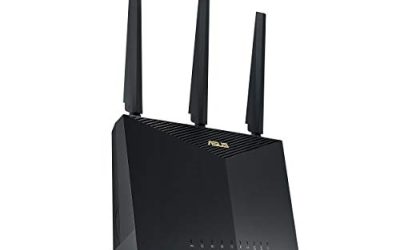
3. ASUS RT-AX5400
- Wi-Fi standard: Wi-Fi 6 (802.11ax), dual-band
- Speed class: AX5400 (574 Mbps + 4,804 Mbps), 160 MHz channels
- Processor: 1.5 GHz tri-core, 512 MB RAM, 256 MB flash
- Ports: 1 x gigabit WAN, 4 x gigabit LAN, 1 x USB 3.2 Gen 1
ASUS positions the RT-AX5400 squarely at gaming and streaming households, and the hardware backs that up. The dual-band Wi-Fi 6 radios reach AX5400 throughput with a 160 MHz channel on 5 GHz, which gives wireless PCs and consoles a wide lane for game downloads and high-bitrate streams. A 1.5 GHz tri-core processor with 512 MB of memory runs the firmware, and the router supports ASUS AiMesh, so a second ASUS unit can extend coverage later instead of forcing a full system replacement.
The gaming toolset is practical rather than decorative. Adaptive QoS can prioritise gaming traffic, and ASUS includes a dedicated game mode in its firmware alongside the usual device-based rules. Four gigabit LAN ports and a gigabit WAN port cover wired play, while a USB 3.2 Gen 1 port supports storage sharing and other add-ons. AiProtection, powered by Trend Micro signatures, guards the network without a separate subscription for its core features, and the parental controls include time scheduling per device. For a household that games on several machines and streams in the same evening, this is a balanced, expandable option.
4. TP-Link Archer AX55 Pro
- Wi-Fi standard: Wi-Fi 6 (802.11ax), dual-band
- Speed class: AX3000 (574 Mbps + 2,402 Mbps), 160 MHz channels
- Ports: 1 x 2.5 Gbps WAN/LAN, 1 x 2.5 Gbps LAN, 3 x gigabit LAN, 1 x USB 3.0
- Antennas: 4 external, with beamforming
The Archer AX55 Pro is the wired player’s pick in this group. Most routers in this tier offer a single fast port; the AX55 Pro carries two 2.5 Gbps ports, one that can serve as the internet link and one for a wired device, plus three further gigabit LAN ports. That layout suits a desk where a gaming PC and a console both deserve a cable, or a setup where a fast NAS feeds local game libraries and media. The USB 3.0 port adds shared storage and media serving on top.
Wireless performance comes from dual-band Wi-Fi 6 at AX3000, with 160 MHz channels on 5 GHz, four high-performance antennas, beamforming, OFDMA and MU-MIMO for efficient multi-device handling. TP-Link’s HomeShield layer provides network security scanning, parental controls and quality-of-service rules that can favour a chosen device, which is the setting that matters most during ranked sessions in a shared home. The router also works with EasyMesh extenders for later coverage expansion, supports VPN server and client functions for remote access, and secures modern clients with WPA3. Setup runs through the Tether app or the web interface.
5. TP-Link Archer AX72 Pro
The Archer AX72 Pro targets larger homes that still want a single-router answer. Six high-performance antennas with high-power amplifiers push its dual-band Wi-Fi 6 signal further than the compact designs in this list, and the AX5400 speed class combines 574 Mbps on 2.4 GHz with 4,804 Mbps on 5 GHz using a 160 MHz, four-stream layout. That combination gives it the strongest headline wireless throughput here alongside the ASUS, with coverage hardware aimed at bigger floor plans and thicker walls.
A 2.5 Gbps WAN/LAN port anchors the wired side, backed by gigabit LAN ports and a USB 3.0 port for shared storage. TP-Link includes its HomeShield security and parental control suite, quality-of-service controls for prioritising a gaming machine, and OneMesh compatibility for households that later want to add a compatible extender rather than replace the router. VPN server and client support, OFDMA and MU-MIMO round out a feature set that mirrors the AX55 Pro while trading the second multi-gig port for greater wireless reach. For a family home with players spread across floors, that trade makes sense.
Specs
- Wi-Fi standard: Wi-Fi 6 (802.11ax), dual-band
- Speed class: AX5400 (574 Mbps + 4,804 Mbps), 160 MHz channels, 4-stream 5 GHz
- Ports: 1 x 2.5 Gbps WAN/LAN, gigabit LAN ports, 1 x USB 3.0
- Antennas: 6 external high-performance, with beamforming
- Gaming features: HomeShield QoS, OFDMA, MU-MIMO, OneMesh support
- Security: WPA3, VPN server and client, HomeShield protection
How to Choose a Gaming Router
Start with the internet plan and the home, not the headline speed class. The combined figures on a router box add every band together, while any single device uses one band at a time, so the 5 GHz or 6 GHz figure is the one that shapes real game downloads and streams. Wi-Fi 6 is the sensible baseline today. Wi-Fi 6E adds the 6 GHz band, which shines for wireless VR and dense apartment buildings. Wi-Fi 7 improves efficiency and latency behaviour on supported clients, and it is the natural choice when the router will stay in place through the next console or PC upgrade.
Quality of service is the feature that most directly protects gameplay. A good QoS system lets the router recognise game traffic, or a specific console or PC, and serve it before bulk downloads and cloud backups. Players in shared homes should treat QoS as essential, and anyone who plays competitively should still wire the main machine by Ethernet whenever the layout allows it, since a cable removes wireless interference from the equation entirely. Multi-gig ports matter when the internet plan runs faster than a gigabit or when a wired PC, console and storage device all share local traffic.
Coverage decides whether one router is enough. Smaller flats and houses are well served by any single unit here. Long or multi-storey homes benefit from mesh expansion options such as AiMesh, EasyMesh or OneMesh, which let a second node join later under one network name. Placement matters as much as hardware: a central, elevated position away from thick walls and metal appliances will outperform a stronger router hidden in a corner cabinet.
FAQ
Do gaming routers actually reduce ping?
A router cannot shorten the distance to a game server, but the right model keeps local latency steady. QoS prioritisation stops downloads and streams on other devices from spiking your ping, and a wired connection removes wireless interference, which is where most home-side jitter comes from.
Is Wi-Fi 6E or Wi-Fi 7 worth choosing for VR headsets?
For wireless PC VR, a clear band matters more than raw throughput. The 6 GHz band on Wi-Fi 6E is usually the least congested option for a headset link, while Wi-Fi 7 improves latency behaviour and efficiency on the 5 GHz band for headsets and handhelds that support it.
How many wired ports does a gaming setup need?
Count the machines that stay in one place: typically a PC, one or two consoles and perhaps a streaming box or network storage. Four LAN ports cover most desks, and a 2.5 Gbps port is worth having when the internet plan or a local storage device can move data faster than a gigabit.
Can one of these routers replace an internet provider modem?
These are routers, not modems, so most homes keep the provider’s modem or gateway and connect the router behind it. With fibre and cable services that allow a direct connection, the router’s WAN port can take over once the provider equipment is set to bridge or passthrough mode.
Related guides
More from Amazon
Programs that pair well with the guide above. Offers and eligibility are set by Amazon and may change.
Free shipping on eligible items, Prime Video and more. Eligible new members can start with a free trial.
Start a Prime free trialAd-free music streaming. Eligible new subscribers can start with a free trial.
Try Music Unlimited freeA Prime membership for ages 18-24 with a trial period. Eligibility is set by Amazon.
See Prime for Young AdultsAudiobooks and podcasts to listen to on the go. Eligible new members can start with a free trial.
Try Audible freeAs an Amazon Associate we earn from qualifying purchases.