Our Short List of 3

- NETGEAR R6700AXv3 — Best for Most Homes. Wi-Fi 6, AX1800 class, four-stream dual band, gigabit ports, coverage listed for up to 1,500 square feet and 20 devices. Check availability on Amazon
- TP-Link Archer A7 AC1750 — Best Wi-Fi 5 Pick for Larger Homes. Dual-band AC1750, gigabit ports, three antennas, a USB port, coverage listed for up to 2,500 square feet. Check availability on Amazon
- TP-Link Archer AX10 AX1500 — Best Simple Wi-Fi 6 Pick. Dual-band Wi-Fi 6, AX1500 class, gigabit WAN port, four gigabit LAN ports, OFDMA, MU-MIMO. Check availability on Amazon
- TP-Link Deco S4 3-Pack — Best Mesh Pick for Large Homes. Dual-band AC1900 mesh, gigabit ports on every unit, coverage listed for up to 5,500 square feet. Check availability on Amazon
All 3 Picks at a Glance
| Product | Specs | Action |
|---|---|---|
| Our Top Picks |
| Check price on Amazon |
 2. TP-Link Archer A7 AC1750 — Best Wi-Fi 5 Pick for Larger Homes | Check price on Amazon | |
 3. TP-Link Archer AX10 AX1500 — Best Simple Wi-Fi 6 Pick | Check price on Amazon |
As an Amazon Associate I earn from qualifying purchases.
Our Top Picks
Top 3 picks at a glance
The Short Answer
A 400 Mbps plan is a middleweight plan: fast enough for several 4K streams, online gaming, and video calls at once, but not so fast that it demands a flagship router. The router that fits it needs two things: a gigabit WAN port, so the wired connection never caps the plan below 400 Mbps, and a 5 GHz radio fast enough for one nearby device to use the full plan speed.
The NETGEAR R6700AXv3 is the pick for most homes: Wi-Fi 6 in the AX1800 class with gigabit ports and coverage listed for up to 1,500 square feet. The TP-Link Archer A7 is the Wi-Fi 5 option for larger single-router homes, with a USB port and coverage listed for up to 2,500 square feet. The TP-Link Archer AX10 is the simplest Wi-Fi 6 pick for a smaller home. And the TP-Link Deco S4 three-pack is the mesh option for a large or multi-story home.
None of these is a multi-gig flagship, and that is deliberate: a router built for a gigabit plan carries hardware a 400 Mbps connection will never use.
Our Top Picks
- NETGEAR R6700AXv3 — Best for Most Homes. Wi-Fi 6, AX1800 class, four-stream dual band, gigabit ports, coverage listed for up to 1,500 square feet and 20 devices. Check availability on Amazon
- TP-Link Archer A7 AC1750 — Best Wi-Fi 5 Pick for Larger Homes. Dual-band AC1750, gigabit ports, three antennas, a USB port, coverage listed for up to 2,500 square feet. Check availability on Amazon
- TP-Link Archer AX10 AX1500 — Best Simple Wi-Fi 6 Pick. Dual-band Wi-Fi 6, AX1500 class, gigabit WAN port, four gigabit LAN ports, OFDMA, MU-MIMO. Check availability on Amazon
- TP-Link Deco S4 3-Pack — Best Mesh Pick for Large Homes. Dual-band AC1900 mesh, gigabit ports on every unit, coverage listed for up to 5,500 square feet. Check availability on Amazon
Quick Comparison
| Pick | Wi-Fi | Combined wireless class | Wired ports | Listed coverage |
|---|---|---|---|---|
| NETGEAR R6700AXv3 | Wi-Fi 6, dual band | AX1800 | Gigabit WAN and LAN | Up to 1,500 sq. ft., 20 devices |
| TP-Link Archer A7 | Wi-Fi 5, dual band | AC1750 | Gigabit WAN and LAN | Up to 2,500 sq. ft. |
| TP-Link Archer AX10 | Wi-Fi 6, dual band | AX1500 | 1 gigabit WAN, 4 gigabit LAN | Confirm on the listing |
| TP-Link Deco S4 3-Pack | Wi-Fi 5, dual band mesh | AC1900 | 2 gigabit ports per unit | Up to 5,500 sq. ft., up to 100 devices |
How to Choose
Start with the WAN port
The WAN port is the socket where the cable from your modem plugs in, and its speed is a hard ceiling on everything behind it. A router with 10/100 ports caps wired throughput at 100 Mbps, throwing away three quarters of a 400 Mbps plan before a single device connects. Every router in this guide has a gigabit WAN port: confirm that first on any router you consider.
Read the 5 GHz figure, not the combined number
Router makers advertise a combined wireless number that adds the 2.4 GHz and 5 GHz bands together, but no single device uses that combined number. The figure that matters is the 5 GHz band on its own: a radio reaching 1,200 Mbps under the manufacturer’s specification has ample headroom above a 400 Mbps plan. All four picks clear that bar: 1,200 Mbps for the R6700AXv3, 1,300 Mbps for the Archer A7, 1,201 Mbps for the Archer AX10, and a 5 GHz band in the same range for the Deco S4.
Wi-Fi 6 helps, but Wi-Fi 5 is not disqualified
Wi-Fi 6 adds OFDMA and MU-MIMO, letting a router serve several devices at once more efficiently. In a home where several people stream, game, and video-call at once, that efficiency is real and worth having. It is not a requirement, though: a Wi-Fi 5 router with gigabit ports and a strong 5 GHz radio, like the Archer A7 or the Deco S4, still delivers the full plan speed to a nearby device.
Coverage is a layout question, and the modem is separate
Manufacturers state coverage under open-air conditions, and real homes have walls and floors that shrink those numbers. A single router suits an apartment or a small home, while a two-story or long home usually needs a mesh system. The Deco S4 three-pack covers that case: three units sharing one network name, so every room keeps a strong signal. None of these routers is a modem: each needs a modem, or a gateway in bridge mode, in front of it. A second router behind an active gateway creates a double NAT setup that can complicate online gaming.
The Picks in Detail
1. NETGEAR R6700AXv3 — Best for Most Homes
The R6700AXv3 is a four-stream Wi-Fi 6 router in the AX1800 class, and it is the most balanced pick in this guide for a 400 Mbps plan. Its 5 GHz band reaches up to 1,200 Mbps and its 2.4 GHz band up to 600 Mbps under the manufacturer’s specification, which gives a single nearby device far more room than the plan itself provides. The listing states coverage for up to 1,500 square feet and up to 20 connected devices, figures that match a typical apartment or a modest house. The Nighthawk app manages setup, with NETGEAR Armor security and Smart Parental Controls built in.
One caution: NETGEAR sells this model in more than one hardware version, and the listing to confirm is the v3 unit, model R6700AX-3AZPAS. An older version of the same model name circulates under a different ASIN, so check the model number on the listing page before ordering, and confirm the exact port count and processor details on the listing.
Pros:
– Wi-Fi 6 with OFDMA and MU-MIMO for busy households
– 5 GHz band with ample headroom above a 400 Mbps plan
– Gigabit wired ports for consoles and desktop PCs
– Coverage and device count stated clearly on the listing
Cons:
– Multiple hardware versions share the model name, so the listing needs a careful check
– Single-unit coverage will not stretch across a large home
– No USB port for shared storage or a printer
2. TP-Link Archer A7 AC1750 — Best Wi-Fi 5 Pick for Larger Homes
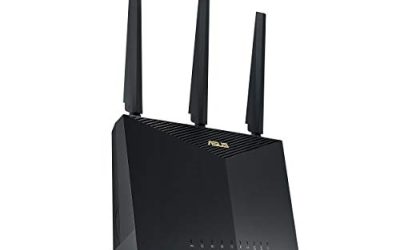
The Archer A7 is the oldest design in this roundup and still earns its place on coverage. It is a dual-band Wi-Fi 5 router in the AC1750 class, with up to 1,300 Mbps on the 5 GHz band and 450 Mbps on the 2.4 GHz band under the manufacturer’s specification, gigabit WAN and LAN ports, three high-gain external antennas, and a USB port the other standalone picks here do not have. The listing states coverage for up to 2,500 square feet, the widest single-router coverage in this guide.
What keeps the A7 relevant is that its fundamentals match the plan: gigabit ports, a strong 5 GHz radio, and antennas that reach. Wi-Fi 5 means it lacks OFDMA, so a very busy household may notice the difference next to a Wi-Fi 6 router, but for streaming, gaming, and browsing on a 400 Mbps plan, the A7 delivers the plan speed to devices in range. A renewed version also circulates on Amazon, so check that the listing you open is the new unit before ordering.
Pros:
– Widest listed single-router coverage in this guide, up to 2,500 square feet
– Strong 5 GHz radio that clears a 400 Mbps plan with room to spare
– USB port for shared storage or a printer
– Gigabit WAN and LAN ports throughout
Cons:
– Wi-Fi 5 only, without the multi-device efficiency of Wi-Fi 6
– Older security standard than the Wi-Fi 6 picks
– A renewed version circulates under similar listings, so the listing needs a careful check
3. TP-Link Archer AX10 AX1500 — Best Simple Wi-Fi 6 Pick
The Archer AX10 is the simplest way to put Wi-Fi 6 on a 400 Mbps plan. It is a dual-band Wi-Fi 6 router in the AX1500 class, reaching up to 1,201 Mbps on the 5 GHz band and 300 Mbps on the 2.4 GHz band under the manufacturer’s specification, with a gigabit WAN port, four gigabit LAN ports, beamforming, OFDMA, and MU-MIMO. Four antennas, parental controls, and Alexa compatibility, controlled through the Tether app.
For a small home or an apartment, the AX10 is a good match because its limits line up with the household: the 5 GHz band has roughly three times the headroom the plan needs, the Wi-Fi 6 features keep several devices moving at once, and the gigabit ports mean a wired device never becomes the bottleneck.
Two flags belong with this pick. TP-Link lists the Archer AX1500 as end of life on some of its regional product pages, so confirm the listing is the new unit and that stock is current before ordering. The listing also does not state a coverage figure as clearly as the other picks, so treat its reach as suited to a smaller space and confirm the coverage details on the listing.
Pros:
– Wi-Fi 6 with OFDMA, MU-MIMO, and beamforming at a modest tier
– 5 GHz band with ample headroom above a 400 Mbps plan
– Gigabit WAN port plus four gigabit LAN ports
– Compact design that fits a small home or apartment
Cons:
– Listed as end of life on some TP-Link regional pages, so the listing needs a careful check
– Coverage figure is not stated as clearly as the other picks
– No USB port
4. TP-Link Deco S4 3-Pack — Best Mesh Pick for Large Homes
The Deco S4 is a different shape of answer to the same question. Instead of one strong router, it is three mesh units in the AC1900 class that share a single network name, with coverage listed for up to 5,500 square feet and support for up to 100 connected devices. Each unit has two gigabit Ethernet ports with WAN and LAN auto-sensing, so any unit can serve as the main router, and the system replaces both a router and a range extender in one purchase. It is a Wi-Fi 5 system, dual band, managed through the Deco app.
For a large or multi-story home on a 400 Mbps plan, mesh is often the right structure even when the plan speed is modest, because the problem in a big home is reach rather than raw speed. A single router at one end of a long house leaves the far rooms on a weak signal, and a weak signal delivers far less than 400 Mbps no matter how fast the plan is. Three Deco units keep devices on a strong nearby signal, and the gigabit ports mean a wired device near any unit still gets the full plan speed.
The honest limits are the Wi-Fi 5 radio and the two ports per unit. Two ports is enough for a modem connection plus one wired device, but a home with several wired devices at one spot will want a small switch beside the unit. Confirm the pack contents and the coverage figure on the listing, and note that TP-Link points buyers toward a newer Wi-Fi 7 Deco system on the same listing page, so check that the pack in the cart is the S4 three-pack.
Pros:
– Mesh coverage listed for up to 5,500 square feet across three units
– Support listed for up to 100 connected devices
– Gigabit ports on every unit with WAN and LAN auto-sensing
– One network name throughout the home, with no dead zones at the far end
Cons:
– Wi-Fi 5 only, without the multi-device efficiency of Wi-Fi 6
– Only two Ethernet ports per unit, so wired-heavy spots need a switch
– Three units to place and power, which suits a large home better than a small one
Who Should Choose What
- Apartment or small house, several people online at once: the NETGEAR R6700AXv3. Wi-Fi 6, a clear device count, and coverage that matches the space.
- Larger single-story home, one router, and a USB port matters: the TP-Link Archer A7. The widest listed coverage of any single router here.
- Small space, first Wi-Fi 6 router, simple setup: the TP-Link Archer AX10, provided the listing checks out as the new unit.
- Two-story or long home with weak far rooms: the TP-Link Deco S4 three-pack. Mesh is the fix for reach.
- Heavy gaming with a wired console and a wired PC: the R6700AXv3 or the Archer A7; wire both machines.
- A home full of smart home gadgets: the Deco S4, with its device count listed at up to 100, or the R6700AXv3 for a smaller home.
Common Mistakes
Buying a router with 10/100 ports. This caps the whole home at 100 Mbps, and no setting or antenna can recover the missing speed. Confirm a gigabit WAN port on the listing before anything else.
Judging a router by its combined wireless number. A combined figure like AX1800 adds two bands together that no device uses at the same time. Read the 5 GHz figure on its own and compare that with the plan speed.
Hiding the router in a cabinet or a far corner. Walls and furniture absorb signal, and a router buried behind a television starts every connection at a disadvantage. Put the router out in the open, roughly central, and at about chest height.
Running a second router behind an active gateway. Two routers both handing out addresses creates a double NAT setup that can complicate online gaming and port forwarding. Put the provider gateway into bridge mode first.
FAQ
Is a Wi-Fi 6 router needed for a 400 Mbps plan?
No, but it helps in a busy home. A Wi-Fi 5 router with gigabit ports and a strong 5 GHz radio delivers the full plan speed to a nearby device. Wi-Fi 6 earns its place when many devices are active at once, because OFDMA and MU-MIMO let the router serve them more efficiently.
Can an AC1750 router handle a 400 Mbps plan?
Yes, provided its wired ports are gigabit. The Archer A7 in this guide is an AC1750 router with up to 1,300 Mbps on its 5 GHz band under the manufacturer’s specification, and its gigabit WAN port carries the full plan into the home. The number to watch is the port speed, not the wireless class.
What port speed do I need for a 400 Mbps plan?
A gigabit WAN port at minimum, with gigabit LAN ports for wired devices. Gigabit ports carry up to 1,000 Mbps, which clears a 400 Mbps plan with headroom. A 10/100 port caps the connection at 100 Mbps.
Will one router cover a two-story house?
It depends on the layout and where the router sits. A single strong router placed centrally on the main floor can cover a modest two-story home, but a long or heavily walled house usually leaves the far upstairs rooms on a weak signal. A mesh system like the Deco S4 three-pack is the more reliable answer there.
Do I still need a modem with one of these routers?
Yes. Every router in this guide needs a modem, or a provider gateway switched to bridge mode, in front of it. The router creates the home network and the Wi-Fi; the modem is what talks to the provider’s line. Check modem compatibility with your provider before ordering.
Should I buy a mesh system for a 400 Mbps plan?
Buy mesh for reach, not for speed. A 400 Mbps plan does not need mesh to go fast; it needs mesh when one router cannot reach every room with a strong signal. If the far bedroom gets a weak signal today, three units spread through the home will do more than any single-router upgrade. If the whole home already gets a strong signal from one spot, a single router is the simpler choice.
Conclusion
A 400 Mbps plan asks for a router that is honest about its limits: a gigabit WAN port, a 5 GHz radio with headroom, and coverage that matches the home. The NETGEAR R6700AXv3 is the pick for most homes, the TP-Link Archer A7 suits a larger single-router home, the TP-Link Archer AX10 is the simplest Wi-Fi 6 route for a smaller space, and the TP-Link Deco S4 three-pack is the answer when one router cannot reach every room. and wire the devices that never move. Confirm the model number, pack contents, and port details on the listing before ordering.
Related guides
More from Amazon
Programs that pair well with the guide above. Offers and eligibility are set by Amazon and may change.
Free shipping on eligible items, Prime Video and more. Eligible new members can start with a free trial.
Start a Prime free trialAd-free music streaming. Eligible new subscribers can start with a free trial.
Try Music Unlimited freeA Prime membership for ages 18-24 with a trial period. Eligibility is set by Amazon.
See Prime for Young AdultsAudiobooks and podcasts to listen to on the go. Eligible new members can start with a free trial.
Try Audible freeAs an Amazon Associate we earn from qualifying purchases.