The best Samsung 65-inch TV for most people in 2026 is the QN70H Neo QLED — a mini-LED set that stays punchy in a daylight living room, handles 4K/120 Hz consoles, and sits in the mid-range tier rather than the premium one. If your room is dark and you watch mostly at night, the S90H OLED gives you better contrast for the same money and is the better gaming panel; if your ceiling is the budget tier, the U8000H Crystal UHD gets you 65 inches of Samsung’s smart platform for the least cash, and the M70H Mini LED is the smarter cheap upgrade if you can stretch. The Q7F QLED is the safe all-rounder when four HDMI devices and mixed lighting matter more than peak brightness, while The Frame LS03F is the only one here you buy for how it looks switched off. This guide compares them on panel technology, brightness class, viewing angles, gaming features and room-light fit, with the numbers you need to pick without a showroom visit.
Our Top Picks
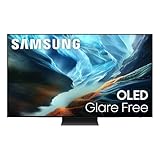
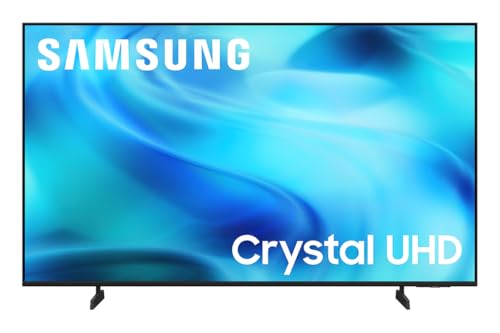 Samsung 65-Inch Class Crystal UHD U8000H Series Samsung65 Inch8.7 x 56.9 x 34.7 inches31.8 poundsCheck on Amazon
 Samsung 65-Inch Class The Frame LS03F 4K QLED65 Inch10.3 x 57.4 x 34.2 Inches49.6 poundsCheck on Amazon


Top 3 picks at a glance
Quick Comparison
The table below covers every model in this roundup. Specs are given at the level the listing and the product class support — where a number varies by panel revision or region, it is described by class rather than as a fixed figure. Price tiers are relative to each other, not to a dollar amount.
| Model (65-inch) | Best for | Key specs (class-level) | Price tier |
|---|---|---|---|
| Samsung U8000H Crystal UHD (2026) | Bright-room basics, bedrooms, second rooms, casual streaming | 4K LCD with LED backlight; Crystal Processor 4K-class upscaling; 60 Hz-class panel; HDR10+ and HLG class support; Tizen smart platform with Vision AI features; typically 3 HDMI inputs; no VRR class feature | Budget |
| Samsung M70H Mini LED (2026) | Buyers who want deeper blacks without paying mid-range money | 4K mini-LED backlight with local dimming zones; quantum-dot-class colour; Tizen smart platform; refresh rate is the spec to verify on the listing (value mini-LED tiers split between 60 Hz-class and 120 Hz-class panels); improved black level versus edge-lit LCD | Budget |
| Samsung S90H OLED (2026) | Dark rooms, film nights, wide seating, high-refresh gaming | 4K OLED (QD-OLED class); per-pixel light control; near-infinite contrast; very wide viewing angles; anti-reflective treatment; 120–144 Hz-class refresh; HDMI 2.1-class ports with VRR and ALLM; Tizen smart platform | Premium |
| Samsung The Frame LS03F (2025) | Decor-first walls, Art Mode, glare-heavy rooms, flush wall mounting | 4K QLED; matte anti-glare layer; Art Mode with art subscription; Slim Fit wall mount ecosystem and swappable bezels; 120 Hz-class panel; typically one HDMI 2.1-class input; Tizen smart platform | Premium |
| Samsung Q7F QLED (2025) | All-round family rooms with several devices and mixed lighting | 4K QLED with quantum-dot layer; Quantum HDR; Object Tracking Sound class audio; 120 Hz-class panel; typically 4 HDMI inputs with one 2.1-class port; Tizen smart platform with Vision AI features | Mid-range |
| Samsung QN70H Neo QLED (2026) | Bright, mixed-use rooms; HDR streaming plus console gaming | 4K Neo QLED with quantum mini-LED backlight and local dimming; high peak-brightness class; anti-glare coating; 120 Hz-class refresh; HDMI 2.1-class ports with VRR and ALLM; Object Tracking Sound class audio; Tizen smart platform | Mid-range |
How We Chose
This roundup is built from published specifications, Samsung’s own product-positioning language, and the well-documented behaviour of each panel technology — not from lab testing or hands-on time, which we do not claim. Four filters did the work. First, panel class: what the backlight or emitter actually is (edge-lit LCD, mini LED, quantum mini LED, OLED, matte QLED) because that single fact predicts contrast, viewing angle and brightness behaviour better than any feature name. Second, room fit: a TV that wins in a dark room can lose badly next to a south-facing window, so every pick is tied to a lighting situation rather than ranked in the abstract.
Third, gaming capability: whether the set has the refresh rate, variable refresh rate support and HDMI bandwidth to take a 4K/120 Hz signal from a current console or PC, and how many of its ports can actually do it. Fourth, upgrade path and value: how much of the premium tier price buys picture quality versus design, and whether a cheaper model in the same list gets you 80% of the experience. Where a specification varies by revision, region or panel batch, we describe it by class and tell you which line on the listing to check before you buy.
1. Samsung U8000H Crystal UHD – Best for Budget Bright-Room Basics
As an Amazon Associate we earn from qualifying purchases at no extra cost to you.
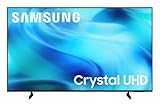
The U8000H is the cheapest way into a 65-inch Samsung in 2026, and it is honest about what it is: a 4K LCD with an LED backlight, Samsung’s Crystal Processor 4K-class upscaling, and the full Tizen smart platform with the Vision AI feature set. It suits a bedroom, a guest room, a kitchen-adjacent space, a dorm, or a living room where the TV is on for background company rather than critical viewing. It also suits anyone whose priority is simply “65 inches, Samsung apps, no fuss” — the smart interface is the same family you get on sets costing several times more, so app support and navigation feel familiar regardless of tier.
Where it fits best is a room with moderate, indirect light. Crystal UHD panels in this class typically have a narrower effective viewing angle than OLED or the better QLED models, so a straight-on sofa position flatters it and a wide, angled seating arrangement exposes it. It is also a 60 Hz-class panel with motion smoothing rather than a true high-refresh display, which matters enormously if you plan to plug in a console — see the gaming notes below.
Key specs at a glance
- Panel: 4K LCD, LED backlight, 65-inch class
- Processor: Crystal Processor 4K class with 4K upscaling
- Refresh: 60 Hz-class panel with motion interpolation
- HDR: HDR10+ and HLG class support
- Smart platform: Tizen with Vision AI features, voice assistant support, free ad-supported channels
- Gaming features: auto game mode and low-latency mode class; no variable refresh rate class feature and no 4K/120 Hz input
- Connectivity: typically three HDMI inputs, USB, optical or eARC-class audio output
Strengths
The value is the point. You are buying screen area, a mature operating system and Samsung’s upscaling rather than contrast performance, and for daytime broadcast, YouTube, casual streaming and kids’ content that trade is entirely rational. Power draw is also the lowest in this group by class, which shows up on the electricity bill over a few years. Set-up is simple, the remote and menu system are consistent with the rest of the range, and there is nothing to configure that a non-enthusiast would find intimidating.
Pros
- Lowest entry price for a 65-inch Samsung in the current lineup
- Full Tizen smart platform with the same app ecosystem as premium models
- Competent 4K upscaling of 1080p and 720p sources
- Lowest typical power consumption of the models here
- Simple to set up and hard to misconfigure
Cons
- Contrast and black level are the weakest in this comparison — dark scenes look grey in a dark room
- Narrower effective viewing angle than OLED or QLED sets
- 60 Hz-class panel with no VRR, so it caps console gaming at 60 fps and can show tearing or judder
- HDR peak brightness is modest, so HDR content barely separates from SDR
- No local dimming, so bright objects bleed into surrounding dark areas
How it compares with the nearest alternative
The nearest alternative in this list is the M70H Mini LED, and the comparison is unusually clean: the M70H is the same idea — a budget-tier 65-inch Samsung — with a mini-LED backlight and local dimming bolted on. That single change lifts black level, contrast and HDR impact enough to be visible in a normally lit room, which is exactly where the U8000H is weakest. The U8000H still wins on price and on simplicity, and if the set is going into a bright bedroom where you mostly watch sitcoms and news, the extra contrast of the M70H will be hard to notice. If the set is going into a living room and you watch films at night, the M70H is the better use of the money.
2. Samsung M70H Mini LED – Best for a Cheap Contrast Upgrade

The M70H is the interesting one in Samsung’s 2026 value stack. It is listed as a budget-tier 65-inch 4K smart TV, but it uses a mini-LED backlight with local dimming rather than the edge-lit or direct-lit arrangement you would normally expect at that price. That means the panel can dim whole regions of the screen independently, so a starfield or a letterboxed film does not glow uniformly grey. It suits a buyer who has outgrown a first TV and wants a visible step up in contrast without jumping into QLED or OLED money — a spare-room upgrade, a first “proper” living-room set, or a gift purchase where you want the picture to feel like an upgrade on day one.
It is also a good fit for a room with moderate light and a straight-on seating position. Local dimming helps most when the room is dim enough that your eyes adapt to the panel rather than to the room, so a curtained living room or an evening-heavy viewing habit gets the most out of it. In a very bright room, the M70H’s advantage narrows, because at that point peak brightness and anti-glare treatment matter more than black level — and both are areas where the mid-range QLED and Neo QLED models pull ahead.
Key specs at a glance
- Panel: 4K LCD with mini-LED backlight and local dimming zones
- Colour: quantum-dot-class colour layer
- Refresh: verify on the listing — value mini-LED tiers split between 60 Hz-class and 120 Hz-class panels
- HDR: HDR10+ and HLG class support, with better highlight separation than a non-dimming LCD
- Smart platform: Tizen with Vision AI features and voice assistant support
- Gaming: auto low-latency game mode class; VRR support depends on whether the panel is the 120 Hz-class variant
- Connectivity: multiple HDMI inputs, USB, eARC-class audio output
Strengths
Contrast per dollar is the headline. Local dimming is the single biggest visible upgrade you can make to an LCD picture, and getting it at the budget tier is unusual. Blooming around bright objects on dark backgrounds is a known limitation of the technology, but the effect is far less objectionable than the uniform grey wash of a non-dimming panel. Colour volume is also good for the tier thanks to the quantum-dot-class layer, and the smart platform is identical to what you get further up the range, so nothing feels cut down in daily use.
Pros
- Mini-LED backlight with local dimming at a budget-tier price
- Clearly better black level and contrast than a non-dimming LCD
- Quantum-dot-class colour, so HDR highlights keep saturation
- Same Tizen platform and app support as Samsung’s premium sets
- Strong value if you mainly watch in the evening with curtains drawn
Cons
- Local dimming can produce visible blooming or haloing around small bright objects
- Refresh rate and VRR support must be confirmed against the specific listing before buying
- Peak brightness is well below the Neo QLED tier, so a sunlit room still washes it out
- Viewing angles are typical LCD — colour and contrast shift as you move off-axis
- Zone count is modest by mini-LED standards, so dimming is coarser than on premium models
How it compares with the nearest alternative
Two comparisons matter. Against the U8000H below it, the M70H is a straight upgrade in picture quality and a straight downgrade in price advantage — the U8000H is cheaper, and if the TV lives in a bright room with casual content, the gap will not justify the difference. Against the QN70H Neo QLED above it, the M70H gives up peak brightness, zone density and anti-glare treatment, but keeps the core idea of a dimming mini-LED backlight. If you watch mostly at night, the M70H gets you most of the way to the Neo QLED look for less; if your room is bright all day, save for the QN70H instead.
3. Samsung S90H OLED – Best for Dark Rooms and Serious Gaming
The S90H is the premium pick in this list and the only OLED, which changes the rules of the comparison. Every pixel emits its own light, so black is genuinely black rather than “dimmed as far as the backlight goes,” and there is no backlight to bloom. That makes it the best choice for a dedicated film room, a basement, a bedroom where you watch with the lights off, or any space where you control the ambient light. It is also the best gaming display here: OLED’s near-instant pixel response removes the smearing that LCD panels produce in fast camera pans, and the panel class supports high refresh rates with variable refresh rate, so a current console or a gaming PC can run 4K at high frame rates with frame pacing that matches the source.
It also suits wide seating. OLED keeps colour and contrast almost unchanged as you move off-axis, so a long sofa, an L-shaped arrangement or a room with chairs at the sides does not punish the people at the edges the way an LCD does. If your household regularly has four or five people watching from different angles, this is the model where that stops being a compromise.
Key specs at a glance
- Panel: 4K OLED (QD-OLED class), per-pixel light emission, no backlight
- Contrast: effectively infinite, with no blooming or haloing
- Viewing angles: very wide — minimal colour or contrast shift off-axis
- Refresh: 120–144 Hz class, with VRR and auto low-latency mode
- HDR: HDR10+ and HLG class support, with strong highlight punch in small bright areas
- Anti-reflection: anti-reflective treatment on the panel surface
- Connectivity: HDMI 2.1-class inputs suitable for 4K/120 Hz sources, eARC-class audio output
- Smart platform: Tizen with Vision AI features
Strengths
Contrast is the whole story, and it is not a subtle difference — a dark scene on OLED has no glow behind the credits, no grey haze in the letterbox bars, and no light bleeding around subtitles. Gaming performance is equally strong, with the combination of high refresh, VRR and low latency that console and PC players actually notice. Add wide viewing angles and the fact that OLED panels are thin and light enough to mount almost flush, and you have the best pure picture quality in this roundup.
Pros
- Per-pixel contrast — the best black level available in a 65-inch consumer TV
- Very wide viewing angles, so off-centre seats stay accurate
- High refresh rate with VRR and low latency: the best gaming panel here
- Excellent motion clarity thanks to near-instant pixel response
- Slim, light chassis that mounts close to the wall
Cons
- Peak brightness in full-screen bright scenes is lower than mini-LED, so a sunlit room can look flat
- Static elements — news tickers, channel logos, game HUDs — carry a long-term burn-in risk with heavy repetition
- Automatic brightness limiting dims the whole picture when a scene is very bright for a long time
- Highest price tier in this list
- Requires more care in a bright room: reflections and ambient light hit harder than on a matte panel
How it compares with the nearest alternative
The nearest alternative is the QN70H Neo QLED, and the choice between them is almost entirely about room light. In a dark room, the S90H wins on contrast, viewing angle, motion and gaming responsiveness, and no amount of dimming zones closes that gap. In a bright room — big windows, daytime viewing, no blinds — the QN70H’s higher peak brightness and anti-glare coating produce a more watchable picture, and the S90H’s perfect blacks are partly wasted because your eyes are adapted to the room rather than the screen. If you game in a dark room, buy the S90H. If your TV is on all day in a bright living room, buy the QN70H and put the difference toward a soundbar.
4. Samsung The Frame LS03F – Best for Decor-First Walls

The Frame LS03F is the one TV here you would buy for reasons that have nothing to do with contrast ratios. It is a 4K QLED set built around a matte, anti-glare display layer and an Art Mode that shows paintings, photography or your own images when the TV is not in use, with a slim-fit wall mount and swappable bezels designed to make it read as a framed picture rather than a black rectangle. It suits a living room or hallway where the television is visible all day, a design-conscious household, or a room with a wall of windows where reflections are the main problem you are trying to solve.
It is also the most sensible pick for anyone who hates glossy screens. The matte layer scatters reflected light instead of mirroring it, which means a window behind the sofa stops producing a hard reflection of your room. That is a genuine functional benefit, not just a styling choice, and it is why The Frame ends up in bright rooms even when the buyer did not set out to buy an art TV. The trade-off is that the matte coating slightly softens specular highlights, so HDR sparkle is a touch less crisp than on a glossy panel of the same class.
Key specs at a glance
- Panel: 4K QLED with quantum-dot colour
- Surface: matte anti-glare layer that diffuses reflections rather than mirroring them
- Art Mode: displays artwork, photos and custom images when the TV is off, with an art subscription for the full library
- Mounting: designed around a Slim Fit wall mount for near-flush installation, with optional magnetic bezels in several finishes
- Refresh: 120 Hz-class panel
- Connectivity: typically one HDMI 2.1-class input alongside standard HDMI inputs, eARC-class audio output
- Smart platform: Tizen with Vision AI features
Strengths
Nothing else in this list solves the “big black rectangle on the wall” problem, and for a lot of buyers that is the actual objection to a 65-inch TV in a main living space. The matte finish is the most useful anti-glare treatment you can get on a Samsung LCD, and it holds up in a room with windows on two sides. Picture quality is solidly QLED-class — good colour, good brightness for daytime viewing, 120 Hz-class motion — so you are not sacrificing basic competence for the design.
Pros
- Matte anti-glare surface handles window reflections better than any glossy panel here
- Art Mode turns the set into decor when it is switched off
- Near-flush wall mounting with interchangeable bezels
- 120 Hz-class panel and QLED colour, so it is not a style-over-substance product
- Ideal for rooms where the TV is visible from a kitchen or dining area all day
Cons
- You pay a premium tier price partly for design and the mounting ecosystem
- The matte layer slightly reduces highlight punch compared with a glossy panel
- Typically only one HDMI 2.1-class input, so two high-refresh consoles will fight over it
- Brightness class is below the Neo QLED tier, so it is not the pick for HDR spectacle
- Art Mode’s full library needs a subscription, which is an ongoing cost
How it compares with the nearest alternative
The nearest alternative is the Q7F QLED, which is a mid-range rather than premium purchase and gives you a similar QLED picture class with a conventional glossy finish and more HDMI inputs. If you want the best picture for the money in a normal room, the Q7F is the rational choice and The Frame is not. The Frame wins when reflections, aesthetics or wall mounting are the deciding factors — a bright room with a window opposite the sofa, a rental where you want a flush install, or a living room where a black panel would be an eyesore. Against the S90H, The Frame trades contrast and gaming capability for glare handling and Art Mode; they solve different problems and are rarely competing for the same wall.
5. Samsung Q7F QLED – Best for All-Around Family Rooms

The Q7F is the mid-range workhorse of this list, and for a lot of households it is the correct answer precisely because it is unremarkable. It is a 4K QLED with a quantum-dot colour layer, Quantum HDR support and Object Tracking Sound-class audio that follows on-screen action, wrapped in Samsung’s Tizen platform with the Vision AI feature set. It suits a family living room where the TV is used for everything: streaming, broadcast, sport, kids’ content, a console, and a soundbar over eARC.
It also suits a room with mixed lighting — some daytime viewing, some evening viewing, no extreme in either direction. QLED’s quantum-dot layer holds colour saturation better than a basic LCD as brightness rises, so daytime sport and news look properly coloured rather than washed out, and the 120 Hz-class panel means motion in football, hockey and fast pans is handled without the smear you get on a 60 Hz-class set. If your household has multiple devices, the input count matters too, and this tier typically gives you four HDMI inputs rather than three.
Key specs at a glance
- Panel: 4K QLED with quantum-dot colour layer
- HDR: Quantum HDR class processing with HDR10+ and HLG support
- Refresh: 120 Hz-class panel with motion smoothing controls
- Audio: Object Tracking Sound class processing that moves the soundstage with on-screen action
- Connectivity: typically four HDMI inputs, one of which is 2.1-class for 4K/120 Hz sources; eARC-class audio output
- Gaming: auto low-latency mode and VRR class support on the 2.1-class input
- Smart platform: Tizen with Vision AI features, voice assistants, free ad-supported channels
Strengths
Balance is the strength. There is no single specification where the Q7F is the best in this list, and there is no common use case where it is bad. Four HDMI inputs solve the device-juggling problem that premium models sometimes create by shipping fewer ports, the 120 Hz-class panel makes it a legitimate console display, and QLED colour keeps daytime content looking correct. It is also the tier where the price-to-picture ratio tends to be most favourable, because you are past the compromises of the budget tier without paying for the flagship brightness and dimming hardware.
Pros
- Balanced performance with no serious weakness for general viewing
- Typically four HDMI inputs, easing device congestion
- 120 Hz-class panel with VRR support for consoles on the 2.1-class input
- Quantum-dot colour holds up better than basic LCD in daytime light
- Mid-range tier pricing, so more budget left for a soundbar
Cons
- No mini-LED backlight with dense local dimming, so black level trails the M70H and QN70H
- Peak brightness is below the Neo QLED tier, limiting HDR impact in a bright room
- Viewing angles are LCD-typical, with colour shift off-axis
- Only one HDMI 2.1-class port, so a second high-refresh console needs a workaround
- Glossy finish means window reflections are a real consideration
How it compares with the nearest alternative
The nearest alternative is the QN70H Neo QLED, and the step between them is essentially the backlight. The QN70H adds quantum mini-LED dimming, higher peak brightness and an anti-glare coating, which together make it the better set in a bright room and the better set for HDR films. The Q7F counters with a lower price, the same smart platform, and — depending on the year and region — sometimes a more generous input count. If your room is dim and you mainly stream series, the Q7F is the smarter buy and the difference is better spent on audio. If your room is bright or you watch a lot of HDR content, the QN70H is worth the stretch. Against the U8000H, the Q7F is a clear upgrade in colour, motion and input count.
6. Samsung QN70H Neo QLED – Best Overall for Bright, Mixed-Use Rooms

The QN70H is the best overall 65-inch Samsung in this roundup for the widest range of real rooms, and the reason is that it refuses to be bad at anything. It is a Neo QLED — Samsung’s name for a quantum mini-LED backlight with local dimming — which means it combines LCD brightness with a dimming system dense enough to produce credible black levels. That combination is what makes it the right answer for a living room with windows, a lamp-lit evening setup, a console under the TV and a soundbar beside it. It is a mid-range purchase rather than a premium one, which is the other half of why it wins: you get most of the premium experience without the premium tier price.
It suits households that watch across the whole day. Morning news in a bright kitchen-adjacent room, afternoon sport with sunlight coming in, evening streaming with the lights dimmed — a mini-LED set handles all three because it has brightness headroom for the first two and dimming for the third. It also suits gamers who want one TV for everything: 120 Hz-class refresh, VRR and auto low-latency mode on the 2.1-class inputs mean a current console runs at its higher frame-rate modes without tearing, and the anti-glare coating means you are not fighting a window reflection during a daytime session.
Key specs at a glance
- Panel: 4K Neo QLED with quantum mini-LED backlight and local dimming
- Brightness: high peak-brightness class, well above standard QLED and budget LCD tiers
- Contrast: local dimming produces strong black levels, with some blooming around small bright objects
- Surface: anti-glare coating that reduces window reflections
- Refresh: 120 Hz-class panel with VRR and auto low-latency mode
- Connectivity: HDMI 2.1-class inputs for 4K/120 Hz sources, eARC-class audio output
- Audio: Object Tracking Sound class processing; supports Q-Symphony-style pairing with compatible Samsung soundbars
- Smart platform: Tizen with Vision AI features
Strengths
The brightness-and-dimming combination is the core strength, and it is the one thing a spec sheet undersells: a mini-LED set does not just look brighter, it looks brighter while keeping black areas dark, which is what makes HDR highlights pop in a room that is not pitch black. Add anti-glare treatment and the picture stays legible with daylight in the room. Gaming features are complete for a console generation, and the smart platform is Samsung’s current one, so app support and feature updates should track the rest of the 2026 range.
Pros
- Best all-round performance in this list for mixed lighting conditions
- High peak brightness with local dimming for convincing HDR
- Anti-glare coating keeps the picture usable in a bright room
- 120 Hz-class refresh with VRR and low-latency mode for consoles
- Mid-range tier pricing rather than premium
Cons
- Blooming and haloing around small bright objects on dark backgrounds is still visible
- Viewing angles are LCD-typical and cannot match the OLED in this list
- Black level is excellent for an LCD but not literally black
- Full-screen bright scenes can trigger dimming behaviour that reduces overall punch
- No Dolby Vision support, in line with Samsung’s HDR strategy across the range
How it compares with the nearest alternative
Its nearest alternatives are the Q7F below it and the S90H above it, and it sits deliberately between them. Against the Q7F, the QN70H buys you a mini-LED backlight, higher peak brightness and anti-glare treatment — the three things that matter most in a bright room — for a step up in price. Against the S90H, it trades away perfect blacks, wide viewing angles and OLED motion in exchange for brightness and no burn-in risk, at a lower tier price. In practical terms: if your room gets bright during the day, the QN70H beats the S90H; if your room is dark and you game seriously, the S90H beats the QN70H. For everyone in between, the QN70H is the safer buy.
Room Light, Seating Distance, and Brightness: Getting the Numbers Right
Most TV buying mistakes are room mistakes, not TV mistakes. Two calculations do most of the work.
How far away should a 65-inch TV be?
A 65-inch 16:9 panel is about 56.7 inches wide and
Related guides
- Best Streaming Gear for Twitch: Webcams, Capture Card, Backdrop and Light (2026)
- Best Over Ear Headphones: 9 Closed, Open-Back and Bluetooth Picks Explained (2026)
- Best Monitor for Console Gaming: Eight 1080p and 1440p Screens Compared by HDMI and Refresh Rate (2026)
- Best Monitors for PS5 Pro 4K 120Hz: Eight Screens and the HDMI Bandwidth Check (2026)