The best sliding miter saw for most workshops is the DEWALT DWS780 12-inch Double Bevel Miter Saw: it delivers the widest practical crosscut capacity in this group (about 2×14 dimensional lumber at 90 degrees and 2×12 at 45 degrees), bevels 49 degrees left and right so you never flip a workpiece, and uses an XPS shadow-line cut guide instead of a laser. It suits finish carpenters, trim crews and serious remodelers who cut crown, baseboard and deck framing from a fixed bench. If you want dual-bevel capability in a lighter, less expensive 10-inch package, the SKIL MS6305-00 is the value pick. If your materials include aluminum, steel or plastic as often as wood, the Evolution R185SMS+ cuts all of them with one blade. For truck-based work with no outlet, the WOODSTARTER 8-inch cordless is the budget entry point, while the DEWALT DCS785B is the cordless 12-inch option for anyone already on the 20V MAX XR battery platform. Match a saw to your widest routine cut, not your widest possible cut — the capacity you use every day is what should drive the purchase.
Our Top Picks
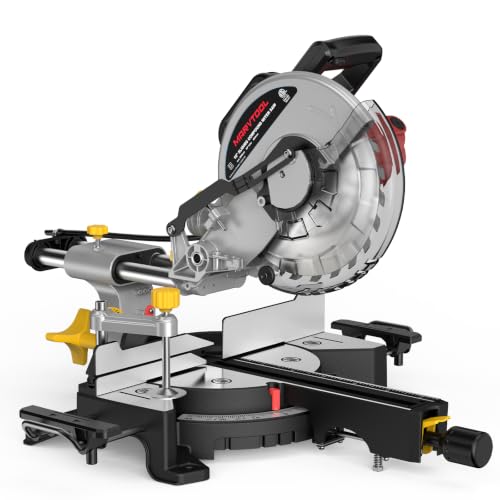
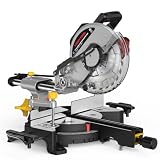
 SKIL 10" Dual Bevel Sliding Compound Miter Saw-MS6305-0010''35.43 x 22.44 x 14.17 inches39.4 poundsCheck on Amazon




Top 3 picks at a glance


Quick Comparison
| Product | Best for | Key specs | Price tier |
|---|---|---|---|
| SKIL 10″ Dual Bevel Sliding Compound Miter Saw (MS6305-00) | Dual-bevel trimming on a value budget | 10 in. blade, 15 A corded, dual bevel both directions, sliding rails, compact 10-inch-class base | Mid-range |
| WOODSTARTER Cordless Miter Saw (8 in., 18.5 V) | Cordless cutting in finished or remote spaces | 8 in. 40-tooth blade, 18.5 V lithium-ion 4000 mAh pack, dual clamps, compact and light | Budget |
| Marvtool 10″ Sliding Compound Miter Saw | First saw for a home shop | 10 in. blade, 15 A, 5,000 RPM, single bevel 0–45 degrees, extension table, 36T blade | Budget |
| DOVAMAN 10″ Sliding Miter Saw, Multi-Material, 2-Speed | Mixed wood and non-ferrous material cutting | 10 in. blade, 15 A, two speed ranges, multi-material blade, sliding rails | Mid-range |
| Metabo HPT 10″ Compound Miter Saw (C10FCG2) | Small shops and tight benches | 10 in. blade, 15 A, single bevel, non-sliding compound design, light chassis | Budget |
| VEVOR 12″ Sliding Compound Miter Saw, 15 A, 60T | Large crosscuts on a tight budget | 12 in. blade, 15 A corded, 60-tooth blade, double bevel sliding design | Premium |
| DEWALT 12″ Double Bevel Miter Saw (DWS780) | Demanding trim and framing work | 12 in. blade, 15 A, 3,800 RPM, bevel 49 degrees left/right, miter 60 right/50 left, XPS shadow line, about 56 lb | Premium |
| DOVAMAN 12″ Dual-Bevel Sliding Compound Miter Saw | Big-capacity cuts at a mid-premium price | 12 in. blade, 15 A, dual bevel, sliding rails, large base and table extensions | Premium |
| DEWALT 20V MAX XR 12″ Double Bevel Sliding Miter Saw (DCS785B) | Cordless 12-inch capacity, tool-only buyers | 12 in. blade, 20V MAX XR cordless, double bevel, sliding rails, tool only (no battery or charger) | Premium |
| Evolution Power Tools R185SMS+ | Cutting metal, plastic and wood with one saw | 185 mm multi-material TCT blade, sliding rails, 45 degree bevel, 50 degree miter, compact chassis | Budget |
| DOVAMAN 10″ Dual-Bevel Sliding Compound Miter Saw | Dual-bevel accuracy in a 10-inch footprint | 10 in. blade, 15 A, dual bevel, sliding compound design, compact base | Mid-range |
| VEVOR 10″ Double Bevel Sliding Compound Miter Saw | LED-guided alignment on a mid-range budget | 10 in. blade, 15 A, 60-tooth blade, double bevel, LED laser alignment, adjustable fence | Mid-range |
How We Chose
This roundup is built from published manufacturer specifications, the listing details for each saw, and the established engineering conventions of the miter saw category — not from bench sessions. Every saw here was selected against five criteria that actually change how a saw behaves in a workshop: crosscut capacity at 90 and 45 degrees, bevel range and whether it bevels in one direction or two, footprint including the rear clearance sliding rails demand, dust-collection design, and portability measured in weight and power source.
Category fit came next. A 12-inch corded slider, a 10-inch dual-bevel slider, a compact non-sliding compound saw and a cordless 8-inch unit solve genuinely different problems, so each product had to justify its place by owning a use case rather than by ranking well on a single spec. We also weighed the upgrade path: a saw that shares a battery platform you already own, or accepts standard blades and common arbor sizes, costs less to live with over five years than one that locks you into proprietary consumables. Price tiers reflect general market positioning — budget, mid-range and premium — rather than a live figure, because listings move daily.
1. SKIL 10″ Dual Bevel Sliding Compound Miter Saw (MS6305-00) – Best for dual-bevel trimming on a value budget
As an Amazon Associate we earn from qualifying purchases at no extra cost to you.
The MS6305-00 is the saw to look at when you want the two features that matter most in finish work — sliding rails and a bevel that swings both directions — without paying 12-inch money. SKIL is the value-oriented brand within the Chervon tool group, and its miter saws are aimed at homeowners, hobbyists and value-conscious remodelers who want modern features at a lower entry point. In practice that means a 10-inch dual-bevel slider with a 15-amp corded motor, a cast base with positive miter detents, and a head that glides on twin rails to extend crosscut capacity well past what a fixed-head saw can manage.
Dual bevel is the headline. On a single-bevel saw, every cut that leans the wrong way forces you to flip the workpiece, re-clamp, and re-reference your mark — and on long stock, flipping a 12-foot piece of baseboard on a bench is a two-person job. A saw that bevels both left and right at 45 degrees eliminates that entirely. For crown molding, picture-frame miters and window casing, it is the single biggest time saver you can buy.
The 10-inch blade size is also a practical advantage, not a compromise. Ten-inch blades cost less than 12-inch equivalents, are stocked in a wider range of tooth counts, and take less motor effort to spin up. The saw itself is lighter and easier to carry than any 12-inch slider, which matters if the saw lives on a shelf and comes down for weekend projects.
Key specs at a glance
- Blade size: 10 in. (a 10-inch blade on a sliding head)
- Motor: 15 A corded, 120 V
- Bevel: dual, both directions, 0–45 degrees class
- Miter: compound miter with positive stops at common angles
- Design: sliding compound head on twin rails
- Capacity class: typically about 11–12 in. crosscut at 90 degrees, about 8 in. at 45 degrees (2×8 flat)
Pros
- Dual bevel in both directions at a mid-range price
- Sliding head gives roughly double the crosscut capacity of a fixed 10-inch saw
- Lighter and easier to move than a 12-inch slider
- 10-inch blades are cheap and available in many tooth counts
- Compact base fits a normal 24-inch-deep bench with room for the rails
Cons
- Won’t crosscut a 2×12 at 90 degrees the way a 12-inch slider will
- Sliding rails need rear clearance, so it can’t sit flush against a wall
- Stock dust bag captures only a fraction of the fines
- Not a multi-material saw — wood and wood-composite only
How it compares: the nearest alternatives in this list are the DOVAMAN 10-inch dual-bevel slider and the Marvtool 10-inch single-bevel slider. The Marvtool is cheaper but bevels one direction only, which costs you time on every reversed miter. The DOVAMAN 10-inch dual-bevel is the closest like-for-like rival; choose the SKIL if you want the established brand’s parts and accessory ecosystem, and the DOVAMAN if you want a specific feature set on the listing. Against the 12-inch sliders further down, the SKIL trades roughly two inches of crosscut capacity for a meaningful drop in weight and price.
2. WOODSTARTER Cordless Miter Saw (8 in., 18.5 V) – Best for cordless cutting in finished or remote spaces
The WOODSTARTER is the saw you buy when the outlet is the problem, not the cut. It is a compact 8-inch cordless miter saw running on an 18.5 V lithium-ion pack rated at 4000 mAh, with a 40-tooth blade and dual clamps. That combination puts it in a category of its own in this list: it is the only saw here that runs without a cord at a budget price point, and one of only two cordless machines overall.
Where it earns its place is in occupied spaces. Cutting shoe molding in a finished living room, trimming closet shelving in a rental, or working in a basement with no convenient circuit — those jobs punish a corded saw. An 8-inch blade also means the saw is small and light enough to carry one-handed up a ladder or into a crawlspace, and the 40-tooth count is a reasonable compromise between fast crosscutting in softwood and clean enough edges for painted trim.
The trade-off is capacity and stamina. An 8-inch blade simply cannot span the width a 10- or 12-inch saw can, so this is a trim-and-detail tool rather than a framing saw. Cordless operation also means runtime is a function of pack capacity, blade sharpness, and how hard the material is. A 4000 mAh pack at 18.5 V nominal stores about 74 watt-hours; if the saw averages somewhere in the 250–400 W range under load, that works out to roughly 11–18 minutes of cumulative trigger time — the equivalent of a few hundred short trim cuts, not a day of deck building. Treat that as arithmetic rather than a measured result, because real runtime swings with temperature, blade condition and how aggressively you feed the head.
Key specs at a glance
- Blade: 8 in., 40-tooth
- Power: 18.5 V lithium-ion, 4000 mAh pack (about 74 Wh nominal)
- Clamping: dual clamps included
- Design: compact cordless miter saw, no cord, no outlet required
- Capacity class: small — trim stock, 1x and 2x material in narrower dimensions
Pros
- Runs anywhere — no circuit, no extension cord, no trip hazard
- Very light and easy to carry into finished interiors
- Dual clamps hold small trim securely, which matters more on a light saw
- Lowest-cost way to get cordless miter capability
- Quiet enough for occupied buildings compared with a 15 A corded saw
Cons
- 8-inch capacity rules out wide boards and most framing lumber
- Runtime is limited by pack size and material
- Not a substitute for a corded saw on a production trim job
- Battery platform is proprietary, so packs don’t cross over to other brands
How it compares: the obvious step up is the DEWALT DCS785B, a 12-inch cordless double-bevel slider that runs on the 20V MAX XR platform. The DEWALT cuts far more material per pass and holds resale value better, but it costs several times as much, is tool-only so you must already own packs, and weighs enough that you won’t carry it one-handed. If your work is small trim in awkward places, the WOODSTARTER does the job for a fraction of the money. If your work is real crosscutting, the cordless 12-inch class is where you need to be.
3. Marvtool 10″ Sliding Compound Miter Saw – Best for a first saw in a home shop
The Marvtool is a straightforward, feature-focused budget slider: a 10-inch blade driven by a 15-amp motor turning at 5,000 RPM, sliding rails, a single bevel adjustable from 0 to 45 degrees, an extension table for supporting longer stock, and a 36-tooth blade in the box. For someone assembling a first workshop, that combination covers a remarkable amount of ground.
The 5,000 RPM figure is worth understanding, because blade speed changes how a saw feels. A faster-spinning 10-inch blade leaves a smoother offcut in softwood and helps clear chips, which is why 10-inch saws frequently run at higher RPM than 12-inch machines. The 36-tooth blade is the standard general-purpose count for a 10-inch saw: enough teeth for reasonably clean crosscuts in pine and poplar, few enough for acceptable feed rates in 2x framing material. If you plan to cut a lot of trim, a 60- or 80-tooth blade is the first upgrade worth buying.
The extension table is a genuinely useful inclusion on a budget saw. Long stock that overhangs the base without support tends to dip at the cut, which produces a slightly ragged edge and can pinch the blade. Extension arms or tables reduce that, and they’re often the first thing missing from cheaper sliders.
Single bevel is the compromise. You can tilt the head from 0 to 45 degrees in one direction. For any cut that needs the opposite lean, you flip the workpiece. On short pieces that costs seconds; on 10-foot lengths of baseboard it costs minutes and a helper.
Key specs at a glance
- Blade: 10 in., 36-tooth included
- Motor: 15 A corded, 5,000 RPM
- Bevel: single, 0–45 degrees, one direction only
- Design: sliding compound head
- Support: extension table for long stock
- Capacity class: about 11–12 in. at 90 degrees, about 7–8 in. at 45 degrees
Pros
- Sliding rails give real crosscut capacity at a budget price
- 5,000 RPM produces clean crosscuts in softwood and trim
- Extension table supports longer stock out of the box
- 15-amp motor handles 2x material without bogging down
- Simple single-bevel mechanism means fewer things to misalign
Cons
- Single bevel forces workpiece flips on reversed miters
- Included 36T blade is coarse for finish trim
- Stock dust collection is minimal — plan on a shop vac
- Rails require rear clearance on the bench
How it compares: against the SKIL MS6305-00, the Marvtool gives up dual bevel but typically costs less and spins faster. If you cut mostly 2x lumber and simple 45-degree miters on picture frames or small trim, single bevel is a reasonable sacrifice. If your work involves crown molding, casing returns, or any repetitive trim where flipping stock slows you down, the SKIL or the DOVAMAN 10-inch dual-bevel is worth the step up. Against the Metabo HPT C10FCG2, the Marvtool wins on crosscut capacity because it slides, while the Metabo wins on bench footprint and weight.
4. DOVAMAN 10″ Sliding Miter Saw, Multi-Material, 2-Speed – Best for mixed wood and metal cutting
Most miter saws are wood-only tools, and using them on aluminum or steel is dangerous — a standard carbide wood blade has the wrong tooth geometry and hook angle for metal, and it will grab, heat up and throw chips. The DOVAMAN 10-inch multi-material saw with a two-speed motor is built around the opposite assumption: it is designed to cut wood, aluminum, plastic and similar materials by changing the blade and selecting the appropriate speed range.
Two speeds matter more than they sound. Non-ferrous metals and plastics cut best at lower surface speeds, where the teeth take a controlled chip instead of rubbing and melting. Wood cuts best at higher speed. A single-speed saw forces you to compromise; a two-speed machine lets you slow down for aluminum extrusion and speed up for pine. If you do window and door work, deck railing with aluminum balusters, or shop projects that mix PVC trim with wood, that flexibility is the entire point of the tool.
The sliding head gives it the same crosscut advantage as any slider in the 10-inch class — roughly 11 to 12 inches at 90 degrees, dropping to around 7 to 8 inches at 45 degrees. A 15-amp motor provides enough torque to hold speed in 2x material.
One caution that applies to every multi-material saw: the blade must match the material. A dedicated multi-material blade with the correct tooth geometry is what makes metal cutting safe. Never put a standard wood crosscut blade into aluminum, and always clamp metal workpieces — never hold them by hand.
Key specs at a glance
- Blade: 10 in., multi-material type
- Motor: 15 A corded with two speed ranges
- Design: sliding compound head
- Materials: wood, aluminum, plastics and similar non-ferrous stock (with the correct blade)
- Capacity class: about 11–12 in. at 90 degrees, about 7–8 in. at 45 degrees
Pros
- Two speed ranges let you match blade speed to material
- Sliding head delivers full 10-inch-class crosscut capacity
- Covers aluminum trim, PVC and wood with one machine
- 15-amp motor holds RPM under load in thick stock
- Replaces two single-purpose saws for mixed-material work
Cons
- Slower feed rates required in metal, so it’s not a production metal saw
- Blade changes are mandatory between material families
- Heavier and bulkier than a non-sliding compound saw
- Metal chips and dust need more cleanup discipline than sawdust
How it compares: the closest competitor is the Evolution R185SMS+, which is also a multi-material sliding saw but with a much smaller 185 mm blade and a lower price. The Evolution wins on portability and cost; the DOVAMAN wins on crosscut capacity and on having two selectable speeds rather than one. If you’re cutting aluminum extrusion for railings or window trim in longer lengths, the 10-inch DOVAMAN is the more capable machine. If you’re cutting small metal stock and want to spend less, the Evolution covers it.
5. Metabo HPT 10″ Compound Miter Saw (C10FCG2) – Best for small shops and tight benches

The C10FCG2 is the only non-sliding saw in this roundup, and that is precisely its value. Metabo HPT builds the C10FCG2 as a 10-inch compound miter saw with a 15-amp motor and single bevel — no rails, no rear travel, no long base. It is a light, compact machine that sits on a shelf or a small bench and does simple crosscuts and miters all day.
Why would you choose a non-sliding saw in 2026? Three reasons. First, footprint: a sliding saw’s rails need 12 to 20 inches of rear clearance, and in a garage where the bench backs against a wall, that space doesn’t exist. A fixed-head saw can sit nearly flush. Second, weight: without rails and a sliding carriage, the saw is dramatically lighter, which matters if you carry it between jobs or store it overhead. Third, simplicity: fewer moving parts means fewer alignment checks and less to go wrong.
The cost is crosscut capacity. A fixed 10-inch head cuts roughly half its blade diameter plus a margin — in practice about 5-1/2 to 6 inches at 90 degrees, dropping to about 4 inches at 45 degrees. That handles 2×4 and 2×6 on the flat, most picture-frame stock, and small trim. It will not handle a 2×8, a wide shelf board, or a 5-1/4-inch baseboard laid flat.
Metabo HPT is the North American brand of the Japanese toolmaker Hitachi’s power tool business, and the C10FCG2 is a workhorse in the light-duty professional and serious-DIY segment. Expect a cast base with detents, a decent stock blade, and a simple dust bag.
Key specs at a glance
- Blade: 10 in.
- Motor: 15 A corded
- Bevel: single, 0–45 degrees
- Design: non-sliding compound miter saw (fixed head)
- Footprint: no rear rail travel — can sit close to a wall
- Capacity class: about 5-1/2–6 in. at 90 degrees, about 4 in. at 45 degrees
Pros
- Smallest footprint here — no rear clearance needed for rails
- Lightest corded saw in this roundup by a wide margin
- Fewer moving parts means less to align and less to break
- 15-amp motor is more than adequate for 2×4 and 2×6 cuts
- Established brand with widely available service and parts
Cons
- Cannot crosscut wide boards, 2×8 or wider trim
- Single bevel requires flipping workpieces
- 45-degree capacity of about 4 inches rules out most crown and tall base
- Not upgradable — capacity is fixed for the life of the saw
How it compares: against the Marvtool 10-inch slider, the Metabo HPT gives up roughly six inches of crosscut capacity but wins on bench space, weight and simplicity. If your material list tops out at 2×6 and small trim, the non-sliding saw is the smarter buy. If you ever need to cut a 1×8 shelf or a 2×8 joist, you’ll want the slider. Against the SKIL MS6305-00, the difference is even starker: the SKIL slides and bevels both ways, but needs the rear clearance the Metabo doesn’t.
6. VEVOR 12″ Sliding Compound Miter Saw, 15 A, 60T – Best for large crosscuts at a value price

The VEVOR 12-inch slider is the entry point to true 12-inch capacity in this list: a 12-inch blade, a 15-amp corded motor, a 60-tooth blade in the box, and a double-bevel sliding head. If your material list includes 2×10 or 2×12 lumber, wide shelving, or 6-inch-plus crown molding, the 12-inch class is where the capacity lives, and this saw delivers it without the price of the top-tier machines.
Sixty teeth on a 12-inch blade is a sensible general-purpose count. Twelve-inch blades need more teeth than 10-inch blades to achieve the same tooth-per-inch density at the cut, so a 60T 12-inch blade cuts roughly as cleanly as a 40T 10-inch blade. That makes the included blade usable for trim as well as framing, which is unusual at this price point — most budget 12-inch saws ship with a coarser blade you’ll replace immediately.
Double bevel is the other significant feature. Both left and right bevels at 45 degrees mean no workpiece flipping, which is essential once you’re cutting heavy 2×12 stock that’s awkward to turn on a bench. Combined with the sliding head, the saw covers the full range of compound cuts: miter, bevel, and the two combined for crown molding.
The realistic caveats are refinement, not capability. Value-tier 12-inch sliders tend to have more flex in the rails, less precise detents, and rougher factory blade alignment than premium machines. They also weigh a lot — a 12-inch slider with a cast base and full rails is typically in the 45 to 60 pound range, and that weight sits on the bench, not in a carry bag.
Key specs at a glance
- Blade: 12 in., 60-tooth included
- Motor: 15 A corded
- Bevel: double, both directions
- Design: sliding compound head on twin rails
- Capacity class: about 13–14 in. at 90 degrees, about 9–10 in. at 45 degrees
- Weight class: heavy — bench-mounted rather than carried
Pros
- True 12-inch crosscut capacity at the lower end of the 12-inch market
- 60-tooth blade is fine enough for trim out of the box
- Double bevel eliminates workpiece flipping
- Handles crown molding and wide shelving a 10-inch saw can’t
- 15-amp motor is the industry-standard size for this class
Cons
- Heavy — not a saw you move between rooms casually
- Value-tier rails and detents are less rigid than premium machines
- Requires significant rear clearance for the sliding travel
- Dust collection is basic; a shop vac connection is essentially mandatory
How it compares: the DEWALT DWS780 is the premium benchmark in the same 12-inch double-bevel sliding class, with a 3,800 RPM motor, a 49-degree bevel range in both directions, and an XPS shadow-line cut guide instead of a laser. The DEWALT costs several times more and is the better long-term tool for daily professional use. The VEVOR gets you the same capacity category and the same double-bevel capability for far less, which is the right trade if the saw works weekends rather than every day. Against the DOVAMAN 12-inch dual-bevel slider, the two are close in concept; the deciding factors will be blade quality, rail smoothness and base rigidity as described on each listing.
7. DEWALT 12″ Double Bevel Miter Saw (DWS780) – Best for demanding trim and framing work

The DWS780 is the saw that most trim carpenters end up with after they’ve owned two cheaper ones. It is a 12-inch double-bevel sliding compound miter saw with a 15-amp motor turning at 3,800 RPM, a bevel range of 49 degrees in both directions, and a miter range of 60 degrees right and 50 degrees left. Crosscut capacity is about 2×14 dimensional lumber at 90 degrees and 2×12 at 45 degrees — enough for deck framing, stair stringers and wide shelving without repositioning stock.
The feature that separates it most sharply from cheaper sliders is the XPS cross-cut positioning system. Instead of a laser line that can drift as the blade kerf changes, an LED casts the shadow of the actual blade onto the workpiece, so the cut line you see is the kerf you’ll get. Lasers need periodic alignment and become inaccurate as they collect dust; the shadow-line approach is self-correcting because it’s derived from the blade itself.
Bevel detents at common angles, a stainless steel miter detent plate with positive stops, and a cam-lock miter handle are the details that make the saw repeatable. Repeatability is the difference between a saw you trust for a 40-piece crown run and one you re-check on every cut. The 49-degree bevel range also matters: many crown molding profiles are cut at 45 degrees, but a slightly wider range lets you compensate for out-of-square walls and ceilings, which are the norm in real houses.
The weight is the honest downside. At roughly 56 pounds, this is a bench saw or a stand-mounted saw. It is not something you carry up a ladder, and moving it between floors is a two-hand, brace-your-back operation. The dust bag is also typical for the category — meaning it captures the coarse chips and lets the fine dust go everywhere. A shop vac connected to the port, ideally through a cyclone separator, is the real solution.
Key specs at a glance
- Blade: 12 in., 1 in. arbor
- Motor: 15 A corded, 3,800 RPM
- Bevel: 49 degrees left and right (double bevel)
- Miter: 60 degrees right, 50 degrees left
- Capacity: about 2×14 at 90 degrees, about 2×12 at 45 degrees
- Cut positioning: XPS LED shadow line
- Weight: about 56 lb
Pros
- Class-leading crosscut capacity for a 12-inch slider
- XPS shadow line is more reliable than a laser over time
- 49-degree bevel both directions handles out-of-square walls
- Positive miter detents and a solid detent plate make cuts repeatable
- Huge aftermarket support for blades, stands and parts
Cons
- Heavy at about 56 lb — effectively a stationary bench saw
- Premium price, several times a budget 12-inch slider
- Needs a large bench with substantial rear clearance
- Stock dust collection is weak, like every saw in this class
How it compares: the DEWALT DCS785B is the cordless sibling in this list — the same 12-inch double-bevel sliding format on the 20V MAX XR platform, sold tool-only. Choose the DWS780 if you have power at the bench and want unlimited runtime with maximum torque; choose the DCS785B if you work in finished or unpowered spaces and already own the batteries. Against the VEVOR 12-inch slider, the DWS780 costs far more but delivers the XPS system, tighter detents and better long-term durability. For a professional cutting trim every day, that gap pays for itself; for occasional weekend use, it may not.
8. DOVAMAN 12″ Dual-Bevel Sliding Compound Miter Saw – Best for big-capacity cuts at a mid-premium price

The DOVAMAN 12-inch dual-bevel slider sits in the space between budget 12-inch machines and the top-tier professional saws: full 12-inch sliding capacity, a 15-amp motor, double bevel in both directions, and a large base with table extensions to support long stock. It is aimed at the buyer who needs genuine 2×12 capacity and dual bevel but isn’t ready to spend premium money.
At 12 inches with a sliding head, this saw covers the cuts that define a serious workshop: crosscutting 2×10 and 2×12 framing, cutting 45-degree miters on wide casing, and nesting crown molding. The dual-bevel design means you can swing the head left or right at 45 degrees, which is what makes crown and tall baseboard work practical — you keep the molding nested against the fence in the same orientation and simply change the bevel direction.
Table extensions matter more on a 12-inch saw than on a 10-inch one, because the stock you’re cutting is heavier and longer. A 12-foot 2×12 overhanging an unsupported base will sag at the cut, and sag produces a cut that isn’t square. Extension arms or an outfeed stand are not accessories on a saw this size; they’re part of making it accurate.
The trade-offs are the standard ones for the class. A 12-inch slider with a cast base weighs in the 45 to 60 pound range, so it lives on a bench or a rolling stand. It needs rear clearance for the rail travel. And at this price point, expect competent but not exceptional rail smoothness — you may find yourself checking the bevel angle with a square more often than you would on a premium machine.
Key specs at a glance
- Blade: 12 in.
- Motor: 15 A corded
- Bevel: dual, both directions
- Design: sliding compound head with large base and table extensions
- Capacity class: about 13–14 in. at 90 degrees, about 9–10 in. at 45 degrees
- Weight class: heavy — plan on a stand or a dedicated bench
Pros
- Full 12-inch sliding capacity for framing and wide trim
- Dual bevel in both directions for crown and casing work
- Table extensions support long, heavy stock
- Substantially less expensive than the top-tier 12-inch saws
- 15-amp motor is appropriate for the blade size
Cons
- Heavy and awkward to move without a stand
- Rails and detents unlikely to match premium precision
- Large rear clearance requirement
- Included blade quality varies; budget for an upgrade if cutting finish trim
How it compares: against the DEWALT DWS780, the DOVAMAN gives up the XPS shadow line, the 49-degree bevel range and the tightest detents, but keeps the essential capability — 12-inch crosscut, double bevel, sliding head — at a much lower price. Against the VEVOR 12-inch double-bevel slider, the two occupy similar territory; the differentiators will be the base design, the table extensions and the specific blade included. For a home shop that occasionally cuts 2×12 but mostly cuts trim, this is the sweet spot of the 12-inch class.
9. DEWALT 20V MAX XR 12″ Double Bevel Sliding Miter Saw (DCS785B) – Best for cordless 12-inch capacity

The DCS785B is the cordless answer to the same question the DWS780 answers with a cord: how do you make full 12-inch double-bevel sliding cuts? It is a 20V MAX XR cordless machine in the same 12-inch double-bevel sliding format, sold as tool only, which means no battery and no charger in the box.
Tool-only listings are a specific kind of purchase, and it’s worth being explicit about what they assume. You are buying into a battery platform. If you already own 20V MAX XR packs and a charger, the saw is the only thing you need. If you don’t, the total cost includes high-capacity packs and a charger, and for a 12-inch sliding saw you should be looking at the largest packs in the platform rather than the compact ones — a 12-inch slider under load draws far more than a drill.
Here is the arithmetic that matters, and it’s the calculation nobody puts on the box. A pack rated 9.0 Ah at 20 V nominal stores about 180 watt-hours. If the saw averages somewhere around 400–600 W while cutting — a reasonable assumption for a cordless 12-inch head in softwood, and one that will be higher in wet pressure-treated lumber — that’s roughly 18 to 27 minutes of cumulative trigger time. At four seconds per cut, that’s on the order of 270 to 400 crosscuts per pack. Those figures are arithmetic from stated assumptions, not measured results: blade sharpness, material density, ambient temperature and how hard you push the head all move the number significantly. The practical conclusion is that cordless 12-inch cutting is a real capability but a managed one — carry two packs, and don’t plan a full day of deck framing on a single charge.
What you gain is freedom from the circuit problem. A 15-amp corded saw and a 9-amp shop vac on the same 15-amp household circuit is a nuisance-trip waiting to happen. Cordless removes the saw from that equation entirely.
Key specs at a glance
- Blade: 12 in.
- Power: 20V MAX XR cordless, tool only (no battery or charger)
- Bevel: double, both directions
- Design: sliding compound head
- Runtime estimate: roughly 18–27 minutes of cumulative trigger time per 9.0 Ah-class pack, by calculation
- Weight class: heavy, plus battery weight
Related guides