The best serger sewing machine for most people is the Brother 1034D: it runs 3-thread and 4-thread overlock, has adjustable differential feed, and its color-coded threading path is the one most first-time serger owners get through without a fight. It suits sewists who make garments from knits and mid-weight wovens, who want a rolled hem without buying a separate plate, and who would rather learn one machine properly than chase a longer feature list. If your fabric pile leans toward denim, canvas and bag-making, the SINGER HD0500S Heavy Duty is the better match, because its heavy-duty build is aimed squarely at dense seams. If you already own an overlock and only need to hem knits the way ready-to-wear does, the Brother 2340CV coverstitch machine is the specialist answer, not a replacement. If budget decides everything, the VEVOR 1250 SPM and the FEIYUE FY505 both put a working 2-3-4 thread overlock on the table for the price of a mid-range conventional sewing machine. This guide compares stitch options, threading difficulty, differential feed and workspace needs across twelve machines so you can match one to your projects and your experience level.
Our Top Picks
 Brother 1034D Serger Overlock Sewing Machine10.98 x 11.73 x 13.19 inches10 x 11 x 13 inches8.02 PoundsCheck on Amazon
 VEVOR Serger Overlock Sewing Machine 1250 SPM 212.6 x 11 x 12.6 in11 x 12.6 x 12.6 inches16.53 poundsCheck on Amazon
 SINGER® HD0500S Heavy Duty Serger Overlock MachineExtra Large13.38 x 11.18 x 10.7 inches15.87 poundsCheck on Amazon
 SINGER® Heavy Duty 0420™ Next Evolution Serger Overlock11.3" x 12.2" x 10.9"11.3 x 10.9 x 12.2 InchesCheck on Amazon

Top 3 picks at a glance

Quick Comparison
Every machine below is an overlock serger except the Brother 2340CV, which is a coverstitch machine and belongs in a different slot in your setup. Price tiers are relative to the serger market as a whole: budget means entry-level pricing, mid-range means the mainstream band where most buyers land, and premium means the top of that brand’s serger range. Actual prices move around, so treat the tier as a category, not a quote.
| Product | Best for | Key specs | Price tier |
|---|---|---|---|
| Brother 1034D | All-round first serger | 3- and 4-thread overlock, differential feed, color-coded threading, convertible rolled hem | Premium |
| SINGER S0100 | High-volume garment sewing | 2-3-4 thread, high-speed class, overlock plus rolled hem configurations | Mid-range |
| VEVOR 1250 SPM | Lowest-cost route into 4-thread | 2-3-4 thread, 1,250 SPM listed, differential feed 0.7-2.0, white body | Budget |
| SINGER HD0500S Heavy Duty | Denim, canvas, heavy seams | 2-3-4 thread, heavy-duty class build, black finish | Mid-range |
| SINGER Heavy Duty 0420 Next Evolution | Stepping up from a basic overlock | 2-3-4 thread, Next Evolution series features, heavy-duty class | Mid-range |
| SINGER S14-78 | Simple, proven starter | 2-3-4 stitch capability, white body, overlock class | Budget |
| SINGER X5004-HD | Wide stitch repertoire | 2-3-4 thread, heavy-duty class, overlock plus decorative configurations | Mid-range |
| SINGER Heavy Duty 0460 Next Evolution | Top of the SINGER serger line | 2-3-4 thread, Next Evolution series features, heavy-duty class | Premium |
| Brother 2340CV | Coverstitch hems on knits | Coverstitch and chainstitch, 2- and 3-needle configurations, differential feed. Not an overlock. | Premium |
| SINGER S0080 Next Evolution | Stitch variety at a mid-range price | 2-3-4 thread, 8 built-in stitches, overlock class | Mid-range |
| SewLaVie 360 | Threading-shy beginners | Overlock class, wide-open threading access, 2-3-4 thread | Budget |
| FEIYUE FY505 | Bare-bones budget or second machine | 2/3/4 thread capability, overlock class | Budget |
How We Chose
This roundup is built from published specifications, brand documentation and the patterns of use that show up repeatedly in serger communities, not from physical testing. Four criteria did the sorting. First, specifications that actually change what you can sew: thread configuration, differential feed range, stitch length and width adjustment, and speed class. A machine that cannot do 2-thread is not disqualified, but it is flagged, because 2-thread is where rolled hems and flatlock-style decorative work usually live. Second, category fit: we kept the coverstitch machine in the list but marked it clearly, since a buyer who confuses a coverstitch with an overlock ends up with a machine that cannot finish a raw seam edge. Third, use case: garment sewing on knits, garment sewing on wovens, denim and bag-making, and home decor each reward different priorities, and heavy-duty machines are only an advantage if you actually sew heavy fabric. Fourth, upgrade path: whether a machine leaves you room to grow, whether accessories and needles are easy to find, and whether the next logical purchase is a coverstitch, a better overlock, or nothing at all. Where an exact figure was not published or varied between revisions, we describe the machine by spec class rather than inventing a number.
1. Brother 1034D – Best for all-round first-serger ownership
As an Amazon Associate we earn from qualifying purchases at no extra cost to you.
The Brother 1034D is the machine most often recommended to someone buying their first serger, and the reason is not the spec sheet, it is the learning curve. It suits garment sewists who work in knits and mid-weight wovens, who want one machine that handles seam finishing, edge finishing and rolled hems, and who would rather spend their first month sewing than re-threading. It is a 3-thread and 4-thread machine, so there is no 2-thread mode; in practice that matters less than the spec sheet suggests, because the 1034D produces rolled hems through its 3-thread configuration with the stitch width narrowed and the differential feed adjusted.
Key specs
- Thread configuration: 3-thread and 4-thread overlock
- Differential feed: adjustable, in the 0.7-2.0 class range typical of this category
- Stitch length: adjustable across roughly the 2-4 mm range
- Stitch width: adjustable, with a narrow setting for rolled hems
- Threading: color-coded thread paths with an easy-access lower looper
- Speed: high-speed class, in the region of 1,300 stitches per minute
- Rolled hem: convertible without a separate accessory plate
Where it earns its reputation
Threading is the wall that stops most people from using a serger at all, and the 1034D is built around that problem. The thread paths are color-coded, the lower looper is reachable without contortion, and the tension dials are laid out so you can see which thread each one controls while you are troubleshooting a bad stitch. That matters because serger tension problems are almost always diagnosed by looking at which thread is loose or tight, and a machine that makes the mapping obvious shortens the fix from twenty minutes to two.
The second strength is consistency. A serger that drifts out of adjustment mid-project is worse than a slower one that holds its settings, and the 1034D’s dial-based adjustments are of the type that stay put once dialed in. Differential feed covers the usual range, which means you can set it above 1.0 to stop knits from stretching into a wavy edge and below 1.0 to stop lightweight wovens from puckering. For someone whose projects are T-shirts, leggings, simple dresses and the occasional tote, that covers essentially everything.
Pros
- Color-coded threading makes the hardest part of serger ownership manageable
- Handles 3-thread and 4-thread work, covering most garment seams
- Differential feed prevents both stretched knit edges and puckered woven edges
- Rolled hem without buying a separate plate keeps the accessory cost down
Cons
- No 2-thread mode, which limits flatlock-style decorative work and some narrow rolled hem setups
- Not aimed at heavy fabric, so denim and canvas seams are a stretch for it
- Premium tier pricing for what is functionally an entry-to-mid feature set
How it compares
Against the SINGER S0080 Next Evolution, the trade is straightforward. The S0080 lists eight built-in stitches and adds 2-thread capability, so it does more on paper and costs less in tier terms. The 1034D counters with the threading experience and the reputation for holding adjustment, which is why it still gets recommended to beginners over machines with longer feature lists. If you want the widest stitch menu at a mid-range tier, take the S0080. If you want the machine that gives you the fewest reasons to give up in month one, take the 1034D.
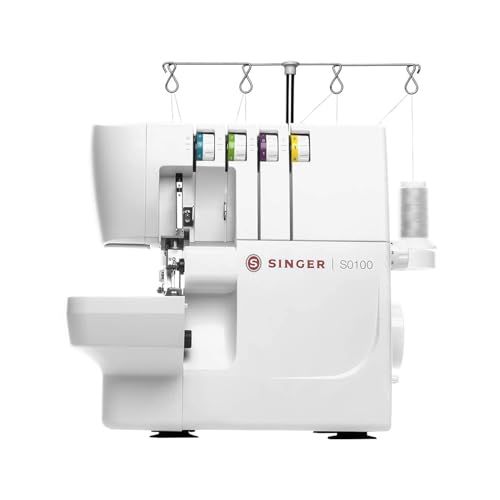
2. SINGER S0100 – Best for high-volume garment sewing
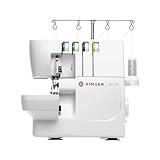
The SINGER S0100 is the pick for someone who already knows they will sew a lot of garments and wants throughput plus a full thread menu. Its listing name advertises high speed, and it carries 2-3-4 thread capability, which is the configuration that gives you the most flexibility per dollar in the mid-range tier. It suits sewists producing multiples: a run of six T-shirts, a stack of leggings, a wardrobe of simple dresses. It also suits anyone who wants 2-thread rolled hems without giving up the 4-thread seam strength they use on the body of a garment.
Key specs
- Thread configuration: 2-thread, 3-thread and 4-thread
- Speed: high-speed class for this category
- Differential feed: adjustable, standard 0.7-2.0 class range
- Stitch length and width: adjustable via dials
- Stitch types: overlock seams, edge finishing, rolled hems, narrow rolled hems
- Threading: color-coded paths with an accessible lower looper
Where it earns its reputation
The value here is the 2-thread mode. A 2-thread configuration is what produces the tight, narrow rolled hem you see on the inside of a good knit garment and on lightweight scarves, and it is also the base for flatlock-style decorative work where the seam is meant to lie flat. Machines without 2-thread force you into a 3-thread rolled hem, which is wider and reads differently on fine fabric. If your projects include lightweight knits, chiffon-weight wovens or anything where the hem edge is visible, the 2-thread option is a genuine capability rather than a checkbox.
The second consideration is speed class. On a long straight seam, a high-speed machine lets you feed fabric at a steady rate and get a more even stitch than you would at a cautious crawl, because hesitating mid-seam is what produces wobble. That is the real benefit of a faster machine: not that you save seconds per seam, but that you can move at the speed the machine wants and keep the edge lined up. For batch sewing, that compounds across an afternoon.
Pros
- 2-3-4 thread capability covers rolled hems, standard overlocking and strong knit seams
- High-speed class suits batch garment production rather than one-off projects
- Differential feed handles both stretchy knits and lightweight wovens
- Mid-range tier keeps it reachable compared with premium machines
Cons
- Threading a 4-thread setup is still a four-thread job; the extra capability adds setup time
- Not a heavy-duty class machine, so denim and canvas are outside its comfort zone
- High speed demands more practice before you trust yourself near a curve
How it compares
Against the SINGER X5004-HD, the split is speed and thread menu versus heavy-duty build. The S0100 gives you the full 2-3-4 range and a high-speed class motor; the X5004-HD leans toward heavier construction and a broader stitch repertoire. If your fabric is knits and mid-weight wovens and your goal is volume, the S0100 is the cleaner match. If your projects include upholstery-weight fabric, canvas bags or denim, step up to the heavy-duty class instead.
3. VEVOR Serger 1250 SPM – Best for the lowest-cost route into 4-thread overlocking

The VEVOR serger is the budget-tier answer to the question of whether you can get a working 2-3-4 thread overlock without spending mid-range money. Its listing states 1,250 stitches per minute, 2-3-4 thread capability, a differential feed range of 0.7 to 2.0, and a white body. It suits the sewist who wants to finish seams properly on a first set of projects, the hobbyist adding a second machine to a small setup, and anyone who is not yet sure how much serging they will actually do and wants to find out cheaply.
Key specs
- Thread configuration: 2-thread, 3-thread and 4-thread
- Speed: 1,250 stitches per minute as listed
- Differential feed: 0.7 to 2.0, which is the full standard range
- Stitch length and width: adjustable
- Stitch types: overlock seams, edge finishing, rolled hems
- Finish: white body
Where it earns its reputation
The differential feed range is the spec that matters most here, and 0.7 to 2.0 is the same range you find on machines costing considerably more. That range is what lets you gather fabric at the top end and prevent puckering at the bottom end, and it is the single feature most often missing from cheap sergers that turn out to be frustrating. A machine with differential feed in this range can genuinely handle the same jobs as a mid-range overlock; what it will not match is the smoothness of the mechanism, the quality of the tension dials, or the documentation.
The second thing to understand is what the 1,250 SPM figure means in practice. It is the machine’s maximum, reached with the pedal floored on a straight seam. In real use, most of your seams are short, curved, or interrupted by pin removal, so you will rarely sustain that. The number is useful mainly for comparison against other machines in the same tier, not as an expectation of how fast a project goes.
Pros
- Full 0.7-2.0 differential feed range, which is unusual at the budget tier
- 2-3-4 thread capability including rolled hems
- Lowest-cost way to find out whether serging fits your sewing
- Simple dial-based adjustment with few electronic failure points
Cons
- Threading documentation and path markings are usually less clear than on name-brand machines
- Tension dials in this tier tend to need more frequent readjustment between fabrics
- Support, parts and accessory availability are less predictable than with established brands
How it compares
Against the FEIYUE FY505, both are budget-tier 2/3/4 thread machines, and the VEVOR has the advantage of a published speed figure and an explicitly stated differential feed range. Against the SINGER S14-78, the VEVOR matches the thread capability but sits in a tier below on brand support and parts availability. If you want the cheapest possible working overlock and you are comfortable troubleshooting on your own, the VEVOR is the value pick. If you want a budget machine with a known brand behind it, the S14-78 is the safer choice.
4. SINGER HD0500S Heavy Duty – Best for denim, canvas and heavy seams
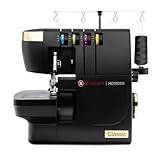
The SINGER HD0500S is the machine to choose when your fabric stack is the deciding factor. It carries 2-3-4 thread capability in a heavy-duty class build and comes in black, which is a cosmetic detail but a useful reminder that this is a different animal from the lighter machines in SINGER’s range. It suits bag makers, denim sewists, people who work with canvas and upholstery-weight fabric, and anyone whose previous serger stalled or skipped on a thick seam. It also suits sewists who want the extra rigidity of a heavy-duty chassis for long-term stability rather than for any single project.
Key specs
- Thread configuration: 2-thread, 3-thread and 4-thread
- Build class: heavy-duty, aimed at dense and layered fabric
- Differential feed: adjustable, standard class range
- Stitch length and width: adjustable via dials
- Stitch types: overlock seams, edge finishing, rolled hems
- Finish: black body
Where it earns its reputation
The reason heavy-duty matters on a serger is not motor power in isolation, it is whether the machine can push a needle through four layers of denim at the seam intersection without deflecting it. Deflection is what causes skipped stitches and broken needles, and it is a function of chassis rigidity, feed dog grip and how well the machine holds its timing under load. A heavy-duty class machine is built with more of all three, which is why it is the right pick even if you only occasionally sew heavy fabric. A machine that cannot handle the thickest seam in your project is a machine you stop trusting.
The practical trade is that heavier machines can feel less delicate on fine fabric. Chiffon and lightweight knits sometimes want a lighter touch and a narrower stitch width, and a heavy-duty serger will still do the job but rewards careful adjustment more than a light machine does. If ninety percent of your sewing is fine knits and only ten percent is denim, the HD0500S is still a defensible choice, but you are paying for capability you will use rarely.
Pros
- Built for dense fabrics that stall lighter sergers
- Full 2-3-4 thread range including rolled hems
- Rigid chassis holds timing better under load, which reduces skipped stitches
- Mid-range tier for a heavy-duty class machine
Cons
- Less delicate feel on very fine fabrics than a light-duty machine
- Heavier and bulkier, which matters if your workspace is small
- Heavy-duty capability is wasted if you never sew above mid-weight fabric
How it compares
Against the SINGER Heavy Duty 0420 Next Evolution, the HD0500S is the more specialized machine: heavy-duty first, with the standard 2-3-4 thread set. The 0420 sits a step up within the same heavy-duty family and adds the Next Evolution series features. If your priority is purely getting through thick seams at the lowest tier, the HD0500S is the direct answer. If you want the heavy-duty build plus a more developed feature set and are willing to move up a step, the 0420 is the one to look at.
5. SINGER Heavy Duty 0420 Next Evolution – Best for stepping up from a basic overlock

The SINGER Heavy Duty 0420 Next Evolution is aimed at the sewist who has outgrown a first serger. It carries 2-3-4 thread capability inside the Next Evolution series and the heavy-duty class, which puts it in the middle of SINGER’s serger range: more machine than an entry overlock, less than the top of the line. It suits someone whose projects have grown from simple knits into layered garments, bags, home decor and heavier wovens, and who wants a machine that will not need replacing again in two years.
Key specs
- Thread configuration: 2-thread, 3-thread and 4-thread
- Series: Next Evolution, which carries the more developed feature set in SINGER’s serger line
- Build class: heavy-duty
- Differential feed: adjustable, standard class range
- Stitch length and width: adjustable
- Stitch types: overlock seams, edge finishing, rolled hems
Where it earns its reputation
The upgrade argument for the 0420 is about headroom rather than any single headline feature. When you move from a basic overlock to a machine in this class, three things change. The chassis gets stiffer, so thick seam intersections stop being a gamble. The tension system gets more consistent, so you spend less time re-dialing when you switch from jersey to quilting cotton to canvas. And the thread path is usually laid out for faster re-threading, which matters more as your project count rises. None of those are dramatic on their own; together they are the difference between a machine you fight and a machine you use.
It is worth being honest about who should not buy it. If your sewing is almost entirely lightweight knits and simple garments, the 0420’s heavy-duty build adds weight and price without adding capability you will notice. A mid-range machine like the SINGER S0100 or the Brother 1034D covers that work just as well. The 0420 makes sense when you can point at a specific project that your current machine struggled with.
Pros
- Full 2-3-4 thread range for rolled hems, overlocking and strong knit seams
- Heavy-duty chassis handles layered and dense fabrics
- Next Evolution series features give it room to grow into
- Mid-range tier rather than premium, despite the heavy-duty build
Cons
- More machine than a light-fabric sewist needs
- Sits between the HD0500S below and the 0460 above, so the choice within the family takes thought
- Heavy-duty weight takes up more of a small table
How it compares
Against the SINGER Heavy Duty 0460 Next Evolution, the 0420 is the mid-range entry into the same series and the 0460 is the premium top of the line. The features overlap heavily; the 0460 is the machine you buy when you want the most developed version of the family and do not want to wonder later what you left on the table. Against the HD0500S, the 0420 is the more developed machine at the same broad tier. Choose the 0420 if you want the upgrade path; choose the HD0500S if heavy fabric is the only thing that matters.
6. SINGER S14-78 – Best for a simple, proven budget starter

The SINGER S14-78 is the budget-tier machine for someone who wants a recognizable brand behind their first serger. It offers 2-3-4 stitch capability in a white body, which puts it in the same functional territory as machines costing more. It suits beginners who want to learn overlocking without a large outlay, sewists who want a second machine dedicated to rolled hems or edge finishing, and anyone buying for a teenager or a shared household where a premium machine would be overkill.
Key specs
- Thread configuration: 2-thread, 3-thread and 4-thread
- Stitch capability: overlock seams, edge finishing, rolled hems
- Differential feed: adjustable, standard class range
- Stitch length and width: adjustable
- Finish: white body
- Adjustment: dial-based, with no electronic settings to fail
Where it earns its reputation
The argument for the
Related guides
- Best Streaming Gear for Twitch: Webcams, Capture Card, Backdrop and Light (2026)
- Best Over Ear Headphones: 9 Closed, Open-Back and Bluetooth Picks Explained (2026)
- Best Monitor for Console Gaming: Eight 1080p and 1440p Screens Compared by HDMI and Refresh Rate (2026)
- Best Monitors for PS5 Pro 4K 120Hz: Eight Screens and the HDMI Bandwidth Check (2026)