Our Top Picks



Top 3 picks at a glance
Best reptile heat lamps: the quick answer
The best reptile heat lamp is a heat source matched to the animal’s basking needs, enclosure dimensions, and fixture—not simply the highest-wattage bulb that fits. For many small enclosures, a 50–75 W halogen basking bulb in a suitable dome is a practical starting point; larger or taller habitats may need 90–150 W, a wider beam, or a separate heat source. These are starting ranges, not temperature guarantees: distance, room temperature, ventilation, and reflector shape can change the result substantially.
Use a thermostat or dimmer-rated temperature controller where appropriate, and verify the basking surface and cooler areas with digital thermometers or an infrared temperature gun. A lamp’s printed wattage does not tell you the temperature an animal will experience.
As an Amazon Associate we earn from qualifying purchases at no extra cost to you.



Choose by habitat, beam, and target temperature
First identify the species’ recommended basking-surface temperature and ambient warm-side and cool-side ranges from a reliable husbandry source. Then consider how far the bulb will sit from the basking spot. A focused beam concentrates energy on a smaller area; a flood beam spreads it across a wider surface. Neither is automatically better: the basking spot should be large enough for the animal, while the rest of the enclosure must retain a usable temperature gradient.
| Enclosure size and lamp distance | Useful starting class | Beam and fixture fit | What to check after setup |
|---|---|---|---|
| Small, roughly 10–20 gallons; short throw | 25–50 W | Narrow or standard reflector dome; avoid a beam that heats the whole enclosure | Measure the basking surface and confirm a cooler retreat remains available |
| Medium, roughly 20–40 gallons; moderate throw | 50–75 W | Flood beam for a broader basking area, or focused beam for a compact target | Check both the center and edge of the basking area for hot spots |
| Large, roughly 40–75 gallons; taller or longer throw | 75–100 W, sometimes higher | Reflector sized to the target area; a single bulb may not provide even coverage | Check warm-side air temperature as well as the surface temperature |
| Very large, tall, or cool-room habitat | 100–150 W class, or multiple controlled sources | Choose a fixture rated for the bulb and enclosure location; consider splitting heat across zones | Verify the cool side remains within the species’ safe range |
Gallons are only a rough guide: a long, low enclosure and a tall enclosure with the same volume can need different beam geometry. Treat the table as a shortlist for testing, not as a substitute for temperature measurements.
Bulb types: heat delivery versus service life
Halogen basking bulbs
Halogen bulbs produce bright, directional heat and are often a good fit for a daytime basking zone. Their focused output can create a useful warm spot at a distance, but that same concentration can overheat a small target or nearby decor. Bulb life varies by product, handling, switching frequency, and electrical conditions; plan for replacement rather than assuming output will remain unchanged indefinitely.
Incandescent basking bulbs
Standard incandescent basking bulbs are widely used for daytime heat and come in different wattages and beam patterns. They are simple, but generally less energy-efficient than halogen options, and frequent on-off cycling can shorten service life. Check the actual basking temperature after installation instead of assuming two bulbs with the same wattage behave alike.
Ceramic heat emitters and deep-heat projectors
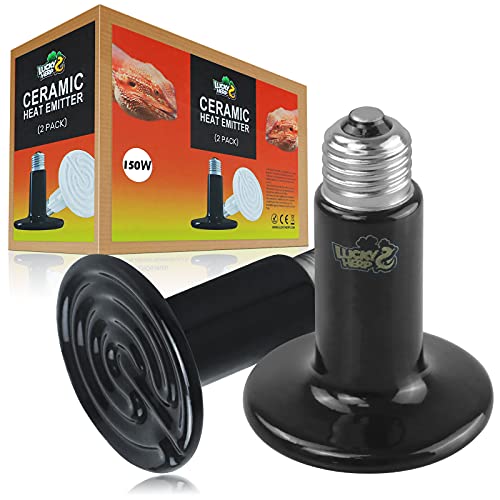
A ceramic heat emitter gives off heat without visible light, making it useful when supplemental heat is needed at night and the species’ husbandry requirements allow it. It can become very hot and requires a ceramic-socket fixture, suitable clearance, and temperature control. Deep-heat projectors are another non-visible-light option; they differ by model in output and beam, so confirm compatibility and measure temperatures rather than treating them as interchangeable with a basking bulb.
Heat lamps do not replace UVB lighting. If the species needs UVB, provide an appropriate UVB source and follow its distance and replacement guidance separately.
Match the bulb to the fixture before buying
- Socket and rating: Confirm the fixture’s socket type and maximum wattage. A bulb that physically screws in can still exceed the fixture’s rating.
- Bulb shape and reflector: A wide flood bulb may not sit correctly in a small dome; a narrow beam in a broad reflector may create a smaller hot spot than expected.
- Heat resistance: Ceramic heat emitters need a heat-rated ceramic socket, not a plastic lamp holder. Use a fixture designed for the bulb’s operating temperature.
- Mounting and clearance: Keep the fixture stable and away from flammable materials. Use a secure screen or guard when needed to prevent contact burns, while accounting for heat lost through mesh.
- Control compatibility: Dimming controllers are generally suited to dimmable incandescent or halogen bulbs. Non-light-emitting heaters may need a compatible thermostat. Follow the heater and controller manufacturers’ instructions.
A worked setup: why wattage alone misleads
Suppose a 30-gallon enclosure starts with a 50 W basking bulb. After the lamp has warmed up and conditions have stabilized, an infrared thermometer reads 31°C (88°F) at the basking surface, while the animal’s care guidance calls for a 35°C (95°F) basking surface. The difference is 4°C (7°F), but it does not mean that increasing wattage by a fixed percentage will raise the surface by the same percentage. Heat transfer is not linear, and a narrower beam or shorter distance can change the result more than a small wattage increase.
Before changing bulbs, check that the thermometer is aimed at the actual basking surface, the bulb is not past its useful life, and the fixture is at the intended distance. If those checks are sound, try a modest wattage step—such as moving to a 60–75 W class bulb if the fixture permits—or use a compatible dimmer to adjust output. Recheck the surface and warm- and cool-side air temperatures after each change. Stop if the cool retreat becomes too warm, even if the basking spot reaches its target.
Temperature checks that prevent common mistakes
- Measure separate zones: Use a digital probe for air temperature and an infrared thermometer for the basking surface. A single reading cannot describe the whole habitat.
- Allow stabilization: Recheck after the lamp has operated long enough for the enclosure to settle, then measure at different times of day and after room-temperature changes.
- Account for mesh: A lamp above a screen may deliver less heat to the basking area than a lamp mounted inside. Never solve that by removing a safety barrier without an appropriate secure setup.
- Watch for uneven heating: If one small patch is much hotter than the rest, choose a broader beam, increase distance where safe, or reposition the basking platform.
- Replace by condition and guidance: A bulb can still light while producing less heat than before. Track measured temperatures and follow manufacturer replacement guidance; visible brightness alone is not a reliable performance check.
Which option fits your situation?
| Your priority | Best starting choice | Trade-off |
|---|---|---|
| Compact, bright daytime basking zone | Halogen basking bulb with a focused or moderate beam | Can create a sharp hot spot; measure carefully |
| Broader basking area | Flood-style basking bulb in a reflector sized to the platform | May need more wattage or a closer safe mounting position than a focused beam |
| Supplemental heat without visible light | Ceramic heat emitter or compatible deep-heat projector | Requires appropriate control and fixture; does not provide daytime light or UVB |
| Temperature varies with room conditions | Suitable bulb plus a compatible controller and independent thermometers | More setup effort, but better control than repeatedly swapping wattages |
Frequently asked questions
Can a heat lamp provide the UVB my reptile needs?
No, a heat lamp does not replace UVB lighting. If the species needs UVB, provide an appropriate UVB source separately and follow its recommended distance and replacement guidance. Heat bulbs are intended to provide warmth, while UVB lighting addresses a different husbandry requirement. Measure temperatures independently rather than using the UVB fixture or bulb as an indication of heat.
Can I use a ceramic heat emitter at night?
Yes, a ceramic heat emitter can provide supplemental heat without visible light when the species’ husbandry requirements allow nighttime heating. It can become very hot, so use a heat-rated ceramic socket, suitable clearance, and compatible temperature control. It does not provide daytime light or UVB, so those requirements must be addressed separately when needed.
How do I know whether the basking area is evenly heated?
Measure both the center and edge of the basking area with an infrared thermometer. A focused beam can create a small, intense hot spot, while a flood beam spreads heat across a wider surface. If one patch is much hotter than the rest, consider a broader beam, a safe increase in distance, or repositioning the basking platform.
What should I do if the cool side becomes too warm?
Stop increasing heat if the cool retreat becomes too warm, even when the basking spot has reached its target. Recheck the warm- and cool-side air temperatures, then consider increasing the lamp distance where safe, repositioning the basking platform, or using a compatible dimmer or controller. The enclosure needs a usable temperature gradient, not just one hot spot.
Can a bulb still work properly if it is still producing light?
Not necessarily. A bulb can continue to light while producing less heat than before, so visible brightness is not a reliable performance check. Track measured temperatures over time and follow the manufacturer’s replacement guidance. If temperatures change unexpectedly, check the bulb’s condition, the fixture, the lamp distance, and whether enclosure conditions such as room temperature or ventilation have changed.
Bottom line
For the best reptile heat lamps, choose the beam and fixture around the basking area, use wattage only as a starting point, and confirm the result with temperature measurements. A well-matched lower-wattage bulb can outperform a more powerful bulb with the wrong beam or mounting distance. Prioritize a safe gradient, a fixture rated for the heat source, and a replacement plan based on measured performance and manufacturer guidance.
Related guides
- Best Streaming Gear for Twitch: Webcams, Capture Card, Backdrop and Light (2026)
- Best Over Ear Headphones: 9 Closed, Open-Back and Bluetooth Picks Explained (2026)
- Best Monitor for Console Gaming: Eight 1080p and 1440p Screens Compared by HDMI and Refresh Rate (2026)
- Best Monitors for PS5 Pro 4K 120Hz: Eight Screens and the HDMI Bandwidth Check (2026)