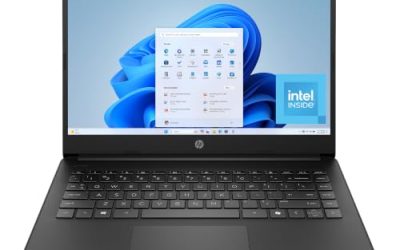
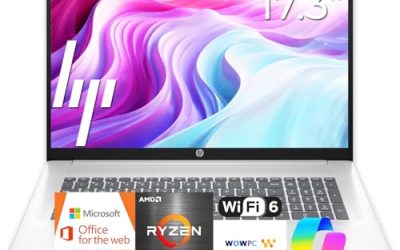
A large screen laptop is a compromise you make on purpose. You accept a heavier body and a bigger bag in exchange for more room to work: two windows side by side, a spreadsheet with all its columns visible, a video call next to your notes, or simply bigger text that is easier on tired eyes. The keyword really splits into two camps. One camp wants a mainstream 17.3-inch laptop from a familiar maker. The other wants something far larger, in the 18.5-inch range, that behaves almost like an all-in-one with a keyboard.
This guide covers both camps using eight listings: five 17.3-inch HP laptops (one of them a touchscreen with an external docking-style drive) and three 18.5-inch models from lesser-known sellers, the kind of lineup a 2026 shopper meets when browsing large displays. It is written for people who mostly work at a desk or table, such as home-office workers, students with a dorm setup, and anyone who prefers a big display to an external monitor. As always, judgments come from the listing titles only, and anything truncated or vague is pointed out so you can check the listing.
Our Top Picks
 EKY 18.5 Inch Large Screen Laptop Computer16GB RAM+1TB SSD16.8 x 10.97 x 0.83 inches1.9 KilogramsCheck on Amazon
 HP 17.3" Touchscreen Laptop Computer32GB RAM | 1.5TB Storage14.14 x 9.31 x 0.78 inches6 PoundsCheck on Amazon


Top 3 picks at a glance
Quick Picks
As an Amazon Associate we earn from qualifying purchases at no extra cost to you.





| Product | Best for | Key spec taken from the title |
|---|---|---|
| HP 17.3 Touchscreen (Core Ultra 7) | Touch and security features | Core Ultra 7, 16GB RAM, Win 11 Pro, fingerprint reader |
| HP 17 Business (Ryzen 5) | All-round large-screen office use | 17.3-inch FHD, 16GB RAM, 512GB SSD, numeric keypad |
| HP 17.3 (Ryzen 5 7520U) | Roomy everyday laptop | HD+ display, 16GB RAM, 512GB SSD, Radeon graphics |
| HP OmniBook 3 17 (Core Ultra 5) | Newer Intel platform | Core Ultra 5 225U, FHD, 8GB RAM, 512GB SSD |
| HP OmniBook 3 17 (Ryzen 3) | Entry-level large screen | FHD, Ryzen 3, 8GB RAM, Radeon 610M |
| 18.5 Inch Core i9 laptop | Biggest screen with color coverage | 100% sRGB FHD, WiFi-6, backlit keyboard, numeric pad |
| EKY 18.5 Inch Laptop | Ports and storage on an XL screen | 16GB RAM, 1TB SSD, RJ45, HDMI, TF card |
| BWPED 18.5 Laptop | Most memory on a giant screen | 24GB RAM, 1TB SSD, Core m3, 48Wh battery |
How to Choose
17.3 inches or 18.5 inches
The jump from 17.3 to 18.5 inches looks small on paper, but it changes the machine. At 17.3 inches you still get a laptop that fits on a normal desk and can travel occasionally. At 18.5 inches you are buying a desktop-replacement shape that you will probably leave in one room. If you plan to move it between a bedroom and a living room, the 17.3-inch group is the more sensible choice.
Resolution and panel quality
A larger panel needs more pixels to stay sharp. Full HD (1920 by 1080) is the practical minimum, and a listing that says HD+ is a step down in sharpness. One 18.5-inch title mentions 100% sRGB coverage, which is a measure of color range that matters for photo viewing, though you should still check the listing for the exact panel type. Touchscreens are handy for tapping and scrolling but add cost. Think about viewing distance too: a big panel at arm’s length is comfortable, but on a lap or a small side table the edges of a 17- or 18-inch screen can feel too wide, so measure your workspace first.
Memory, storage, and ports
Aim for 16GB of RAM and a 512GB SSD as the comfortable standard for a laptop you will use for years. 8GB is workable for browsing and documents. Large-screen laptops also have room for ports, so look for HDMI, USB, and an Ethernet (RJ45) jack if you work on a wired connection. A TF card slot, listed on one model, helps with camera and drone footage. Remember that a bigger body does not guarantee more ports: some thin 17-inch laptops trade ports for style, so read the listing rather than assuming.
What to ignore, and where corners get cut
Ignore clock-speed numbers on their own: “up to 3.4GHz” or “up to 4.8GHz” is a ceiling, not a guarantee, and says little about sustained performance. Budget models trim battery size, so check the capacity where it is listed, and expect large screens to drain faster. Be careful with unfamiliar brands whose titles omit the exact model or software details, because you will have fewer places to look up drivers, manuals, and support when something goes wrong. Also expect to use a power adapter often, since large panels draw more energy than small ones.
The 8 Best Options
HP 17.3 Touchscreen (Core Ultra 7)
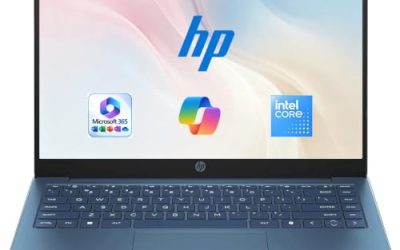
The most feature-heavy HP listing: a 17.3-inch touchscreen, an Intel Core Ultra 7 processor, 16GB of RAM, 1TB total storage split as a 512GB SSD plus a 512GB external docking set, Windows 11 Pro, and a fingerprint reader.
- Strength: Windows 11 Pro and a fingerprint reader suit work and shared offices.
- Strength: touch input is rare among the other listings.
- Trade-off: half of the 1TB is external, so internal storage is 512GB.
Who should skip it: anyone who does not need touch or the premium tier. It is a good fit for a household where several people share one big-screen computer and want quick, secure sign-in without typing a password each time.
HP 17 Business (Ryzen 5)
A 17.3-inch FHD laptop with a Ryzen 5 processor, 16GB of RAM, a 512GB SSD, and a numeric keypad, with long battery life mentioned in the title.
- Strength: a balanced 16GB and 512GB configuration.
- Strength: the numeric keypad speeds up spreadsheet work.
- Trade-off: the edition of Windows is not clear in the visible title.
Who should skip it: shoppers who want touch, a fingerprint reader, or a larger-than-17-inch panel. For many buyers this is the default, middle-of-the-road pick: nothing in the title looks like a weak spot, and the numeric keypad earns its keep for numbers-heavy jobs.
HP 17.3 (Ryzen 5 7520U)
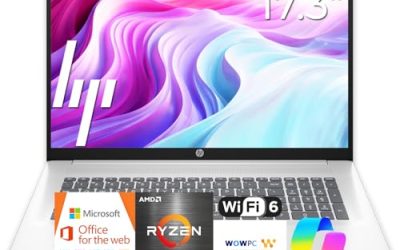
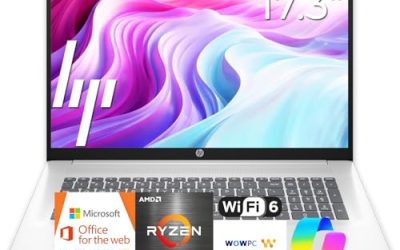
A 17.3-inch laptop with a Ryzen 5 7520U, 16GB of RAM, a 512GB SSD, AMD Radeon graphics, Windows 11 Home, and a Natural Silver finish.
- Strength: a named processor with 16GB of memory is a solid everyday base.
- Strength: Windows 11 Home keeps setup simple for home users.
- Trade-off: the HD+ display is lower in resolution than the full HD panels on other listings.
Who should skip it: buyers who care about sharp text on a big screen. It suits someone who mainly browses, streams video, and keeps files in the cloud, where resolution is less critical than memory and storage.
HP OmniBook 3 17 (Core Ultra 5)
The OmniBook 3 17 pairs a 17.3-inch FHD display with an Intel Core Ultra 5 225U, 8GB of RAM, a 512GB SSD, Intel graphics, and Windows 11 Home in Glacier Silver.
- Strength: a newer-generation Intel platform with full HD resolution.
- Strength: a clearly named model line makes it easy to research.
- Trade-off: only 8GB of RAM.
Who should skip it: heavy multitaskers, who are better off with a 16GB model. It is best for steady web, document, and streaming use on a roomy, sharp display.
HP OmniBook 3 17 (Ryzen 3)
The AMD twin of the OmniBook above, with a Ryzen 3 processor, Radeon 610M graphics, a 17.3-inch FHD display, 8GB of RAM, a 512GB SSD, and Mica Silver styling.
- Strength: full HD at 17.3 inches in the entry-level tier.
- Strength: the 512GB drive is generous for this level.
- Trade-off: the Ryzen 3 sits at the bottom of the group in processor class.
Who should skip it: video editors and anyone who often runs several heavy apps at once. It is a reasonable pick for a first big-screen laptop, such as one for a grandparent who wants larger text.
18.5 Inch Core i9 Laptop
The most unusual listing here: an 18.5-inch laptop advertising a Core i9 CPU up to 4.8GHz, 16GB of RAM, a 512GB SSD, WiFi-6, a 100% sRGB full HD display, Windows 11 Home, a backlit keyboard, and a numeric pad.
- Strength: the huge display lists full sRGB coverage.
- Strength: a backlit keyboard and numeric pad suit long sessions.
- Trade-off: the brand and exact processor model are not shown, so verify details in the listing.
Who should skip it: shoppers who want a recognizable maker and clear support options. If you consider it, treat the listing as the source of truth and read every spec line before deciding.
EKY 18.5 Inch Laptop
An XL-screen laptop listing 16GB of RAM, a 1TB SSD, a processor up to 3.4GHz, a 6316mAh battery, a privacy-shutter camera, TF card support, RJ45, and HDMI.
- Strength: 1TB of internal storage is the most generous among the 16GB models.
- Strength: Ethernet, HDMI, and a card slot make it practical as a desk machine.
- Trade-off: the processor model is not named in the visible text.
Who should skip it: those who want a well-known processor line or carry the laptop daily. The camera shutter in the title is a nice privacy touch for video calls.
BWPED 18.5 Laptop
A Grey 18.5-inch laptop with 24GB of RAM, a 1TB SSD, a 3.4GHz Core m3, a 48Wh battery, three USB ports, HDMI, RJ45, dual-band Wi-Fi, and Bluetooth 5.0.
- Strength: 24GB of RAM is the highest memory amount in the group.
- Strength: the ports list is generous for a desk setup.
- Trade-off: Core m3 is a low-power chip class, so it fits light work better than heavy tasks.
Who should skip it: anyone who needs strong processing power. It makes sense as a living-room or home-office screen for documents, browsing, and video.
Which One Fits Your Situation
A home office with a long spreadsheet habit
The HP 17 Business (Ryzen 5) is a sensible fit, with a full keypad, 16GB of RAM, and an FHD panel.
A shared family computer with a fingerprint login
Choose the HP 17.3 Touchscreen (Core Ultra 7). Touch input and a fingerprint reader make it friendlier for multiple users.
Someone who wants the biggest possible picture
The EKY 18.5 Inch Laptop or the BWPED 18.5 Laptop gives you the largest screens here. Choose BWPED for the 24GB of memory or EKY for the cleaner ports-and-storage mix.
A budget-minded student at a desk
The HP OmniBook 3 17 (Ryzen 3) delivers a full HD 17.3-inch screen at the entry tier. If you want a newer Intel chip, switch to the Core Ultra 5 version.
Common Mistakes
- Expecting a large-screen laptop to travel as easily as a 14-inch model.
- Picking an HD+ screen at 17 inches and being surprised by softer text.
- Trusting clock-speed ceilings like “up to 4.8GHz” as a performance guarantee.
- Skipping the port list when you need Ethernet, HDMI, or a card slot.
- Buying a lesser-known brand without checking the model details the title leaves out.
Related guides
- How To Check Motherboard Vrm Temperature In Hwinfo
- How To Clean Quest 3 Lenses And Facial Interface
- Micro Sd Cards For Samsung Galaxy Phones
Frequently Asked Questions
Is an 18.5-inch laptop worth it?
It is worth it if the laptop stays on a desk and you want maximum screen room. For frequent travel, a 17.3-inch model is more manageable.
How much RAM is right for a big-screen laptop?
16GB is a comfortable target, with 8GB acceptable for light work. The BWPED listing goes up to 24GB.
Do large laptops have worse battery life?
Big panels draw more power, so expect shorter runtime than a smaller model with a similar battery. Check the battery capacity where the title lists it.
Is a touchscreen helpful on a 17-inch laptop?
It can be handy for scrolling and tapping, but it is not essential. Choose it only if you will use it regularly.