The best integrated amplifiers are the ones that provide enough clean power for your speakers and room, connect to all your sources, and include the features you’ll actually use. For many systems, a 50–100-watt-per-channel amplifier with digital inputs and a subwoofer output is a versatile starting point; less-sensitive speakers, larger rooms, or high listening levels may call for more power.
As an Amazon Associate we earn from qualifying purchases at no extra cost to you.


Our Top Picks
 Yamaha Audio A-S301BL Natural Sound Integrated Stereo Amplifier17.1 x 15.25 x 6 inches19.8 poundsCheck on Amazon
 Marantz Slimline Integrated Stereo Amplifier with 45W14.57 x 17.32 x 4.13 Inches23.1 poundsCheck on Amazon
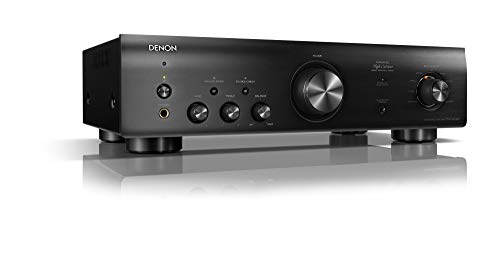
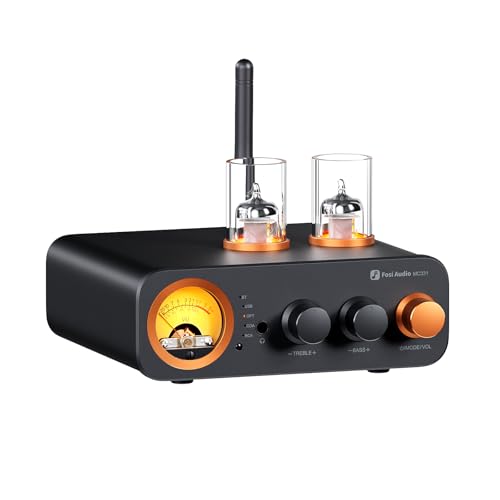
Top 3 picks at a glance
Choose by room, speakers, and listening habits
Amplifier wattage alone doesn’t predict sound quality or compatibility. Start with your speakers’ sensitivity and impedance, then consider how far you sit from them and how loudly you listen. A compact room with efficient speakers has different needs from a large space with demanding floorstanders.
| Situation | Useful amplifier target | Features to prioritize |
|---|---|---|
| Small room, nearfield listening, speakers rated 88 dB or higher | 30–60 W per channel into 8 ohms | USB or optical input if using a computer or TV |
| Average living room, speakers around 86–90 dB | 50–100 W per channel into 8 ohms | Subwoofer output, multiple digital inputs, or HDMI ARC |
| Large room, lower-sensitivity speakers, or louder playback | 100 W or more per channel, with a strong 4-ohm rating | Stable operation at low impedance and useful heat ventilation |
| Vinyl-focused system | Match power to the speakers and room | Built-in phono stage compatible with your cartridge |
These are practical starting points, not strict thresholds. Manufacturers may quote power under different conditions, so compare figures measured at the same impedance and, where available, across the full audio bandwidth with distortion specified. A single high wattage figure measured at 1 kHz may not tell you how the amplifier behaves with music or difficult speakers.
Estimate how much power you need
Speaker sensitivity gives a rough way to connect amplifier power with listening distance and volume. A speaker rated at 88 dB sensitivity produces about 88 dB at one meter with one watt of input under the specified measurement conditions. Each doubling of power adds roughly 3 dB; doubling listening distance in a typical room reduces the direct sound by about 6 dB.
Worked example: a living-room system
Suppose you have 88 dB-sensitive speakers, sit three meters away, and want peaks near 95 dB. Moving from one meter to three meters costs roughly 9–10 dB, so about 97–98 dB at one meter is needed. That is approximately 10 watts for an average level; allowing another 10 dB of musical headroom takes the peak requirement toward 100 watts.
This is a simplified estimate, not a guarantee: room reflections, speaker placement, impedance dips, and the recording all affect the result. It shows why a 30-watt amplifier may be comfortable for moderate listening yet run out of headroom on dynamic music in a larger room. If your speakers are 4-ohm models or their impedance drops substantially, look for an amplifier explicitly rated to handle 4-ohm loads rather than relying on its 8-ohm figure.
Match the amplifier to your sources
Make a source list before comparing models. Integrated amplifiers combine a preamplifier and power amplifier, but they don’t all include the same conversion, streaming, or home-theater connections.
- Turntable: A phono input is for a turntable with a moving-magnet cartridge unless the amplifier specifically supports moving-coil cartridges too. If your turntable already has a phono preamp, use a regular line input instead.
- TV: HDMI ARC or eARC is often the simplest connection for TV audio and volume control. Optical is a good alternative, but usually won’t provide the same control integration.
- Computer: USB audio is convenient when supported. Optical or coaxial digital inputs can work well with a computer’s audio output or an external digital-to-analog converter.
- Phone and streaming: Bluetooth is easy for casual playback. Wi-Fi streaming or network playback is generally more suitable when you want a permanent home-audio setup.
- Subwoofer: A dedicated subwoofer output makes connection simpler. Check whether the amplifier offers bass management or a high-pass filter for the main speakers; a subwoofer jack alone doesn’t guarantee those functions.
- Headphones: If you listen privately, check for a headphone output and whether it can drive your headphones comfortably. Not every integrated amplifier is designed for demanding headphones.
Amplifier choices by system type
These established models illustrate different approaches. Their suitability depends on current versions and regional specifications, so verify the exact connections and power ratings before buying.
| Model | Best fit | Why consider it | Check before choosing |
|---|---|---|---|
| Yamaha A-S301 | Budget-conscious two-channel setup | Provides analog and digital inputs, plus a phono input for moving-magnet turntables | Whether its power and connectivity meet your needs for the room and speakers |
| Yamaha A-S801 | Systems needing more power and digital-source flexibility | Includes a USB input as well as optical and coaxial digital connections | Its feature set may be unnecessary if you already use an external DAC or streamer |
| Marantz Model 40n | Listeners who want streaming and a phono input in one component | Combines network audio features with conventional amplifier connections | Confirm the streaming services and control options you use are supported |
| Cambridge Audio CXA81 | Digital and analog sources in a conventional stereo system | Offers several digital inputs, Bluetooth, and a USB audio connection | Check its current input configuration and whether you need a phono stage |
| NAD C 399 | Listeners seeking a flexible, higher-power platform | Supports optional expansion modules, including BluOS streaming options | Modules may add cost; confirm the installed configuration and speaker compatibility |
Typical market prices vary by country, retailer, and product generation. As broad guides, entry-level integrated amplifiers often fall around $300–$700, versatile midrange options around $700–$1,500, and feature-rich or higher-powered models can cost $1,500 or more. Treat price as a way to narrow the field, not a substitute for checking specifications.
Use this decision path before buying
- Check your speakers. Note their nominal impedance, sensitivity, and any manufacturer guidance about amplifier power. If the impedance is low or varies sharply, favor an amplifier with a clear 4-ohm rating.
- Estimate room demand. Consider listening distance, room size, and whether you want loud peaks with dynamic music. More distance and lower sensitivity both increase the power needed for the same volume.
- List every source. Confirm the amplifier has the right inputs for your turntable, TV, computer, and streamer. Avoid paying extra for a phono stage or streaming platform you won’t use.
- Decide how bass should work. If using a subwoofer, check for a sub output and whether the amplifier can redirect low frequencies away from the main speakers. That can reduce speaker workload and improve flexibility, but the feature is not universal.
- Plan the setup. Leave ventilation space, use suitable speaker cable, and connect each speaker to the correct polarity. Start with the volume low, then raise it gradually while listening for obvious strain or distortion.
Common mismatches to avoid
Choosing by wattage alone: A well-designed, lower-power amplifier can suit efficient speakers in a small room, while a nominally powerful model may struggle with a difficult load. Compare impedance ratings and real connectivity alongside watts.
Expecting an integrated amplifier to include everything: Some models lack a phono stage, USB input, network streaming, or bass management. An external component can fill a gap, but build its cost and extra cables into your decision.
Buying far more power than your setup needs: Extra headroom can be useful, especially with demanding speakers, but it doesn’t guarantee better sound at normal levels. A stable amplifier with the right inputs and a good speaker match is usually a better fit than a larger number on the spec sheet.
Frequently asked questions
Do I need a phono stage for my turntable?
You need a phono input only if your turntable does not already have a phono preamp. A standard phono input is intended for a turntable with a moving-magnet cartridge, unless the amplifier specifically supports moving-coil cartridges too. If the turntable has a built-in phono preamp, connect it to a regular line input instead.
Is a higher-wattage integrated amplifier always better?
No. A higher wattage figure does not by itself predict sound quality or compatibility. Efficient speakers in a small room may work well with a lower-power amplifier, while less-sensitive speakers or a difficult impedance load may need more power and stronger four-ohm capability. Compare power ratings, impedance behavior, room demand, and connectivity rather than watts alone.
What is the easiest way to connect a TV?
HDMI ARC or eARC is often the simplest TV connection because it can support audio and volume-control integration. Optical is a useful alternative, but it usually does not provide the same control integration. Before choosing an amplifier, confirm which connection your TV supports and whether the amplifier has the required input.
Can an integrated amplifier manage a subwoofer’s bass?
A dedicated subwoofer output makes connecting a subwoofer simpler, but the output alone does not guarantee bass management. Check whether the amplifier provides bass management or a high-pass filter for the main speakers. Redirecting low frequencies away from the main speakers can reduce their workload and improve flexibility, but this feature is not universal.
What should I check before connecting headphones?
Check that the integrated amplifier has a headphone output and can drive your headphones comfortably. Not every integrated amplifier is designed for demanding headphones, so the presence of a headphone jack does not establish that every headphone will perform well. If private listening is important, include headphone capability in your source and feature checklist.
Related guides
- Best Streaming Gear for Twitch: Webcams, Capture Card, Backdrop and Light (2026)
- Best Over Ear Headphones: 9 Closed, Open-Back and Bluetooth Picks Explained (2026)
- Best Monitor for Console Gaming: Eight 1080p and 1440p Screens Compared by HDMI and Refresh Rate (2026)
- Best Monitors for PS5 Pro 4K 120Hz: Eight Screens and the HDMI Bandwidth Check (2026)