Best Gooseneck Hitches for Towing
The best gooseneck hitches for towing are the B&W Turnoverball for a removable-ball system with a clear bed when unused, the CURT Double Lock EZr for another well-established removable-ball option, and a fixed hitch such as the B&W Companion for compatible trucks that prioritize a fifth-wheel-style head. Choose by your truck’s year, make, model, bed length, and towing requirements—not by the hitch’s headline rating alone.
Quick comparison
| Hitch or system | Rated capacity* | Ball and chain setup | Best fit |
|---|---|---|---|
| B&W Turnoverball | Up to 30,000 lb trailer weight; up to 7,500 lb vertical load on applicable models | Removable, reversible ball; safety-chain anchors in the bed | Owners who want an unobstructed bed when the ball is removed |
| CURT Double Lock EZr | Up to 30,000 lb trailer weight; up to 7,500 lb vertical load on applicable models | Removable ball with a positive locking mechanism; integrated chain anchors | Buyers seeking a removable-ball hitch with a separate locking action |
| B&W Companion (with compatible Turnoverball base) | Up to 25,000 lb trailer weight on applicable models | Coupler head mounts to a gooseneck base; chain connection depends on the base and trailer setup | Fifth-wheel-style towing when a compatible truck-bed base is installed |
*Capacities vary by part number and truck application. Verify the exact hitch and installation instructions. The truck’s ratings, axle limits, tire capacity, and any lower component rating still govern.
As an Amazon Associate we earn from qualifying purchases at no extra cost to you.
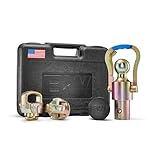
Which hitch should you choose?
- Choose a B&W Turnoverball if you regularly switch between towing and carrying cargo. Its ball can be removed and stored upside down in the receiver, leaving the bed largely clear. Confirm that a kit is listed for your exact truck; the base and frame brackets are vehicle-specific.
- Choose a CURT Double Lock EZr if you want a removable ball and a locking arrangement that helps secure it in the receiver. Check the model’s truck-specific fitment and rated vertical load as carefully as its gross trailer rating.
- Choose a B&W Companion if your towing setup needs a fifth-wheel-style head and your truck has the matching gooseneck base. It is not simply a higher-capacity gooseneck ball: the head, base, and trailer connection must be compatible.
- Consider a fixed, application-specific hitch if you tow the same gooseneck trailer most of the time and do not need an open bed. Compare its permanent bed intrusion and coupler height with the convenience of a removable-ball system.
How to compare the ratings that matter
A large gross trailer weight number does not tell you whether a hitch suits your load. Check both gross trailer weight and vertical load (often called pin weight or tongue load). Then compare those limits with the truck’s door-label payload, gross vehicle weight rating (GVWR), rear-axle rating (GAWR), tires, and towing rating. The lowest applicable limit wins.
For example, suppose a loaded trailer weighs 20,000 lb and places 20% of its weight on the hitch. That is 4,000 lb of vertical load. A hitch rated for 7,500 lb vertical load clears that particular hitch-rating check, but it does not establish that the truck can tow the combination: the 4,000 lb load also occupies payload and bears on the rear axle. Add passengers, cargo, accessories, and hitch hardware before comparing the result with the truck’s available payload and axle capacity.
Trailer weight estimates should use the trailer’s actual loaded weight, not just its empty or advertised weight. A scale ticket is more useful than a brochure figure when you are close to a limit.
Ball, safety chains, and bed clearance
Most removable-ball kits include a receiver, ball, handle or locking mechanism, and safety-chain attachment points. The ball must match the trailer coupler’s required diameter, and the trailer’s safety chains must attach to the hitch’s designated anchors—not to an improvised bed loop or an unrelated truck component. Check that the anchors are accessible and that chain hooks can connect without binding.
A reversible ball is convenient, but it still requires correct seating and locking before towing. Follow the manufacturer’s inspection and lubrication instructions. Before each trip, check that the ball is secure, the coupler is latched, the chains are crossed and connected as directed, and the breakaway system is attached to an appropriate point independently of the safety chains.
Removable-ball systems leave a smaller bed opening than a permanent coupler, but they do not make the floor completely untouched: the receiver and access opening remain. A Companion-style head takes up substantially more bed space while installed. If you have a short-bed truck, evaluate cab-to-trailer clearance during tight turns; hitch choice alone cannot guarantee that the trailer will clear the cab.
Fitment and installation: check these before buying
- Match the vehicle precisely. Use the hitch manufacturer’s fit guide for the truck’s model year, make, model, bed length, drive configuration, and trim where requested. A kit listed for one generation or frame may not fit another.
- Check the bed and frame configuration. Factory prep packages, existing fifth-wheel equipment, fuel tanks, exhaust parts, spare tires, and under-bed accessories can affect fit or installation. Do not assume a factory puck system accepts a frame-mounted gooseneck base without the specified adapter.
- Confirm placement and clearances. The ball location must suit the truck and trailer, and the installed assembly needs clearance from wiring, fuel lines, brake lines, and other components. Follow the exact template and torque specifications.
- Plan for drilling and torque-critical fasteners. Some installations require drilling the bed and fitting brackets to the frame; others use different vehicle-specific mounting arrangements. Installation difficulty varies substantially by truck. If you cannot safely support the vehicle or access and torque the frame fasteners as instructed, use a qualified installer.
- Verify every component after installation. Recheck fasteners at the intervals specified by the manufacturer, inspect the ball and anchors for damage, and confirm that wiring and underbody components remain clear.
Corrosion resistance and long-term upkeep
Look for a durable finish on exposed steel parts, but do not treat a coating as maintenance-free or as proof that two hitches will last equally long. Road salt, standing water, grit, and damaged coatings all accelerate corrosion. Rinse the hitch and underbody after winter driving, keep the receiver and ball clean, and use only the lubricant or corrosion-prevention product allowed by the hitch instructions. Avoid coating locking surfaces or coupler contact areas if the manufacturer says they must remain dry or clean.
Inspect the ball, receiver, safety-chain anchors, welds, and frame fasteners for rust, cracking, deformation, or abnormal movement. Replace damaged parts rather than attempting to repair a load-bearing hitch with an unapproved weld or modification.
Decision matrix
| Your situation | Best starting point | What to verify first |
|---|---|---|
| You alternate between towing and hauling bulky cargo | Removable-ball system, such as Turnoverball or Double Lock EZr | Vehicle-specific kit, bed opening, and anchor access |
| You need a fifth-wheel-style connection | Compatible Companion-and-base setup | Base compatibility, head rating, trailer fit, and cab clearance |
| Your loaded trailer is near the truck’s payload or axle limit | Do not select by hitch rating alone; weigh the combination | Payload remaining, rear-axle load, tire limits, and vertical load |
| Your truck has a factory prep package or aftermarket bed equipment | Only a system explicitly listed for that configuration | Adapter requirements and interference beneath the bed |
Frequently asked questions
Can I use a gooseneck hitch if my truck has a factory prep package?
Yes, but only if the hitch or specified adapter is listed for that factory prep configuration. Check the manufacturer’s fit guide and confirm that the base, adapter, and under-bed components are compatible. Do not assume a factory puck system accepts a frame-mounted gooseneck base without the specified adapter.
Does removing the gooseneck ball leave my truck bed completely flat?
No, a removable-ball system still leaves the receiver and an access opening in the bed. Removing the ball can leave the bed largely clear, but it does not make the floor completely untouched. A Companion-style head takes up substantially more bed space while installed.
How do I know whether my trailer’s safety chains are attached correctly?
Attach the chains to the hitch’s designated anchors, not to an improvised bed loop or an unrelated truck component. Check that the anchors are accessible and the hooks connect without binding. Before travel, confirm that the chains are crossed and connected as directed, and attach the breakaway system to an appropriate point independently of the chains.
Will a gooseneck hitch guarantee that my trailer clears the cab on a short-bed truck?
No, hitch choice alone cannot guarantee cab clearance. Evaluate the clearance between the cab and trailer during tight turns, especially with a short-bed truck. The trailer fit and the complete towing setup matter, so confirm clearances for your truck and trailer before towing.
What should I inspect on a gooseneck hitch after installation?
Check the ball, receiver, safety-chain anchors, welds, and frame fasteners for rust, cracking, deformation, or abnormal movement. Recheck fasteners at the intervals specified by the manufacturer, and confirm that wiring and underbody components remain clear. Replace damaged parts rather than repairing a load-bearing hitch with an unapproved weld or modification.
Bottom line
For a general-purpose removable-ball setup, start by comparing the B&W Turnoverball and CURT Double Lock EZr kits that fit your exact truck. Choose a Companion-style system when the trailer requires a fifth-wheel head and the base is compatible. Before ordering, verify gross and vertical ratings, truck payload and axle limits, safety-chain provisions, bed and cab clearance, installation requirements, and the manufacturer’s vehicle fit guide. The right hitch is the one whose complete setup fits the truck and trailer—not simply the one with the biggest number.
Related guides
- Best Streaming Gear for Twitch: Webcams, Capture Card, Backdrop and Light (2026)
- Best Over Ear Headphones: 9 Closed, Open-Back and Bluetooth Picks Explained (2026)
- Best Monitor for Console Gaming: Eight 1080p and 1440p Screens Compared by HDMI and Refresh Rate (2026)
- Best Monitors for PS5 Pro 4K 120Hz: Eight Screens and the HDMI Bandwidth Check (2026)