Our Top Picks
 ANYFUN Pro Complete Skateboards for Beginners Girls Boys31"x8"30.6 x 7.8 x 3.9 inches3.2 PoundsCheck on Amazon
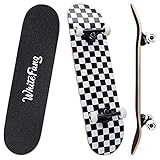
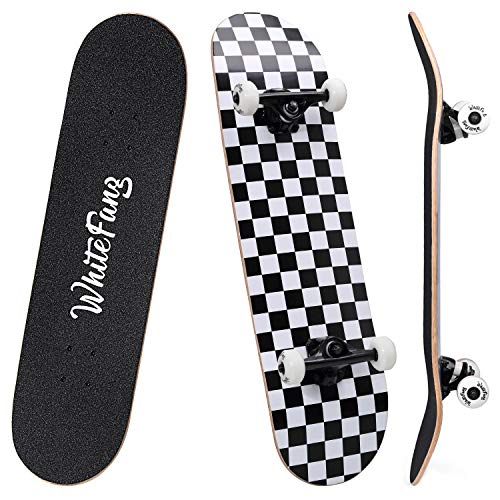 WhiteFang Skateboards for Beginners31.75 Inch L נ7.88 Inch W31.75 x 7.88 x 3.9 inches4.69 PoundsCheck on Amazon

Top 3 picks at a glance
Best Complete Skateboards for Beginners
The best complete skateboard for beginners is a properly assembled, standard popsicle-shape board with a deck width that suits your shoe size, trucks that match that width, and wheels chosen for the surface you ride. For most adults learning street skating, an 8.0–8.25-inch complete is a sensible starting point; go wider for more foot room and cruising stability, or narrower if you have small shoes and want a lighter board for flip tricks.
Choose by fit and riding surface
“Complete” means the deck, trucks, wheels, bearings and hardware come assembled, but it does not guarantee that those parts are well matched. Check the actual dimensions rather than choosing by brand or graphics alone. Deck width affects foot room and leverage; truck fit affects turning and stability; wheel hardness determines how comfortably the board rolls over rough ground.
As an Amazon Associate we earn from qualifying purchases at no extra cost to you.


| Your situation | Deck width to consider | Wheel starting point | Why it fits |
|---|---|---|---|
| Shoe size US 4–6; mostly smooth skatepark | 7.75–8.0 in | 52–54 mm, 99A–101A | A lighter, narrower board can feel easier to move underfoot on smooth concrete. |
| Shoe size US 6–9; mixed street and park | 8.0–8.25 in | 52–54 mm, 97A–101A | A versatile middle ground with enough room for learning basic tricks. |
| Shoe size US 9–12; street, park and general practice | 8.25–8.5 in | 53–56 mm, 97A–101A | More standing room can make balance and landing foot placement feel less cramped. |
| Rough sidewalks or neighborhood cruising | 8.25–9.0 in | 54–60 mm, 78A–90A | Softer, larger wheels roll over cracks more comfortably, though they are less suited to technical tricks. |
These are starting ranges, not rules. Shoe sizes vary by brand, and riding style matters: a smaller rider may prefer a wider deck, while a larger rider may like a narrower one. If you can, stand on a board before buying and check whether your feet feel supported without the board seeming cumbersome.
How the main complete-board choices compare
Budget entry-level complete: lowest-cost route to learning
A basic complete from a recognized skate brand can be a reasonable first choice if you are unsure whether you will stick with skating. Look for a maple deck, properly matched trucks, and wheels with a clearly stated diameter and hardness. The trade-off is often less precise or less durable hardware. A low price is not a problem by itself, but avoid boards that do not list basic dimensions or appear to use toy-like plastic parts.
Midrange skate-shop complete: the best all-around pick for most beginners
A midrange complete is often the strongest value when you plan to skate regularly. It is more likely to use a dependable maple deck and trucks with predictable turning, while still arriving assembled. Choose a standard 8.0–8.25-inch model with hard wheels if smooth parks and tricks are the priority. For bumpy pavement, look for a version with softer wheels rather than assuming every board in the range has the same setup.
Premium complete: worthwhile when fit and component details matter
A premium complete can make sense if you already know the width you want or expect to skate often. It may offer stronger or more consistent components, but a higher price does not automatically make a board easier to learn on. Prioritize deck fit and wheel suitability over upgrades you may not notice as a beginner. Complete skateboards commonly range from under $100 for basic setups to roughly $100–$200 or more for better-equipped models; prices vary by brand and season.
Cruiser-style complete: more comfortable for distance, less versatile for tricks
A cruiser complete, often with a wider deck and softer wheels, is a good match for commuting short distances or rolling over rough paths. Those wheels absorb vibration better than typical hard skatepark wheels. The compromise is that a cruiser is not the best single board for learning standard flip tricks or skating transitions. If you want one board for both, choose a conventional popsicle deck and consider a slightly softer all-around wheel rather than an oversized cruiser setup.
Check truck fit before you buy
The truck axle should be close to the deck’s width. As a practical shopping check, compare the manufacturer’s axle-width specification with the deck width: the numbers should be a close match, not separated by a large amount. Brands may state truck width in different units, so check the actual product chart instead of comparing numbers without units. A poorly matched setup can leave the wheels noticeably inside or outside the deck edges and may feel awkward when turning or balancing.
Truck height also matters. Standard-height trucks work for many beginner setups. If a complete uses larger wheels, check whether it includes enough clearance to avoid wheel bite—the wheel contacting the deck during a sharp turn. Tightening the trucks can reduce wheel bite, but making them excessively tight to compensate can make steering difficult.
Use wheel hardness to match the ground
Wheel hardness is usually shown on the durometer “A” scale: a higher number generally means a harder wheel. Hard wheels, often around 99A–101A, are common for smooth parks because they slide more readily and feel responsive. On cracked sidewalks, they can rattle, lose speed and make small obstacles feel harsh. Softer wheels, commonly around 78A–90A, roll more quietly and comfortably over rough ground, but may grip more and feel less suitable for some tricks.
Wheel diameter is a separate choice. Smaller wheels—roughly 52–54 mm—are common on street and park setups. Larger wheels roll over surface imperfections more easily, but can add weight and need enough deck clearance. For a beginner who wants to practice tricks on smooth ground, start with 52–54 mm hard wheels. For rough pavement, a 54–60 mm softer-wheel setup is a better starting point, provided the trucks and deck have clearance.
A quick decision process
- Measure your shoe size: use the table as a first filter, then prioritize how supported your feet feel.
- Decide where you will ride most: smooth skatepark or clean pavement points toward smaller, harder wheels; rough paths point toward larger, softer ones.
- Confirm deck and truck match: check the deck width and the truck manufacturer’s axle-width chart before ordering.
- Look for build details: prefer a maple deck and listed component dimensions. A complete with vague specifications makes it hard to judge fit or replace parts later.
- Pick a realistic budget: buy the best-fitting setup in your range, rather than paying extra for features unrelated to how you plan to ride.
What to inspect when the board arrives
Before riding, make sure the trucks are firmly attached, all four wheels spin without rubbing the deck, and the nuts on the axles are secure without pinching the wheels so tightly that they barely turn. Stand on the board on a safe, flat surface and gently lean heel to toe. The trucks should turn smoothly and return toward center; if they feel extremely loose or stiff, adjust them gradually with the correct skate tool. Make small changes and test again rather than tightening everything at once.
Wear a helmet and suitable protective gear while learning, and practice on a clear, smooth area away from traffic. A board that fits and rolls predictably makes those first sessions easier—but balance, pushing and stopping still take practice.
Frequently asked questions
Is a complete skateboard ready to ride as soon as it arrives?
It arrives with the deck, trucks, wheels, bearings, and hardware assembled, but check it before riding. Make sure the trucks are firmly attached, the wheels spin without rubbing, and the axle nuts do not pinch the wheels. On a safe, flat surface, gently lean heel to toe and check that the trucks turn smoothly and return toward center.
Can I use one skateboard for both tricks and rough sidewalks?
Yes, but the setup involves a compromise. A conventional popsicle deck is more versatile for tricks than a cruiser, while slightly softer wheels may make rough pavement more comfortable. The article suggests larger, softer wheels for rough ground, provided the trucks and deck have enough clearance; oversized cruiser setups are less suited to standard flip tricks.
What does wheel hardness tell me?
Wheel hardness indicates how hard or soft the wheels are, and is usually shown on the durometer A scale. Higher numbers generally mean harder wheels. Hard wheels are common for smooth parks and feel responsive, while softer wheels roll more comfortably and quietly over rough ground but may grip more and feel less suitable for some tricks.
How can I tell whether a complete has enough wheel clearance?
Check whether the setup leaves enough space between the wheels and deck, especially if the board has larger wheels. During a sharp turn, a wheel contacting the deck is called wheel bite. The article notes that tightening the trucks can reduce wheel bite, but excessively tight trucks can make steering difficult.
What protective gear should I use while learning?
Wear a helmet and suitable protective gear while learning. Practice on a clear, smooth area away from traffic. Before setting off, check that the board’s trucks are attached firmly and its wheels spin freely without rubbing the deck; make any adjustments gradually and test again rather than tightening everything at once.
Related guides
- Best Streaming Gear for Twitch: Webcams, Capture Card, Backdrop and Light (2026)
- Best Over Ear Headphones: 9 Closed, Open-Back and Bluetooth Picks Explained (2026)
- Best Monitor for Console Gaming: Eight 1080p and 1440p Screens Compared by HDMI and Refresh Rate (2026)
- Best Monitors for PS5 Pro 4K 120Hz: Eight Screens and the HDMI Bandwidth Check (2026)