The best powered column PA speaker for most solo performers is the ALTO TS108C: its 600 W column-array format puts the high-frequency output in a tall vertical line rather than a single horn, so vocals and acoustic guitar carry to the back of a small room with far less level drop-off than a conventional box, and the column breaks down into pieces that fit a hatchback. If budget is the binding constraint, the Gemini AS-2110P is the cheapest way here to get a 10-inch powered speaker with a usable built-in mixer, and it is genuinely gig-worthy for one singer-guitarist. If you would rather buy one complete system — speakers, stands, mics, cables and a mixer in a single purchase — the PRORECK Delta 126 and PRORECK Party 15 sit at the top of this list for coverage and headroom. Everything below is aimed at one performer, one to four inputs, and rooms that hold roughly 30–150 people.
Our Top Picks
 PYLE-PRO 1000W Powered Bluetooth PA System Speakers10" - 1000W11.8 x 9.6 x 18.5 inches13.9 PoundsCheck on Amazon
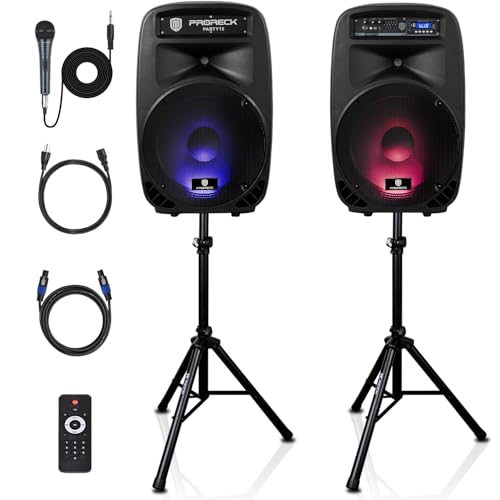 PRORECK Party 15 Portable 15-Inch 2000 Watt 2-Way15 inch30 x 19 x 29 Inches81.6 PoundsCheck on Amazon

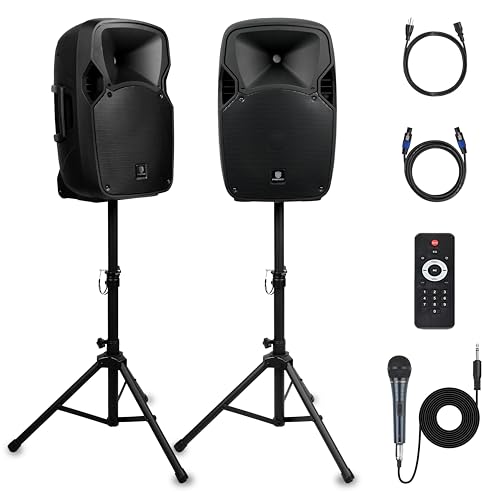


Top 3 picks at a glance

Quick Comparison
| Product | Best for | Key specs | Price tier |
|---|---|---|---|
| ALTO TS108C 600W Powered Column Array PA Speaker | True column-array coverage in tight, reflective rooms | 600 W listed; column-array format; powered; compact multi-piece footprint | Premium |
| PYLE-PRO 1000W Powered Bluetooth PA System with 10″ Subwoofer | Solo acts who want low-end from one box and a simple setup | 1000 W listed; 10-inch subwoofer plus monitor speaker; Bluetooth; active | Budget |
| PRORECK Party 12 12-Inch 1800W 2-Way Powered PA System Combo Set | Duo-to-trio gigs that need a full kit out of the box | 1800 W listed; 12-inch 2-way; Bluetooth, USB drive, SD card, FM radio; combo set | Mid-range |
| Gemini AS-2108P 8″ Powered PA Speaker, 300 W, Floor Monitor | Singer-songwriters on the tightest possible budget | 300 W listed; 8-inch woofer; wedge/floor-monitor shape; powered | Budget |
| Gemini AS-2110P 10″ Powered PA Speaker, 400 W, Built-in Mixer | Solo performers who need more inputs and headroom for the money | 400 W listed; 10-inch woofer; built-in mixer; powered | Budget |
| PRORECK Party 15 Portable 15-Inch 2000 W 2-Way Powered PA System Combo Set | Solo acts playing larger rooms and light outdoor sets with backing tracks | 2000 W listed; 15-inch 2-way; Bluetooth, USB, SD card; combo set | Premium |
| Rockville RPG8 8″ Powered Active DJ PA Speaker, 100 W RMS / 400 W Peak | Busking, tiny cafés and rehearsal rooms | 100 W RMS / 400 W peak; 8-inch woofer; active; pole-mountable | Budget |
| Rockville DX12 12″ Active Powered DJ PA Speaker with 2-Channel Mixer | Solo performers who want a real mixer on the back panel | 12-inch woofer; active; onboard 2-channel mixer; pole-mountable | Mid-range |
| PRORECK Club AB 12-Inch DJ/Powered PA Speaker System Combo Set | Solo performers who need a matched pair for wider rooms | 12-inch powered PA; Bluetooth, USB, SD card, remote; combo set | Premium |
| PRORECK Delta 126 2000W Bluetooth PA System with 6-Channel Powered Mixer | Solo performers who also run a small band or party PA | 2000 W listed; 6-channel powered mixer; two 12-inch passive speakers | Premium |
| Berlingtone 8-Inch 500W Powered PA Speaker System with Bluetooth, TWS | Grab-and-go stereo pairing without a second amp | 500 W listed; 8-inch; Bluetooth with TWS pairing; mic input; portable | Mid-range |
| Pyle PPHP155ST Wireless Portable PA Speaker System, 1500 W | Outdoor and party-style solo gigs with a wireless mic | 1500 W listed; 15-inch class; wireless mic; Bluetooth; portable active system | Mid-range |
How We Chose
This roundup was assembled from published product listings, manufacturer spec sheets and the established behaviour of each product category, not from bench testing. Four criteria did the sorting. First, category fit: the query is about column PA speakers for solo performers, and genuine column arrays are rare in this price band, so the ALTO TS108C leads the list and the remaining picks are judged on how well a conventional powered box substitutes for one — vertical coverage, footprint, and how gracefully the level falls off toward the back row. Second, published specs: listed wattage, driver size, input count, Bluetooth and playback options, and whether the rating is stated as RMS or peak. Third, use case: a solo singer-guitarist with two inputs has different needs from a solo act running backing tracks, a second mic and a subwoofer, so each pick is tied to a specific performer profile rather than ranked in the abstract. Fourth, upgrade path: whether the box can be pole-mounted, paired with a second unit for stereo, or fed from a small external mixer later, since a solo rig rarely stays a solo rig forever.
1. ALTO TS108C – Best for true column-array coverage in tight rooms
As an Amazon Associate we earn from qualifying purchases at no extra cost to you.
The ALTO TS108C is the only true column-array design in this roundup, and that single fact explains why it tops the list for the reader who searched for a column PA in the first place. A column array stacks several small drivers vertically in a narrow tower instead of firing everything out of one horn. The practical result is a tall, narrow coverage pattern: the sound spreads wide left-to-right but stays tight top-to-bottom, so it hits the audience rather than the ceiling and the back wall. In a low-ceilinged café, a brewery taproom with a hard back wall, or a small function room with a glass frontage, that geometry is worth more than an extra few hundred watts.
It suits the solo performer who plays rooms of roughly 30–80 people and is tired of fighting reflections. The listing describes a 600 W powered system in a column-array format, which places it in the same power class as a mid-sized conventional box while taking up a fraction of the floor or stand space. Alto’s broader powered-speaker line is known for lightweight Class D amplification and a compact cabinet philosophy, and this model follows that pattern: the tower is easy to carry, and the system breaks down into pieces small enough that a single person can load in without a hand truck.
Key specs as listed
- 600 W listed power output
- Powered column-array format — vertically stacked drivers rather than a single horn
- Self-powered: no external amplifier or rack required
- Compact, multi-piece footprint designed for one-person transport
- Premium tier pricing relative to the budget boxes in this list
Why it works for a solo act
The physics do the heavy lifting. A conventional point-source box loses roughly 6 dB of level every time you double the distance from it in open air. A column array behaves differently in its near field: because the vertical line of drivers is long relative to the wavelengths it is producing, the energy spreads cylindrically rather than spherically, and level falls off at closer to 3 dB per doubling of distance. In a room where the last row is 6–8 metres back, that difference is worth several decibels of usable headroom before feedback or distortion sets in — which is exactly the margin a solo vocalist needs, because a solo set has no band to hide behind. If the voice is thin or the guitar is dull, there is nothing to mask it.
The narrow vertical pattern also reduces the ceiling and floor splash that makes a small room sound like a swimming pool. You hear less of the room and more of the performer, which means you can run the system at a lower level and still be heard clearly at the back. For a solo act, lower stage volume is the single biggest win available, because it directly reduces the feedback risk on an open vocal mic.
Pros
- Column geometry gives even front-to-back coverage that a single-horn box cannot match in the same footprint
- Narrow vertical pattern keeps energy off ceilings and floors, reducing room reflections
- Breaks down small enough for one person to load in and out without help
- Self-powered, so there is no amp rack to carry or wire
- Premium build and presentation suit corporate and wedding-adjacent solo work
Cons
- Premium tier — the most expensive way here to cover a small room
- Column arrays trade maximum output for coverage; a big conventional box can be louder at close range
- Deep bass still requires a subwoofer, since the column handles the mid and high range
- Fewer inputs than a combo-set system with a separate mixer
Nearest alternative: the PRORECK Delta 126. Both are premium picks, but they solve opposite problems. The Delta 126 gives you two passive 12-inch speakers, a six-channel powered mixer and far more raw output — the right answer if you sometimes play with other people or need to cover a 150-person room. The TS108C gives you a smaller, lighter, better-behaved system for a room where the acoustics, not the audience size, are the challenge. Buy the Alto for the rooms you actually play; buy the Delta for the rooms you occasionally get booked into.
2. PYLE-PRO 1000W Powered Bluetooth PA System – Best for low-end from one box

This Pyle system is the odd one out in the best way: it is built around a 10-inch subwoofer rather than a full-range box, with a separate monitor speaker covering the upper range. The listing describes a 1000 W active Bluetooth PA system with a 10-inch subwoofer and monitor speaker. For a solo performer running backing tracks, that configuration is the fastest route to a rig that sounds finished rather than thin.
It suits the solo act who plays recorded backing tracks — a wedding singer, a one-person covers set, a karaoke host, a DJ doing small private parties — and who wants bass you can feel without carrying a separate sub, crossover and speaker stand. A single 8-inch or 10-inch full-range box will reproduce a bass guitar or kick drum, but it reproduces it apologetically. Splitting the low end into a dedicated subwoofer cabinet and letting a smaller satellite handle the mids and highs is how professional systems are built, and this Pyle does it in one purchase.
Key specs as listed
- 1000 W listed output
- 10-inch subwoofer plus monitor speaker — a two-cabinet active system
- Bluetooth streaming built in
- Active (self-powered) design, no external amp needed
- Budget tier pricing despite the subwoofer configuration
Why it works for a solo act
The split-cabinet approach solves a problem that catches a lot of solo performers. When you put a full-range signal into a small woofer, the cone has to move a long way to produce bass, and that excursion modulates the midrange it is also producing. The result is a muddy, slightly congested vocal — the classic “small PA” sound. Separating the low frequencies into a dedicated cabinet removes that compromise. Vocals come through clean, and the low end arrives from a driver sized to produce it.
The practical benefit is that you can run the whole system at a lower overall level and still get a full-sounding result, because you are not pushing a small box past its comfortable range to fake bass. That matters for a solo act in a small venue, where the difference between sounding good and sounding loud-but-thin is usually about 6 dB of restraint.
The Bluetooth input is genuinely useful rather than a marketing checkbox for this performer profile: set-break music, backing tracks from a phone or tablet, and the ability to hand the source device to someone else without a cable change.
Pros
- Dedicated 10-inch subwoofer gives real low end from a single purchase
- Separating bass from the mid/high cabinet keeps vocals clearer at the same volume
- Bluetooth makes backing tracks and set-break music trivial to run
- Budget tier — the cheapest way in this list to get a subwoofer in the rig
- Active design means no amplifier, crossover or rack to buy separately
Cons
- Two cabinets to carry rather than one, and the subwoofer is the heavy piece
- 1000 W is a peak-class figure; expect far less continuous output
- Fewer routing and EQ options than a system with a separate mixer
- Subwoofer plus satellite takes more setup time than a single column
Nearest alternative: the Berlingtone 8-Inch 500W system. Both are compact powered systems, but the Berlingtone is a full-range box with TWS stereo pairing, while this Pyle splits the frequency range across two cabinets. If you need bass and play tracks, the Pyle wins. If you need the simplest possible load-in and mostly perform voice and guitar, the Berlingtone is lighter and quicker to set up — and it can run as a stereo pair, which the Pyle cannot.
3. PRORECK Party 12 – Best for solo and duo gigs that need a full kit out of the box
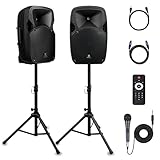
The PRORECK Party 12 is a combo set rather than a single speaker: the listing describes an 1800 W 12-inch two-way powered PA system with Bluetooth, USB drive, SD card and FM radio, sold as a complete package. That “combo set” framing is the entire point — it is aimed at the performer who wants to open one box and be able to gig, rather than assembling a system component by component over several months.
It suits the solo performer who is also, functionally, a small act: someone who occasionally plays as a duo or trio, needs a second speaker for stereo or for a wider spread, and wants stands, cables and a couple of microphones included. It also suits the performer who does not want to think about impedance, crossover points, or whether a passive speaker can be driven by a particular amp — a self-contained powered set removes all of that.
Key specs as listed
- 1800 W listed output
- 12-inch two-way powered speaker configuration
- Bluetooth, USB drive, SD card and FM radio playback built in
- Sold as a combo set — multiple components in one purchase
- Mid-range tier pricing
Why it works for a solo act
The 12-inch woofer is the sweet spot of this entire category. It moves enough air to produce usable bass down into the 50–60 Hz region without a subwoofer for most material, and it does so in a cabinet that one person can carry up a flight of stairs. An 8-inch box is lighter but runs out of low end early; a 15-inch box has more bottom but is heavier and, in a small room, more likely to boom. A 12-inch powered box covers the widest range of solo gigs per kilogram carried.
The media inputs are the second half of the value story. USB drive and SD card playback mean a solo act can run a full set of backing tracks without a laptop or phone in the signal chain — no notifications interrupting a ballad, no screen dimming mid-song, no battery anxiety at hour three. FM radio is a bonus that matters more than it sounds for background-music work at a restaurant or a market stall, where you are being paid to fill a room rather than to perform in it.
Because the set includes the stands and cabling, it also removes the most common first-gig failure: arriving with a speaker and no way to get it above the audience’s knees. A speaker on the floor loses its high-frequency content to the front row’s legs and torsos; on a stand at head height, it covers the room.
Pros
- Complete system in one purchase — no missing cables or stands on gig day
- 12-inch two-way format covers most solo and duo material without a subwoofer
- USB and SD playback remove the phone or laptop from the signal chain
- Scales to duo and trio work with the included second cabinet
- Mid-range pricing for a multi-component package
Cons
- Bulkier and heavier to transport than a single column or 8-inch box
- Included accessories are usually functional rather than premium
- More setup steps than a one-piece powered speaker
- Peak-class wattage figure flatters the real continuous output
Nearest alternative: the PRORECK Club AB 12. These two overlap heavily — both are 12-inch PRORECK combo sets with Bluetooth and card playback — and the honest answer is that either will serve a solo or duo act well. The Party 12 leans toward the performer who wants maximum playback flexibility (USB, SD and radio) in a single package, while the Club AB 12 is the better pick if you specifically want a matched powered pair for stereo work and remote control from the stage. Choose on which convenience you will actually use.
4. Gemini AS-2108P – Best for singer-songwriters on the tightest budget

The Gemini AS-2108P is the entry point to this whole category: the listing describes a 300 W powered 8-inch PA speaker built in a floor-monitor shape. That last detail is more useful than it first appears. A wedge-shaped cabinet can be laid on its side and angled up at the performer as a monitor, or stood upright and used as a main speaker. Very few budget boxes offer both.
It suits the solo singer-songwriter playing coffee houses, small bars, farmers’ markets, bookshops and house concerts — rooms of 20–40 people where the goal is to be heard clearly, not to fill a dance floor. It also suits the performer who is testing whether they want to gig at all, and who would rather find out with a low-cost 8-inch box than a premium system.
Key specs as listed
- 300 W listed output
- 8-inch woofer in a two-way powered cabinet
- Floor-monitor / wedge-capable enclosure
- Active design with onboard amplification
- Budget tier pricing
Why it works for a solo act
An 8-inch powered box is the most honest piece of gear in this roundup. It will not pretend to be a club system. What it will do is reproduce a voice and an acoustic guitar accurately at conversational-to-raised volume in a room where people are seated and listening. For that job, the smaller woofer is actually an advantage: its narrower dispersion and lighter cone often produce a more articulate midrange than a 12-inch box asked to work quietly, because the driver is operating in its comfortable range rather than at the bottom of its travel.
The wedge shape is the standout feature. In a small, awkward room — a corner stage, a low platform, a spot next to a window — being able to angle the speaker up at your own ears changes how you perform. You hear what the audience hears, which means you sing in tune and play with dynamics instead of pushing harder because you cannot hear yourself. Most performers solve this by buying a separate monitor, which doubles the cost and the load-in. This cabinet solves it by being the monitor.
At 300 W listed, expect this to be a peak-class rating; the continuous output will be a fraction of that. In practice, for a 30-person room, that is entirely adequate. Where it runs out is outdoors, or in a room with 60+ people talking over you.
Pros
- Wedge-capable cabinet works as both main speaker and personal monitor
- Lowest-cost way into powered PA in this list
- 8-inch driver gives clear, articulate vocals at modest levels
- Light enough for genuinely one-handed transport
- Simple enough to set up in under two minutes
Cons
- Limited low end — no meaningful sub-bass, and thin on kick drum or bass guitar
- Limited headroom for rooms above roughly 40 people
- Fewer inputs and less EQ control than the 10-inch Gemini above it
- Not the right choice if you run heavy backing tracks
Nearest alternative: the Gemini AS-2110P. Same brand, same family, one size up. The AS-2110P adds a 10-inch woofer, more listed power and a built-in mixer for a modest step up in price. If you are only ever going to play quiet acoustic sets, the AS-2108P is enough and the wedge shape is a real advantage. If you want one box that can handle a slightly bigger room, a second vocalist or a backing track with any low end at all, skip straight to the 10-inch model.
5. Gemini AS-2110P – Best budget pick for solo performers who need real inputs
The Gemini AS-2110P is the practical sweet spot of the budget tier. The listing describes a 400 W powered 10-inch PA speaker with a built-in mixer. That combination — a 10-inch woofer plus onboard mixing — is what separates a speaker you can rehearse with from a speaker you can gig with.
It suits the solo performer with more than one thing to plug in: a vocal mic and an instrument, or a vocal mic and a backing-track source, or two vocalists sharing one box. It also suits the performer who does not want to buy a separate mixer, which is a meaningful saving in both money and setup time.
Key specs as listed
- 400 W listed output
- 10-inch woofer, two-way powered cabinet
- Built-in mixer for direct connection of microphones and instruments
- Active design, self-powered
- Budget tier pricing
Why it works for a solo act
The jump from 8 to 10 inches is the most consequential upgrade in this category, and it is not really about volume. A 10-inch woofer typically extends usable low-frequency output by roughly half an octave compared with an 8-inch driver in a similar cabinet. In plain terms, a 10-inch box will reproduce the lower strings of a guitar, the body of a male vocal and the bass line of a backing track; an 8-inch box will hint at them. For a solo act running tracks, that difference is the difference between a performance that sounds like a recording and one that sounds like a phone speaker.
The built-in mixer is the other half. A solo performer’s input list is short but non-negotiable: one vocal mic, one instrument or playback source. Two usable channels with independent level control covers the overwhelming majority of solo work, and having them on the back of the speaker means one fewer box, one fewer power supply and one fewer cable to forget. The trade-off is that onboard mixers at this price are basic — level and sometimes tone, rarely a full EQ — but for two inputs, that is sufficient.
Combined with the 10-inch driver, this makes the AS-2110P the box that a solo performer can grow into rather than out of. It handles a 40–70 person room, a duo sharing one speaker, and a solo set with backing tracks, without any additional purchase.
Pros
- 10-inch woofer gives meaningfully more low end than an 8-inch box
- Built-in mixer removes the need for a separate mixer purchase
- Handles a 40–70 person room for solo and duo material
- Still light enough for one-person transport and fast setup
- Budget tier — the best value-per-capability pick in this list
Cons
- Onboard mixer is basic, with limited EQ and no effects
- 400 W is a peak-class figure, not continuous output
- Single speaker only — no stereo without buying a second unit
- Still needs a subwoofer for convincing kick drum or bass guitar
Nearest alternative: the Rockville RPG8. Both are budget 8-to-10-inch class boxes, but the RPG8 is an 8-inch design rated 100 W RMS / 400 W peak, which makes it a smaller, lighter, quieter proposition. The AS-2110P wins on low end, room size and input flexibility; the RPG8 wins on weight, footprint and price. For a genuine gigging solo act, the Gemini is the better long-term buy. For busking and rehearsals, the Rockville is plenty.
6. PRORECK Party 15 – Best for solo acts covering larger rooms with backing tracks
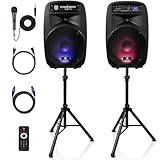
The PRORECK Party 15 is the big-room option for a solo performer. The listing describes a 2000 W portable 15-inch two-way powered PA system combo set with Bluetooth, USB and SD card playback. Where the Party 12 is a versatile middleweight, this is the system you buy when the room, not the performer, is the limiting factor.
It suits the solo act playing function rooms, marquees, small outdoor stages, community halls and party sets — 100–200 people, often with a dance floor, often with backing tracks that include real bass and drums. It also suits the performer who does both: a quiet acoustic set in the early evening and a louder, track-driven set later on, using one system for both.
Key specs as listed
- 2000 W listed output
- 15-inch two-way powered speaker configuration
- Bluetooth, USB and SD card playback
- Sold as a portable combo set
- Premium tier pricing
Why it works for a solo act
A 15-inch woofer is the point at which a full-range box starts producing genuinely usable low end without a subwoofer. Where a 12-inch cabinet rolls off in the 50–60 Hz region, a 15-inch design typically reaches a little lower and, more importantly, moves more air doing it. For a solo act running produced backing tracks, that means the kick and bass line arrive with weight rather than a polite suggestion of weight — which is what makes a room feel like a party rather than a recital.
The larger cabinet also means less strain at any given level. A big woofer asked to produce a modest 95 dB is barely working; a small woofer asked to do the same is near its limits. That headroom translates directly into cleaner vocals at the same perceived volume, and less risk of the compression and distortion that make a system sound loud but unpleasant.
The portable combo-set format matters here too. A 2000 W listed rating on a system that includes its own amplification and playback sources means no amplifier matching, no impedance arithmetic and no rack. For a solo performer, that is the difference between a two-trip load-in and a four-trip load-in with a helper.
Pros
- 15-inch woofer delivers usable low end without a separate subwoofer
- Headroom to cover 100–200 person rooms and light outdoor sets
- Bluetooth, USB and SD playback cover every common backing-track scenario
- Cleaner vocals at high volume than smaller boxes, thanks to driver headroom
- Self-contained combo set — no amplifier or rack to buy
Cons
- Heaviest and bulkiest class of box in this list; a two-person lift in practice
- Premium tier pricing
- Overkill — and prone to boomy low end — in small, reflective rooms
- 2000 W is a peak-class figure; treat it as a marketing ceiling, not continuous output
Nearest alternative: the Pyle PPHP155ST. Both are 15-inch-class portable systems with wireless or Bluetooth convenience, and both are aimed at the same performer. The PPHP155ST’s differentiator is its wireless microphone, which is a genuine convenience for a solo act who moves around the room or performs in a space where a cable run is awkward. The Party 15’s differentiator is its combo-set completeness and its media playback options. If you want a wireless mic in the box, take the Pyle; if you want the most system per purchase, take the PRORECK.
7. Rockville RPG8 – Best for busking and the smallest possible rig
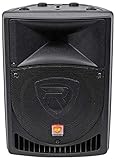
The Rockville RPG8 is the lightest, simplest option in this roundup. The listing describes an 8-inch powered active DJ/PA speaker rated at 100 W RMS and 400 W peak. That RMS figure is worth noting: it is one of the few honest continuous ratings in this list, and it tells you exactly what class of job this box is for.
It suits the busker, the rehearsal-room user, the solo performer playing cafés and small markets, and the performer who needs a second speaker for a monitor or a small satellite. It also suits anyone who has to walk their gear to a pitch — a pedestrianised high street, a park, a beachfront — where every kilogram matters and a trolley is not an option.
Key specs as listed
- 100 W RMS / 400 W peak output
- 8-inch woofer in an active powered cabinet
- Pole-mountable for stand deployment
- Self-powered, no external amplifier
- Budget tier pricing
Why it works for a solo act
The 100 W RMS rating is the useful number here. Continuous power ratings are the honest measure of what a speaker can sustain without distortion or thermal shutdown, and 100 W RMS into a reasonably efficient 8-inch cabinet produces roughly 110–115 dB of peak output at one metre. That is plenty for a busking pitch where the audience is standing three to five metres away, and it is adequate for a quiet café set where the room is doing half the work.
The size is the real feature. An 8-inch powered cabinet in this class typically weighs in the region of 15–20 lb, which is a one-hand carry, and it fits on the passenger seat of a small car. For a performer who gigs by foot, bicycle or public transport, that is not a minor convenience — it determines whether you can take the gig at all.
It is also the most sensible way to buy a monitor. If you already run a main system and cannot hear yourself, an RPG8 on a short stand or angled on the floor beside you costs less than most dedicated monitors and doubles as a backup main speaker if your primary box fails mid-set. Having a spare in the car is one of the least glamorous and most valuable habits a working solo performer can develop.
Pros
- 100 W RMS continuous rating — an honest measure of real-world capability
- Light enough for one-handed carry and public-transport gigs
- Pole-mountable, so it can be raised above the audience
- Cheap enough to buy as a monitor or a backup speaker
- Simple controls mean almost nothing to go wrong on stage
Cons
- Smallest low-end output in this list — no bass content to speak of
- Runs out of headroom above roughly 30–40 listeners
- Minimal input and EQ facilities
- Not suitable for track-driven sets with drums and bass
Nearest alternative: the Gemini AS-2108P. Both are budget 8-inch powered boxes, and both can be angled at the performer. The Gemini has the advantage of a purpose-built wedge shape for monitoring and a higher listed power figure; the Rockville has the advantage of a clearly stated RMS rating, which makes it easier to predict what you are buying. For busking, the Rockville’s lighter, simpler build is the better fit. For a seated listening-room gig, the Gemini’s monitor geometry wins.
8. Rockville DX12 – Best for solo performers who want a real mixer on the back

The Rockville DX12 is aimed squarely at the performer who wants a single box to be the entire rig. The listing describes a 12-inch active powered PA speaker with a two-channel mixer built into the cabinet. That configuration — one cabinet, one power cable, two inputs — is the fastest possible route from car to first song.
It suits the solo singer-guitarist who plays 50–100 person rooms and wants a clean, uncluttered stage. It also suits the solo performer who has been running a small external mixer and is tired of the extra box, extra power supply and extra cable that comes with it.
Key specs as listed
- 12-inch woofer in an active powered cabinet
- Two-channel onboard mixer with independent level control
- Pole-mountable for stand deployment
- Self-powered, no external amplifier required
- Mid-range tier pricing
Why it works for a solo act
Two channels is exactly the right number for most solo work. Channel one takes the vocal mic; channel two takes the guitar, the backing-track source, or a second microphone. Anything more than that and you are running a band, at which point a separate mixer becomes the correct answer. Anything less and you are swapping cables between songs, which is where performances fall apart.
The 12-inch driver is the other reason this box sits in the middle of the list. It covers the full range of solo material — voice, acoustic guitar, backing tracks with some low end — without a subwoofer, and it does so in a cabinet that one person can lift onto a stand. That combination of a built-in mixer and a 12-inch woofer is what makes a single-speaker rig viable rather than a compromise.
There is a practical monitoring benefit too. With the mixer on the back of the speaker, you can reach behind and adjust your own vocal level between songs without walking to a separate desk. For a solo performer working without a sound engineer, that self-sufficiency is worth more than an extra channel of EQ.
Pros
- Two-channel onboard mixer covers vocal plus instrument or playback
- 12-inch woofer handles solo material without a subwoofer
- Single-box rig means one power cable and one speaker stand
- On-speaker level control lets you adjust mid-set without leaving the mic
- Mid-range pricing for a genuinely complete single-speaker solution
Cons
- No stereo output from one cabinet
- Onboard mixer offers level control rather than full channel EQ
- Heavier than the 8-inch and 10-inch budget options
- Bass content will not satisfy a track-heavy set with prominent kick and bass
Nearest alternative: the Gemini AS-2110P. Both are powered boxes with built-in mixers, and the decision comes down to size and price. The Gemini is a 10-inch box in the budget tier, which makes it lighter, cheaper and easier to move; the Rockville is a 12-inch box in the mid-range tier, which gives it more low end and more headroom for a larger room. If you play 30–60 person rooms, the Gemini is the sensible buy. If you regularly play 60–100, the DX12’s extra driver area is worth the weight.
9. PRORECK Club AB 12 – Best for solo performers who want a matched pair

The PRORECK Club AB 12 is a combo set built around a 12-inch powered PA speaker, with Bluetooth, USB, SD card and remote control. The distinguishing feature is the pairing: this is a system designed to give a solo performer a proper stereo spread rather than a single point source.
It suits the solo performer who plays wider rooms — a long narrow bar, a rectangular function space, a stage that is wider than it is deep — where one speaker cannot cover the audience evenly. It also suits the performer running stereo backing tracks, where a single speaker collapses the stereo image into mono and loses the width that makes a produced track sound big.
Key specs as listed
- 12-inch powered PA speaker configuration
- Bluetooth, USB and SD card playback
- Remote control included
- Sold as a combo set for a matched stereo setup
- Premium tier pricing
Why it works for a solo act
Two speakers do not simply double the volume — they change the shape of the coverage. Placed on stands a few metres apart and angled slightly inward, a pair of 12-inch boxes covers a wide room far more evenly than one box ever will, because the audience is never more than a few metres off-axis from at least one speaker. Off-axis response is where single-speaker rigs fail: the performer sounds bright and present to the people directly in front and dull and distant to the people at the sides.
The stereo argument matters for anyone running produced backing tracks. A stereo mix collapsed to mono can cause phase cancellation in the low end and loses the spatial width that makes a track feel like a record rather than a rehearsal. Two cabinets, panned left and right, restore that. For a solo act whose entire sound is voice plus a produced track, this is a significant quality gain.
The remote control is a small but genuinely practical addition for a solo performer. Being able to adjust playback level or skip a track without walking back to the speaker — or worse, reaching behind it mid-song — keeps a set flowing.
Pros
- Matched pair gives even coverage across wide, shallow rooms
- Stereo playback restores width and avoids mono phase problems
- 12-inch woofers handle solo material without a subwoofer
- Remote control keeps set management off the stage floor
- Complete combo set reduces the risk of missing accessories
Cons
- Two speakers means two stands, two cables and two trips to the car
- Premium tier pricing
- In a very small room, a pair of 12-inch boxes is more system than the space needs
- Bluetooth pairing latency can make it unsuitable for live monitoring of tracks
Nearest alternative: the PRORECK Party 12. Both are 12-inch PRORECK combo sets at adjacent price points, and the difference is philosophical. The Party 12 is about playback flexibility in a single package; the Club AB 12 is about coverage and stereo. If you play long, narrow rooms or run stereo tracks, the Club AB 12’s second cabinet earns its keep. If you mostly play square-ish rooms and want the simplest possible setup, the Party 12 gets you there with less to carry.
10. PRORECK Delta 126 – Best for solo performers who also run a small band PA

The PRORECK Delta 126 is the most capable system in this roundup and the one that most clearly steps outside the solo-performer brief. The listing describes a 2000 W Bluetooth PA system with a six-channel powered mixer and two 12-inch passive speakers. That architecture — a powered mixer head plus passive cabinets — is the traditional small-band PA format, and it is worth understanding before you buy it.
It suits the solo performer who is really a small-act operator: someone who plays solo sets but also hosts open mics, runs a duo or trio, provides sound for a party, or hires out a basic PA for small events. If your gear needs to cover more than one configuration, this is the system that does it.
Key specs as listed
- 2000 W listed output
- Six-channel powered mixer
- Two 12-inch passive speakers
- Bluetooth connectivity
- Premium tier pricing
Why it works for a solo act
Six channels is the significant number. A solo performer needs two. A duo needs four — two vocals, two instruments. A trio needs five or six. Buying a six-channel system means one purchase covers every configuration you are likely to play for the next several years, which is cheaper than buying a two-channel system now and a mixer plus extra speakers in eighteen months.
The powered-mixer-plus-passive-cabinets format has a real advantage over all-in-one powered speakers: the amplification lives in the mixer head, not in each cabinet, so the speakers themselves are lighter and there is only one mains lead to the stage rather than one per speaker. The trade-off is more cabling between the mixer and the speakers, and the requirement that you use the supplied cabinets or matching ones.
For a solo performer, the practical benefit is flexibility. On a solo gig, you can leave one speaker in the car and run a single cabinet — lighter load-in, same mixer. On a band or party gig, both cabinets come out and you have a full system. Very few powered speakers offer that kind of optionality, because the amplifier is bolted to the cabinet.
Pros
- Six-channel mixer covers solo, duo and trio configurations from one purchase
- Powered mixer head keeps the cabinets themselves lighter
- 2000 W listed output covers 150+ person rooms with headroom
- Can be run as a single-speaker rig on solo gigs to reduce load-in
- The most future-proof purchase in this list
Cons
- Most complex setup here — mixer, two speakers and interconnecting cables
- Premium tier pricing, and the heaviest total load
- Passive speakers require the supplied powered mixer; they cannot be used with a different amp without checking impedance
- Far more system than a solo act playing 40-person rooms needs
Nearest alternative: the ALTO TS108C. Both are premium picks at the top of this list, but they represent opposite design philosophies. The Alto is a compact column array built for one performer in an acoustically difficult small room. The Delta 126 is a full band PA built for flexibility and output. If your gigs are solo and your rooms are small, the Alto will sound better and load in faster. If your gigs are varied and your rooms are large, the Delta’s channel count and headroom will keep you from buying twice.
11. Berlingtone 8-Inch 500W – Best for grab-and-go stereo pairing

The Berlingtone 8-Inch is built around convenience. The listing describes a 500 W powered PA speaker system with Bluetooth, TWS (true wireless stereo) pairing, a microphone input and a portable, wireless-friendly design. The TWS feature is the reason it earns a place here rather than being one more budget 8-inch box.
It suits the solo performer who wants a stereo rig without a stereo amplifier. TWS lets two of these cabinets link wirelessly and split the left and right channels between them — no signal cable between the speakers, no mixer, no second amplifier. For a solo act running backing tracks from a phone or tablet, that is the shortest possible path from source to stereo sound.
Key specs as listed
- 500 W listed output
- 8-inch driver in a powered portable cabinet
- Bluetooth with TWS true wireless stereo pairing
- Microphone input on the cabinet
- Mid-range tier pricing
Why it works for a solo act
Wireless stereo pairing solves a real cabling problem. In a conventional stereo setup, you run a signal cable from the mixer or source to the left speaker and another to the right, which means either a long cable run across the performance area or a pair of cables that everyone trips over. TWS removes both. Two cabinets, two power leads, one pairing button.
The 8-inch driver is the honest limitation and also part of the appeal. At 500 W listed, this is a peak-class figure, but an 8-inch box in a portable cabinet is genuinely light — the sort of thing that goes from car to stand in one trip with the second cabinet under your arm. For a solo performer playing cafés, small bars, markets, ceremonies and private parties, that portability is worth more than the extra low end a 12-inch box would give you, particularly if you are not running material with heavy bass.
The microphone input means you do not need a separate mixer for a basic vocal-and-track setup, though running a mic through a Bluetooth-linked stereo pair is not ideal — for live vocal work, a wired connection to one cabinet is more predictable.
Pros
- TWS pairing gives stereo without cables, a mixer or a second amplifier
- 8-inch cabinet is genuinely one-trip portable
- Microphone input covers a basic solo vocal-and-track setup
- Bluetooth makes source devices trivial to swap
- Mid-range pricing for a stereo-capable pair
Cons
- 500 W is a peak-class rating; continuous output is modest
- 8-inch driver has limited low end
- Wireless pairing adds a small latency that is fine for playback but not for monitoring
- Less headroom than any 12-inch option here for rooms above 60 people
Nearest alternative: the Gemini AS-2110P. Both are compact powered boxes, but they optimise for different things. The Gemini gives you a 10-inch driver and a wired built-in mixer — more low end, more predictable, no wireless variables. The Berlingtone gives you wireless stereo pairing and a smaller, lighter cabinet. If you play tracks and want stereo width with minimum setup, the Berlingtone is the more interesting buy. If you play live and want the most reliable two-input box for the money, the Gemini is the safer pick.
12. Pyle PPHP155ST – Best for outdoor and party-style solo gigs

The Pyle PPHP155ST is the outdoor specialist. The listing describes a 1500 W wireless portable PA speaker system with Bluetooth, a 15-inch-class cabinet and a wireless microphone. That combination — big driver, built-in wireless mic, battery-friendly portable format — is designed for the performer who works in spaces without a convenient stage or a power outlet nearby.
It suits the solo performer doing outdoor sets: beer gardens, weddings on lawns, market stalls, community events, parties and functions where the audience is standing, spread out, and often talking. It also suits the performer who moves around while performing — a roaming entertainer, a host, a ceremony singer — for whom a wireless microphone is not a luxury but a requirement.
Key specs as listed
- 1500 W listed output
- 15-inch class cabinet
- Wireless microphone included
- Bluetooth connectivity
- Portable, wireless-friendly active system
- Mid-range tier pricing
Why it works for a solo act
Outdoors is the hardest environment for a small PA, and it is worth understanding why. Indoors, walls and ceilings reflect sound back into the room and effectively reinforce what the audience hears. Outdoors, there is no reinforcement: the sound radiates away and nothing comes back. A system that sounds full in a 60-person bar can sound thin and distant in a 60-person garden. The practical rule is that you need roughly one size larger a speaker outdoors than you would use indoors for the same audience.
That is exactly what the PPHP155ST is: a 15-inch-class cabinet for a job that an 8-inch or 10-inch box would struggle with outside. The larger driver moves enough air to carry across an open space, and the higher listed output gives the headroom to compete with ambient noise — conversation, traffic, wind, other performers.
The wireless microphone is the second part of the outdoor argument. Outdoors, cable runs are awkward and often unsafe: you are running a mic cable across grass, gravel or a public footpath. A wireless handheld removes that entirely, and it lets a solo performer step out in front of the speaker — away from the feedback zone — which is a benefit in any environment, indoors or out.
Pros
- 15-inch-class driver has the output to carry in open, unreflective spaces
- Wireless microphone included, which suits roaming and outdoor performance
- Bluetooth playback for backing tracks and break music
- Self-contained portable system, no amplifier or rack required
- Mid-range pricing for a large-cabinet, wireless-mic package
Cons
- 1500 W is a peak-class rating, not continuous output
- Large cabinet is heavy and awkward for one person to move
- Big low-end output can boom in small indoor rooms
- Wireless mic systems in this class need line-of-sight and fresh batteries to stay reliable
Nearest alternative:
Related guides