The best budget reverse osmosis system for most households is a five-stage under-sink unit such as the APEC ROES-50, iSpring RCC7, or Express Water RO5, while apartment renters and high-demand kitchens should consider a compact tankless model instead.
Reverse osmosis (RO) systems remove dissolved minerals, many metals, fluoride, and other contaminants by forcing water through a semipermeable membrane. The cheapest system is not always the least expensive to own: replacement filters, wasted water, storage capacity, and installation can matter more than the purchase price.
As an Amazon Associate we earn from qualifying purchases at no extra cost to you.


Our Top Picks
 DREO Reverse Osmosis Water Filter Countertop5L15.67 x 6.73 x 13.35 inches10.78 poundsCheck on Amazon
 Waterdrop G3P600 Tankless Reverse Osmosis Water Filter System600 GPD18.06 x 5.68 x 17.76 Inches31 poundsCheck on Amazon


Top 3 picks at a glance
Best budget reverse osmosis systems by household
| Household situation | Best fit | Typical upfront range | Why it makes sense |
|---|---|---|---|
| One to three people, normal under-sink cabinet | Five-stage tank system | $180–$300 | Lowest ownership cost and simple filter changes |
| Four or more people, limited cabinet space | Tankless 400–600 GPD system | $300–$600 | Higher flow and no large storage tank |
| Renter or frequent mover | Countertop RO system | $200–$500 | No permanent plumbing modification in many installations |
| Well water or difficult source water | Standard RO with appropriate pretreatment | $250–$600 before pretreatment | Allows sediment, iron, hardness, or sulfur treatment to be added |
| Lowest long-term cost | Standard 4- or 5-stage tank system | $180–$350 | Inexpensive universal-style cartridges are widely available |
Best overall budget choice: a five-stage tank system
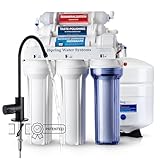
A conventional five-stage system is usually the strongest value. Models such as the APEC ROES-50, iSpring RCC7, and Express Water RO5 use a similar layout: sediment filtration, one or more carbon filters, an RO membrane, and a final polishing filter. They normally include a pressurized storage tank, dedicated faucet, feed-water adapter, drain saddle, and tubing.
These systems commonly cost about $180–$300, depending on included accessories and certification claims. Their nominal membrane ratings are often around 50 gallons per day, although real output depends on water temperature, pressure, and total dissolved solids. For drinking, cooking, and a coffee machine, that capacity is usually adequate because the storage tank supplies water faster than the membrane produces it.
Why the tank matters
A 50-GPD membrane does not continuously deliver 50 gallons in ordinary household conditions. A useful planning estimate is 50 gallons divided by 24 hours, or about 2.1 gallons per hour under ideal conditions. Cold water and low pressure can reduce that substantially. The tank solves the delay: the system slowly makes water, then the faucet draws from the reserve.
Choose this type if you have room for a roughly cylindrical tank beneath the sink and want inexpensive, easy-to-source filters. The main disadvantages are slower faucet flow after the tank empties and the need to sacrifice cabinet space.
Best compact option: tankless RO systems
Tankless systems such as the Waterdrop G3 or G2 series and comparable 400–600-GPD units are better when cabinet space and dispensing speed matter. Their internal pump raises membrane pressure, and an electronic monitor may display filter life or water quality. Instead of storing purified water in a tank, they produce it on demand.
Expect an upfront price of approximately $300–$600. Replacement cartridges are usually proprietary, so annual filter costs can be higher than with a basic tank system. Some models also need an electrical outlet under the sink, which adds a meaningful installation requirement.
When the premium pays off
Suppose a household uses four gallons of RO water each day. A tankless unit rated at 600 GPD has a theoretical maximum of 25 gallons per hour, though actual performance will be lower. Even at half that rate, it can refill a pitcher or cooking pot quickly. A 50-GPD tank system may still work, but the household could empty its tank during heavy cooking, leaving a waiting period.
Do not buy a high-GPD tankless unit solely because the number is larger. Check the waste-water ratio, replacement cartridge prices, pump noise, power requirement, and whether the faucet or filter head uses a proprietary connection.
Lowest ownership cost: standard-cartridge RO
The APEC ROES-50, iSpring RCC7, and Express Water RO5 represent the standard-cartridge approach. Exact replacement intervals vary, but a reasonable planning schedule is:
- Sediment and carbon prefilters: every 6–12 months, commonly $25–$60 for a set.
- RO membrane: roughly 2–3 years in typical municipal water, commonly $30–$80.
- Final inline polishing filter: every 6–12 months, commonly $10–$25.
- Sanitization: about once a year or whenever the membrane and filters are replaced.
That produces an approximate consumables budget of $70–$150 per year for many households, excluding unusual pretreatment. Proprietary tankless cartridges may cost about $100–$250 per year, but they can offset some of that expense with better efficiency and a smaller footprint.
Installation requirements that affect the real price
A typical under-sink installation needs a cold-water connection, a drain connection, a dedicated faucet hole, and enough vertical and horizontal space for the filter housings. The drain saddle sends reject water to the sink drain, while the storage tank needs a flat, stable location.
- Existing spare faucet hole: Installation is easier because the RO faucet can use an unused soap-dispenser or sprayer opening.
- No spare hole: Drilling a stainless-steel or stone sink may require a plumber or countertop professional.
- Garbage disposal or dishwasher drain: The drain connection must be arranged correctly to prevent leaks and avoid an improperly positioned air-gap fitting.
- Low water pressure: A booster pump may be necessary. Many systems perform best around 60 psi; performance can fall noticeably below that.
- Hard, iron-rich, or sediment-heavy well water: Add pretreatment before the RO membrane. Otherwise, the membrane can foul rapidly.
- Tankless design: Confirm that a grounded electrical outlet is available and protected from leaks.
Professional installation often adds roughly $150–$400, depending on drilling, plumbing access, and local labor. A system advertised at $220 can therefore become a $370–$620 project if the installation is not straightforward.
Water efficiency: calculate the hidden cost
RO systems send some water to the drain while producing purified water. Older or inexpensive units may produce three to five gallons of reject water per gallon of purified water. More efficient systems may approach one-to-one under favorable conditions, but the advertised ratio is usually based on specific pressure, temperature, and water-quality conditions.
For a household that uses four gallons per day, a 3:1 ratio means:
- Purified water: 4 gallons per day.
- Reject water: 12 gallons per day.
- Total water entering the system: 16 gallons per day.
- Annual reject water: 12 × 365 = 4,380 gallons.
That may be inexpensive where water and sewer charges are low, but it is more significant in drought-prone or metered areas. Reject water can often be collected for plants, cleaning, or toilet flushing, provided it is used promptly and local plumbing rules are followed.
Decision matrix: match the system to your priorities
| Your priority | Choose | Avoid or reconsider |
|---|---|---|
| Spend as little as possible initially | Four- or five-stage tank system | Premium tankless models with electronic displays |
| Minimize filter costs | System using widely available standard-size cartridges | Proprietary all-in-one filter packs |
| Fast filling and no storage tank | Powered tankless system rated 400 GPD or higher | Low-output countertop or 50-GPD tankless unit |
| No electrical outlet under the sink | Passive tank system | Pump-assisted tankless system |
| Rental property | Countertop unit or reversible faucet installation | Drilling countertops or permanent plumbing changes |
| Well water | RO paired with tested pretreatment | Installing RO without checking iron, hardness, and bacteria |
What to check before buying
1. Verify the contaminant target
RO is not a universal substitute for water testing. Review your municipal water report or obtain a certified well-water test. Look for a system with documentation relevant to the contaminants you care about, rather than treating a generic “five-stage” label as proof of every performance claim.
2. Compare annual ownership cost
Add the price of replacement prefilters, membrane, postfilter, and any required proprietary cartridge. Divide the result by the expected number of years. A $450 tankless unit with $180 annual filters may cost more over three years than a $230 tank system with $100 annual filters.
3. Measure the cabinet
Measure width, height, depth, the location of the drainpipe, and clearance for removing filter housings. Tank systems often fail the space test because the tank is larger than the filter assembly itself.
4. Check pressure and temperature
Low pressure, very cold water, and high dissolved-solids levels reduce output. If a product’s performance rating assumes ideal conditions, expect lower real-world production and a slower tank refill.
Frequently asked questions
Can a reverse osmosis system supply water quickly enough for cooking and drinking?
Yes, a five-stage tank system is usually adequate for drinking, cooking, and a coffee machine because its storage tank supplies water faster than the membrane produces it. A nominal 50-GPD membrane may make only about 2.1 gallons per hour under ideal conditions, and cold water or low pressure can reduce output. The tank provides a reserve for immediate use.
What happens to the water sent to the drain by an RO system?
The water sent to the drain becomes reject water rather than purified drinking water. At a 3:1 ratio, producing 4 gallons of purified water uses 12 gallons of reject water, or 4,380 gallons annually. Reject water can often be collected for plants, cleaning, or toilet flushing, provided it is used promptly and local plumbing rules are followed.
Does a tankless RO system need electricity?
Often, yes, because many tankless systems use an internal pump and may include electronic monitoring. Confirm that a grounded electrical outlet is available under the sink and protected from leaks before buying. A passive tank system does not have the same electrical requirement, but it needs room for a roughly cylindrical storage tank and may dispense more slowly after the reserve is empty.
What comes with a typical under-sink RO system?
A typical under-sink system includes a pressurized storage tank, dedicated faucet, feed-water adapter, drain saddle, and tubing. Installation also needs a cold-water connection, a drain connection, a dedicated faucet hole, and adequate space for the filter housings. An unused soap-dispenser or sprayer opening can make faucet installation easier, while drilling may be needed if no spare hole exists.
Why can a 600-GPD rating be misleading?
A 600-GPD rating describes a theoretical maximum, not guaranteed household output. A 600-GPD unit is rated at 25 gallons per hour, but actual performance will be lower and depends on conditions such as pressure and temperature. When comparing tankless systems, also check the waste-water ratio, replacement cartridge prices, pump noise, power requirement, and proprietary connections.
Bottom line
For most budget-conscious households, a standard five-stage tank system offers the best balance of purchase price, inexpensive replacements, and simple installation. Choose a tankless model when cabinet space, dispensing speed, or water efficiency justifies the higher cost. Choose a countertop unit when you cannot modify the plumbing, and treat well water as a separate planning problem that may require pretreatment before any RO membrane.
Related guides
- Best Streaming Gear for Twitch: Webcams, Capture Card, Backdrop and Light (2026)
- Best Over Ear Headphones: 9 Closed, Open-Back and Bluetooth Picks Explained (2026)
- Best Monitor for Console Gaming: Eight 1080p and 1440p Screens Compared by HDMI and Refresh Rate (2026)
- Best Monitors for PS5 Pro 4K 120Hz: Eight Screens and the HDMI Bandwidth Check (2026)