Binoculars are the first real astronomy tool many people buy, and for good reason. Two eyes, a wide patch of sky, and no setup time: you step outside, raise the glass, and the Pleiades turn from a smudge into a cluster. But stargazing is a different job than watching birds or ball games. It rewards big front lenses, a steady platform, and a field of view wide enough to sweep along the Milky Way, so a “budget” pair needs to be chosen with those priorities in mind rather than just the highest magnification on the box.
This guide compares five budget-tier models that list stargazing as an intended use, from a pocket-size 10×25 to a heavy 25×100 giant. Prices are not the focus here; tiers are. The goal is to help you decide whether a light, handheld pair or a larger tripod-bound pair suits your sky, your back garden, and your patience. Everything below is based on the specs in each listing, with a 2026 buyer’s eye on what matters in the dark.
Our Top Picks

Top 3 picks at a glance
Quick Picks
As an Amazon Associate we earn from qualifying purchases at no extra cost to you.


| Product | Best for | Key spec from the title |
|---|---|---|
| 20×50 waterproof binoculars | A middle path between reach and portability | 20×50, waterproof, low light vision, easy focus |
| Sogries 25×100 astronomy binoculars | Dedicated tripod sky viewing | 25×100, astronomy and stargazing focus |
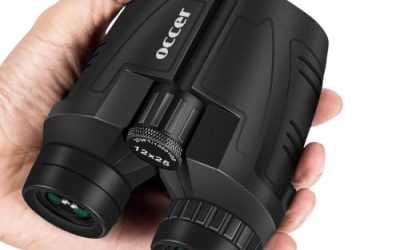
| 10×25 compact binoculars | Casual moon looks and travel | 10×25, waterproof, compact |
| ESSLNB 30×80 | Deep reach on a stable mount | 30×80, BAK4 prism |
| Basics 7×50 | Wide-field sweeping and beginners | 7×50, wide field of view, FMC optics, tripod compatible |
How to Choose
Aperture beats magnification in the dark
The second number in a spec like 7×50 is the front lens diameter in millimeters, and for stargazing it matters most. A 50 millimeter lens gathers many times more light than a 25 millimeter one, which is why a faint nebula that vanishes in a compact pair can show up in a 50 millimeter model. Aim for at least 50 millimeters if the night sky is your main use. Models with 80 or 100 millimeter lenses collect even more light, but they weigh more and become impractical to hold up for long.
The trade-off is simple: more glass means more light, more weight, and a bigger need for support. If you only have a balcony and a few free minutes after dinner, a 50 millimeter pair that you will use often beats a 100 millimeter pair that stays in the closet. Match the size of the instrument to the habit you will actually keep.
Choose power you can actually hold steady
Seven to ten power is easy to hold for a minute or two of sky scanning. At 20x and beyond, the image jitters unless you brace the pair against a wall, a car roof, or a tripod. The 25x and 30x models in this guide effectively require a mount. If you want to do handheld lying on a reclining chair, a lighter 7×50 or 10×50 is more forgiving. If you plan to use a tripod, higher magnification starts to make sense for lunar craters and Jupiter’s moons.
A few habits help at any power: lean against a wall, rest your elbows on a table, or lie back in a reclining chair so your neck does not strain. Looking straight up is hard work for the arms, which is another reason heavier models belong on a mount with an angled bracket rather than in your hands.
Field of view and exit pupil
A wide field of view lets you star-hop from one object to another, which is how most beginners learn the sky. Exit pupil, found by dividing aperture by power, should be around 5 to 7 millimeters for dark-sky viewing. A 7×50 gives about 7.1 millimeters, a classic astronomy combination, while a 20×50 gives about 2.5 millimeters and a darker, narrower view. High-power models trade away that brightness for reach. Also check the stated sky conditions: under city lights, a smaller exit pupil can actually be an advantage because it keeps stray glow from washing out the image, while a rural sky rewards the wider pupil.
Tripod compatibility, coatings, and what budget models skip
Look for a threaded socket on the front of the hinge that accepts a tripod adapter. Large binoculars are close to impossible to hold for stargazing, so this feature is not optional for 80 or 100 millimeter models. For glass, FMC or fully multi-coated lenses and BAK4 prisms are the baseline. Budget pairs commonly skimp on edge sharpness, so stars near the rim of the view may look like small comets, and on eyepiece comfort. Ignore terms like “professional” or “military grade” when they are not backed by specifics.
Finally, budget does not have to mean disappointment. A modest pair in a good-sized aperture will still show the lunar maria, the four bright moons of Jupiter, the Andromeda galaxy as a soft glow, and countless stars in the Milky Way. Treat your first pair as a way to learn the sky, and upgrade only when you know what you want to see next.
The 5 Best Options
20×50 Waterproof Binoculars
This 20×50 listing pairs a waterproof body with low light vision and easy focus, and it names stargazing alongside bird watching, hunting, and travel. It is the middle option for buyers who want serious reach but do not want to buy an enormous pair.
- Strength: 50 millimeter lenses give a reasonable light grab for the moon and bright clusters.
- Strength: Waterproof construction handles dew, which is a constant nuisance at night.
- Trade-off: Twenty-power is hard to hold steady without a rest or tripod.
It suits someone who can mount it, perhaps on a camera tripod, and wants a general-purpose pair that also works for daytime viewing at a ballgame, a lake, or a campsite. It is also a sensible compromise for a household where one pair has to serve a hobbyist, a hiker, and a curious teenager. Skip it if you want a dim-object telescope substitute or insist on handheld use, since its shake will frustrate you.
Sogries 25×100 Astronomy Binoculars
Sogries is the dedicated astronomy option here. The title leads with astronomy and stargazing, high power, and long range, and the 100 millimeter lenses are the biggest in the group. With the right mount, it is the pair most likely to reveal faint objects.
- Strength: 100 millimeter lenses collect a large amount of light for deep sky targets.
- Strength: 25x power is a serious step toward lunar detail.
- Trade-off: Heavy and requires a sturdy tripod, so it is not for casual grab-and-go use.
It is for backyard observers who plan to set up a mount and settle in for an hour, sweeping star clusters, tracking the moon across the field, and returning night after night to the same patch of sky. A reclining chair and a red flashlight make the routine more comfortable. Skip it if you have only a lightweight tripod or want to carry the pair on trips.
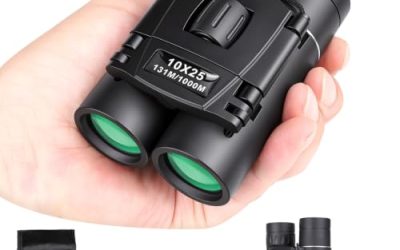
10×25 Compact Binoculars
The 10×25 pocket pair lists stargazing among many uses, from football games to cruises. It is waterproof, compact, and easy to carry, which makes it the most casual option here. Do not expect much from its small lenses beyond the moon, bright planets, and rich star fields.
- Strength: Truly portable, ready whenever the sky clears.
- Strength: Waterproof body fits camping and travel.
- Trade-off: The 25 millimeter lenses limit dim object visibility.
It suits a curious beginner or a traveler who wants a simple moon-and-stars companion, perhaps for a campsite, a beach, or a rooftop where a larger instrument would never come along. Because it is light, it is also the easiest pair here to hold up for a minute of casual sky-watching. Skip it if faint nebulae and galaxies are the goal.
ESSLNB 30×80 Binoculars
ESSLNB offers 30×80 with BAK4 prisms and targets bird watching, stargazing, hunting, travel, and concerts. The 80 millimeter lenses pull in a lot of light, and the 30x power brings distant detail forward, but both factors demand a stable platform.
- Strength: Large aperture for the money, helpful for faint objects.
- Strength: BAK4 prism for decent contrast at the budget tier.
- Trade-off: Thirty-power and heavy build make handheld use unrealistic.
It is for observers who own or will buy a tripod and want reach plus light gathering, whether that means the lunar terminator, the Beehive cluster, or distant daytime scenery from a fixed spot. Plan on a solid head and a bracket that holds it firmly, since the weight will strain a flimsy setup. Skip it if you want a lightweight pair for walking around.
Basics 7×50 High Power Binoculars
The 7×50 is the classic astronomy-friendly format, and this listing says it is ideal for stargazing and long-distance viewing, with a wide field of view, FMC optics, and tripod compatibility. It is the easiest of the five to use at first.
- Strength: Wide field of view and bright exit pupil for sweeping the Milky Way.
- Strength: Low power is easy to hold, with tripod compatibility for longer sessions.
- Trade-off: Seven-power will not show fine lunar detail the way 20x or 25x can.
It suits beginners learning constellations, families sharing one pair on a blanket, and anyone who wants a gentle introduction to the sky before committing to heavier gear. The wide field makes it easy to find Orion, the Pleiades, and the Milky Way. Skip it if you want to split tight double stars or study craters.
Which One Fits Your Situation
You are just learning the constellations
Start with the Basics 7×50. The wide field makes star-hopping easier, and low magnification means you can sit in a lawn chair and still find targets without a mount.
You want to see lunar craters and Jupiter’s moons
Choose the 20×50 or the 25×100 and use a tripod. The higher power reveals more detail, but a stable mount is what makes it useful.
You want maximum light for faint objects
The Sogries 25×100 or the ESSLNB 30×80 collects the most light. Treat them as semi-permanent backyard instruments rather than travel gear.
You travel often and want something small
The 10×25 compact fits a jacket pocket and handles the moon and bright stars. Do not expect it to replace a larger pair under a dark sky.
Common Mistakes
- Buying 30x or higher and trying to hold it by hand.
- Choosing magnification over aperture and ending up with a dim, shaky view.
- Skipping a tripod adapter or L-bracket for a heavy pair.
- Expecting binoculars to show planets in telescope-level detail.
- Ignoring dew, which can fog the lenses in a few minutes on a cold night.
Related guides
- How To Clean Quest 3 Lenses And Facial Interface
- Vr Facial Interfaces For Glasses Wearers
- Micro Sd Cards For Samsung Galaxy Phones
Frequently Asked Questions
What size binoculars are best for stargazing?
Fifty millimeter lenses are a solid starting point. Larger apertures show more but weigh more and need support.
Do I need a tripod?
For 20x and above, yes. Even at lower powers, a tripod or a chair that supports your elbows makes the view steadier and more comfortable.
Can binoculars show planets?
You can see Jupiter as a bright disk with its moons, and Saturn as an elongated shape at higher power. For rings and cloud bands, a telescope does better.
Is a budget pair good enough?
Yes, for learning the sky. Expect softer edges and some color fringing on bright stars, but the view is a big step up from the naked eye. Buyers who start with a modest pair often learn what they want next, whether that is a tripod head, a larger aperture, or eventually a small telescope.