The best Aquasana whole house filter for most homes is the Rhino EQ-1000 — its 1,000,000-gallon capacity spreads the purchase price across a decade of use, which works out to the lowest cost per gallon in the lineup. Smaller households can save upfront with the EQ-600, while homes on well water or with microbial concerns should step up to a Rhino system bundled with the UV sterilizer. Below we compare capacity, filtration stages, maintenance costs, and installation demands so you can match a system to your actual water use.
As an Amazon Associate we earn from qualifying purchases at no extra cost to you.


Our Top Picks
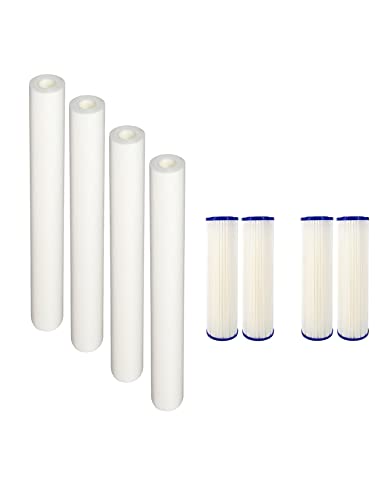 CFS Whole House Pre and Post Filter Sets4 Sets - Pre + Post Filter2.5 x 2.5 x 20 Inches2.99 PoundsCheck on Amazon


Top 3 picks at a glance
The lineup at a glance
| Model | Rated capacity | Flow rate | Stages | Best for |
|---|---|---|---|---|
| Rhino EQ-600 | 600,000 gal / ~6 yrs | ~7 GPM | 3 (sediment pre-filter, carbon + KDF) | 1–2 bathroom homes |
| Rhino EQ-1000 | 1,000,000 gal / ~10 yrs | ~7 GPM | 3 (sediment pre-filter, carbon + KDF) | 3+ bathroom homes |
| Rhino EQ-1000 + UV | 1,000,000 gal | ~7 GPM | 4 (adds UV lamp) | Well water, boil-advisory areas |
| Rhino + salt-free conditioner kit | 600k–1M gal (filter) | ~7 GPM | Filtration + scale control | Hard water regions |
All Rhino systems share the same core media: a sediment pre-filter, then a tank blending catalytic activated carbon with KDF (copper-zinc) media. That combination targets chlorine, chloramine, sediment, and scale-forming minerals, plus some heavy metals and VOCs. Aquasana’s unique dual-tank upflow design keeps the media loose and fluidized, which is why these units sustain higher capacity than a single dense tank.
Worked math: capacity vs. what your household actually uses
The number on the box only matters relative to your daily demand. A typical US household uses roughly 80–100 gallons per person per day for all indoor purposes — showers, laundry, dishes, drinking, flushing.
- 2 people × 90 gal/day = 65,700 gal/year. The EQ-600 lasts ~9 years at that rate — longer than its 6-year rating suggests, though media ages chemically too, so treat the time rating as the cap.
- 4 people × 90 gal/day = 131,400 gal/year. The EQ-600 runs out in ~4.5 years; the EQ-1000 covers ~7.6 years. The bigger tank wins on economics despite the higher sticker price.
- Cost per gallon: Whole house systems in this class typically run $800–$1,500 for the main tank alone, $1,300–$2,000 with UV or conditioner add-ons, before installation. At $1,000 for the EQ-1000 over a million gallons, that’s about $0.001 per gallon — versus $0.0017/gal for an EQ-600 at ~$800 actually used to 600,000 gallons. Add pre-filter replacements (see below) and real-world cost lands around $0.002–0.004/gal either way.
The takeaway: don’t buy the 600k tank to save $200–$400 if a 4-person household will burn through it in under five years. Buy by gallons-per-dollar, not sticker price.
Filtration stages: what each add-on actually does
Base Rhino (carbon + KDF)
Handles the common municipal complaints: chlorine taste and smell, chloramine, sediment, and a broad range of chemical contaminants. This is sufficient for most city-water homes. It does not soften water or kill microbes.
UV sterilizer add-on
A lamp chamber that neutralizes bacteria, viruses, and cysts like Giardia and Cryptosporidium. Worth it if you’re on well water, have had boil-water advisories, or have immunocompromised family members. Budget roughly $300–$500 extra plus annual lamp replacement (typically $50–$100) and a small electricity draw of ~15–30W — about $20–$30/year on your power bill.
Salt-free conditioner (Scale Control Media)
Template-assisted crystallization prevents hardness minerals from forming scale — it conditions rather than softens, so no salt, no drain line, and minerals remain in the water. Suits hard-water homes (10+ gpg) that want to protect appliances and water heaters without the feel of softened water.
Pro-grade install kit
A bypass manifold with brass fittings, shut-off valves, and a pre-filter pressure gauge. The gauge matters: it tells you when the sediment pre-filter is clogged so you replace on evidence, not a calendar. Around $100–$150 — worth it for DIY installs and for plumbers’ convenience.
Maintenance costs over 10 years
| Item | Frequency | Typical cost | 10-yr total |
|---|---|---|---|
| Sediment pre-filter | Every 2–3 months | $15–$25 each | $600–$1,500 |
| Main tank media | Once (EQ-1000) | Included | $0 |
| UV lamp | Yearly | $50–$100 | $500–$1,000 |
| UV sleeve cleaning | Yearly | Free (vinegar) | $0 |
The hidden cost is the pre-filter, not the main tank. Homes with heavy sediment may swap it monthly; clean city water can stretch to quarterly. Multiply your local cartridge price by 4–6 per year before comparing systems — this is where “cheap” tanks with proprietary pre-filters get expensive.
Installation requirements before you buy
- Location: Installs on the main water line after the meter/pressure regulator, before the water heater branches. You’ll need ~50+ inches of vertical clearance for the stacked dual-tank design and enough width for the bypass loop.
- Plumbing: Cutting into 3/4″ or 1″ copper/PEX. Professional installation typically runs $300–$800 depending on access. DIY is feasible with PEX tools and the pro kit.
- Space + drainage: The base system needs no drain or power. UV requires a nearby 120V outlet. No backwashing means no drain line — a real advantage over softeners and backwashing carbon tanks.
- Flow check: At ~7 GPM, one shower + one appliance is fine. Large homes running 3+ simultaneous showers should verify peak demand — some competitors push 10–15 GPM.
- Pre-install test: Get a basic water test ($20–$40 kits or municipal reports). If your issue is PFAS, arsenic, or nitrates, a carbon/KDF tank alone won’t fully address it — you’d pair it with a point-of-use reverse osmosis system at the kitchen tap.
Decision matrix: which system fits your situation
| Your situation | Recommended setup |
|---|---|
| City water, 1–2 people, chlorine taste is the complaint | Rhino EQ-600 |
| City water, family of 3–5 | Rhino EQ-1000 |
| Well water or history of boil advisories | Rhino EQ-1000 + UV |
| Hard water (>10 gpg), scaling on fixtures | Rhino + salt-free conditioner |
| PFAS/lead/nitrate concerns | Rhino for whole-house + under-sink RO at the tap |
FAQ
Does the Rhino remove fluoride?
Not meaningfully at the whole-house stage. Aquasana addresses fluoride in its OptimH2O under-sink reverse osmosis system — pair the two if fluoride removal is a priority.
Will it drop my water pressure?
Expect a modest drop (a few PSI) through the media beds, growing larger as the pre-filter clogs. If pressure suddenly falls, the pre-filter is the first suspect — that’s what the pro kit’s gauge is for.
Do I still need a water softener?
Only if you want true soft water (slick feel, zero hardness). The salt-free conditioner prevents scale but leaves mineral content unchanged — many households find that sufficient.
Related guides
- Best Streaming Gear for Twitch: Webcams, Capture Card, Backdrop and Light (2026)
- Best Over Ear Headphones: 9 Closed, Open-Back and Bluetooth Picks Explained (2026)
- Best Monitor for Console Gaming: Eight 1080p and 1440p Screens Compared by HDMI and Refresh Rate (2026)
- Best Monitors for PS5 Pro 4K 120Hz: Eight Screens and the HDMI Bandwidth Check (2026)