As an Amazon Associate we earn from qualifying purchases.
Affiliate disclosure: This article contains affiliate links. If you buy through them, this site may earn a commission at no additional cost to you.
Most AirPods Pro 3 reviews are written for commuters. This one is written for players: it examines Apple’s third-generation flagship earbuds (ASIN: B0FQFB8FMG) through the questions a gaming and VR-adjacent audience actually asks. How good is the head-tracked spatial audio for games and films? What does Bluetooth latency really mean for different genres? Can these earbuds stand in for a gaming headset, and where do they fall short? The assessment is built from Apple’s published specifications and launch coverage — it makes no detailed research claims — and it starts with the silicon, because one point needs stating clearly at the top.
Our Top Picks
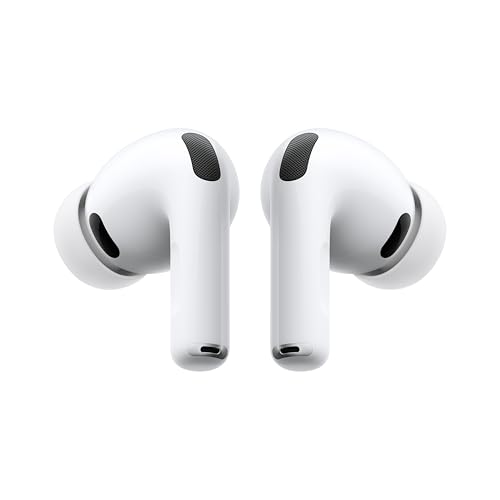 Apple AirPods Pro 3 Wireless Earbuds with ActiveOne Size1.1 x 0.8 x 1.2 inches0.02 poundsCheck on Amazon

Top 3 picks at a glance
The Chip: H2, and Why That Is Not a Disappointment
AirPods Pro 3 runs on Apple’s H2 chip, the same architecture introduced with AirPods Pro 2 — not a new H3. Apple directed its engineering budget elsewhere: a redesigned acoustic architecture, new foam-infused ear tips, upgraded drivers and amplifiers, and additional sensors. The H2 remains responsible for computational audio, adaptive noise cancellation and spatial audio processing, and it was not the bottleneck in the previous generation. Buyers waiting for a chip jump should recalibrate: this generation’s changes are acoustic, ergonomic and sensor-based, and they are substantial enough that the unchanged chip is a footnote rather than a flaw.
Spatial Audio: The Headline Feature for This Audience
Personalised Spatial Audio with dynamic head tracking is the feature that justifies reviewing these earbuds on a gaming site. Using the TrueDepth camera on an iPhone, the system maps the user’s ear geometry to tune the spatial rendering, and the H2 then re-renders supported audio in real time as the head moves, keeping the soundstage anchored to the screen rather than to the listener’s skull. In games that output a spatial mix — Apple Arcade titles, streamed console games, and films or shows with Dolby Atmos tracks — the effect is a stable, theatre-like image that plain stereo earbuds cannot produce, and it is the closest thing in the earbud category to the head-tracked audio that VR headsets have normalised.
The honest boundaries matter. Head-tracked spatial audio depends on the source: a game or app must supply a multichannel or spatialised mix, and most competitive PC titles are played through systems the AirPods connect to only over standard Bluetooth, where spatial features reduce to whatever the platform provides. On PlayStation and Xbox, the AirPods Pro 3 do not connect natively at all; a Bluetooth transmitter or remote-play route is required, and each added hop adds latency. With a Switch 2, native Bluetooth pairing works, and the experience is at its best in single-player titles where the audio mix, not the millisecond, is the point. In VR itself, a Quest headset’s built-in audio or a wired solution remains more practical than earbuds under a head strap for most players, though the Pro 3’s low profile makes them one of the more plausible earbud options for lying-back media viewing in a headset.
Latency: The Number That Decides Which Genres Work
Bluetooth audio latency is the hard physical limit of any wireless earbud, and no review aimed at gamers should skip it. Apple’s H2 pipeline is among the lowest-latency Bluetooth implementations available when paired with Apple devices, but even the best Bluetooth link carries a delay measured in tens of milliseconds at minimum, and more across non-Apple hosts. What that means in practice splits cleanly by genre. Turn-based games, RPGs, adventure titles, racing games played casually and all video content — where platforms compensate by delaying the picture — are unaffected. Rhythm games and competitive shooters are where the delay becomes a skill issue: audio cues for footsteps and gunfire arrive late relative to the image, and rhythm timing windows were designed around wired or proprietary 2.4GHz links.
The verdict on this point is not a criticism of the Pro 3 specifically — it applies to every Bluetooth earbud — but it defines their role. AirPods Pro 3 are an excellent single-player and media audio device and a poor substitute for a dedicated low-latency gaming headset at a desk or in a ranked queue. Apple’s own ecosystem softens this on iPhone and iPad gaming, where the pipeline is tightest; PC and console players should treat them as the portable option, not the primary one.
Noise Cancellation, Transparency and the Fit That Enables Both
Apple rates the Pro 3’s active noise cancellation at up to twice the reduction of the Pro 2 and four times the original AirPods Pro, achieved with ultra-low-noise microphones, computational audio and the new foam-infused silicone tips, which expand gently in the canal to improve the passive seal that ANC depends on. Five tip sizes are now included, extending down to an XXS size — a meaningful change for smaller ears, because seal quality is the single largest variable in both bass response and cancellation performance between individual listeners.
Adaptive Transparency continues to be the feature owners use most outside games: it passes the world through while automatically reducing harsh sounds above a threshold. For the gaming audience, the practical application is the living-room session — playing on a handheld or tablet while remaining aware of a doorbell, a child or a conversation — and it remains a capability most gaming headsets simply do not offer.
Microphones and Calls: The Streamer Question
Earbuds get asked to do double duty as streaming and Discord microphones, so the Pro 3’s voice pipeline deserves scrutiny. Apple applies H2-driven voice isolation that prioritises the wearer’s speech against background noise, and in launch coverage the call quality is consistently described as a step up from the Pro 2, particularly in wind and street noise. For casual Discord sessions, party chat and calls, the Pro 3 microphones are entirely adequate and better than most headset boom mics at rejecting a room. For content creation, the limits are physics and bandwidth: Bluetooth’s voice channel compresses audio hard, and no earbud mic competes with a dedicated USB or XLR microphone for a stream. The sensible setup mirrors the latency verdict — earbuds for chat on the move, a real microphone at the desk.
Against the Alternatives a Gamer Might Cross-Shop
The realistic rivals are not other earbuds alone. Sony’s WF-1000XM5 remains the audiophile cross-shop, with a warmer tuning many prefer for music and strong ANC, but without Apple’s spatial ecosystem or heart-rate sensing. Samsung’s Galaxy Buds line mirrors the Pro 3’s ecosystem play for Android owners. The more instructive comparison is with a dedicated wireless gaming headset in the same spending class: the headset wins on latency, microphone quality, battery per charge measured in days rather than hours, and console compatibility — and loses on portability, calls, fitness and every non-gaming hour of the day. Buyers who can only fund one should fund the device that matches where their hours actually are; buyers who fund both will find the Pro 3 is the one that leaves the house.
The New Sensors: Heart Rate Moves In
The Pro 3 adds heart-rate sensing to the earbuds, using photoplethysmography sensors that pulse infrared light to measure blood flow during workouts, feeding Apple’s Fitness app and compatible workout apps. It is a fitness feature rather than a gaming one, but it signals where the product line is going: the earbuds are becoming a sensor platform. For players, the indirect benefit is real — one device now covers the run, the commute and the evening session, which is the actual usage pattern of most owners.
Battery, Case and Durability
Apple rates the buds at up to 8 hours of listening with ANC enabled on a single charge, with the USB-C MagSafe charging case extending total listening to roughly 24 hours with ANC — note that the case contributes fewer top-ups than the Pro 2’s case did, a trade created by the buds’ own longer runtime. A five-minute charge in the case returns about an hour of listening. The buds carry an IP57 rating, improving dust and water resistance over the previous generation, and the case supports MagSafe, Qi and Apple Watch chargers, plus a lanyard loop and a speaker for Find My alerts.
Setup Notes for Players
Three configuration points decide how well the Pro 3 serves a gaming life. First, run the ear-tip fit test and be honest about changing sizes between ears; asymmetric sizing is common and the ANC and bass dividends of a correct seal are larger than any EQ adjustment. Second, on iPhone and iPad, enable Personalised Spatial Audio with a fresh ear scan and set head tracking per app: games and films benefit, while music listeners often prefer fixed spatial or plain stereo. Third, know the connection map before travelling: Switch 2 pairs natively, Apple devices pair best, Windows pairs as a standard Bluetooth device, and PlayStation and Xbox require a transmitter or a remote-play detour — packing a small USB-C Bluetooth transmitter is the difference between the Pro 3 working at a friend’s house and not. None of this is burdensome, but all of it is the difference between the earbuds as reviewed and the earbuds as experienced.
Who This Review Is Really For
The reader this review serves is the player whose gaming is spread across a life: a Switch 2 on the train, an iPad on the sofa, a phone everywhere, films at night and a desk setup for the serious sessions. That player’s audio problem was never the desk — it was everything else, and it is solved by a device that is always in a pocket, pairs instantly, cancels the train and renders a film’s Atmos mix with head-tracked width. The Pro 3 is that device at its current best. The player whose gaming is one chair, one PC and one ranked ladder should read this review as a well-executed answer to a question they are not asking, and put the money into the headset, the microphone or the GPU instead.
Verdict
Judged as gaming hardware, AirPods Pro 3 have a defined lane and they own it: the best spatial-audio experience available in an earbud for Apple-ecosystem gaming and media, class-leading noise cancellation built on a genuinely improved fit, and sensors no rival earbud currently matches. Judged as a headset replacement, they fail the latency test that every Bluetooth earbud fails, and console players face connection workarounds besides. The correct conclusion is complementary, not competitive: keep the dedicated headset at the desk, and let the AirPods Pro 3 be the device for handheld play, travel, films and everything between sessions. In that role, they are the strongest earbuds Apple has made, H2 chip and all.
Top Picks for Earbuds Worth Comparing
Gamers cross-shop earbuds on latency, noise cancellation and mic quality. These alternatives show where the AirPods sit against both mainstream and gaming-focused designs.
Apple AirPods Pro 3 Wireless Earbuds with Active Noise Cancellation
The model reviewed above, with active noise cancellation and heart-rate sensing. It fits best with iPhone, iPad and Mac, where its features integrate most smoothly.
Beats Studio Buds+ Earbuds, 36H Battery, Noise Cancelling
A noise-cancelling alternative with a listed 36-hour battery with the case. It works across Apple and Android phones, which suits mixed households.

AOC Gamebuds for PS5 PC Switch, 2.4GHz USB-C Dongle
Gaming-focused earbuds with a USB-C dongle for a direct wireless link. A dongle is usually the better path when you care most about lag on consoles or PC.

ASUS ROG Cetra True Wireless SpeedNova Gaming Earbuds
A dual-mode set with both 2.4GHz and Bluetooth connections. It is useful when you want one pair for a console session and for walking around.

Before You Choose
Latency is the key trade-off for gaming. Bluetooth earbuds add a short delay that matters in fast shooters, while dongle-based models usually keep it lower. Check mic quality for voice chat, and confirm the case and tips fit your ears for long sessions. Battery life and charging speed also deserve a look.
Related guides
More from Amazon
Programs that pair well with the guide above. Offers and eligibility are set by Amazon and may change.
Free shipping on eligible items, Prime Video and more. Eligible new members can start with a free trial.
Start a Prime free trialAd-free music streaming. Eligible new subscribers can start with a free trial.
Try Music Unlimited freeA Prime membership for ages 18-24 with a trial period. Eligibility is set by Amazon.
See Prime for Young AdultsAudiobooks and podcasts to listen to on the go. Eligible new members can start with a free trial.
Try Audible freeAs an Amazon Associate we earn from qualifying purchases.