Our Short List of 3

- Best for: People who want a simple, high-capacity desktop drive for a growing home archive.
- Best for: Households that want a large backup drive with software and recovery support included.

- Best for: People who want a large, password-protected archive for family photos, documents, and work files.
All 4 Picks at a Glance
| Product | Specs | Action |
|---|---|---|
| WD Elements 8TB Desktop External Hard Drive |
| Check price on Amazon |
| Seagate Expansion 8TB External Hard Drive |
| Check price on Amazon |
| WD My Book 8TB Desktop External Hard Drive |
| Check price on Amazon |
 Seagate IronWolf 4TB NAS Internal Hard Drive |
| Check price on Amazon |
Photos, game libraries, video projects, and years of documents do not disappear when a computer fills up, but they do become harder to protect. Cloud subscriptions add a monthly bill, small portable drives get lost, and a single internal drive can fail without warning. That is why many people still turn to a large hard drive for long-term storage. A well-chosen drive gives you room to keep everything in one place, move files off a crowded computer, and create a backup you can store safely away from daily use.
The best long term storage hard drives are not simply the largest drives available. They need the right balance of capacity, connection type, durability, and software support for the way you plan to use them. A desktop drive that stays on a desk suits a growing photo archive. A NAS-ready internal drive suits a home server that runs day and night. A drive with hardware encryption and backup software suits irreplaceable family files. This guide explains what matters, compares four hard drives based on specifications, features, and user feedback, and helps you choose one that fits your library, your setup, and your long-term plans.
Disclosure: As an Amazon Associate, we earn from qualifying purchases.
Our Top Picks
Top 3 picks at a glance
Quick Picks at a Glance
| Product | Key Spec | Best For |
|---|---|---|
| WD Elements 8TB Desktop External Hard Drive | 8 TB, USB 3.0, plug-and-play desktop drive | Simple, large desktop archives |
| Seagate Expansion 8TB External Hard Drive | 8 TB, USB 3.0, Rescue Data Recovery Services | Easy backups with recovery support |
| WD My Book 8TB Desktop External Hard Drive | 8 TB, USB 3.0, password protection and hardware encryption | Protected family and work archives |
| Seagate IronWolf 4TB NAS Internal Hard Drive | 4 TB, SATA 6 Gb/s, 3.5-inch NAS drive | NAS systems and always-on storage |
How to Choose
1. Capacity and Room to Grow
Start with how much you already have, then add room for the next few years. Photos, 4K video, and modern games grow quickly. An 8 TB desktop drive holds a very large photo collection, many game installs, and years of documents, while a 4 TB internal drive can be a sensible start for a NAS. Choose more capacity than you need today.
2. Durability and Drive Design
Long-term storage depends on a drive built for steady use. Desktop external drives use 3.5-inch mechanical hard drives inside a powered enclosure, which suits a desk or shelf. Internal NAS drives are designed for multi-bay enclosures and continuous operation, with firmware tuned for vibration, heat, and around-the-clock access. Check the intended use, warranty length, and data recovery services.
3. Interface and Connection Speed
The connection decides how quickly you can move a large archive onto the drive. Most desktop external drives in this guide use USB 3.0, which is widely compatible with Windows and Mac computers and fast enough for large transfers. Internal NAS drives use a SATA 6 Gb/s connection inside a NAS enclosure or desktop computer, which suits a shared home system rather than a drive you carry between computers.
4. Archival Suitability and Access Habits
A good archive drive is easy to write to, easy to find files on, and easy to leave alone. For cold storage, where files are written once and read rarely, a simple desktop drive that you connect, update, and then store safely can work well. For active archives, a NAS drive makes more sense because it stays connected. The best choice matches your habits, not just the largest capacity.
5. Backup Software and Data Protection
Hardware alone does not protect an archive. Backup software, password protection, and hardware encryption add layers that matter when a drive holds personal or work files. Some drives include backup tools that copy selected folders on a schedule, while others rely on the backup software already on your computer. Password protection and 256-bit AES hardware encryption help keep files private if a drive is lost or borrowed.
6. Form Factor, Power, and Placement
Desktop external drives need mains power and a stable place to sit, so they suit a home office or desk rather than a bag. Their larger 3.5-inch design allows higher capacities at a lower cost per terabyte than small portable drives. Internal NAS drives need a compatible bay, a SATA connection, and adequate cooling inside the enclosure. Measure the space on your desk or in your NAS, and check that you have a spare power outlet or drive bay.
Top Picks
WD Elements 8TB Desktop External Hard Drive
- Best for: People who want a simple, high-capacity desktop drive for a growing home archive.
People who want a simple, high-capacity desktop drive for a growing home archive.
WD Elements 8TB Desktop External Hard Drive
The WD Elements 8TB Desktop External Hard Drive, model WDBWLG0080HBK-NESN, is a straightforward choice for a large, stationary archive. It offers 8 TB in a 3.5-inch desktop enclosure with a USB 3.0 connection, so you can plug it into a Windows or Mac computer and start moving files without installing the drive inside a computer. The listing describes it as a mechanical hard drive with plug-and-play storage, which suits photo libraries, video collections, documents, and game backups that do not need to travel. Its upright black enclosure measures 6.53 inches tall, 5.31 inches deep, and 1.89 inches wide. Based on specifications, features, and user feedback, it is a simple capacity-first drive: few extras, plenty of room, and a familiar setup for freeing space on a main computer.
Pros:
– Large 8 TB capacity for photos, videos, and game libraries
– Simple USB 3.0 plug-and-play setup with no internal installation
– Desktop design suited to a fixed archive on a desk or shelf
– Widely compatible with Windows and Mac computers
Cons:
– Needs mains power and is not designed as a portable drive
– No password protection or hardware encryption listed as a headline feature
– Large file transfers still take time because it is a mechanical hard drive
Seagate Expansion 8TB External Hard Drive
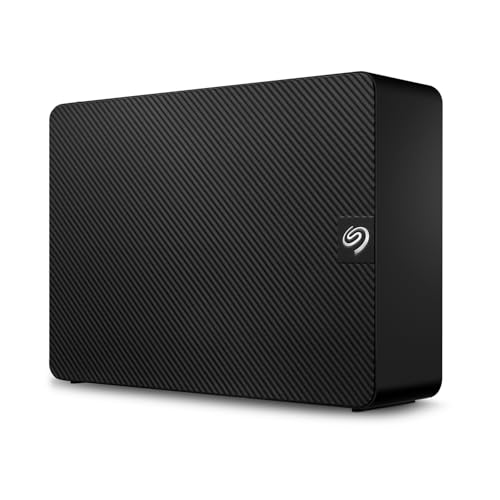
- Best for: Households that want a large backup drive with software and recovery support included.
Households that want a large backup drive with software and recovery support included.
Seagate Expansion 8TB External Hard Drive
The Seagate Expansion 8TB External Hard Drive, model STKP8000400, is another 8 TB desktop option, with a stronger focus on backup and recovery. It connects through USB 3.0 and is listed as an external hard drive for PC use, with Toolkit backup software and Rescue Data Recovery Services included. That combination suits long-term storage because it covers both sides of the job: copying files onto the drive, and having a recovery service to turn to if something goes wrong. It is a desktop unit rather than a pocket portable, so it works best in a fixed location. Based on specifications, features, and user feedback, it is a practical pick for households that want a large backup drive without learning a new storage system or opening a computer case.
Pros:
– Large 8 TB capacity for full-system and media backups
– Includes Toolkit backup software for scheduled copies
– Includes Rescue Data Recovery Services in the listing
– Simple USB 3.0 desktop setup for Windows and Mac use
Cons:
– Desktop design needs mains power and a fixed location
– Mechanical hard drive speeds are slower than solid-state storage for active work
– Recovery services have terms and limits, so read the listing before relying on them
WD My Book 8TB Desktop External Hard Drive
- Best for: People who want a large, password-protected archive for family photos, documents, and work files.
People who want a large, password-protected archive for family photos, documents, and work files.
WD My Book 8TB Desktop External Hard Drive
The WD My Book 8TB Desktop External Hard Drive, model WDBBGB0080HBK-NESN, is the most protection-focused external drive in this guide. It offers 8 TB of desktop storage through USB 3.0, along with password protection, 256-bit AES hardware encryption, and backup software for device management and automatic backup. Those features matter because archives often hold tax records, work files, scanned documents, and family photos that should stay private as well as safe. It is designed to work with PC and Mac computers, and its software helps manage backups and device settings. Based on specifications, features, and user feedback, it suits people who want one drive to hold a sensitive archive and protect it with a password, rather than a bare drive that anyone can plug in and read.
Pros:
– Large 8 TB capacity for sensitive personal and work archives
– Password protection and 256-bit AES hardware encryption
– Includes backup software for automatic backup and device management
– Desktop design suited to a fixed home office or media setup
Cons:
– Needs mains power and is not a portable travel drive
– Encryption and password setup add steps before first use
– Mechanical hard drive speeds are slower than solid-state drives for frequent editing
Seagate IronWolf 4TB NAS Internal Hard Drive
- Best for: NAS owners and home server users who want reliable, shared, always-on storage.
NAS owners and home server users who want reliable, shared, always-on storage.
Seagate IronWolf 4TB NAS Internal Hard Drive
The Seagate IronWolf 4TB NAS Internal Hard Drive, model ST4000VN008, is the internal pick in this guide and the right choice for a network storage system. It is a 3.5-inch internal hard drive with a SATA 6 Gb/s interface, designed for NAS servers, personal cloud storage, and RAID enclosures. Unlike the desktop external drives above, it installs inside a NAS or compatible desktop computer, where it can stay connected and share files across a home network. The listing describes it as a NAS hard drive for RAID network attached storage, with Rescue Services included, which suits always-on use. Based on specifications, features, and user feedback, it is best for people who already have, or plan to build, a NAS and want a dedicated archive that other devices can reach.
Pros:
– Designed for NAS, RAID, and always-on home storage systems
– 3.5-inch SATA 6 Gb/s internal design for multi-bay enclosures
– Includes Rescue Services in the listing for added peace of mind
– Good foundation for a shared family or media archive
Cons:
– Smaller 4 TB capacity than the 8 TB external drives in this guide
– Needs a compatible NAS enclosure or desktop bay and SATA connection
– Not a plug-and-play USB drive for quick use between computers
Comparison Table
| Product | Capacity | Interface | Form Factor | Key Feature |
|---|---|---|---|---|
| WD Elements 8TB Desktop External Hard Drive | 8 TB | USB 3.0 | 3.5-inch desktop external | Simple plug-and-play archive |
| Seagate Expansion 8TB External Hard Drive | 8 TB | USB 3.0 | 3.5-inch desktop external | Toolkit backup and Rescue Services |
| WD My Book 8TB Desktop External Hard Drive | 8 TB | USB 3.0 | 3.5-inch desktop external | Password protection and hardware encryption |
| Seagate IronWolf 4TB NAS Internal Hard Drive | 4 TB | SATA 6 Gb/s | 3.5-inch internal NAS | NAS and RAID ready |
Buying Guide
Choose by starting with the job, not the headline capacity. To clear space on one computer and keep a large photo or game library safe, an 8 TB desktop external drive is usually the simplest answer. To protect sensitive files, choose the WD My Book for its password protection and hardware encryption. To share files across a household, choose the Seagate IronWolf for a NAS.
A common mistake is treating one copy as a backup. Keep at least two copies of irreplaceable files in different places: one on your computer and one on an external drive, or one on a NAS and one on a second drive stored elsewhere. Leave free space, use clear folder names by year and project, and label the drive with its contents and the date of the last update.
Spin up a cold-storage drive every few months and check that files still open. Keep drives in a cool, dry place away from direct heat, dust, and knocks, and use a surge-protected outlet for desktop drives that stay plugged in. Check the warranty and recovery terms before you buy.
For gaming, a large hard drive is useful for storing games you are not playing right now, along with captures, mods, and installers. For photos and video, sort by date, keep originals separate from exports, and back up the originals first.
Frequently Asked Questions
How long can a hard drive store files?
A hard drive can store files for many years when kept in a cool, dry place, handled carefully, and checked from time to time. No drive lasts forever, so keep a second copy of irreplaceable files.
Are hard drives good for long-term storage?
Yes, hard drives offer large capacities for photos, videos, games, and documents at a lower cost per terabyte than many faster storage types. They work best as part of a backup plan with at least two copies.
Should I choose an external drive or a NAS drive?
Choose an external desktop drive for simple plug-and-play storage for one computer. Choose a NAS internal drive for shared storage that stays connected to a home network and serves several devices.
How much capacity do I need for long-term storage?
It depends on what you store. A photo library with raw files, a video collection, or a large game library can grow into several terabytes quickly. Add up your current files, then choose a drive with room for several years of growth. An 8 TB drive suits a large household archive, while a 4 TB NAS drive suits a smaller shared system.
Do I need backup software with a long-term storage drive?
Backup software can copy selected folders on a schedule. Some drives include backup tools, while others work with the backup software already on your computer. Verify after each backup that files copied correctly and can be opened.
How should I store a hard drive I am not using every day?
Store it in a cool, dry place away from heat, moisture, dust, and strong magnets, ideally in its original box or a padded case. Keep it upright and stable, avoid drops and knocks, and connect it every few months to check files and refresh the backup.
Conclusion
The best long term storage hard drives give you room, reliability, and a routine you can maintain for years. For a simple large archive, start with the WD Elements 8TB. For backups with recovery support, choose the Seagate Expansion 8TB. For a protected family or work archive, choose the WD My Book 8TB. For a shared home system, choose the Seagate IronWolf 4TB for a NAS.
Whichever drive you choose, buy for the archive you will have in a few years, not just the files you have today. Copy files carefully, verify them, keep a second copy of anything irreplaceable, and check the drive regularly. A good hard drive gives you a simple, repeatable way to keep photos, games, and documents safe for the long term.
Related guides
More from Amazon
Programs that pair well with the guide above. Offers and eligibility are set by Amazon and may change.
Free shipping on eligible items, Prime Video and more. Eligible new members can start with a free trial.
Start a Prime free trialAd-free music streaming. Eligible new subscribers can start with a free trial.
Try Music Unlimited freeA Prime membership for ages 18-24 with a trial period. Eligibility is set by Amazon.
See Prime for Young AdultsAudiobooks and podcasts to listen to on the go. Eligible new members can start with a free trial.
Try Audible freeAs an Amazon Associate we earn from qualifying purchases.