Our Short List of 3

- Best for: A Ryzen 9000 build planned around Gen5 SSDs, USB4 devices and a long service life.
- Socket AM5 with AMD X870 chipset, supports Ryzen 9000, 8000 and 7000 series
- ATX form factor, 4x DDR5 DIMM slots, memory speeds listed up to 8200 MT/s
- 16+2+2 twin digital VRM design
- 4x M.2 slots, with PCIe 5.0 x16 graphics slot

- Best for: A Core Ultra build with several NVMe drives and high-speed external devices.
- Socket LGA 1851 with Intel Z890 chipset, for Intel Core Ultra Series 2 processors
- ATX form factor, 4x DDR5 DIMM slots
- 18+2+1+2 power stage design as listed in the product title
- 7x M.2 slots and a PCIe 5.0 x16 graphics slot

- Best for: A compact Ryzen gaming PC in a micro-ATX case that still wants a Gen5 SSD option.
- Socket AM5 with AMD B650 chipset, supports Ryzen 9000, 8000 and 7000 series
- Micro-ATX form factor, 4x DDR5 DIMM slots, up to 7200+ MT/s with overclocking
- 8+2+1 power phase design with Dr.MOS
- 3x M.2 slots, including one PCIe 5.0 x4 slot
All 3 Picks at a Glance
| Product | Specs | Action |
|---|---|---|
| GIGABYTE X870 AORUS Elite WIFI7 |
| Check price on Amazon |
| ASUS ROG Strix Z890-E Gaming WiFi |
| Check price on Amazon |
| ASRock B650M Pro RS WiFi |
| Check price on Amazon |
A motherboard rarely makes a build faster on its own, but the wrong one can block everything else: a socket that excludes your CPU, a chipset with too few storage lanes, or memory support that stops below the kit you already bought. The real decision is which platform you are committing to for the next several years, because the board fixes the CPU family, the memory generation and most of your expansion room in a single purchase.
This guide is for builders starting a new gaming PC and for upgraders whose current board has run out of storage slots, networking or CPU support. The five picks span AMD AM5, Intel LGA 1700 and Intel LGA 1851, and each one was chosen from the specifications printed on its Amazon product page, so the socket, chipset, memory and slot counts below can be checked against the listing before you order.
Our Top Picks
Top 3 picks at a glance
Quick Picks
As an Amazon Associate we earn from qualifying purchases
| Product | Best for | Key spec from title |
|---|---|---|
| MSI MAG B650 Tomahawk WiFi | Most AM5 gaming builds | AM5, DDR5, 3x M.2, Wi-Fi 6E |
| GIGABYTE X870 AORUS Elite WIFI7 | Ryzen 9000 builds wanting USB4 | PCIe 5.0, 4x M.2, Wi-Fi 7 |
| MSI MAG Z790 Tomahawk WiFi | Intel 12th to 14th Gen DDR5 builds | LGA 1700, PCIe 5.0, Wi-Fi 6E |
| ASUS ROG Strix Z890-E Gaming WiFi | Core Ultra builds with many drives | LGA 1851, 7x M.2, Thunderbolt 4 |
| ASRock B650M Pro RS WiFi | Compact micro-ATX AM5 builds | Micro ATX, Gen5 M.2, Wi-Fi 6E |
How to Choose
Match the socket and chipset to your CPU first
Socket compatibility is absolute: an AM5 board takes only Ryzen 7000, 8000 and 9000 processors, an LGA 1700 board takes Intel 12th, 13th and 14th Gen chips, and LGA 1851 is reserved for Core Ultra Series 2. Within a socket, the chipset sets the ceiling for overclocking, lane counts and port totals. A B650 board runs any current Ryzen chip, while X870 adds mandatory USB4 and PCIe 5.0 wiring. Decide the CPU first, then filter boards by socket, then compare chipsets inside that shortlist rather than across platforms.
Count M.2 slots and check PCIe lane sharing
Modern game libraries eat storage, so the number of M.2 slots matters more than it did a few years ago. Three slots is a comfortable minimum for a gaming build; boards below offer three, four or even seven. Raw counts hide a catch, though: on many boards, filling certain M.2 slots borrows bandwidth from the main PCIe x16 graphics slot or disables a SATA port. Read the lane-sharing notes in the manual for any board you plan to fill completely, especially on high-slot-count models, so a fourth SSD does not quietly slow the graphics card.
Check memory generation, capacity and BIOS support
Every board in this guide uses DDR5, which means DDR4 kits from an older build cannot be carried over. Check three figures on the listing: the number of DIMM slots, the maximum capacity, and the rated memory speed with overclocking profiles such as EXPO or XMP. Also confirm the BIOS situation for newer CPUs on older chipsets. A B650 board may need a firmware update before a Ryzen 9000 processor will boot, and a rear Flash BIOS button lets you apply that update without a supported CPU installed.
Compare networking, USB and form factor
Networking separates boards that look similar on paper. Wi-Fi 6E is the sensible baseline for a gaming build, Wi-Fi 7 suits households already running a Wi-Fi 7 router, and wired speeds range from 2.5Gbps to 5Gbps LAN. Count rear USB ports against your peripherals, headsets and VR sensors, and note whether fast Type-C or Thunderbolt 4 is included. Finally, match the form factor to your case: ATX boards give the most slots and spacing, while micro-ATX boards like the ASRock below fit smaller cases with fewer expansion compromises than buyers usually expect.
The 5 Best Options
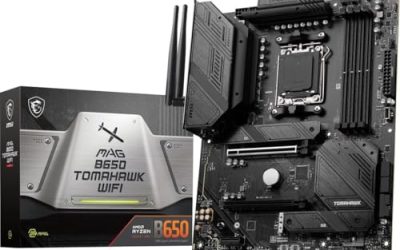
MSI MAG B650 Tomahawk WiFi
For most people building a Ryzen gaming PC, this is the board to beat. It pairs the AM5 socket with a 14+2+1 power design that handles everything from a Ryzen 5 up to the flagship Ryzen 9 chips, three M.2 slots for a growing game library, and networking that needs no add-in cards. Because B650 boards have been on sale for several CPU generations now, the platform is mature, the BIOS is stable, and the listing’s specification list is long without drifting into features most gaming builds never touch.
Specs
- Socket AM5 with AMD B650 chipset, supports Ryzen 9000, 8000 and 7000 series
- ATX form factor, 4x DDR5 DIMM slots
- 14+2+1 Duet Rail power system with 80A smart power stages
- 3x M.2 slots, PCIe 4.0, plus SATA 6Gb/s ports
- PCIe 4.0 x16 graphics slot
- Wi-Fi 6E, Bluetooth 5.3 and 2.5Gbps LAN
- USB 3.2 Gen 2, HDMI and DisplayPort outputs
Best for: A first AM5 gaming build that should last through at least one CPU upgrade.
Watch out for: Boards from early production runs can ship with a BIOS too old for Ryzen 9000 chips, so confirm the listing’s stated support or plan a Flash BIOS update before first boot.
GIGABYTE X870 AORUS Elite WIFI7
- Best for: A Ryzen 9000 build planned around Gen5 SSDs, USB4 devices and a long service life.
- Socket AM5 with AMD X870 chipset, supports Ryzen 9000, 8000 and 7000 series
- ATX form factor, 4x DDR5 DIMM slots, memory speeds listed up to 8200 MT/s
- 16+2+2 twin digital VRM design
- 4x M.2 slots, with PCIe 5.0 x16 graphics slot
A Ryzen 9000 build planned around Gen5 SSDs, USB4 devices and a long service life.
Filling every M.2 slot can change how lanes are divided with the graphics slot, so check the manual’s slot configuration table before installing four drives.
Builders who want the current AM5 feature set rather than the value tier should look at this X870 board. It keeps the same Ryzen 9000, 8000 and 7000 support as the B650 picks but wires the graphics slot and three of its four M.2 slots for PCIe 5.0, adds dual USB4 Type-C ports, and moves networking up to Wi-Fi 7. The 16+2+2 power design and full-metal thermal armour suit sustained loads from high-core-count processors, and the EZ-Latch fittings make GPU and SSD swaps tool-light. A five-year warranty is printed in the listing title, longer than most boards carry.
Watch out for: Filling every M.2 slot can change how lanes are divided with the graphics slot, so check the manual’s slot configuration table before installing four drives.
MSI MAG Z790 Tomahawk WiFi
Intel builders holding a 12th, 13th or 14th Gen processor get the same Tomahawk formula on LGA 1700: a 16+1+1 power design with 90A stages, four M.2 slots and a PCIe 5.0 graphics slot, wrapped in an ATX board with strong rear I/O. It is the natural landing spot for anyone upgrading from an early LGA 1700 board whose VRM or storage ran out first, and for new builds that pair a discounted 14th Gen chip with DDR5 memory. Wi-Fi 6E and 2.5Gbps LAN are built in, so networking needs no expansion card.
Specs
- Socket LGA 1700 with Intel Z790 chipset, supports 12th, 13th and 14th Gen Intel processors
- ATX form factor, 4x DDR5 DIMM slots, memory support up to 7200+ MT/s with overclocking
- 16+1+1 Duet Rail power system with 90A smart power stages
- 4x M.2 slots and PCIe 5.0 x16 graphics slot
- Wi-Fi 6E, Bluetooth 5.3 and 2.5Gbps LAN
- USB 3.2 Gen 2, HDMI and DisplayPort outputs
Best for: A DDR5 build around an Intel 13th or 14th Gen Core i7 or i9 that needs real VRM headroom.
Watch out for: MSI sells a DDR4 board with a nearly identical name, so confirm the listing title says DDR5 before ordering, especially when comparing marketplace offers.
ASUS ROG Strix Z890-E Gaming WiFi
- Best for: A Core Ultra build with several NVMe drives and high-speed external devices.
- Socket LGA 1851 with Intel Z890 chipset, for Intel Core Ultra Series 2 processors
- ATX form factor, 4x DDR5 DIMM slots
- 18+2+1+2 power stage design as listed in the product title
- 7x M.2 slots and a PCIe 5.0 x16 graphics slot
A Core Ultra build with several NVMe drives and high-speed external devices.
Several of the seven M.2 slots share bandwidth with the expansion slots, so read the lane-sharing chart in the manual before assuming all seven drives and the GPU run at full speed together.
The newest Intel platform gets its entry here: an LGA 1851 board for Core Ultra Series 2 processors with the heaviest storage layout in this guide. Seven M.2 slots is more than any gaming build strictly needs, but it suits creators and VR users who keep several large libraries installed at once. The listing title lists an 18+2+1+2 power stage design, Wi-Fi 7 and Thunderbolt 4, and the board adds ASUS AI overclocking and cooling tools for owners who tune. It is a premium board, and it only makes sense paired with a processor and graphics card of similar ambition.
Watch out for: Several of the seven M.2 slots share bandwidth with the expansion slots, so read the lane-sharing chart in the manual before assuming all seven drives and the GPU run at full speed together.
ASRock B650M Pro RS WiFi
- Best for: A compact Ryzen gaming PC in a micro-ATX case that still wants a Gen5 SSD option.
- Socket AM5 with AMD B650 chipset, supports Ryzen 9000, 8000 and 7000 series
- Micro-ATX form factor, 4x DDR5 DIMM slots, up to 7200+ MT/s with overclocking
- 8+2+1 power phase design with Dr.MOS
- 3x M.2 slots, including one PCIe 5.0 x4 slot
A compact Ryzen gaming PC in a micro-ATX case that still wants a Gen5 SSD option.
ASRock also sells a non-WiFi version of this board under a similar name, so check the listing title includes WiFi if wireless networking matters to your build.
A smaller case does not have to mean an older platform. This micro-ATX board brings AM5 and DDR5 down to a compact footprint and a lower price band while keeping one feature bigger boards charge more for: a PCIe 5.0 M.2 slot for a Gen5 boot drive, backed by two further M.2 slots. The 8+2+1 power design with Dr.MOS stages is aimed at the mid-range Ryzen chips most compact builds use, and Wi-Fi 6E plus 2.5G LAN are integrated rather than optional. For a desk-friendly Ryzen build, it covers the essentials without paying for unused full-size slots.
Watch out for: ASRock also sells a non-WiFi version of this board under a similar name, so check the listing title includes WiFi if wireless networking matters to your build.
Which One Fits Your Situation
You are building a new Ryzen gaming PC
Start with the MSI MAG B650 Tomahawk WiFi if the budget has to stretch across a graphics card and monitor as well; it covers the platform’s essentials with mature firmware. Choose the GIGABYTE X870 AORUS Elite WIFI7 instead when the build uses a Ryzen 9000 processor, a Gen5 SSD or USB4 storage, because its PCIe 5.0 wiring and newer networking are the parts you cannot retrofit later.
You are upgrading an Intel LGA 1700 system
The MSI MAG Z790 Tomahawk WiFi is the drop-in step up: your 12th, 13th or 14th Gen processor carries over, DDR5 support is standard, and the stronger power design removes the VRM ceiling that limits many early LGA 1700 boards. It also suits a fresh build built around a discounted 14th Gen chip, provided the listing confirms DDR5 rather than the DDR4 namesake.
You are moving to Intel Core Ultra
The ASUS ROG Strix Z890-E Gaming WiFi is the pick for an LGA 1851 build that will hold several NVMe drives or fast Thunderbolt devices. Its seven M.2 slots and Wi-Fi 7 are over-provisioned for a single-GPU gaming rig, which is why it fits builders who also capture, edit or keep multiple game libraries installed. Pair it with a Core Ultra chip from the same tier.
You are building small
The ASRock B650M Pro RS WiFi fits micro-ATX cases while keeping AM5, DDR5 and a Gen5 M.2 slot, so a compact build gives up expansion slots rather than platform life. Check your case’s rear clearance for the Wi-Fi antenna leads and confirm the graphics card length against the smaller board layout before ordering parts around it.
Common Mistakes
- Buying a board before choosing the CPU, then discovering the socket excludes the processor you wanted.
- Assuming DDR4 memory carries over to a new build when every current platform here requires DDR5.
- Filling every M.2 slot without reading the lane-sharing table, then finding the graphics slot running below x16.
- Paying for a flagship chipset when the build uses one GPU and two SSDs, which a mid-range board already covers.
- Ignoring rear USB and networking counts until headsets, VR sensors and capture gear compete for too few ports.
Frequently Asked Questions
Will a B650 board hold back a Ryzen 9000 processor?
No. B650 boards support Ryzen 9000 chips, and the power designs on boards like the Tomahawk above run even the flagship parts at their rated boost behaviour. What you give up versus X870 is feature wiring such as USB4 and PCIe 5.0 on more slots, not CPU performance. A BIOS update may be required before the newer processor will boot.
Can I reuse my DDR4 memory on any of these boards?
No. All five boards in this guide use DDR5, and DDR4 modules physically do not fit the slots. Budget for a DDR5 kit when moving from an AM4 or early Intel platform. The only DDR4 boards still sold for these sockets are older-generation models, and choosing one means giving up the newer chipsets and CPU support listed here.
How many M.2 slots does a gaming PC actually need?
Two is enough for most builds: one fast drive for the operating system and current games, one larger drive for the back catalogue. Three or four slots help if you record gameplay or keep many large titles installed. Beyond that, check lane sharing, because extra slots on some boards borrow bandwidth from the graphics slot when populated.
Do LGA 1700 coolers fit the LGA 1851 socket?
Yes, in most cases. LGA 1851 keeps the same mounting hole pattern as LGA 1700, so the majority of coolers that list LGA 1700 support also mount on Z890 boards like the ASUS above. Check the cooler maker’s compatibility list for your exact model before relying on it, and use fresh thermal paste whenever a cooler moves to a new processor.
Related guides
More from Amazon
Programs that pair well with the guide above. Offers and eligibility are set by Amazon and may change.
Free shipping on eligible items, Prime Video and more. Eligible new members can start with a free trial.
Start a Prime free trialAd-free music streaming. Eligible new subscribers can start with a free trial.
Try Music Unlimited freeA Prime membership for ages 18-24 with a trial period. Eligibility is set by Amazon.
See Prime for Young AdultsAudiobooks and podcasts to listen to on the go. Eligible new members can start with a free trial.
Try Audible freeAs an Amazon Associate we earn from qualifying purchases.