As an Amazon Associate, we earn from qualifying purchases made through links on this page.
Most gaming mouse advice pushes lighter and lighter shells, but a large group of players genuinely aims better with mass under the hand. A heavy gaming mouse resists small hand tremors, makes low-sensitivity arm movements easier to stop precisely, and gives flick shots a planted, deliberate feel instead of a skatey one. Players who came up on older office-style mice, MMO and MOBA players who rest the whole palm on the shell, and anyone who finds ultralight mice twitchy often end up shopping in exactly this category.
This guide covers the best heavy gaming mouse options that are still sold new on Amazon US, verified at the time of writing. Every pick qualifies on weight by specification: either a stock weight well above the modern lightweight class, or a tuning system that lets you add mass and shift the balance point. We compare the Logitech G502 HERO, the Corsair Nightsword RGB, and the Razer Basilisk V3 Pro on sensor performance, button layout, weight adjustment, and grip fit, so you can match the heft to the way you actually play.
Our Top Picks

Top 3 picks at a glance

What to look for in a heavy gaming mouse
How much weight is “heavy” now
The current competitive scene has pushed mainstream gaming mice down toward the 50–70 gram range, so anything over roughly 100 grams sits in heavy territory today, and models in the 115–145 gram band are genuinely weighty. What matters is not the number alone but how the mass is distributed. A mouse with its balance point under the palm feels stable and calm, while a nose-heavy shell can feel like it wants to tip forward during lifts. If you play at low sensitivity and lift often, check where reviewers and manufacturers place the center of gravity, and prefer designs that keep it centered or slightly rearward.
Adjustable weights versus fixed weight
Two of the picks below include physical weight systems. Removable weights let you start lighter while you adapt, then add mass in small steps until stopping power feels right. They also let you change the balance, not just the total: the Nightsword, for example, uses two mounting zones so you can bias the mouse forward or backward. A fixed-weight design such as the Basilisk V3 Pro is simpler and avoids loose parts, but you are committed to the stock figure, so check it against the mice you already own before buying.
Sensor and buttons still matter
Weight should never be an excuse for a weak sensor. All three picks here use proven optical sensors with high tracking ceilings, so heavy does not mean outdated. Button count is the other deciding factor, because heavy mice are disproportionately popular with MMO, MOBA, and simulation players who bind abilities, macros, and push-to-talk to the mouse. Count the buttons you will actually use, check whether the side cluster is reachable without regripping, and confirm the software supports per-game profiles if you switch titles often.
Wired or wireless at this weight
Heavy mice exist in both formats, and the choice changes the experience more than the spec sheet suggests. A wired heavy mouse is the simpler tool: no battery to charge, no receiver to place, and the full weight budget goes into the shell and the weight system rather than a cell. A wireless heavy mouse such as the Basilisk V3 Pro trades some maximum mass for freedom of movement, which matters if your low-sensitivity swings cover a large pad. Neither format is more accurate in 2026; pick based on whether you value tuning range or cable-free movement.
Grip style and hand size
Heavy mice pair naturally with palm grip, where the shell supports the whole hand and the mass works for you. Claw grip players can still enjoy a heavier mouse, but fingertip players usually fight the inertia on every micro-adjustment. Shell length and hump position matter as much as grams: a tall rear hump fills the palm and spreads the weight, while a low, long shell suits larger hands. If your hand measures on the smaller side, a compact heavy mouse will feel more controllable than a long flagship hull.
The best heavy gaming mouse picks
Logitech G502 HERO (ASIN: B07GBZ4Q68)

See the Logitech G502 HERO on Amazon
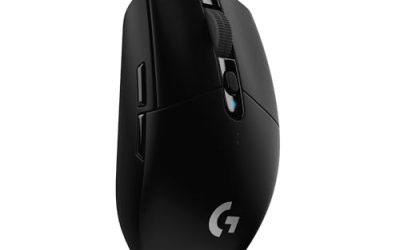
The G502 HERO is the default recommendation in this category for a reason: it is one of the few mice that lets you build your own weight. The stock shell weighs 121 grams, and the box includes five 3.6-gram weights that slot into the base and side compartments, taking the total to roughly 139 grams and letting you bias the balance toward the front, back, or sides. Under the shell, the HERO 25K sensor tracks up to 25,600 DPI with the consistency that made this model a long-running staple for both esports-adjacent players and everyday gaming.
- Sensor: Logitech HERO 25K optical, up to 25,600 DPI
- Weight: 121 g stock, up to about 139 g with the five included 3.6 g weights
- Buttons: 11 programmable, including a sniper (DPI shift) button
- Connection: wired USB with a braided cable
- Extras: LIGHTSYNC RGB, onboard memory, mechanical button tensioning
Who it is for: palm and claw players who want one mouse that can be tuned from medium-heavy to properly heavy, plus MMO and MOBA players who will use the full button cluster and the dual-mode scroll wheel.
Limitations: it is wired only, the shape is right-handed and fairly narrow for its length, and the sculpted shell with its many edges collects dust in the grooves. The weight system is generous, but players who want more than about 139 grams have nowhere further to go.
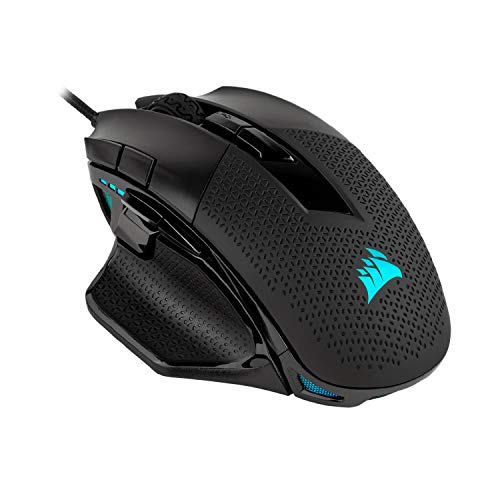
Corsair Nightsword RGB (ASIN: B07QX9C9WH)
See the Corsair Nightsword RGB on Amazon
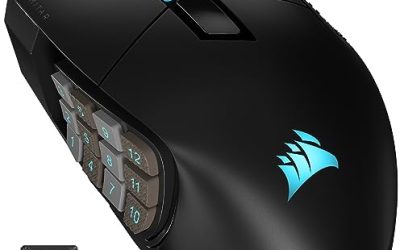
The Nightsword RGB takes weight tuning further than anything else in this guide. Its chassis accepts weights in two separate mounting zones, giving a total range of 119 to 141 grams and, more importantly, real control over the center of gravity: load the rear zone to calm the back of the mouse during arm swings, or the front zone if you like the nose to lead. The PixArt PMW3391 sensor is a custom Corsair variant rated to 18,000 DPI, and it tracks with the precision expected of a flagship wired mouse.
- Sensor: PixArt PMW3391 optical, up to 18,000 DPI
- Weight: adjustable from 119 g to 141 g across two mounting zones
- Buttons: 10 programmable, with a dedicated sniper button
- Connection: wired USB, 1.8 m braided cable
- Extras: dynamic RGB zones, iCUE software, onboard profile storage
Who it is for: larger-handed palm grippers who want the heaviest adjustable option here and care about balance as much as raw grams. The wide, flared base and textured thumb rest suit players who plant the whole hand and push the mouse with the arm.
Limitations: the shell is big, and smaller hands will struggle to reach the sniper button without shifting grip. It is wired only, the weight system adds complexity some players will set once and never touch again, and iCUE is a heavier software install than some rivals.
Razer Basilisk V3 Pro (ASIN: B0B42XQNMH)
See the Razer Basilisk V3 Pro on Amazon
The Basilisk V3 Pro is the heavy pick for players who refuse to give up wireless. At 112 grams it is the lightest mouse in this guide, which tells you how far the market has shifted, but it still lands far above the ultralight class and carries that weight in a dense, right-handed ergonomic shell with a proper thumb rest. The Focus Pro 30K optical sensor is among the most capable ever fitted to a wireless mouse, and Razer’s HyperSpeed connection keeps latency at wired-competitive levels, with Bluetooth as a battery-saving fallback for work hours.
- Sensor: Razer Focus Pro 30K optical, up to 30,000 DPI
- Weight: 112 g fixed
- Buttons: 11 programmable, including a multi-function trigger
- Connection: HyperSpeed 2.4 GHz wireless, Bluetooth, and wired USB-C
- Extras: HyperScroll tilt wheel, optical switches, up to 90 hours of battery on HyperSpeed
Who it is for: palm grippers who want a weighty, feature-dense mouse for both gaming and desktop work, and who value the free-spinning tilt wheel and wireless freedom more than adjustable mass.
Limitations: the weight is fixed, so there is no way to push past 112 grams, and it is noticeably lighter than the two wired picks if maximum heft is your priority. Full feature access needs Razer Synapse, and the charging dock and wireless charging puck are separate purchases.
Comparison table
| Model | Weight | Sensor | Max DPI | Buttons | Connection | Weight adjustable |
|---|---|---|---|---|---|---|
| Logitech G502 HERO | 121 g, up to ~139 g | HERO 25K | 25,600 | 11 | Wired USB | Yes, five 3.6 g weights |
| Corsair Nightsword RGB | 119–141 g | PixArt PMW3391 | 18,000 | 10 | Wired USB | Yes, two-zone system |
| Razer Basilisk V3 Pro | 112 g | Focus Pro 30K | 30,000 | 11 | Wireless, Bluetooth, USB-C | No |
Frequently asked questions
Is a heavy gaming mouse bad for your wrist?
Weight alone does not make a mouse harmful, but a heavy mouse moved with the wrist at high sensitivity concentrates effort in a small joint. Heavy mice feel best when paired with a lower sensitivity and arm-based movement, which spreads the work across larger muscles. If you feel strain, reduce the weight, raise your sensitivity slightly, or take breaks; persistent pain deserves medical advice, not a peripheral swap.
What weight counts as a heavy gaming mouse today?
With competitive mice now commonly between 50 and 70 grams, anything over about 100 grams reads as heavy, and the 115–145 gram range covered in this guide is the genuinely weighty end of the current market. Players moving from an ultralight mouse should expect an adjustment period of several days.
Are adjustable weights worth it?
They are worth it if you are unsure of your preferred weight or share the mouse between games with different demands. The systems in the G502 HERO and Nightsword RGB let you change both total mass and balance in small steps, which is a cheaper experiment than buying two mice. If you already know you like a specific weight, a fixed design is simpler.
Can a heavy mouse work for FPS games?
Yes, particularly for low-sensitivity players who value stopping precision over rapid flick speed, and for tactical shooters where crosshair placement matters more than constant large swipes. Fast arena-style play at very low sensitivity is where heavy mice feel most tiring, because every repositioning lift moves more mass.
Conclusion
For most buyers, the Logitech G502 HERO is the safest heavy gaming mouse: a proven sensor, 11 buttons, and a weight range that stretches from 121 to about 139 grams covers the majority of control-first players. Choose the Corsair Nightsword RGB if you want the widest tuning range and a larger shell for palm grip, or the Razer Basilisk V3 Pro if your heavy mouse also has to be wireless and double as a productivity tool. Whichever you pick, give your aim a few days to recalibrate before judging the change.
Related guides
More from Amazon
Programs that pair well with the guide above. Offers and eligibility are set by Amazon and may change.
Free shipping on eligible items, Prime Video and more. Eligible new members can start with a free trial.
Start a Prime free trialAd-free music streaming. Eligible new subscribers can start with a free trial.
Try Music Unlimited freeA Prime membership for ages 18-24 with a trial period. Eligibility is set by Amazon.
See Prime for Young AdultsAudiobooks and podcasts to listen to on the go. Eligible new members can start with a free trial.
Try Audible freeAs an Amazon Associate we earn from qualifying purchases.