As an Amazon Associate, we earn from qualifying purchases made through links on this page.
Wireless mice have closed the latency gap, but wired mice still hold real advantages for FPS players: no battery to manage or die mid-match, no receiver to position, a lighter shell because there is no cell inside, and high-polling models that push report rates far beyond the long-standing 1,000 Hz standard. If your desk is a permanent setup and your games are tactical shooters, arena FPS, or battle royale titles, the best wired gaming mouse for FPS remains a deliberate, defensible choice rather than a compromise.
This guide compares three wired mice that are still sold new on Amazon US, verified at the time of writing. The Razer DeathAdder V3 and Razer Viper 8KHz represent the modern FPS formula from two angles: an ergonomic shape with a flagship sensor and 8K polling, and an ambidextrous shape built entirely around its 8,000 Hz report rate. The Logitech G502 HERO closes the list as the control-focused alternative for players who prefer weight and buttons over minimum mass.
Top 3 picks at a glance


What to look for in a wired gaming mouse for FPS
Polling rate and what it changes
Polling rate is how often the mouse reports its position: 1,000 Hz means a report every millisecond, while 8,000 Hz reports every 0.125 milliseconds. On a high-refresh monitor, higher polling makes cursor motion visibly smoother and reduces the delay between a flick and its on-screen result. The gains are real but diminishing, and they assume your PC can handle the interrupt load; both 8K picks below let you step the rate down in software. For most players, a flawless sensor at 1,000 Hz already performs well, but if you run a 240 Hz or faster display, 8K wired models are where the remaining responsiveness lives.
Weight, shape, and grip
FPS aiming rewards a shell you can stop as precisely as you can move. Current wired FPS mice cluster between roughly 55 and 75 grams, light enough for repeated lifts at low sensitivity without the hollow feel of extreme cuts. Shape matters more than the number: the DeathAdder V3’s ergonomic curve supports palm and relaxed claw grips on medium to large hands, while the Viper 8KHz’s low ambidextrous body suits claw and fingertip players and works in either hand. Match the shell to your grip before chasing specifications.
Sensor quality over headline DPI
Every sensor here tracks far beyond usable DPI settings; competitive players typically play between 400 and 3,200 DPI regardless of the maximum printed on the box. What separates good FPS sensors is consistency: no acceleration, no smoothing surprises at speed, and clean tracking during fast swipes. The Focus Pro and Focus+ sensors in the Razer picks and Logitech’s HERO sensor all meet that standard, which is why older but proven designs remain on this list.
Feet, switches, and the details that decide feel
Two mice with identical sensors can feel completely different in a flick, and the difference usually lives in the feet and switches. Large, pure PTFE feet glide consistently across cloth and hard pads and keep static friction low, so small corrections start moving when you intend them to. Switch feel matters just as much: optical switches, used by both Razer picks here, actuate with light rather than a mechanical contact, which removes debounce delay and keeps click timing consistent over the life of the mouse. Pre-travel and post-travel are worth attention too; a crisp, short click supports rapid tapping in semi-automatic firefights, while a mushy click makes controlled bursts harder to count. None of this appears in a headline DPI figure, which is why proven designs with refined feet and switches stay competitive for years.
Cable quality
A wired mouse lives or dies by its cable. Modern flexible paracord-style cables, such as Razer’s Speedflex, reduce drag to the point where a light bungee makes the mouse feel close to wireless. Stiff, rubbery cables are the one specification worth avoiding entirely in this category; if a cable fights you, every other advantage of the wired format is wasted. Route the cable with slack, keep it off sharp desk edges, and any of the three mice below will track without tugging.
The best wired gaming mouse picks for FPS
Razer DeathAdder V3 (ASIN: B0B6XTDJS1)

See the Razer DeathAdder V3 on Amazon
The wired DeathAdder V3 is the ergonomic flagship of Razer’s FPS line. Its Focus Pro 30K optical sensor is among the most capable tracking engines available, and the wired connection unlocks true 8,000 Hz polling for players with high-refresh monitors. At 63 grams the shell stays light while keeping the long, supportive DeathAdder curve that palm and relaxed-claw players have relied on for years. Optical switches rated for fast, consistent actuation, large PTFE feet, and a soft Speedflex cable complete a package aimed squarely at competitive shooters.
- Sensor: Razer Focus Pro 30K optical, up to 30,000 DPI
- Polling rate: up to 8,000 Hz wired
- Weight: 63 g
- Switches: Razer optical mouse switches, third generation
- Cable: Speedflex, low-drag design
- Shape: right-handed ergonomic, medium to large hands
Who it is for: tactical FPS and battle-royale players with medium to large hands who palm or relaxed-claw grip and want the strongest sensor-and-polling combination in a wired ergonomic shell.
Limitations: the size excludes smaller hands and fingertip players who want a compact mouse. The button count is lean, which suits shooters but not MMO players, and running 8,000 Hz polling adds CPU load that older systems may feel in some titles.
Razer Viper 8KHz (ASIN: B09QFVT5P2)
See the Razer Viper 8KHz on Amazon
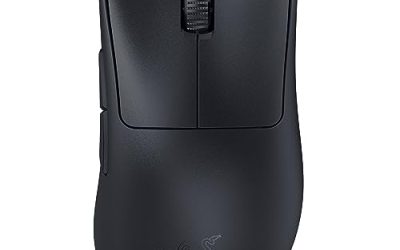
The Viper 8KHz was built around a single idea: report position to the PC 8,000 times per second over a wired link, with an ambidextrous shell that any grip and either hand can use. Its Focus+ 20K optical sensor tracks up to 20,000 DPI, third-generation optical switches actuate with light for fast, debounce-free clicks, and onboard memory stores your DPI stages and polling setting. At 71 grams it is slightly heavier than the DeathAdder V3 wired, a trade for the symmetrical body and its eight programmable buttons, including side buttons on both flanks for left-handed players.
- Sensor: Razer Focus+ optical, up to 20,000 DPI
- Polling rate: true 8,000 Hz wired
- Weight: 71 g
- Switches: Razer optical mouse switches, third generation
- Buttons: 8 programmable, ambidextrous layout
- Cable: Speedflex, with onboard memory for profiles
Who it is for: claw and fingertip players, left-handed players, and high-refresh-monitor owners who want the smoothest possible wired tracking in a symmetrical shell.
Limitations: the low, flat profile offers little palm support for relaxed grips, and the side buttons on the off-hand flank can be pressed accidentally until you adjust. As with any 8K mouse, the benefit depends on your monitor’s refresh rate and your system’s headroom.
Logitech G502 HERO (ASIN: B07GBZ4Q68)
See the Logitech G502 HERO on Amazon
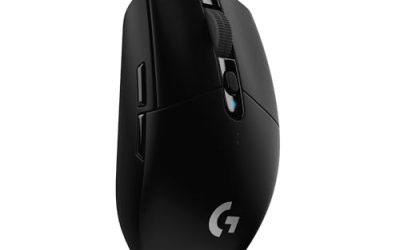
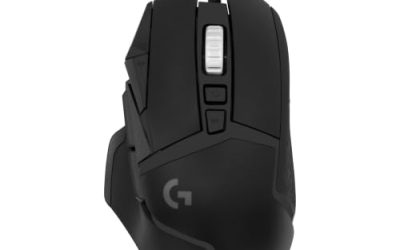
The G502 HERO is the deliberate exception in this guide: a heavy, button-rich wired mouse included for FPS players who aim with control rather than speed. The HERO 25K sensor tracks up to 25,600 DPI with the consistency competitive play demands, and the 121-gram shell, tunable to about 139 grams with the five included 3.6-gram weights, damps micro-tremor and makes low-sensitivity stops feel certain. Eleven programmable buttons, a sniper DPI-shift button for scoped moments, and a dual-mode scroll wheel round out a mouse that tactical-shooter and hybrid-genre players have kept on desks for years.
- Sensor: Logitech HERO 25K optical, up to 25,600 DPI
- Polling rate: 1,000 Hz
- Weight: 121 g, up to about 139 g with included weights
- Buttons: 11 programmable, including a sniper button
- Extras: dual-mode scroll wheel, LIGHTSYNC RGB, onboard memory
Who it is for: low-sensitivity players in tactical shooters who prefer a planted, weighted feel, and players who split time between FPS and button-heavy genres on one mouse.
Limitations: it polls at 1,000 Hz rather than 8,000 Hz, and the weight that steadies deliberate aim will tire fast, repeated lifting in arena-style play. The sculpted shape is right-handed and narrow, and the braided cable is stiffer than the Speedflex cables on the Razer picks.
Comparison table
| Model | Sensor | Max DPI | Polling | Weight | Shape | Buttons |
|---|---|---|---|---|---|---|
| Razer DeathAdder V3 | Focus Pro 30K | 30,000 | Up to 8,000 Hz | 63 g | Ergonomic right-hand | 6 |
| Razer Viper 8KHz | Focus+ 20K | 20,000 | 8,000 Hz | 71 g | Ambidextrous | 8 |
| Logitech G502 HERO | HERO 25K | 25,600 | 1,000 Hz | 121–139 g | Ergonomic right-hand | 11 |
Frequently asked questions
Is wired still better than wireless for FPS?
For latency alone, modern gaming wireless has effectively caught up. Wired keeps practical edges: no battery weight, no charging, no receiver placement, and the highest polling rates are still most common and most affordable on wired models. If you play at a fixed desk, wired remains a rational first choice.
Do I need 8,000 Hz polling?
You need a high-refresh monitor to see its full benefit, ideally 240 Hz or above, and a system with CPU headroom. On a 144 Hz display the difference over 1,000 Hz is subtle. Both Razer picks let you lower the rate in software, so an 8K mouse is not a risky purchase if your setup is mid-upgrade.
What DPI should I use for FPS games?
Most competitive players settle between 400 and 1,600 DPI and adjust in-game sensitivity to taste, valuing control over raw cursor speed. The very high maximum DPI figures on these mice are headroom, not a recommendation; consistency of the sensor matters far more than the ceiling.
How do I choose between the DeathAdder V3 and the Viper 8KHz?
Start with your hand and grip. The DeathAdder V3’s taller ergonomic curve supports palm and relaxed claw grips on medium to large hands, while the Viper 8KHz’s low symmetrical body suits claw and fingertip grips and works in either hand. Both offer flagship tracking and 8,000 Hz wired polling, so the decision is about fit, not performance: if possible, judge by the shape of the mouse you already play best on and pick the closer match.
Does a mouse bungee matter with these cables?
Less than it used to. Speedflex-style cables are light and flexible enough that many players skip the bungee entirely. If your cable catches on a monitor stand or desk edge, a bungee still helps by keeping the loop suspended and the drag constant.
Conclusion
For most FPS players, the Razer DeathAdder V3 is the wired pick: flagship sensor, 8,000 Hz polling, and a proven ergonomic shape at 63 grams. It is also the easiest of the three to recommend without caveats about grip or hand size, provided your hand is medium or larger and your desk setup is permanent enough that a cable never needs to move with you. Choose the Viper 8KHz for a symmetrical shell, left-handed use, or a claw and fingertip grip. And if your aim style values weight and control over speed, the G502 HERO remains the wired heavyweight that tactical players keep coming back to.
Related guides
More from Amazon
Programs that pair well with the guide above. Offers and eligibility are set by Amazon and may change.
Free shipping on eligible items, Prime Video and more. Eligible new members can start with a free trial.
Start a Prime free trialAd-free music streaming. Eligible new subscribers can start with a free trial.
Try Music Unlimited freeA Prime membership for ages 18-24 with a trial period. Eligibility is set by Amazon.
See Prime for Young AdultsAudiobooks and podcasts to listen to on the go. Eligible new members can start with a free trial.
Try Audible freeAs an Amazon Associate we earn from qualifying purchases.