The best rollator walker for most people is the VOCIC Z21: 8-inch all-terrain wheels, a 350 lb listed capacity, and a folding frame that sits between clinical and outdoor designs at a mid-range price. It suits anyone who rolls across kitchen tile, sidewalk, and slightly broken pavement in the same trip and wants one walker to cover all of it. If budget is the hard limit, the Drive Medical Rollator Walker with Seat, 7.5-Inch Wheels, Blue is the safest cheap pick, because 7.5-inch casters clear door thresholds far more easily than the 6-inch wheels common at that tier. If lifting the walker into a car every day is your main problem, the Drive Medical AeroWalk Ultra-Lite at 15.2 lb, with a tall 23-inch seat height, is the premium answer for taller users. And if your daily route includes gravel, grass, or cracked asphalt, start with the MAXWALK and its 12-inch all-terrain wheels.
Our Top Picks
 Drive Medical Rollator Walker with Seat1 Count (Pack of 1)31.5 x 24.5 x 10.75 inches20 PoundsCheck on Amazon
 VOCIC Z21 Rollator Walker for Seniors with Seat350 Pound13.8 x 23.6 x 75 inches22.9 PoundsCheck on Amazon
 HOMLAND Foldable Rollator Walker for Seniors with Seat350 Pound27.5 x 25 x 40 Inches20.4 PoundsCheck on Amazon
 VOCIC Z11 Standard Rollator Walker for Seniors withStandard27.6 x 22 x 38.2 inches19.4 PoundsCheck on Amazon
 Drive Medical Nitro Sprint Rollator Walker with SeatStandard33.46 x 28.94 x 9.65 inches19 poundsCheck on Amazon

Top 3 picks at a glance

Quick Comparison
| Product | Best for | Key specs (as listed) | Price tier |
|---|---|---|---|
| Drive Medical Rollator Walker with Seat, 7.5-Inch Wheels, Blue | First rollator on a tight budget | 7.5″ wheels; folding frame with seat and backrest; blue | Budget |
| VOCIC Z21 | Most people, mixed indoor/outdoor routes | 8″ all-terrain wheels; 350 lb capacity; folding frame with seat | Mid-range |
| Medline Steel Rollator Walker with Seat, Burgundy | Low-cost steel frame with a 350 lb rating | Steel frame; 350 lb capacity; 6″ wheels; foldable; adjustable handle height | Budget |
| HOMLAND Foldable Rollator Walker with Seat, 16″ Extra-Wide Seat | Wider seating surface | 16″ extra-wide seat; folding frame; four-wheel configuration | Mid-range |
| VOCIC Z11 Standard Rollator | Highest listed capacity on a budget | 380 lb capacity; folding frame with seat; standard four-wheel layout | Budget |
| Drive Medical Nitro Sprint Rollator, Standard, Black | Premium ride quality and sportier handling | Nitro-line frame; standard size; black finish; folding with seat | Premium |
| Medline Rollator Walker with Seat, 6-Inch Wheels, 350 lb | Clinical-style steel frame in the mid tier | Steel frame; 6″ wheels; 350 lb capacity; folding with seat | Mid-range |
| HOMLAND Foldable Rollator, 17 lb Lightweight | Frequent car loading without paying top tier | 17 lb listed weight; folding frame with seat | Premium |
| HOMLAND Foldable 3-Wheel Walker, 11 lb | Narrow indoor spaces and tight turns | Three wheels; 11 lb listed weight; folding; no seat | Mid-range |
| Drive Medical AeroWalk Ultra-Lite Rollator, Blue | Tall users and daily car transport | 15.2 lb; 23″ seat height; folding frame with seat; blue | Premium |
| MAXWALK Rollator Walker with Seat, 12″ All-Terrain Wheels, Gold | Gravel, grass and rough pavement | 12″ all-terrain wheels; folding frame with seat; gold | Premium |
| Drive Medical Aluminum Rollator Walker, Padded Seat, 6-Inch Wheels, Blue | Light indoor use on a budget | Aluminum frame; padded seat; 6″ wheels; blue | Budget |
How We Chose
This roundup is built from published manufacturer specifications, brand documentation, and the geometry of the category rather than from hands-on use. We did not test, benchmark, or own any of these walkers, so nothing here is a claim about how a specific unit feels in your hallway. What we compared is the set of numbers that actually decide whether a rollator works for a given person: listed weight capacity, wheel diameter, seat height, folded dimensions, walker weight, and brake architecture. Category fit came next — a 3-wheel walker, a steel clinical frame, and a 12-inch-wheel all-terrain model solve three different problems, so we placed each one where it does the most good instead of ranking them on one ladder. We also weighted upgrade path: whether a buyer can start with a budget frame and later move to a lighter or larger-wheeled model without changing how they use the walker day to day. Finally, we checked that each pick is a currently listed product from a brand with a real service and parts footprint, because brake cables, grips, and casters wear out long before a frame does.
1. Drive Medical Rollator Walker with Seat, 7.5-Inch Wheels, Blue – Best for First Rollator on a Tight Budget
As an Amazon Associate we earn from qualifying purchases at no extra cost to you.
This is the walker to buy when the decision is price-driven but you still want wheels that behave. The 7.5-inch casters are the important detail: they sit above the 6-inch clinical standard that catches on door thresholds and sidewalk seams, and below the 8-inch all-terrain class that costs more. For a rider who stays mostly on interior floors with occasional sidewalk trips, that is the sweet spot, and it is why this model is our default budget recommendation rather than the cheaper 6-inch frames further down this list.
- Wheels: 7.5-inch casters, front and rear — a middle step between clinical 6-inch and all-terrain 8-inch
- Seat: padded seat with backrest, in the standard rollator band of roughly 21 inches from the floor; confirm the exact figure on the product page
- Frame: four-wheel folding rollator; cross-fold design, so expect roughly 10–11 inches of folded thickness in this class
- Brakes: squeeze-to-slow levers with push-down parking, the category default
- Finish: blue
- Route type: smooth indoor floors, sidewalks, short outdoor errands
The strengths here are familiarity and parts availability. Drive Medical is one of the largest mobility brands in the consumer market, which matters more than it sounds: cable assemblies, hand grips, and caster wheels for this style of frame are widely stocked, so a walker bought today can still be repaired in three or four years instead of being thrown out when one rubber part perishes. The 7.5-inch wheel also gives a meaningfully easier push over a typical ¾-inch door threshold than a 6-inch wheel — the geometry works out to roughly 18–20% less horizontal force needed at the handle for the same load, which is the difference between a nudge and a shove for someone with limited grip strength.
The trade-offs are the usual ones at this price. You are not getting all-terrain rubber, so gravel and wet grass will feel draggy. You are also not getting the lightest frame in the category, so lifting it into a trunk is a two-hand job for many buyers. And because the seat height is fixed within the standard band, very tall users will find their knees riding high when they sit down.
Pros
- 7.5-inch wheels clear thresholds better than the 6-inch wheels at the same price
- Widely available replacement parts from a major brand
- Seat and backrest included at a budget-tier price
- Simple cross-fold mechanism with no tools required
Cons
- Not light enough for effortless daily car loading
- Hard casters transmit vibration on brick and cobble
- Fixed seat height will not suit very tall or very short riders ideally
Against the nearest alternative, the Drive Medical Aluminum Rollator with Padded Seat and 6-inch wheels, this one wins on wheel size and loses slightly on seat padding and frame weight. If your route is entirely indoors and the walker never leaves the house, the aluminum model is fine; if you cross a single exterior threshold a day, pay the small premium for 7.5 inches.
2. VOCIC Z21 Rollator Walker for Seniors with Seat, 8″ All Terrain – Best Overall for Mixed Routes

The Z21 is our best overall pick because it solves the most common real-world problem: a route that starts on tile, crosses a threshold, and ends on imperfect pavement. The 8-inch all-terrain wheels are the single biggest upgrade over budget frames, and the 350 lb listed capacity puts it in the range that covers most adult riders with sensible headroom left over for a bag hanging from the handlebar.
- Wheels: 8-inch all-terrain casters — the practical minimum for regular outdoor use
- Listed capacity: 350 lb
- Seat: padded seat with backrest, standard rollator height band (roughly 20.5–22 inches); check the product page for the exact measurement
- Folding: cross-fold frame, roughly 10–11 inches folded thickness in this class
- Brakes: loop levers with push-down parking brake
- Best route type: mixed indoor and outdoor, sidewalk and light gravel
What makes the 8-inch wheel worth the money is threshold geometry. Pushing a rigid caster over a ¾-inch lip requires a horizontal force that scales with the wheel’s radius; at a typical 50 lb of load on the front casters, a 6-inch wheel needs about 44 lb of push, an 8-inch wheel about 36 lb, and a 12-inch wheel about 28 lb. That 8-inch figure is roughly a fifth less effort than the clinical standard, and it is the reason a walker with 8-inch wheels feels like it “just goes” where a 6-inch frame stalls.
The 350 lb rating is also the right tier for most buyers. If you weigh 250 lb and carry a 15 lb bag, you are at 265 lb, which leaves about 24% headroom against a 350 lb frame — comfortably inside the 15–20% margin we recommend as a minimum. A 300 lb rider with the same bag is at 315 lb, only 10% headroom, and should be looking at the 380 lb VOCIC Z11 instead.
Pros
- 8-inch all-terrain wheels handle thresholds, sidewalk seams and packed gravel
- 350 lb capacity with realistic headroom for most riders
- Mid-range price for a spec set that used to sit in the premium tier
- Standard four-wheel layout, so it stays stable when you lean on one side
Cons
- Heavier and bulkier than a 6-inch indoor frame, which matters if you lift it daily
- All-terrain rubber is slightly draggier on smooth tile than hard casters
- Not the highest capacity in this list
Against the nearest alternative, the Drive Medical Nitro Sprint, the Z21 gives you most of the outdoor capability for less money but loses on frame refinement and wheel size. Choose the Z21 if you want one walker that does everything acceptably; choose the Nitro Sprint if the walker is your primary mobility tool and you want the better ride.
3. Medline Steel Rollator Walker with Seat, Burgundy – Best Budget Steel Frame with a 350 lb Rating

Steel is the reason to look at this one. At the budget tier, most frames are aluminum, which is lighter but flexier under a heavy rider. A steel rollator with a 350 lb listing gives you a stiffer feel and a lower price, at the cost of weight you will notice every time you lift it. This is a good pick for a rider who mostly walks one familiar route and rarely puts the walker in a car.
- Frame: steel, folding, with seat and backrest
- Listed capacity: 350 lb
- Wheels: 6-inch casters — the clinical standard
- Handles: adjustable height, which is the most important fit adjustment on any rollator
- Finish: burgundy
- Route type: indoor floors, smooth pavement, short trips
Adjustable handle height is the headline feature here, and it is worth more than it sounds. Handle height should land near your wrist crease when you stand with your arms hanging — roughly half your height in inches, which puts most adults between 31 and 35 inches. A rollator that cannot reach your number forces you to round your shoulders or lean forward, and that posture is exactly what a walker is supposed to prevent. Check the adjustment range against your own measurement before buying.
The 6-inch wheels are the limitation. They are fine on smooth flooring and decent on level sidewalk, but they will catch on a ¾-inch threshold more often than not, and on a 1.5-inch lip the required push force roughly doubles the load on the front casters — in practice, you lift the front wheels over rather than roll them. If your route has any rough edges, this is the wrong walker.
Pros
- Steel frame feels stiffer than aluminum at the same price
- 350 lb listed capacity at a budget-tier price
- Adjustable handle height covers a wide range of users
- Simple, widely understood folding mechanism
Cons
- Heavier than an aluminum frame of the same size
- 6-inch wheels limit you to smooth surfaces
- Steel can rust if stored outdoors or left wet
Against the nearest alternative, the mid-range Medline Rollator with 6-inch wheels and 350 lb capacity (item 7 below), the specs are almost identical — same wheel size, same capacity, same brand. The difference is trim and price position. Buy whichever is cheaper when you are ready, and pick burgundy or the other finish based on nothing more than preference.
4. HOMLAND Foldable Rollator Walker with Seat, 16″ Extra-Wide Seat – Best for Wider Seating

Most rollator seats are narrow perches that assume you will sit for a minute or two. The 16-inch extra-wide seat on this HOMLAND changes that: it is wide enough to sit on properly, which makes the walker usable as a rest stop on a longer outing rather than just an emergency bench. It suits riders who walk further than a block and want to sit down for five or ten minutes at a time.
- Seat: 16-inch extra-wide seat with backrest
- Configuration: four-wheel folding rollator
- Folding: cross-fold frame; a wider seat usually means a slightly wider folded footprint — measure your doorway and trunk opening
- Brakes: squeeze levers with push-down parking
- Route type: neighborhood sidewalks, parks, shopping trips with rest stops
The width has a second benefit that is easy to miss: a wider seat usually comes with a wider frame, and a wider frame is more stable when you lean to one side to reach a shelf or open a door. That lateral stability matters more than most shoppers expect, because the most common rollator incident is not rolling away — it is tipping when weight shifts sideways.
The cost is folded size. A 16-inch seat sits on a frame that folds wider than a standard rollator, so if your car has a narrow trunk opening or your apartment has a tight hallway turn, measure first. As a rule of thumb, a standard rollator folds to roughly 10 inches thick and 24 inches wide, while wide-seat models run a couple of inches wider in both directions.
Seat height on this class of frame sits in the standard band, so if you are taller than about 5’10” you may want to compare it against the Drive Medical AeroWalk Ultra-Lite and its 23-inch seat height, which is designed for exactly that problem.
Pros
- 16-inch seat is genuinely comfortable for longer rests
- Wider frame adds lateral stability
- Mid-range pricing for a spec that used to be a specialty item
- Four-wheel layout stays predictable on uneven pavement
Cons
- Wider folded footprint is harder to fit in small trunks
- Wider frame can be tight in narrow hallways and bathroom doors
- Not the lightest option in this list
Against the nearest alternative, the HOMLAND 17 lb Lightweight Rollator (item 8), this one trades a few pounds of frame weight for the wider seat. If you sit often, take the wide seat; if you lift the walker into a car twice a day, take the lighter one.
5. VOCIC Z11 Standard Rollator Walker for Seniors with Seat, 380 LBS – Best Budget Pick for Higher Weight Capacity
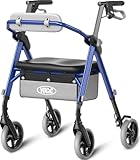
The 380 lb listing makes this the capacity champion of the budget tier, and capacity is the spec most often under-bought. A frame rated at 300 lb carrying a 290 lb rider plus a 15 lb bag is running over its rating, and the failure mode is not dramatic — it is a frame that flexes, a seat that sags, and brakes that need constant adjustment. The Z11 gives you a stated 380 lb ceiling at a price that undercuts most 350 lb mid-range models.
- Listed capacity: 380 lb — the highest in this roundup
- Configuration: standard four-wheel folding rollator with seat
- Wheels: standard casters; expect the 6–8 inch class — confirm the exact diameter on the product page
- Brakes: squeeze levers with push-down parking
- Route type: indoor and light outdoor, depending on wheel size fitted
Run the headroom math before you buy anything in this category. Take your weight, add the bag you actually carry (a purse plus a water bottle plus groceries is easily 10–15 lb), and check that the total is no more than 85% of the listed capacity. At 380 lb, that means a comfortable working load of about 323 lb. A 290 lb rider with a 15 lb bag lands at 305 lb, which is inside the margin; the same rider on a 300 lb frame would be over the line before they picked up a shopping bag.
What you give up for the capacity and the price is refinement. Budget frames in this class typically use harder casters, simpler padding, and less precise brake cable routing, so you should expect to adjust the brakes after the first few weeks of use as the cables settle. That is a five-minute job with a small wrench, but it is a job.
Pros
- 380 lb listed capacity at a budget price
- Standard four-wheel layout for predictable stability
- Seat and backrest included
- Good match for heavier riders who cannot justify a premium frame
Cons
- Wheel size may be smaller than all-terrain models, limiting outdoor use
- Budget-tier finish and padding
- Heavier frame, so lifting into a car is a two-hand task
Against the nearest alternative, the VOCIC Z21, the Z11 wins on capacity (380 lb vs 350 lb) and loses on wheels and finish. If you are under 280 lb and walk outdoors regularly, the Z21 is the better walker; if you are above 280 lb, or you carry heavy loads, the Z11’s extra headroom is worth more than the wheel upgrade.
6. Drive Medical Nitro Sprint Rollator Walker with Seat, Standard, Black – Best Premium Ride and Handling

The Nitro line is Drive’s sport-oriented family, and the difference shows in the frame geometry and the wheel package rather than in the seat. If your rollator is your primary way of getting around outside the house — several trips a day, several miles a week — the extra money buys you a walker that feels less like medical equipment and more like a piece of gear.
- Frame: Nitro-line frame, standard size, black finish
- Configuration: four-wheel folding rollator with seat and backrest
- Wheels: larger-diameter casters than the brand’s basic rollators; confirm the exact sizes on the product page
- Brakes: lever brakes with push-down parking
- Route type: daily outdoor use, sidewalks, pavement, packed paths
The practical value of the Nitro design is momentum. Bigger wheels roll further per push, so over a mile of sidewalk you take noticeably fewer steps of effort than you would behind a 6-inch caster frame. That matters most for riders who fatigue quickly, because the walker stops being the limiting factor and the route becomes the only constraint.
Premium also buys tighter tolerances. Better frames have less play in the folding joints, which means less rattle and less lateral wobble when you push down on a handle to stand up. If you have ever used a cheap rollator that clunks and shimmies on brick pavement, you know exactly what this fixes.
The trade-off is cost and complexity. A premium frame has more parts that can wear, and if something does go wrong you are looking at a higher replacement cost. It is also worth checking the folded dimensions carefully: sportier frames sometimes fold into a longer, flatter package rather than a compact cube, which can be awkward in a small trunk.
Pros
- Larger wheels roll more easily over long distances
- Tighter frame tolerances mean less rattle and wobble
- Backed by a major brand with broad parts availability
- Standard size suits a wide range of riders
Cons
- Premium price for capability a mid-range 8-inch model mostly matches
- Higher replacement cost for worn parts
- Folded shape may not suit very small trunks
Against the nearest alternative, the VOCIC Z21, the Nitro Sprint is the better long-distance walker and the Z21 is the better value. Buy the Nitro if you are outside daily; buy the Z21 if you are outside a few times a week and want to spend the difference on something else.
7. Medline Rollator Walker with Seat, 6-Inch Wheels, 350 lb – Best Clinical-Style Steel Frame in the Mid Tier

This is the medical-channel version of a classic steel rollator: 6-inch wheels, a 350 lb rating, a folding frame with a seat, and nothing decorative. It suits buyers who want the familiar object they have seen in clinics and senior centers, with a slightly better finish than the cheapest tier and a brand that supplies replacement parts.
- Frame: steel, folding, with seat
- Listed capacity: 350 lb
- Wheels: 6-inch casters
- Brakes: lever brakes with push-down parking
- Route type: indoor floors, level pavement, smooth sidewalks
The honest assessment is that this listing and the budget Medline Steel Rollator in burgundy describe nearly the same walker: same brand, same 6-inch wheels, same 350 lb capacity, same folding steel frame. The price tiers differ, which usually reflects trim, color, and which distribution channel the listing sits in rather than a mechanical difference. If you are choosing between them, compare the current prices and the seat padding description, and do not agonize over the rest.
Where a 6-inch clinical frame earns its place is indoor use. On vinyl, tile, and low-pile carpet, small hard casters are actually easier to steer than large soft ones, because they have a tighter turning circle and less rolling resistance on a smooth surface. If your walker lives inside a single-story home and only occasionally goes to a doctor’s appointment, this is a perfectly rational choice.
The limitation is the same as any 6-inch frame: thresholds. A ¾-inch lip needs roughly 44 lb of push at the handle for a 50 lb front-caster load, and a 1.5-inch lip needs about 87 lb — nearly double. In practice you lift the front end. If your home has a raised threshold at the front door, budget for that habit or choose a larger wheel.
Pros
- Steel frame with a 350 lb rating
- Widely recognized clinical design with familiar controls
- Good indoor maneuverability thanks to small casters
- Replacement parts available from a large medical brand
Cons
- Nearly identical to the cheaper Medline steel model
- 6-inch wheels struggle with thresholds and rough pavement
- Steel frame is heavy to lift
Against the nearest alternative, the Drive Medical Rollator with 7.5-inch wheels, this Medline is the better indoor walker and the Drive is the better all-rounder. If you cross an exterior threshold most days, the 7.5-inch wheel is worth the small difference in price.
8. HOMLAND Foldable Rollator Walker, 17 lb Lightweight – Best Premium Pick for Frequent Car Loading

A 17 lb listed weight is the number that matters here. If you load a walker into a car trunk two or three times a day, every pound is a decision you make with your shoulders and lower back. This HOMLAND sits in the light premium class: noticeably easier to lift than a steel frame, and still a full four-wheel walker with a seat rather than a stripped-down travel frame.
- Listed weight: 17 lb
- Configuration: four-wheel folding rollator with seat
- Folding: cross-fold frame; a 17 lb frame in this class typically folds to roughly 10 inches thick
- Brakes: lever brakes with push-down parking
- Route type: errands, appointments, mixed indoor and outdoor
Lighter frames change behavior, not just effort. When a walker is easy to lift, you take it more places — into the shop, out of the car at the trailhead, up a step into a friend’s house. That is a real functional gain over a heavier frame that stays in the garage, and it is the main argument for paying premium prices for a rollator at all.
The trade-off with light frames is stiffness. Aluminum saves weight by using less material, so a 17 lb walker will flex slightly more under a heavy rider than a 25 lb steel one. If you are near the top of the listed capacity, the flex is noticeable when you push down on the handle to stand. If you are well under it, you will never feel it, and you get all the benefit of the lighter frame.
Check the capacity figure against your own weight plus your bag before committing. Lightweight and high-capacity are in tension in this category, and a 17 lb frame rarely carries the same rating as a heavier steel model.
Pros
- 17 lb is light enough for most riders to lift one-handed into a trunk
- Full four-wheel stability with a seat and backrest
- Light enough that you will actually take it places
- Folds compactly for a walker in this class
Cons
- Premium price for the weight saving
- Lighter frames flex more near their capacity limit
- Less capacity headroom than a steel equivalent
Against the nearest alternative, the Drive Medical AeroWalk Ultra-Lite at 15.2 lb, the AeroWalk is lighter and has a taller 23-inch seat, while this HOMLAND is generally the more affordable of the two. If you are tall, the AeroWalk’s seat height decides it; if you are average height and price-sensitive, take the HOMLAND.
9. HOMLAND Foldable 3-Wheel Walker, 11 lb – Best for Narrow Indoor Spaces

An 11 lb three-wheel walker is a different tool from everything else on this page. With no seat and a single front wheel, it turns in a much tighter radius, which makes it the right choice for a small apartment, a narrow kitchen, or a hallway where a four-wheel frame would scrape both walls. It is a mobility aid for walking, not a chair with wheels.
- Listed weight: 11 lb
- Configuration: three wheels — one front, two rear
- Seat: none
- Folding: foldable frame, compact when collapsed
- Route type: indoor, smooth floors, tight spaces
The three-wheel layout is the point and the problem. It steers beautifully — a single front wheel pivots around a smaller circle than a pair of casters ever will — but it has a smaller support polygon, so it is less resistant to sideways tipping. For a rider with good balance who needs maneuverability, that is a fair trade. For a rider who leans heavily on the handles or has significant balance loss, a four-wheel walker is the safer choice regardless of how much easier the three-wheel version turns.
The 11 lb weight is a genuine advantage. It is light enough to lift onto a hook, into a closet, or into a car with one hand, and light enough that a caregiver can move it out of the way without a second thought. For a secondary walker kept in a small bathroom or kitchen, that matters more than capacity.
What you cannot do with it is sit down. If you need to rest mid-route, this is the wrong product — look at the four-wheel models with seats instead, starting with the HOMLAND 16-inch wide-seat rollator.
Pros
- 11 lb is the lightest walker in this roundup
- Three-wheel steering turns in very tight spaces
- Compact folded size suits closets and small cars
- Excellent as a secondary walker for indoor use
Cons
- No seat, so no rest stops
- Less laterally stable than a four-wheel walker
- Not suitable for rough ground or long outdoor routes
Against the nearest alternative, the HOMLAND 17 lb four-wheel rollator, this is a specialist rather than a substitute. If you need one walker for everything, buy the four-wheel. If you need something for a tight hallway and already own a main walker, this is the better second purchase.
10. Drive Medical AeroWalk Ultra-Lite Rollator, 15.2 lb, 23″ Seat Height, Blue – Best for Tall Users Who Travel

The 23-inch seat height is the reason this walker exists, and it is unusual. Most rollator seats sit in the 20–22 inch band, which is deliberately higher than a dining chair so you can slide off without deep knee flexion — but it still leaves tall riders with their knees above their hips. At 23 inches, a rider around 6 feet tall can sit with thighs closer to level, which is the difference between a rest and a strain.
- Listed weight: 15.2 lb — the lightest four-wheel walker here
- Seat height: 23 inches
- Frame: aluminum ultra-lite, folding, with seat and backrest
- Brakes: lever brakes with push-down parking
- Finish: blue
- Route type: travel, appointments, errands, mixed surfaces
Do the seat-height check before you buy, because taller is not automatically better. Sit on a firm chair and measure from the floor to the crease at the back of your knee — that is your popliteal height, and it is the number your rollator seat should roughly match. A 5’4″ rider typically measures about 17 inches, a 5’9″ rider about 18.5 inches, and a 6’0″ rider about 19.5 inches. Rollator seats run above that on purpose, but a 23-inch seat on a 5’4″ rider means feet dangling and pressure on the back of the thighs. On a 6’2″ rider it is close to right.
The 15.2 lb weight pairs naturally with the tall seat, because tall riders are often the ones who also need to lift a walker into a taller vehicle. Combine low weight with the tall seat and you have a walker that suits a big-framed user who drives themselves around.
Pros
- 23-inch seat height suits taller riders better than the standard band
- 15.2 lb is genuinely light for a four-wheel walker with a seat
- Aluminum frame from a major brand with parts support
- Good travel companion thanks to low weight and standard folding
Cons
- Premium price for the weight and seat height
- 23-inch seat is too tall for shorter riders
- Light frame flexes more if you are near the capacity limit
Against the nearest alternative, the HOMLAND 17 lb Lightweight, the AeroWalk wins on seat height and weight, and the HOMLAND usually wins on price. If you are under 5’8″, the HOMLAND’s lower seat will actually fit you better.
11. MAXWALK Rollator Walker with Seat, 12″ All-Terrain Wheels, Gold – Best for Rough Ground

Twelve-inch wheels are a category of their own. If your route includes gravel driveways, grass, cracked asphalt, or unpaved paths, nothing with 6- or 8-inch casters will do the job comfortably, and this is the walker in this roundup built for exactly that terrain.
- Wheels: 12-inch all-terrain — the largest in this roundup
- Configuration: four-wheel folding rollator with seat and backrest
- Brakes: lever brakes with push-down parking
- Finish: gold
- Route type: gravel, grass, dirt paths, broken pavement, curb lips
The geometry is worth spelling out because it explains the price. The force needed to push a rigid wheel over a step rises steeply as the wheel gets smaller. At a 50 lb front-caster load, clearing a ¾-inch threshold takes roughly 44 lb of push with a 6-inch wheel, 36 lb with an 8-inch wheel, and 28 lb with a 12-inch wheel. Stretch the step to 1.5 inches — a typical curb lip or a raised driveway edge — and the numbers become 87 lb, 60 lb, and 44 lb respectively. A 12-inch wheel makes a 1.5-inch lip about as hard as a 6-inch wheel makes a ¾-inch one. That is the whole argument for big wheels in one comparison.
Soft, wide tires also absorb vibration, which matters over distance. Brick sidewalks and cobblestone will still transmit some chatter, but far less than hard plastic casters. For riders with arthritic hands or shoulders, that reduction in shock is often more valuable than the reduced push force.
The costs are size and weight. A 12-inch-wheel walker is bulky when folded, heavier to lift, and takes more room to turn in a hallway. It is a walker for the outdoors,
Related guides
- Best Streaming Gear for Twitch: Webcams, Capture Card, Backdrop and Light (2026)
- Best Over Ear Headphones: 9 Closed, Open-Back and Bluetooth Picks Explained (2026)
- Best Monitor for Console Gaming: Eight 1080p and 1440p Screens Compared by HDMI and Refresh Rate (2026)
- Best Monitors for PS5 Pro 4K 120Hz: Eight Screens and the HDMI Bandwidth Check (2026)