The best water dispensers for most homes and offices are bottom-loading bottled dispensers for easy use without plumbing, point-of-use (POU) plumbed-in dispensers for high-traffic offices, and countertop reverse osmosis (RO) dispensers for small spaces where filtration matters more than bulk capacity.
As an Amazon Associate we earn from qualifying purchases at no extra cost to you.


Our Top Picks
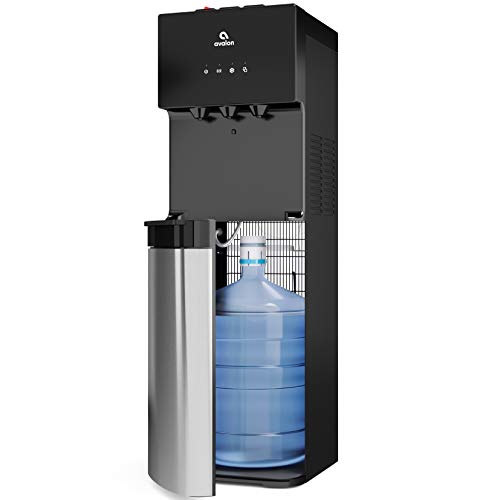 Avalon A4BLWTRCLR Bottom Loading Water Cooler Water Dispenser3 or 5 gallon bottle13 x 12 x 41 inches38.1 PoundsCheck on Amazon


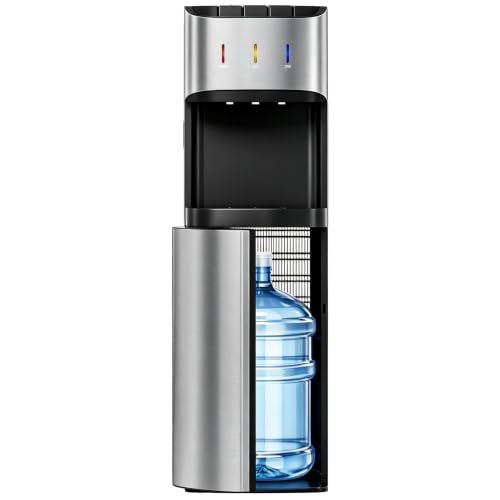
Top 3 picks at a glance
How to Choose the Right Type First
Buying a dispenser comes down to four decisions in order: water source, temperature needs, filtration, and space. Get these right and you avoid the two most common regrets — paying for plumbing you don’t need, or buying a small countertop unit that can’t keep up with a family or office.
| Type | Best For | Cold / Hot Temp Range | Typical Power Draw | Footprint (W x D) | Upfront Cost Range |
|---|---|---|---|---|---|
| Top-Loading Bottled (3 or 5-gallon) | Budget home use, rentals | 39-50°F cold / 180-195°F hot | 90-110W cooling, 420-550W heating | 12 x 13 inches | usually $120–$200 |
| Bottom-Loading Bottled (3 or 5-gallon) | Homes, small offices, no lifting | 38-47°F cold / 185-203°F hot | 85-100W cooling, 450-500W heating | 12 x 14 inches | usually $180–$350 |
| Point-of-Use (POU) Plumbed-In | Offices 10+ people, waiting rooms | 37-44°F cold / 180-190°F hot | 80-120W cooling, 500W heating | 13 x 15 inches | usually $300–$600 |
| Countertop Hot/Cold with Filtration (RO/UF) | Apartments, small kitchens, home offices | 41-50°F cold / 185-205°F hot | 80-90W cooling, 400-500W heating | 10 x 17 inches | usually $250–$500 |
| Ceramic / Non-Electric Gravity Dispenser | Garages, outages, no power access | Room temp only, or ambient + ice | 0W | 14 x 14 inches | usually $60–$150 |
If you cannot run a water line to the location, eliminate POU models. If you don’t want to handle or store 40-pound 5-gallon bottles, eliminate top-loading and bottom-loading and focus on POU or countertop RO.
Capacity: How Much Water You Actually Need
Capacity is not about tank size. Most dispensers only hold 0.8 to 2.5 liters internally at temperature at any one time; continuous output depends on recovery rate — how fast it reheats or re-chills after dispensing.
A practical rule for sizing:
- Home (2-4 people, drinking + occasional cooking): 3 to 5 gallons per day is typical. A single 5-gallon bottle or a countertop unit with a 3-4 liter internal tank refilled once or twice daily is enough.
- Small office (5-10 people): 5 to 10 gallons per day. One 5-gallon bottle per 1-2 days, or a plumbed POU with unlimited supply is more efficient.
- Large office (15+ people): 10+ gallons per day. A plumbed POU with a direct water line is the only low-maintenance option. Bottled service becomes expensive and requires storage for empty and full bottles.
Check recovery specs before buying for hot drinks. A dispenser that holds only 1 liter of hot water but recovers at 4-5 liters per hour will serve back-to-back teas or instant coffee for 5-6 people. A unit with a larger 2-liter tank but slow 2-liter-per-hour recovery will run out and force a 10-minute wait.
Worked Calculation: Electricity Cost for Hot and Cold
Heating uses far more energy than cooling, but neither runs continuously. Use this to estimate your monthly cost:
Assumptions: Cold compressor 100W, runs about 8 minutes per hour in a 72°F room (13% duty cycle). Hot heater 500W, runs about 10 minutes per hour if you keep hot enabled all day (17% duty cycle). Electricity rate around $0 per kWh. Unit left on 24/7.
Calculation:
Cold: 0.10 kW x 0.13 x 24 hours = 0.31 kWh per day = 9.3 kWh per month = ~$1/month
Hot: 0.50 kW x 0.17 x 24 hours = 2.04 kWh per day = 61.2 kWh per month = ~$9/month
Combined total ~70.5 kWh = ~$11 per month with both enabled. Turning off hot overnight or using an energy-saving mode with a timer cuts hot consumption by 30-40%, saving roughly $3-$4 per month. If you only need room-temperature and cold water, disable the hot switch entirely and your cost drops to under $2 per month.
Hot, Cold, and Room Temperature: Which to Pay For
Not every dispenser needs all three taps. Each temperature option adds cost, energy use, and a failure point.
- Cold + Room Temp only: Best for homes that mainly want chilled water and don’t drink instant coffee, tea, or oatmeal at the dispenser. Uses less energy and has fewer scale issues than hot models. Look for a compressor-cooled system, not thermoelectric, if you want water below 45°F. Thermoelectric coolers are quieter but often only reach 50-55°F.
- Hot + Cold + Room Temp: The most versatile for offices and families. Choose a model with a child safety lock on the hot tap and separate hot and cold switches on the back so you can disable heating. Hot tanks should be stainless steel, not plastic, for durability and taste.
- Hot only or ambient only: Rarely worth it unless you have a specific need like a tea station. A standalone kettle is usually faster for hot-only use.
Temperature matters for taste and safety. For food safety, cold should be below 50°F. For tea and instant drinks, 185°F+ extracts properly; 160°F will taste weak. If the spec sheet lists hot as “up to 185°F” rather than a sustained range, it will drop quickly after the first two cups.
Filtration: Bottled vs. Built-In
Bottled dispensers (top or bottom loading) provide no filtration — water quality depends entirely on the bottled water you buy. Plumbed and countertop dispensers include filtration, but the type determines maintenance and what it removes.
- Sediment + Carbon Block (most POU and bottleless coolers): Reduces chlorine, taste, odor, and particulates. Good for municipal tap water that is already safe but tastes poor. Filters usually last 6 months or 1,500-3,000 gallons. Very low waste water.
- Ultrafiltration (UF) + Carbon: Adds removal of bacteria and some colloids without stripping minerals, and doesn’t produce waste water like RO. Good balance for city water where you want extra protection but want to keep minerals and avoid a drain line.
- Reverse Osmosis (RO) + Remineralization: The most thorough for well water or high TDS (>300 ppm) tap water. Removes dissolved solids, lead, fluoride, and nitrates. Requires a 3 to 4-stage system and produces 1-2 gallons of waste water per gallon filtered. Needs a remineralization stage if you dislike flat taste.
For home use on city water, a 2 or 3-stage carbon + UF system is usually sufficient and cheaper to maintain. For well water or if your tap tests high for lead or nitrates, go RO even though filter costs are higher.
Room-Size Fit and Placement
Dispensers are taller than they look in photos — most freestanding units are 41-42 inches high including the faucet, and need 4-6 inches of clearance behind for ventilation. Countertop units are 16-18 inches tall but need overhead clearance to remove a top-fill tank.
Use this fit guide:
- Small kitchen / studio (under 90 sq ft): Choose a countertop RO or a slim bottom-loader under 12 inches wide. Avoid POU — you need access to a water line and drain that small kitchens rarely have near an open floor spot.
- Medium kitchen / home office (100-180 sq ft): Bottom-loading freestanding is ideal. It fits beside a counter or in a corner without plumbing and hides the bottle for a cleaner look. Keep it away from direct sunlight, which warms the cold tank and grows algae in clear bottles.
- Large office / break room (200+ sq ft, 10+ people): POU plumbed is worth the install fee. You reclaim the 10-15 sq ft normally needed to store 3-4 spare bottles, and you eliminate delivery scheduling. Requires within 15 feet of a cold water line and a nearby outlet (standard 110-120V, 3-prong grounded).
Floor strength is rarely an issue, but a full 5-gallon bottle plus dispenser weighs 55-60 pounds concentrated on four small feet. On soft vinyl or floating floors, place a small appliance mat underneath to prevent dents.
Maintenance Requirements You Should Plan For
All dispensers need cleaning more often than the manual suggests if you use the hot tank. Scale and biofilm form fastest in warm sections.
- Cleaning schedule: Sanitize internal tanks and taps every 3 months with unscented bleach or manufacturer solution (1 teaspoon per gallon, flush twice with fresh water). In offices, do this monthly if 10+ people use it daily. Wipe the drip tray weekly — it is the primary source of odor.
- Filter replacement cost: Carbon/UF sets usually cost $30–$60 per 6-month cycle. RO membrane sets cost $60–$120 per year plus $25–$40 for carbon pre-filters twice a year. Factor this into total cost: a $350 POU with $80/year in filters is cheaper over 3 years than a bottled unit buying 2 bottles per week at $7–$9 each.
- Descaling hot tank: If you have hard water (over 120 ppm hardness) and use hot frequently, descale every 6 months with citric acid solution to prevent heating element failure. Signs you waited too long are longer heat times, lukewarm hot water, or a metallic taste.
- Bottle handling: For bottom-loading units, the pump and tubing need sanitizing with each bottle change — wipe the bottle cap and piercing valve with alcohol. Never let an empty bottle sit on the dispenser for days; it draws in air and grows bacteria.
Decision Matrix: Match Your Situation to the Right Choice
| Your Situation | Recommended Type | Why |
|---|---|---|
| Rental apartment, no plumbing changes allowed | Bottom-loading bottled or countertop | No install, moves with you, no landlord approval |
| Hard well water or TDS over 300 ppm | Countertop RO or POU with RO | Only RO reliably reduces dissolved solids and heavy metals |
| Household with small children | Bottom-loading with hot safety lock + stainless hot tank | No heavy lifting, prevents scalding, easy to disable hot |
| Office of 12+ people, want lowest operating cost | POU plumbed, 3-temp, carbon + UF or RO | Unlimited supply, no bottle storage, ~$80/year filter cost vs. $700+/year bottled |
| Need quiet in bedroom / home office overnight | Thermoelectric countertop or unit with night mode | Compressor models click on every 20-30 minutes; thermoelectric is silent but less cold |
| Frequent power outages or outdoor use | Ceramic gravity or non-electric | Works without power, no compressor or heater to fail |
What to Check Before You Buy
Compare spec sheets on these five points rather than marketing claims:
- Certifications: Look for Energy Star and NSF/ANSI 42, 53, or 58 depending on filter type. UL or ETL listing is required for office insurance compliance.
- Hot and cold recovery rates listed separately: A unit that only lists “2.5L hot tank” without litres per hour recovery will disappoint for sequential use.
- Noise rating: Compressor units are 40-50 dB when running — similar to a small refrigerator. Check if it has a low-noise or eco mode for overnight.
- Warranty on compressor and heater: Good models offer 1 year overall and 2-3 years on compressor. RO systems should warranty against leaks for at least 1 year.
- Drain and leak protection: POU units should include an auto shut-off valve and leak detector. Countertop RO units should have a drip tray sensor that stops dispensing when full.
For most families in 2026, a bottom-loading hot/cold dispenser with stainless steel tanks and a carbon filter pitcher alongside it is the most practical setup. For offices that go through more than one 5-gallon bottle per week, a plumbed POU system with a 3-stage filtration pays for its higher upfront cost within 12 to 18 months through eliminated deliveries and storage.
Frequently asked questions
Do bottom-loading dispensers require less lifting than top-loading models?
Yes, bottom-loading dispensers avoid lifting a full 5-gallon bottle onto the top of the unit. They are suited to homes and small offices where users do not want to handle or store 40-pound bottles at shoulder height. They still require storing full and empty bottles, unlike point-of-use or countertop reverse osmosis models that use a water line or refillable tank.
How much clearance does a freestanding dispenser need around it?
A freestanding dispenser usually needs 4-6 inches of clearance behind it for ventilation. Most units are 41-42 inches high including the faucet, so measure both height and depth before placing one beneath shelving or cabinets. Keep the dispenser away from direct sunlight because sunlight can warm the cold tank and encourage algae growth in clear bottles.
Is a child safety lock important on a hot-water dispenser?
Yes, a child safety lock is an important feature on a dispenser with a hot tap. Hot water is typically listed at 180-205°F, and the article recommends choosing a lock on the hot tap. Separate hot and cold switches are also useful because they let you disable heating when hot water is not needed.
How often should a water dispenser be cleaned?
Sanitize the internal tanks and taps every 3 months, using unscented bleach or the manufacturer’s solution, and flush the system twice with fresh water. In offices where 10+ people use the dispenser daily, sanitize it monthly. Wipe the drip tray weekly, since the article identifies it as the primary source of odor.
What should I do if my dispenser will not fit beneath a cabinet?
Choose a countertop unit only if there is enough overhead clearance to remove its top-fill tank. Countertop models are 16-18 inches tall, while most freestanding units are 41-42 inches high including the faucet. Also account for ventilation: freestanding models need 4-6 inches behind them, and the location should have access to a nearby outlet.
Related guides
- Best Streaming Gear for Twitch: Webcams, Capture Card, Backdrop and Light (2026)
- Best Over Ear Headphones: 9 Closed, Open-Back and Bluetooth Picks Explained (2026)
- Best Monitor for Console Gaming: Eight 1080p and 1440p Screens Compared by HDMI and Refresh Rate (2026)
- Best Monitors for PS5 Pro 4K 120Hz: Eight Screens and the HDMI Bandwidth Check (2026)