
If you’re streaming PCVR games to a Quest headset, a Pico, or another standalone display, Virtual Desktop is still the most flexible tool for the job in 2026. But it’s also easy to get wrong. The single biggest mistake people make is cranking resolution and bitrate before fixing the fundamentals: your router, your codec, and your headset’s refresh rate matter more than any slider in the app. Prioritize in this order — a stable wireless link first, then codec choice, then bitrate, then resolution, then in-game graphics settings. Get the foundation right and the rest of the settings fall into place.
This guide assumes you’re using Virtual Desktop’s Streamer app on your PC and the Virtual Desktop client from your headset’s store, both fully updated.
As an Amazon Associate we earn from qualifying purchases at no extra cost to you.


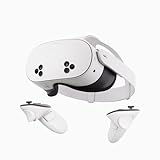

Our Top Picks


Top 3 picks at a glance
Quick Recommended Settings
| Setting | Recommended value | Why |
|---|---|---|
| Streaming codec | HEVC (H.265) on older GPUs; AV1 on RTX 40/50 or RX 7000/9000 series | AV1 gives better image quality per megabit; HEVC is the safe fallback |
| Bitrate (VR prof. and up) | 100–150 Mbps on AV1; 150–300 Mbps on HEVC | Beyond these, quality gains diminish and network stalls increase |
| Resolution | “High” preset, or Medium on mid-tier GPUs | Matches most GPUs without dropping frames |
| Refresh rate / Framerate | 90 Hz on Quest; 72 Hz if your GPU can’t hold 90 | Frame drops at 120 Hz are more noticeable than 90 Hz itself |
| Snapdragon Super Resolution | On, if using a Snapdragon 8 Gen 2/3 headset and Bitrate is below 150 | Sharpening pass on-device; costs a little GPU headroom |
| VR graphics preference | Default (Virtual Desktop’s dynamic resolution) | Keeps frame times consistent; manual overrides cause stutter |
| Router | Dedicated 5 GHz or 6 GHz Wi-Fi 6/6E/7 AP, PC wired by Ethernet | Wireless interference is the #1 cause of stutters |
| Synchronous SpaceWarp | Off unless you can’t hold your target framerate | Reprojection artifacts look worse than a lower setting |
Setting-by-Setting
Codec
Exact value: In the headset’s Virtual Desktop client, open the VR tab, click the settings (gear) icon, and under Video pick AV1 if your GPU supports it (NVIDIA RTX 40-series or newer, AMD RX 7000-series or newer). Otherwise choose HEVC (H.265). Never use H.264 unless you’re troubleshooting.
Trade-off: AV1 compresses more efficiently, so the same bitrate looks noticeably cleaner with less banding in dark scenes. The cost is slightly higher encode latency on the PC and incompatibility with older cards. If you see heavy artifacting on AV1 with a supported card, your GPU’s encoder may be saturated — drop to HEVC.
Bitrate
Exact value: Use the Bitrate slider in the same Video menu. Start at 100 Mbps for AV1, or 200 Mbps for HEVC, and adjust in 50 Mbps steps. Do not exceed roughly 400 Mbps on HEVC; Quest hardware caps decode around that region, and values past it are wasted.
Trade-off: Higher bitrate means sharper image and less compression smear during motion, but each increase raises the odds of a Wi-Fi stall, which shows up as a momentary freeze or gray flash. If your link is solid (see the network section), raise the bitrate until you notice stalls, then back off one step.
Resolution
Exact value: In the Video menu, set Resolution to High. On a mid-tier GPU (RTX 3060-class or equivalent), use Medium. Avoid Ultra unless you have an RTX 4080/5080-class card or better — the encode cost scales with pixel count.
Trade-off: Higher resolution costs GPU encode time and raw render load. If you’re GPU-bound in-game, lowering resolution frees more headroom than most in-game settings do.
Refresh rate
Exact value: Set Framerate (or Refresh rate, depending on client version) to 90 Hz. Only step up to 120 Hz if your game holds that natively; otherwise use 72 Hz on weaker GPUs.
Trade-off: 120 Hz doubles encoder workload versus 90 Hz for smoother motion, but if your PC can’t sustain it, Virtual Desktop will drop frames and the stutter is worse than the lower native rate. 90 Hz is the sweet spot for almost everyone.
Snapdragon Super Resolution (SSR)
Exact value: On headsets with a Snapdragon 8 Gen 2 or newer chip (Quest 3 and later), toggle SSR to On in the Video menu, but only when your bitrate is under 150 Mbps.
Trade-off: SSR upscales on the headset, letting you send a lower-bitrate, lower-resolution stream that looks sharp. The cost is a small amount of on-device GPU usage and occasional shimmer on fine detail. If you run very high bitrates, SSR adds little and can cost clarity.
Synchronous SpaceWarp (SSW)
Exact value: Leave SSW set to Off in the Video menu. Enable Mode A only if your PC cannot hold half your target framerate in a demanding title.
Trade-off: SSW synthesizes frames on-device to smooth motion when your PC falls behind, but it softens fine detail and can smear fast motion. Use it as a fallback, not a default.
VR graphics preference
Exact value: Leave it at Default. Override to Priority only if you’ve confirmed the game is CPU-bound and you want Virtual Desktop to bias resolution downward.
Trade-off: Manual overrides fight with the app’s dynamic resolution logic, which usually does a better job of holding frame times than a fixed setting you picked once.
Buffer and latency stats
Exact value: Open the performance overlay with Left grip + A/B (or the Show performance graphs option in the Streaming tab of the Streamer app on PC). Watch the encode, transport, and decode lines. If transport spikes repeatedly, your network — not your settings — is the bottleneck.
Trade-off: The overlay costs a negligible amount of headroom and should stay on while you tune. Turn it off once configured.
By Hardware Tier
Low-tier (RTX 2060/3050, RX 6600-class, older CPUs)
Use HEVC (H.265) — AV1 encode overhead will hurt too much. Set bitrate to 100–120 Mbps, resolution to Medium, and framerate to 72 Hz. Leave SSR on to recover perceived sharpness. Expect to lower in-game settings rather than Virtual Desktop settings to gain framerate; the stream settings here are already minimal.
Mid-tier (RTX 3070–4070, RX 6700 XT–7700 XT)
If you’re on an RTX 40-series card, use AV1 at 120–150 Mbps. On RTX 30-series or AMD RX 6000/7000, use HEVC at 150–200 Mbps. Resolution: High. Framerate: 90 Hz. Leave SSW off. This tier benefits most from tuning in-game resolution scale down slightly (e.g., 0.9) before touching stream settings.
High-tier (RTX 4080/50-series, RX 7900 XT/9000-series)
AV1 at 150 Mbps, or HEVC at 250–300 Mbps if you have bandwidth to spare. Resolution: High or Ultra. Framerate: 90 Hz, or 120 Hz for games that sustain it natively (rhythm and racing titles especially). Consider a dedicated Wi-Fi 7 access point wired via 2.5 GbE if you haven’t already — at this tier, the network is nearly always the limiting factor, not the GPU.
Common Mistakes
Streaming over the same router that handles your home internet
What causes it: Using an ISP combo router on a congested 5 GHz channel shared with phones, TVs, and smart-home devices.
How to check: In Virtual Desktop’s performance overlay, watch the transport line for repeated spikes during play. Also check your router’s admin page (often 192.168.1.1) for connected clients and channel utilization.
What to do: Add a dedicated Wi-Fi 6/6E access point (or use a second router in AP mode) on a clean channel — 149–165 range on 5 GHz or any 6 GHz channel — placed in the same room with line of sight to the headset. Wire your PC to that AP via Ethernet. In Windows, right-click the network icon, choose Network & Internet settings → Advanced network settings, and confirm the Ethernet adapter is active while streaming.
How to undo: Disable the dedicated AP’s SSID and reconnect your PC to the original router.
Windows HDR enabled with a SDR-optimized stream
What causes it: HDR can double the encoder workload and wash out colors unless the headset and stream support it properly.
How to check: In Windows, go to Settings → System → Display → HDR. If it says On, it’s active.
What to do: Toggle HDR Off, then compare image quality in Virtual Desktop. If you want HDR, enable it only if your client version lists HDR support in the release notes and your game supports it natively.
How to undo: Re-toggle HDR back on in the same menu.
GPU power management throttling the encoder
What causes it: Windows Preferred graphics performance or NVIDIA control panel power settings letting the GPU downclock during light scenes, causing stutter when the encoder kicks in.
How to check: Watch GPU clock in Task Manager’s Performance → GPU tab during play; if clocks drop well below rated boost while frames also drop, power management may be at fault.
What to do: Open Settings → System → Display → Graphics, add Virtual Desktop Streamer.exe (default path: C:\Program Files\Virtual Desktop Streamer\Virtual Desktop Streamer.exe), and set it to High performance. In NVIDIA Control Panel, under Manage 3D settings → Program Settings, set Power management mode to Prefer maximum performance for that same executable.
How to undo: Return both settings to Let Windows decide / Normal.
Blocking Virtual Desktop in the Windows firewall
What causes it: First-run firewall prompts dismissed or denied, preventing the client from discovering the PC.
How to check: If the headset shows Computer not found but both devices are on the same network, the firewall is a likely cause.
What to do: Open Windows Security → Firewall & network protection → Allow an app through firewall, find both Virtual Desktop Streamer entries, and check both Private and Public.
How to undo: Uncheck the entries to re-block them.
FAQ
Is AV1 really worth it over HEVC?
Yes, if your GPU supports it. AV1 delivers visibly less banding and cleaner motion at the same bitrate, which means you can run lower bitrates on congested networks and still keep image quality. If your card predates AV1 encoding support, HEVC at 150–200 Mbps is still very good and shouldn’t be a reason to upgrade.
Should I use Air Link instead for some games?
Virtual Desktop generally offers more tuning options and a wider feature set, but specific titles with aggressive anti-cheat or standalone-native versions can behave differently. If a particular game runs poorly through Virtual Desktop, test it through the headset’s first-party streaming tool before assuming the settings are wrong.
Why does my stream look great standing still but smear when I turn my head?
That’s bitrate starvation during motion — the encoder drops detail on fast-moving pixels. Raise the bitrate by 50 Mbps steps until the smear disappears, or switch codec to AV1 if your hardware supports it. If you’re already at a high bitrate and still see smear, your Wi-Fi link is dropping packets; revisit the network section above.
Does Virtual Desktop work over a 5 GHz hotspot from my PC?
It can work in a pinch using the built-in Windows Mobile hotspot feature on 5 GHz, but it’s noticeably worse than a dedicated access point — Windows hotspot mode tends to throttle and doesn’t handle the latency profile well. If you have no other option, set the hotspot to 5 GHz in Settings → Network & internet → Mobile hotspot, and expect a lower bitrate ceiling than a proper router.









