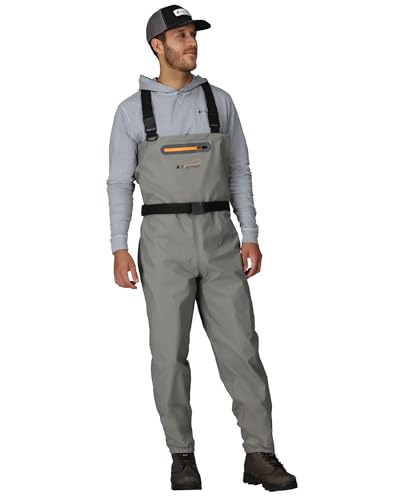
For most anglers who fish a mixed calendar — cold tailwaters in early spring, warm freestone rivers in July, and a handful of boat days in between — the best Orvis fishing waders overall are the Orvis Men’s PRO Wader, listed here in the Short length, which suits shorter inseams and shorter torsos without the baggy knee that a Regular cut creates on a smaller frame. It carries the heaviest-duty waterproof-breathable build and the most useful pocket layout in Orvis’s lineup, and it survives the abrasion that retires cheaper waders first. If you want most of that performance for noticeably less, the Orvis Clearwater Chest Waders for Men are the value pick for a 25–60 day season. Women should look at the Orvis Clearwater Women’s Waders, which use a women’s pattern and a published 30K/8K waterproof-breathable rating. On a tight budget, the Frogg Toggs Hellbender, Canyon II and the TIDEWE chest wader all get you on the water; the Simms Tributary is the alternative if you prefer Simms’ fit; and the Orvis Clearwater Wading Boots finish any stockingfoot kit.
Our Top Picks
 Orvis Clearwater Women’s Fly Fishing WadersMedium Petite15 x 15 x 7 Inches4.55 PoundsCheck on Amazon



Top 3 picks at a glance
Quick Comparison
The table below covers every model in this roundup. Price tiers are bands, not quotes — wader pricing moves with sales and seasonal stock, so treat “budget,” “mid-range” and “premium” as relative positions within the category rather than fixed numbers.
| Product | Best for | Key specs (as listed / category-typical) | Price tier |
|---|---|---|---|
| Orvis Clearwater Chest Waders for Men | All-season breathable waders for a 25–60 day season | Stockingfoot chest wader; waterproof-breathable nylon shell; neoprene booties; external storage pockets; men’s cut | Premium |
| Orvis Clearwater Women’s Fly Fishing Waders | Women anglers who want a true women’s fit | Lightweight waterproof-breathable nylon; published 30K/8K rating; women’s-specific pattern; stockingfoot | Mid-range |
| Frogg Toggs Hellbender Stockingfoot Chest Wader | A first pair or a low-commitment backup | Breathable waterproof stockingfoot chest wader; slate/gray; Large listed | Budget |
| Frogg Toggs Canyon II Stockingfoot Chest Wader | Warm-weather fishing, travel and pack-along backup | Breathable waterproof stockingfoot chest wader; gray; Large listed | Budget |
| TIDEWE Chest Waders for Men and Women | Occasional use, boat and bank fishing, wet chores | Waterproof chest wader; combined men’s/women’s sizing (listed BN M10/W12); budget construction | Budget |
| Simms Tributary Stockingfoot Waders | Anglers who want a durable brand at an entry price | Stockingfoot wader; Basalt colourway; listed M 9-11 Regular | Mid-range |
| Orvis Men’s PRO Wader – Short | Cold water, heavy use and technical wading | Top-tier waterproof-breathable build; reinforced wear zones; full pocket set; Short length | Premium |
| Orvis Clearwater Wading Boots for Men | Finishing a stockingfoot kit with grip and toe protection | Non-slip sole; rubber toe bumper; men’s sizing; worn over wader booties | Mid-range |
How We Chose
This roundup is built from published specifications, brand documentation and the structural realities of the category — not from time on the water with each pair. The selection criteria were deliberately narrow. First, specification transparency: a wader earns a place here if the maker publishes enough detail to reason about it, such as a waterproof and breathability rating, a fabric construction class, or a clear description of the foot and pocket layout. Second, category fit: each pick has to own a distinct job — cold-water technical fishing, warm-weather breathability, women’s-specific patterning, or budget entry — so the list works as a set of options rather than eight versions of the same thing. Third, use case realism: a wader that only makes sense for two trips a year is described as such, and the price tier reflects that. Fourth, upgrade path: we looked at what you outgrow first — booties, seams, pockets, or the fit — and flagged which models leave room to move up later. Finally, ecosystem compatibility: stockingfoot waders only work with boots that fit over the booties, so boot sizing and sole choice are treated as part of the decision, not an afterthought.
1. Orvis Clearwater Chest Waders for Men – Best for All-Season Breathable Performance
As an Amazon Associate we earn from qualifying purchases at no extra cost to you.

These are the waders to buy if you want one pair to cover most of your season and you fish often enough that comfort matters but not so often that you need a competition-grade shell. The listed configuration is a stockingfoot chest wader with neoprene booties, a waterproof-breathable nylon shell and external storage — which is the classic three-season fly-fishing setup. It suits the angler fishing 25 to 60 days a year across spring creeks, autumn tailwaters and warm summer freestone, who wants a bootie that fits properly inside a wading boot rather than a moulded rubber foot, and who wants chest-level storage that doesn’t require a separate chest pack for a couple of fly boxes.
Stockingfoot versus bootfoot is the first thing to understand here. A stockingfoot wader ends in a neoprene sock, so you supply the boot. That gives you a much better fit, better ankle support and faster drainage, but it also means an extra purchase and a sizing step that people routinely get wrong. The bootie adds roughly one to one-and-a-half sizes to your street shoe, so a size 10 foot usually wants a size 11 or 12 wading boot over a bootie. Buy the boot after the wader, not before.
Key specs and what they mean on the water
| Attribute | What the listing states | Practical meaning |
|---|---|---|
| Type | Chest wader, stockingfoot | Requires separate wading boots; best fit and drainage of the two foot styles |
| Foot | Neoprene booties | Size boots to the bootie, not to your shoe; expect a 1–1.5 size step up |
| Shell | Waterproof-breathable nylon | A laminate shell — it blocks water and moves vapour; it does not insulate |
| Storage | External storage pockets | Outside chest storage keeps boxes and tippet reachable without an extra pack |
| Cut | Men’s, standard lengths | Length variants matter more than chest size for how the knees sit |
The strength of this model is that it does nothing badly. Breathable nylon keeps the interior from turning into a sauna on a 70°F afternoon, the neoprene booties seal the ankle junction that leaks first on cheaper waders, and the external storage solves the small-annoyance problem of juggling a fly box on a gravel bar. Orvis also has a well-established repair and service path, which matters more than most buyers expect: the second owner of a wader often ends up sending it in for a seam repair, and a brand with a service department is worth a premium over a brand without one.
Where it gives ground is in abrasion resistance and pocket depth. The shell is a lighter class of fabric than the top of Orvis’s range, so if you fish a lot of brushy banks, scramble over logjams or lean into a lot of boulder-strewn pocket water, you will wear through knees and seat faster than you would on a heavier-duty build. The pocket set is practical but not expansive — it holds what you need for a normal day, not for a full day of gear-heavy indicator nymphing.
Pros
- Breathable nylon shell handles warm spring and summer days without the boil-in-bag feeling of a coated budget wader.
- Neoprene booties give a proper ankle seal and fit inside wading boots far better than a moulded rubber foot.
- External storage keeps fly boxes and tools at chest level without adding a pack.
- Backed by Orvis’s established repair and service structure, which extends the working life of the wader.
- Stockingfoot design drains fast and dries faster than bootfoot alternatives when you travel.
Cons
- Premium tier pricing for a mid-line shell — you are paying partly for the brand and service, not only for fabric.
- Lighter face fabric than Orvis’s top model, so brushy and rocky banks wear it faster.
- Requires a separate pair of wading boots, which is an additional cost and an extra sizing decision.
- Pocket layout is practical rather than generous; heavy gear users will still want a pack.
Against the nearest alternative: the Orvis Men’s PRO Wader is the obvious step up. The PRO uses a heavier-duty build with reinforced high-wear zones, a fuller pocket arrangement and a longer service life under hard use — the trade is a higher tier price and a slightly stiffer feel out of the box. If you fish fewer than 25 days a year, the Clearwater is the better value; if you fish 50-plus days and push through cover, the PRO earns its premium within a couple of seasons. Against the Simms Tributary, the Clearwater’s external storage and Orvis service path are the differentiators, while the Tributary appeals to anglers who already know Simms’ fit works for them.
2. Orvis Clearwater Women’s Fly Fishing Waders – Best for Women Who Want a Real Women’s Cut

Women’s waders are not men’s waders in a smaller size, and this is one of the clearer examples of a maker doing the pattern work properly. The listing describes a lightweight, durable, waterproof-breathable nylon build with a published 30K/8K rating — 30,000 mm of water resistance and 8,000 g/m²/24 h of breathability. Those are serious numbers for a mid-range wader, and they put it comfortably ahead of most budget shells on paper.
It suits the woman angler who fishes a genuine spread of conditions — cool spring mornings through warm summer afternoons — and who has been frustrated by a men’s cut that leaves excess fabric at the waist, rides too high at the chest, or bunches at the knee. A women’s pattern typically shortens the torso, reshapes the waist, narrows the shoulder, and adjusts the hip-to-knee ratio. Those changes matter most when you are wading deep, kneeling to release a fish, or stepping over a log; a poor fit is not just uncomfortable, it is a trip hazard because fabric that bunches at the knee catches on things.
Key specs at a glance
- Shell: lightweight waterproof-breathable nylon, with a published 30K/8K rating.
- Type: stockingfoot chest wader, so it pairs with a separate wading boot.
- Cut: women’s-specific pattern — shorter torso, reshaped waist and hip, narrower shoulder.
- Weight class: lightweight, which favours warm-weather fishing and travel.
- Durability claim: “durable” in the listing, which in this class usually means a mid-weight face fabric rather than an ultralight one.
The 30K/8K rating is the headline. A 30,000 mm hydrostatic head is far more water resistance than wading ever demands — one metre of water depth exerts only about 9.8 kPa, or roughly 1.4 psi, while 30,000 mm converts to about 294 kPa (about 42.7 psi). The practical value of a high number is not depth tolerance; it is margin. High-rated laminates tend to hold up better to sustained pressure against a rock, to abrasion, and to the slow degradation that comes from repeated folding and packing. The 8K breathability figure is the one you will actually feel. Worked through: 8,000 g/m²/24 h equals about 333 g/m² per hour, and a chest-to-ankle wader covers roughly 1.2–1.4 m² of a typical adult, giving a theoretical ceiling of around 400–470 g of moisture moved per hour under ideal lab conditions. A brisk walk along a riverbank generates roughly 400–700 g of sweat per hour, and pushing through current or climbing a steep bank pushes that to 800–1,200 g. In other words, no breathable wader keeps up with hard effort — which is why the breathability rating matters most for the moderate-effort hours, and layering discipline matters for the hard ones.
The lightweight build is the main trade-off. Less fabric mass means less abrasion resistance, so if your home water is brushy or you habitually slide down gravel banks, expect the knees to show wear before the membrane fails. It also means less structure, so the wader feels softer and less protective in cold wind than a heavier shell — an insulation layer underneath solves that.
Pros
- A genuine women’s pattern rather than a scaled-down men’s cut, which improves both comfort and safety in deep water.
- Published 30K/8K rating gives a concrete basis for comparison against other waders.
- Lightweight construction packs down small and travels well.
- Breathability is high enough that a warm summer afternoon is genuinely tolerable with the right base layer.
- Stockingfoot design fits standard women’s wading boots and drains quickly.
Cons
- Mid-range pricing sits above budget stockingfoot waders, and above some anglers’ first-pair budget.
- Lightweight face fabric is the first thing to wear on brushy banks and rocky scrambles.
- No insulation of its own — cold-water anglers must budget for a proper layering system.
- Women’s-specific sizing means fewer options on the used market and less cross-compatibility if you lend gear.
Against the nearest alternative: the Orvis Clearwater Chest Waders for Men are the same family and the same basic architecture, but the pattern is built on a men’s block. If you fit men’s sizing well and want the external storage layout, the men’s version is the straightforward choice. If you have ever finished a day with chafing at the waist, cold spots at the small of your back, or fabric bunching behind the knee, the women’s pattern is the reason to pay the difference. Against the Simms Tributary, the Clearwater Women’s has the stronger published waterproof-breathability numbers and the women’s-specific cut; the Tributary appeals more to anglers who already trust a particular Simms size.
3. Frogg Toggs Hellbender Breathable Waterproof Stockingfoot Chest Wader – Best for a First Pair on a Tight Budget
The Hellbender is the entry point. It is a breathable, waterproof stockingfoot chest wader in a slate/gray colourway, listed here in Large, and it exists to answer one question: can I get on the water for the price of a guided trip? Yes. What it will not do is behave like a premium shell in its fourth season.
It suits three kinds of buyer. The new angler who is not yet sure the sport will stick. The occasional angler who fishes five to fifteen days a year, mostly in fair weather. And the experienced angler who wants a cheap second pair to keep in the truck, lend to a visiting friend, or use for messy bank work where destroying a good wader would hurt. All three are legitimate uses, and for all three the Hellbender is a rational purchase.
Key specs at a glance
- Type: stockingfoot chest wader — pairs with separate wading boots.
- Shell: breathable waterproof fabric, described as breathable in the listing.
- Colour: slate/gray, which is a sensible low-contrast choice for spooky fish.
- Listed size: Large — check the brand’s own chart rather than assuming your usual size.
- Construction class: budget. Expect a lighter face fabric and simpler seam finishing than mid-range or premium shells.
The honest assessment of a budget breathable wader is that it is a coated or lightly laminated fabric, and its breathability is real but modest. In practice that means it works well from roughly 40°F to 70°F air temperature, and it becomes noticeably clammy above about 75°F if you are walking any distance. Below about 40°F it is fine as a shell as long as you layer properly underneath, because a waterproof shell does not insulate — it traps your layers and keeps the wind and water off them.
The places a budget wader fails are predictable and worth knowing in advance. The bootie-to-leg seam is the highest-stress junction on any stockingfoot wader, and it is where budget construction shows first. The knees and seat abrade faster because the face fabric is thinner. The suspenders and belt hardware are usually simpler, which matters over a long day. None of that makes the Hellbender a bad buy — it makes it a buy with a known service life. If you fish 10 days a year, a three-to-four season life is plenty. If you fish 60, you will be shopping again inside two seasons and the cost-per-outing math stops favouring the cheap pair.
Pros
- Lowest barrier to entry of any wader here — you can be fishing this weekend without a major outlay.
- Stockingfoot design gives a far better fit and drainage than bootfoot waders in the same price band.
- Low-contrast slate/gray colourway is a genuinely useful detail on clear, pressured water.
- Cheap enough to be a genuine spare pair, a loaner, or a dedicated pair for boat work and bank chores.
- Light and packable, so it doubles as a travel backup.
Cons
- Modest breathability — clammy above roughly 75°F if you are walking to the water.
- Thinner face fabric wears through at knees and seat faster than mid-range shells.
- Bootie and crotch seams are the first failure points, and budget waders are the least likely to be economically repairable.
- Simpler suspender and belt hardware is less comfortable across a full day.
- No published waterproof/breathability rating to compare against rated waders.
Against the nearest alternative: the Frogg Toggs Canyon II is the sibling model, and the choice between them is mostly about intended use rather than specification. The Hellbender is the general-purpose budget chest wader; the Canyon II is the one buyers tend to pick for warm-weather work and travel. If you are choosing your only pair and expect to fish in shoulder-season cold, neither is ideal — that is where the Simms Tributary or the Orvis Clearwater Women’s sit, with heavier construction and published ratings. If you are choosing a first pair for summer, the difference between the two Frogg Toggs models is small enough that price and availability should decide it.
4. Frogg Toggs Canyon II Breathable Waterproof Stockingfoot Chest Wader – Best for Warm Weather and Travel

The Canyon II is the warm-weather sibling in Frogg Toggs’ range: a breathable, waterproof stockingfoot chest wader in gray, listed here in Large. Where the Hellbender reads as a general first pair, the Canyon II reads as the model to reach for when the water is low, the air is hot, and you want the least amount of fabric between you and a breeze.
It suits the summer angler, the travelling angler who wants a wader that folds into a carry-on, and the wet-wading-curious angler who wants a shell for the cold morning and the shaded canyon stretch without committing to a premium pair. It also suits the boat angler who spends more time sitting and standing in a drift boat than wading deep, where a lighter, cooler shell is a real comfort upgrade.
Key specs at a glance
- Type: stockingfoot chest wader — requires separate wading boots.
- Shell: breathable waterproof fabric, as described in the listing.
- Colour: gray, a neutral, low-contrast choice.
- Listed size: Large — verify against the brand chart, since budget sizing runs inconsistently.
- Construction class: budget. Lighter fabric and simpler finishing than mid-range waders.
The reasoning behind using a lightweight budget shell in summer is worth spelling out, because it explains why the “cheaper” wader can be the better tool for a specific job. Breathability is a rate — grams of moisture per square metre per hour — and it drops sharply as the temperature and humidity gradient across the fabric narrows. On a 90°F day with high humidity, even a premium 8,000 g rated laminate is working against a much weaker driving force than it is on a 50°F morning, so the practical difference between a good shell and a modest one shrinks. Meanwhile, the premium shell’s advantages — abrasion resistance, pocket layout, cold-weather structure — matter less on a summer day when you are wearing less underneath and covering fewer miles of brush. The result: in high summer, a lighter, cheaper wader gets you most of the way there, and the money is better spent on boots and a good wading jacket.
What you give up is cold-weather capability and long-term durability. Below about 45°F, the thinner fabric has less structure, so it feels colder and less protective against wind than a heavier shell. The knees and seat abrade faster, and the bootie seam remains the highest-risk junction. If your season is mostly June through September, that is an acceptable trade. If you fish March through November, you will want the Canyon II as a second pair rather than your only pair.
Pros
- Light and cool — the most comfortable of the budget options in genuinely hot weather.
- Packs down small enough for airline travel and road trips where luggage space is tight.
- Neutral gray colourway works on clear, pressured water.
- Stockingfoot design drains and dries quickly, which matters on multi-day trips.
- Low enough cost to justify as a dedicated summer or travel pair.
Cons
- Little cold-weather structure; feels thin and draughty below roughly 45°F.
- Budget face fabric abrades at knees and seat under brush and rock contact.
- No published waterproof or breathability rating to compare numerically.
- Simpler hardware and suspenders than mid-range waders.
- Sizing runs inconsistently in this class — the chart matters more than the label.
Against the nearest alternative: the Hellbender. Both are budget Frogg Toggs stockingfoot chest waders with similar construction, and the practical difference is positioning rather than specification. Choose the Canyon II if your fishing is concentrated in warm months, if you travel, or if you want a second pair for summer; choose the Hellbender if you want the general-purpose budget option and expect a wider spread of conditions. Against the Simms Tributary, the Canyon II is lighter and cheaper but gives up build quality and brand support — the Tributary is the better single pair if you fish in shoulder seasons.
5. TIDEWE Chest Waders for Men and Women – Best for Occasional Use and Boat or Bank Fishing

TIDEWE is a budget outdoor brand that has built a following on cheap, functional waterproof gear, and its chest wader is the most utilitarian item on this list. The listing names it for men and women, gives a combined size designation (listed here as BN M10/W12, meaning roughly men’s 10 and women’s 12), and describes it as a waterproof fishing wader. That combined sizing is genuinely useful — it means one product line covers a wide range of bodies, which is rare in waders.
It suits the casual angler, the boat and bank angler, the paddler, and anyone who needs a waterproof chest-high layer for messy work rather than technical wading. It also suits the household that wants one pair of waders for two people of different sizes to share, which is not something you can do with a tightly patterned premium wader.
Key specs at a glance
- Type: chest wader, waterproof, sized for men and women.
- Sizing: combined men’s/women’s designations (listed BN M10/W12), which widens the fit range considerably.
- Construction class: budget. Expect heavier, more coated-feeling fabric than breathable mid-range waders.
- Foot configuration: varies across the line — check whether the specific variant is bootfoot or stockingfoot before buying, because the two require completely different boot decisions.
- Intended use: general waterproofing — fishing, boat work, bank work, wet chores.
The important caveat is the one the listing itself does not resolve: TIDEWE builds chest waders in more than one foot configuration, and bootfoot versus stockingfoot changes everything about how you use it. A bootfoot wader has a moulded rubber boot attached, so it is heavier, bulkier, slower to dry, and gives less ankle support — but it is a complete solution out of the box with no separate boot purchase and no bootie sizing problem. A stockingfoot variant behaves like the other waders here and needs wading boots. Confirm which one you are buying before you commit, because the boot decision is where most first-time wader buyers lose money.
Performance-wise, this is a shell built for waterproofing first and breathability second. That is the right priority for boat and bank fishing, where you are mostly standing or sitting and not hiking miles. It is the wrong priority for a long walk into a remote canyon on a warm day, where the moisture build-up will be noticeable. Treat it as a waterproof barrier with some breathability rather than a technical breathable shell and you will be satisfied with it.
Pros
- Combined men’s and women’s sizing makes it one of the few waders a household can genuinely share.
- Budget pricing makes it a low-risk purchase for occasional use or as a loaner pair.
- Suits non-fishing uses — boat work, pond maintenance, wet-weather chores — where a premium wader would be wasted.
- Widely available in a broad size run, which helps anglers who fall outside standard wader sizing.
- Simple construction with fewer failure points than a heavily featured technical wader.
Cons
- Breathability is modest; expect clamminess on warm days with any walking involved.
- Foot configuration varies by variant, and the listing does not always make it obvious — verify before buying.
- Heavier and bulkier feel than breathable stockingfoot waders in the mid-range.
- No published waterproof or breathability rating to compare numerically.
- Seams and bootie junctions are budget-grade, so lifespan under frequent use is shorter.
Against the nearest alternative: the Frogg Toggs Hellbender. Both are budget chest waders, but they solve different problems. The Hellbender is a breathable stockingfoot fly-fishing wader — it assumes you own wading boots and you want a better fit and faster drainage. The TIDEWE is a broader, more general-purpose waterproof chest wader, with a wider size range and a configuration that may include an attached boot. If you are a fly angler who already owns boots, the Hellbender is the more natural pick. If you want one pair for occasional fishing plus general wet work, and you value the combined men’s/women’s sizing, the TIDEWE is the more flexible buy.
6. Simms Tributary Stockingfoot Waders – Best for a Durable Brand at an Entry Price

Simms is one of the most respected names in waders, and the Tributary is its entry-level line — the way into the brand without paying flagship prices. The listing describes a stockingfoot wader in the Basalt colourway, sized M 9-11 Regular. The “9-11” is the stockingfoot size, which corresponds to the bootie and therefore to the wading boot you will wear over it; the “Regular” is the length.
It suits the angler who has decided they are in this for the long haul and wants to buy once into a brand with a strong reputation for durability and a well-established repair and warranty culture. It also suits the angler who has tried on a friend’s Simms waders and knows the fit works for them — fit is the single most important variable in wader satisfaction, and once you find a brand whose block suits your body, staying with it is rational.
Key specs at a glance
- Type: stockingfoot chest wader — worn with separate wading boots.
- Size as listed: M 9-11 Regular — the numeric range refers to the bootie/foot size, not the chest.
- Colour: Basalt, a dark neutral that hides dirt and reads as low-contrast on the water.
- Construction class: mid-range. Heavier and more structured than budget shells, lighter than flagship models.
- Brand position: entry-level within a premium brand’s wader range.
The case for buying an entry-level wader from a premium brand is straightforward, and it comes down to where the money goes. A budget wader spends most of its cost on fabric and assembly, with very little left for quality control, hardware and after-sales support. An entry-level wader from a specialist brand spends a larger share on pattern development, seam construction and the infrastructure to repair what it sells. That does not mean the fabric is better than a mid-range competitor’s — it means the odds of a defect, and the odds of being able to fix one, both improve.
The trade-offs are equally clear. The Tributary is not a flagship wader; it uses a mid-weight construction and a simpler feature set than the top of the Simms range, and the pocket layout is functional rather than expansive. It is also priced above the budget tier, so if your season is five days a year, the value calculation does not work in its favour. The place it shines is in the middle: a 20-to-50-day season, a mix of wading and boat work, and a preference for buying gear that will still be serviceable in year five.
Pros
- Entry into a brand with a strong reputation for durability and a well-established repair culture.
- Mid-range construction with more structure and abrasion resistance than budget shells.
- Dark Basalt colourway is practical — it hides river grime and stays low-contrast on the water.
- Clear, specific sizing convention (M 9-11 Regular) makes it easier to match to a wading boot.
- Holds resale value better than budget brands, which softens the cost of upgrading later.
Cons
- Mid-range pricing sits well above budget waders for a similar basic layout.
- Entry-level within its own brand — the feature set is deliberately pared back.
- Stockingfoot only, so boots are an additional purchase.
- No external storage layout as extensive as the Orvis Clearwater’s.
- Fewer length and size options than a full flagship range, so unusual body shapes may not fit perfectly.
Against the nearest alternative: the Orvis Clearwater Chest Waders for Men. These two occupy almost the same position in the market — a mid-to-upper build from a respected specialist, in a stockingfoot chest configuration. The Clearwater’s advantages are its external storage pockets and the Orvis service path; the Tributary’s are its brand reputation for hard-wearing construction and its clear bootie-based sizing. The right answer is almost always fit: try both if you can, or buy from whichever brand’s size chart matches your measurements most closely, because a wader that fits badly is worse than a slightly cheaper one that fits well.
7. Orvis Men’s PRO Wader – Short – Best for Cold Water and Heavy Technical Use

This is the top of Orvis’s wader range and the best overall pick in this roundup for anglers who fish hard. The listing is for the Short length, which is a genuinely important variant: wader sizing is a two-dimensional problem, and most buyers only solve half of it. Chest size determines how much room you have; length determines where the knee sits, how high the chest rides, and whether the crotch drops when you step up onto a bank. A Regular length on a shorter angler produces a low crotch, a knee that lands below the actual knee, and fabric that bunches — all of which reduce mobility and increase wear.
It suits the angler fishing 40-plus days a year across cold tailwaters, technical pocket water and shoulder-season conditions. It also suits the angler who has already replaced two budget pairs and has done the arithmetic on cost per outing. And it suits the shorter angler specifically, because the Short length solves a fit problem that no amount of belt-tightening fixes.
Key specs at a glance
| Attribute | What the listing states | Practical meaning |
|---|---|---|
| Position in range | Orvis PRO (top of the wader line) | Heavier-duty build than the Clearwater family, aimed at frequent use |
| Length variant | Short | Shorter torso and inseam; fixes bunching at the knee on smaller frames |
| Type | Stockingfoot chest wader | Requires wading boots; best fit and drainage |
| Build class | Premium waterproof-breathable laminate | Highest abrasion resistance and longest service life in this list |
| Features | Full technical feature set — reinforced wear zones, extensive pocketing | Designed to carry gear and survive brush, rock and boat abuse |
The economic case for a premium wader is where most buyers get it wrong, because they compare sticker prices instead of cost per outing. Run the numbers. A budget stockingfoot wader in the roughly $80–$160 band, used 25 days a year for three seasons, gives about 75 outings. A mid-range wader in the roughly $180–$300 band, used 30 days a year for five seasons, gives about 150 outings. A premium wader in the roughly $350–$700 band, used 40 days a year for eight seasons, gives about 320 outings. Divide through and the three land in a similar range per outing — the premium pair does not win on raw economics. What it wins on is everything else: it keeps you drier in year six, it has pockets where you need them, it has reinforced knees so a stumble on a boulder does not become a leak, and it is built to be repairable rather than disposable.
The cons are honest ones. It costs the most here, it feels stiffer out of the box than a lightweight shell until it breaks in, and it is heavier to pack for travel. It is also overkill if your season is a dozen days in fair weather — a budget wader would do the same job for a fraction of the outlay.
Pros
- Highest abrasion resistance and longest expected service life of any wader in this roundup.
- Short length variant solves the bunching and low-crotch problem for shorter anglers.
- Full technical pocket layout supports long days without an extra pack.
- Reinforced high-wear zones delay the knee and seat failures that retire cheaper waders.
- Best cold-weather behaviour of the group — more structure means better wind resistance over layers.
Cons
- Premium tier pricing is the highest here.
- Stiffer and heavier out of the box than lightweight shells.
- Bulkier to pack for travel and slower to dry after a soaking.
- Hard to justify for fewer than roughly 25 days a year in fair weather.
- Stockingfoot only, so boots remain a separate purchase.