The best mandoline slicer for most kitchens is the ONCE FOR ALL Upgrade Safe Mandoline Slicer Plus. Its larger platform and guarded blade housing let you push a whole potato, onion or courgette through at a steady rhythm without your fingers ever approaching the cutting edge — which is exactly where inexpensive slicers fail. It suits anyone prepping for four or more people, anyone batch-cooking a gratin or a tray of roast vegetables, and anyone who has cut themselves on a bare-blade mandoline and wants to try again with a design that keeps the blade enclosed. If you slice one cucumber at a time and your drawers are shallow, the OXO Good Grips Handheld Mandoline Slicer is the better fit: a compact handheld with a non-slip handle that stores flat and adjusts through a handful of thickness settings. Cooks who want continuous, knife-like thickness control should look at the Benriner. This guide compares twelve slicers on blade adjustability, slice thickness, safety features and cleaning effort so you can match one to your prep habits rather than to a marketing photo.
Our Top Picks
 OXO Good Grips Handheld Mandoline Slicer with Non-SlipStandard3.75 x 0.5 x 11.5 Inches0.4 poundsCheck on Amazon
 Ourokhome Mandolin Slicer for Kitchen Food6 blades10.24 x 5.2 x 4.21 Inches1.7 PoundsCheck on Amazon
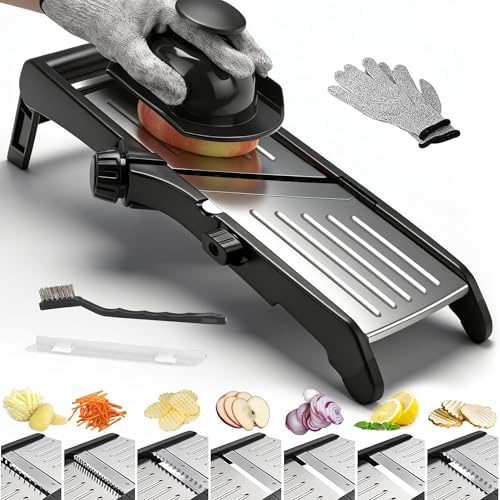


Top 3 picks at a glance
Quick Comparison
| Product | Best for | Key specs | Price tier |
|---|---|---|---|
| OXO Good Grips Handheld Mandoline Slicer | Small, frequent slicing jobs and tight storage | Handheld format, stainless steel blade, soft non-slip handle, dial thickness settings, food holder, dishwasher-safe parts | Mid-range |
| -BINGBING- 7-in-1 Adjustable Vegetable Slicer | Buying one tool that covers slices, julienne and shreds | 7 interchangeable inserts, adjustable thickness, hand guard, container-friendly design | Mid-range |
| ONCE FOR ALL Upgrade Safe Mandoline Slicer Plus | High-volume, safety-first prep | Oversized platform, enclosed blade housing with pusher, wide adjustable thickness range, folding legs, non-slip feet | Premium |
| SupMaKin Safer Mandoline Slicer (1–8 mm) | Precise thickness control on a full-size frame | Adjustable 1–8 mm thickness, full-size body, safety pusher, stainless steel blade, julienne capability | Premium |
| Ourokhome Mandolin Slicer with 6 Blades | Waffle cuts and blade variety on a budget | 6 blades including a waffle cutter, hand-safe pusher, interchangeable inserts, compact storage case | Budget |
| SupMaKin Safe Mandoline Slicer Pro | Large-batch meal prep with a contained blade | Pro full-size frame, adjustable thickness, safety hand guard, stainless steel blade set, non-slip base | Premium |
| Fullstar Handheld Mandoline Vegetable Slicer & Julienne Cutter | Cheap julienne and quick handheld slices | Handheld format, straight and julienne blades, adjustable thickness, finger guard | Budget |
| Benriner Mandoline Slicer with 4 Blades | Professional-grade precision and continuous adjustment | Japanese stainless steel blades, 4 blades, 12.75 × 3.625 inches, BPA-free, beige | Premium |
| Ibergrif Handheld Mandoline Slicer | A first slicer on a tight budget | Handheld format, stainless steel blades, adjustable thickness, safety hand guard | Budget |
| PrepSolutions Adjust-A-Slice Mandoline | Simple dial-and-slice thickness changes | Adjustable thickness dial, stainless steel blade, compact body, hand guard | Budget |
| Fullstar Stainless Steel Mandoline & Julienne Cutter | A mid-range countertop workhorse | Stainless steel construction, straight and julienne blades, adjustable thickness, safety guard | Mid-range |
| Fullstar Pro Mandoline Vegetable Slicer, 6-in-1 | Full-size prep with interchangeable inserts | 6-in-1 insert set, adjustable thickness, full-size platform, safety holder, non-slip feet | Mid-range |
How We Chose
This guide is built from published product specifications and category research rather than from any testing bench. Every slicer here was assessed on four criteria. First, blade adjustability: does thickness change through discrete click stops or a continuous knob, how wide is the range, and can the mechanism hold a setting under pressure instead of drifting mid-vegetable? Second, slice thickness suitability: whether the range covers the thin end (1–1.5 mm for chips and cucumber salads) as well as the thick end (6–8 mm for wedges), since a slicer that only does 3–5 mm is a one-dish tool. Third, safety architecture: whether the blade is enclosed in a housing, whether a pusher or hand guard is included, whether the feet or handle actually grip a wet worktop, and whether the blade can be locked or retracted for storage. Fourth, cleaning effort: how many separate parts touch food, whether they are dishwasher-safe, whether the blade is removable for rinsing, and how much debris collects in the crevices behind the blade and inside the slider channel. We also weighed category fit and upgrade path — a budget handheld is the right answer for someone who slices a cucumber twice a week, while a full-size guarded slicer is the right answer for someone who preps a week of meals on Sunday. Price is expressed only as a tier, because listings change constantly.
1. OXO Good Grips Handheld Mandoline Slicer – Best for quick, small-batch slicing in tight kitchens
As an Amazon Associate we earn from qualifying purchases at no extra cost to you.

The OXO Good Grips Handheld Mandoline Slicer is the slicer to buy if your realistic use case is one or two vegetables at a time and your kitchen has no room for a countertop appliance. It is a compact handheld: you grip the soft, non-slip handle with one hand and draw it across a cucumber, courgette, radish or potato with the other, letting the blade do the work at the bottom of each stroke. The handle is the whole design story here — a wet hand on a slick plastic body is how most mandoline accidents start, and OXO builds the grip specifically for that problem.
- Format: handheld, drawn across the ingredient rather than mounted
- Blade: stainless steel, fixed in the frame with a guarded cutting edge
- Thickness control: a dial that steps through several slice settings
- Safety: soft non-slip handle, included food holder for the last few centimetres
- Cleaning: food-contact parts designed to be rinsed and are typically dishwasher-safe
- Storage: flat profile, fits a drawer rather than a cupboard shelf
The strengths are convenience and control. Because the slicer travels over the food, you can slice directly over a bowl, a salad spinner or a sheet pan, which removes the transfer step that full-size slicers add. The dial is fast to change with wet hands, and the settings cover the useful everyday band — thin enough for cucumber and radish salads, thick enough for sandwich tomato and roasted vegetable rounds. The compact size also means it comes out of the drawer more often than a bulky unit that has to be assembled, unfolded and washed afterwards. For a single cook making lunch, that frequency matters more than maximum capacity.
The trade-off is throughput and range. A handheld has no runway, so long ingredients like a whole daikon or a large sweet potato become awkward, and there is no catch tray or adjustable platform to stabilise the work. The very thin end of the range — the sub-1.5 mm setting that makes proper potato chips — is generally not where a compact dial excels; if chips are your goal, a full-size slicer with a fine setting is a better purchase. Deep julienne is also out of scope, because there is no insert slot.
Pros
- Genuinely comfortable, non-slip grip for wet hands
- Fast dial changes and no assembly before use
- Slices straight into a bowl, cutting down on washing up
- Drawer-friendly footprint
- Easy to rinse; few parts to track
Cons
- No julienne or waffle inserts
- Awkward with long or very large vegetables
- Thinnest settings are not as fine as a full-size precision slicer
- You still need the food holder for the last slice
Against the nearest alternative, the Fullstar Handheld Mandoline Vegetable Slicer & Julienne Cutter, the OXO wins on grip quality and dial feel, and loses on blade variety — the Fullstar handheld bundles a julienne cutter for less money, but its handle and adjuster are simpler. Against the Ibergrif Handheld, the OXO costs more and feels more secure in the hand. If you want one handheld and you slice often, the OXO is the more pleasant tool; if you specifically want matchsticks, the Fullstar handheld or the -BINGBING- insert set is the smarter pick.
2. -BINGBING- 7-in-1 Adjustable Vegetable Slicer – Best for one tool that covers slices, julienne and shreds
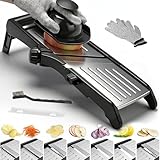
The -BINGBING- 7-in-1 Adjustable Vegetable Slicer is aimed at the cook who wants one box in the cupboard to handle every cut shape a recipe throws at them. Seven interchangeable inserts typically cover a straight slicer, several julienne widths, a coarse shred and a fine shred, with the whole set slotting into a single frame that also adjusts slice thickness. Instead of buying a mandoline plus a box grater plus a julienne peeler, you buy one unit and swap a plate.
- Inserts: seven, covering straight slices, julienne widths and shreds
- Thickness: adjustable independently of the insert
- Safety: hand guard included for the pusher side of the frame
- Format: countertop frame that sits over a bowl or a container
- Cleaning: inserts lift out individually for rinsing
The obvious strength is coverage per unit of storage space. A 7-in-1 earns its shelf footprint because the same frame does coleslaw, matchstick carrots, cucumber rounds and grated cheese. Insert swaps are quick once you learn the orientation, and because each insert is a flat plate rather than a complex assembly, rinsing them is straightforward — the failure mode is not the insert itself but the frame’s slider channel, where fine shreds pack down and need a rinse and a brush.
The second strength is consistency. When you need a whole cabbage shredded to the same width for slaw, an insert does in a minute what a knife does in ten, and every piece cooks or wilts at the same rate. For anyone cooking from recipes that specify “julienned” or “finely shredded”, that consistency is the actual value, not raw speed.
The trade-offs are frame rigidity and blade finesse. Multi-insert designs put the cutting edge on a removable plate, and removable plates are rarely as taut or as fine as a fixed blade — expect slightly more tearing on soft produce like ripe tomato, and expect the thinnest slice setting to be closer to 2 mm than to 1 mm. There is also more to wash: seven inserts means seven things to rinse, dry and store, and a missing insert is a missing function. If you only ever slice cucumbers, the extra parts are pure overhead.
Pros
- Seven cut shapes from one frame and one storage footprint
- Independent thickness adjustment on top of insert choice
- Hand guard included as standard
- Flat inserts rinse quickly and dry without trapping water
- Strong value for anyone who shreds and juliennes regularly
Cons
- Seven inserts to wash, dry and keep track of
- Removable blades are less crisp on soft produce than fixed blades
- Thinnest setting is unlikely to reach chip-grade fineness
- Frame takes up more cupboard space than a handheld
Compared with the Fullstar Pro Mandoline 6-in-1, the -BINGBING- offers one more insert and a similar countertop format, but the Fullstar frame tends to feel more solid under pressure and its thickness adjuster is easier to read at a glance. Compared with the Ourokhome six-blade set, the -BINGBING- is the broader kit for shredding and julienne, while the Ourokhome adds a waffle cutter that no standard insert set includes. If waffle fries are the goal, pick the Ourokhome; for everything else in the multi-cut category, the -BINGBING- is the more balanced choice.
3. ONCE FOR ALL Upgrade Safe Mandoline Slicer Plus – Best for high-volume, safety-first prep

The ONCE FOR ALL Upgrade Safe Mandoline Slicer Plus is the slicer to buy when volume and safety both matter. It is a full-size countertop unit with an oversized platform and, as the name signals, a design built around keeping the blade away from your hands: the cutting edge sits inside a housing, and produce travels down a channel on a pusher rather than being dragged across an exposed blade. The SkyBlue finish is cosmetic, but the extra platform size is not — it is what lets you process a kilo of potatoes without repositioning the unit.
- Format: full-size countertop slicer with folding legs
- Blade: enclosed in a housing with a pusher-style feed
- Thickness: wide adjustable range covering thin rounds through thick slices
- Stability: non-slip feet plus legs that lock open
- Safety: pusher and guard arrangement designed to keep fingers off the edge
- Cleaning: removable food-contact parts, blade housing needs a rinse behind the edge
The core strength is that it removes the two reasons people stop using mandolines. The first is fear: a guarded feed means you can push firmly and quickly without the hesitation that makes hand-slicing slow and uneven. The second is fatigue: a large platform supported on folding legs lets you work at chest height over a sheet pan, so a long prep session does not turn into an awkward balancing act over the sink. The thickness adjuster covers the useful span from thin vegetable rounds up to substantial slices for roasting, and it holds its setting under load, which is what separates a premium frame from a budget one that drifts mid-vegetable.
The folding legs and non-slip feet are the underrated part. Most mandoline frustration is really stability frustration — a slicer that walks across the worktop forces you to slow down and grip harder, and that is when hands slip. A locked-open leg set with rubber feet converts the whole job into a two-hand push, which is both faster and safer.
The costs are footprint and cleaning. This is not a drawer tool; it needs cupboard space and a minute of setup. The blade housing also traps fine debris in the channel behind the edge, so a quick rinse is not always enough — a small brush along the channel is the difference between a slicer that stays pleasant and one that develops a smell. And because the design prioritises safety over exposure, the absolute thinnest, most delicate cuts are slightly harder to achieve than on a bare-blade precision slicer.
Pros
- Enclosed blade design that makes firm, fast pushing possible
- Oversized platform handles large batches without repositioning
- Folding legs and non-slip feet give real stability
- Wide, load-resistant thickness adjustment
- Best choice for anyone who has cut themselves on a slicer before
Cons
- Takes up cupboard space and needs assembly before use
- Blade housing channel needs brushing, not just rinsing
- Not the finest cut available for chips or delicate garnishes
- Premium tier pricing for a single-purpose tool
Its nearest rival is the SupMaKin Safe Mandoline Slicer Pro. Both are full-size, guarded, premium units. The ONCE FOR ALL wins on platform size and stability hardware; the SupMaKin Pro is the closer competitor on blade finesse and tends to feel slightly more precise at the thin end. If your priority is getting through a big pile of vegetables safely, take the ONCE FOR ALL. If your priority is thin, even slices for gratins and chips with a guarded blade, the SupMaKin Pro or the 1–8 mm SupMaKin Safer model is the better match.
4. SupMaKin Safer Mandoline Slicer (1–8 mm) – Best for precise thickness control on a full-size frame

The SupMaKin Safer Mandoline Slicer states its range in the product name — 1–8 mm — and that number is the reason to buy it. A 1 mm floor puts proper potato chips, paper-thin radish and translucent cucumber within reach, while an 8 mm ceiling covers thick rounds for roasting, potato wedges and substantial sandwich slices. Very few slicers at any price span that whole band with a single adjuster, and the ones that do tend to be the ones cooks keep for years.
- Thickness range: 1 mm to 8 mm, adjustable
- Format: full-size countertop frame
- Blade: stainless steel cutting edge in a guarded housing
- Safety: pusher and hand guard arrangement; “Safer” refers to the guarded feed
- Julienne: insert capability for matchsticks
- Cleaning: removable parts plus a channel that needs periodic brushing
The practical value of the range becomes obvious when you map it to dishes. At 1–1.5 mm you get chips and cucumber salad. At 2 mm you get pickled onion and courgette ribbons. At 3 mm you get gratin layers and stir-fry that cooks evenly. At 4–5 mm you get aubergine for moussaka and thick tomato slices. At 6–8 mm you get wedges and thick chips. A slicer that only covers 3–5 mm forces you back to the knife for half those jobs, which is exactly the moment a mandoline stops being worth its shelf space.
The safety framing here is worth reading carefully rather than skimming. “Safer” in the product name refers to a guarded feed that keeps fingers behind a pusher, not to a blade that retracts. That distinction matters when you compare models: a guarded feed protects you during the cut, while a retracting blade protects you during storage and cleaning. The SupMaKin does the first well; for the second, use the guard and a brush rather than a sponge when you clean the edge.
The trade-offs are the usual full-size ones — it needs cupboard space and setup time, and the frame is heavier than a handheld. The adjuster mechanism also rewards a light touch: because it spans such a wide range, it is worth confirming the setting has clicked or seated before you commit a whole potato to it. And like every full-size slicer, the fine debris that collects behind the blade is the maintenance chore that determines whether you still like the tool in six months.
Pros
- 1–8 mm range covers chips through wedges on one tool
- Guarded feed makes confident pushing possible
- Julienne capability in the same frame
- Full-size platform suits batch cooking
- Thin end is fine enough for genuine chip-grade slices
Cons
- Needs cupboard space and setup time
- Wide-range adjuster needs confirmation before each big push
- Blade channel requires brushing to stay clean
- Premium tier for a tool that only slices
Against the ONCE FOR ALL Upgrade Safe Mandoline Slicer Plus, the SupMaKin Safer trades a little platform size and leg stability for a wider, better-documented thickness span — the 1 mm floor is the deciding factor for chips and garnishes. Against the SupMaKin Safe Mandoline Slicer Pro from the same brand, this model is the more transparent about its range; the Pro version emphasises the frame and guard instead. If you cook from recipes that specify thickness, take this one. If you cook by volume and want maximum stability, take the ONCE FOR ALL.
5. Ourokhome Mandolin Slicer with 6 Blades – Best for waffle cuts and blade variety on a budget

The Ourokhome Mandolin Slicer is the budget option that includes something most of its rivals do not: a waffle blade. Six blades in total typically cover straight slicing, a couple of julienne widths, a coarse shred and the waffle cutter, all held in a compact hand-safe frame with a pusher. If you want waffle fries, lattice-cut courgette or decorative vegetable slices without buying a separate tool, this is the cheapest route to that shape.
- Blades: six, including a waffle cutter
- Safety: hand-safe pusher and guard arrangement
- Format: compact countertop frame
- Thickness: adjustable across everyday settings
- Storage: blade set is small enough to keep together
The waffle blade is the headline. A waffle cut works by slicing partway through on one axis and then rotating the vegetable 90 degrees and slicing again, which produces the crosshatched grid that holds seasoning and crisps more evenly in the oven or air fryer. Doing that with a knife is fussy and slow; with a dedicated insert it is a two-pass job. For anyone who cooks oven fries regularly, that single insert justifies the purchase price more than the julienne blades do.
The second strength is that six blades at a budget tier is a lot of function per unit of spend. Shredding cabbage, julienning carrots and slicing cucumber all become quick, and because the frame is compact it is easier to store than a full-size premium unit. The pusher arrangement also means the food travels down a channel rather than being dragged across an exposed edge, which is the safety behaviour you want from a first slicer.
The compromises are predictable at this price. Blade plates in budget multi-blade sets are thinner, so they flex slightly under hard produce — expect a little more resistance on dense sweet potato and slightly less crisp edges on soft tomato. The frame is also lighter, so it benefits from a damp cloth or a silicone mat underneath rather than relying on its own feet alone. And six blades means six things to wash; the waffle insert in particular has a grid that traps starch and needs a brush rather than a rinse.
Pros
- Waffle cutter included — rare at any price, very rare on a budget
- Six cut shapes for a low outlay
- Compact frame stores easily
- Hand-safe pusher arrangement suits beginners
- Good first mandoline for someone unsure how much they will use one
Cons
- Thinner blade plates flex under dense produce
- Light frame benefits from a non-slip mat underneath
- Waffle insert needs brushing to clean properly
- Fine slice settings are not chip-grade
Compared with the -BINGBING- 7-in-1, the Ourokhome has one fewer insert but adds the waffle shape the -BINGBING- lacks. Compared with the PrepSolutions Adjust-A-Slice, the Ourokhome is the more versatile tool for a similar outlay — the PrepSolutions is a simpler dial slicer with no insert ecosystem at all. If you want maximum cut shapes for minimum money, the Ourokhome is the pick; if you want a sturdy, no-fuss slicer and do not care about waffles, the PrepSolutions or the Ibergrif handheld is simpler to live with.
6. SupMaKin Safe Mandoline Slicer Pro – Best for large-batch meal prep with a contained blade

The SupMaKin Safe Mandoline Slicer Pro is the brand’s fuller-frame take on the guarded slicer idea: a large countertop platform, a stainless steel blade set held inside a protective structure, and an emphasis on keeping hands away from the edge during long prep sessions. It is aimed at the cook who processes several kilos of vegetables at a time — meal preppers, batch cooks, anyone feeding a family from a Sunday session.
- Format: pro full-size countertop frame
- Blade: stainless steel set in a guarded housing
- Thickness: adjustable across everyday slice settings
- Safety: dedicated hand guard and pusher for the feed channel
- Base: non-slip footing for a wet worktop
- Cleaning: removable food-contact parts; channel needs a brush
The strength is endurance. A larger platform means fewer interruptions to reposition the slicer or empty a catch area, and a pusher that lets you apply real downward force means dense produce like carrot, celeriac and sweet potato does not stall the stroke. When you are slicing for six meals rather than one, those small friction points are what decide whether you finish the job or reach for the food processor. The guarded blade also removes the mental overhead of watching your fingertips, which is a genuine throughput gain on a long session, not just a safety nicety.
The non-slip base matters more than it sounds. On a wet stainless worktop, a light slicer slides; a heavier pro frame with proper footing stays put, which lets you use a smooth, repeatable push instead of a cautious, gripping one. That repeatability is what produces even slices, and even slices are what produce even cooking — a gratin where every layer is 3 mm cooks in one pass, while a gratin with a mix of 2 mm and 6 mm needs extra time and still ends up uneven.
The costs are storage and cleaning. This is a bulky unit, and the blade channel behind the edge is the part that decides how pleasant it stays: rinse the removable parts, then brush the channel, then dry everything before reassembly. Skip the brushing and starch builds up into a film that dulls the feel of the cut. Compared with the 1–8 mm SupMaKin Safer model, this Pro version is the better choice for volume and the weaker choice for documented fine adjustment; the Safer model is the more transparent about exactly how thin it goes.
Pros
- Large platform suited to multi-kilo prep sessions
- Pusher design accepts real pressure on dense vegetables
- Non-slip base keeps the stroke repeatable
- Guarded blade reduces hesitation and hand fatigue
- Even slices translate directly into even cooking
Cons
- Bulky to store
- Thickness range is less explicitly documented than the 1–8 mm model
- Blade channel requires regular brushing
- Premium price for a slicer-only tool
Against the ONCE FOR ALL Upgrade Safe Mandoline Slicer Plus, this is the closer call in the whole roundup: both are large, guarded, premium units. The ONCE FOR ALL edges it on platform size and folding-leg stability; the SupMaKin Pro is competitive on blade finesse and construction feel. Against the Fullstar Pro 6-in-1, the SupMaKin is the more specialised slicing tool, while the Fullstar gives you insert variety for less money. If slicing is the job and safety is the constraint, take a SupMaKin or the ONCE FOR ALL; if you also want shredding and julienne from the same frame, the Fullstar Pro is the better value.
7. Fullstar Handheld Mandoline Vegetable Slicer & Julienne Cutter – Best for cheap julienne and quick handheld slices

The Fullstar Handheld Mandoline Vegetable Slicer & Julienne Cutter is the budget answer for two specific jobs: slicing a vegetable quickly over a bowl, and cutting matchsticks without a knife. It is a handheld format with a straight blade and a julienne cutter, plus an adjustable thickness setting and a finger guard. At its price tier, it is the cheapest way to find out whether you actually use a mandoline before spending three or four times as much.
- Format: handheld, drawn across the ingredient
- Blades: straight slicer plus julienne cutter
- Thickness: adjustable across everyday settings
- Safety: finger guard included
- Cleaning: compact body, food-contact areas rinse quickly
- Storage: drawer-friendly flat profile
The julienne function is the differentiator at this price. Cutting matchstick carrots or cucumber for a stir-fry by hand takes a few minutes and produces uneven sticks; a julienne cutter does it in seconds with consistent width, and consistent width means everything hits the pan at the same doneness. For anyone cooking Asian dishes, slaws or pickles regularly, that single function earns the purchase.
The handheld format is the second advantage. There is no assembly, no legs to unfold, no platform to position over a bowl — you pick it up, draw it across a courgette, and you are done. Slicing directly into the bowl you will serve from also removes a washing-up step, which is the quiet reason handhelds get used more often than full-size slicers in small households.
The compromises are the standard budget-handheld set. The body is light, so a wet hand on a wet handle is the risk case — the included finger guard covers the last few centimetres of the vegetable, but the grip itself is not the soft, tacky material you get on mid-range handhelds. Blade plates at this tier flex slightly under dense produce, so sweet potato and celeriac take more effort and give slightly less crisp edges. The thinnest setting is unlikely to reach chip-grade fineness, and julienne widths are usually offered as a single size rather than the two or three you get from an insert-based kit.
Pros
- Julienne cutter included at a budget price
- No assembly — pick up and slice
- Slices straight into a bowl or pan
- Very small storage footprint
- Low-risk way to test whether you use a mandoline
Cons
- Light body and basic handle grip
- Blades flex under dense vegetables
- Only one julienne width
- Not fine enough for chip-grade slices
Against the OXO Good Grips Handheld, the Fullstar wins on price and on julienne capability, and loses clearly on grip quality, dial feel and overall build. Against the Ibergrif Handheld, the Fullstar adds the julienne cutter for a similar outlay, which makes it the better buy if matchsticks matter to you. If you want one handheld that feels good in the hand for years, save for the OXO; if you want julienne on a budget right now, the Fullstar handheld is the practical pick.
8. Benriner Mandoline Slicer with 4 Blades – Best for professional-grade precision

The Benriner Mandoline Slicer is the tool professional kitchens reach for, and it has been for decades: Japanese stainless steel blades, a 12.75 × 3.625-inch frame, four blades in the set, BPA-free construction and a plain beige body. It is not a safety-first design and it does not pretend to be. It is a precision instrument, and the people who love it love it for exactly that.
- Blades: four, in Japanese stainless steel (a straight blade plus julienne inserts)
- Frame: 12.75 × 3.625 inches
- Material: BPA-free, beige finish
- Thickness: continuous adjustment via a knob rather than click stops
- Format: countertop frame, typically used over a bowl or board
- Cleaning: hand-wash orientation; blades are removable for rinsing
The defining feature is continuous adjustment. Where most slicers move in discrete steps, the Benriner’s knob slides the blade through a smooth range, so 2 mm really means 2 mm and 2.5 mm is available if a recipe calls for it. That matters more than it first appears: the difference between a 1.5 mm and a 2.5 mm cucumber slice is the difference between a salad that stays crisp and one that goes limp in its dressing. Chefs use continuous control to dial in texture, not just thickness.
The blades are the second reason. Japanese stainless steel holds a keen edge, and a keen edge produces clean cuts rather than crushed ones — the practical effect is that tomato and soft fruit slice instead of collapsing, and cucumber edges stay sharp rather than ragged. The four-blade set covers straight slices plus julienne widths, which is the whole vocabulary most professional prep requires.
The trade-offs are real and worth stating plainly. There is no guarded feed, no pusher housing, no folding legs and no non-slip base to speak of — you are working with an exposed blade and you supply the caution. That means a cut-resistant glove and disciplined technique are part of the purchase, not optional extras. It is also not a dishwasher tool; hand washing and immediate drying protect both the blade and the frame. And the compact width means very large items need to be halved first.
Pros
- Continuous thickness adjustment with no click stops
- Japanese stainless steel blades hold a keen edge
- Clean cuts on soft produce like tomato
- Four blades cover slicing and julienne
- Compact, well-known frame that professionals standardise on
Cons
- No guarded feed or pusher — a cut-resistant glove is effectively required
- Hand wash only in practice
- Narrow frame limits very large vegetables
- Premium price for a tool with no safety furniture
Against the SupMaKin Safer 1–8 mm, the Benriner wins on finesse and continuous control and loses on safety architecture and on the convenience of a guarded feed. Against the OXO Good Grips Handheld, it is a different category of tool: the Benriner is for someone who treats slicing as a craft, the OXO for someone who wants a cucumber sliced before dinner. If you already own a cut-resistant glove and you care about texture, the Benriner is the best pure slicer in this list. If you want safety built into the design rather than supplied by you, buy a guarded model instead.
9. Ibergrif Handheld Mandoline Slicer – Best for a first slicer on a tight budget

The Ibergrif Handheld Mandoline Slicer is the simplest entry point in this roundup: a handheld body, stainless steel blades, adjustable thickness and an included safety hand guard. It does not try to be a multi-insert system or a countertop workhorse. It slices vegetables, it costs very little, and it takes up almost no space.
- Format: handheld, drawn across the ingredient
- Blades: stainless steel
- Thickness: adjustable across everyday settings
- Safety: hand guard included
- Cleaning: simple body, quick rinse
- Storage: drawer-friendly
The case for it is straightforward. If you are not sure how often you will use a mandoline, spending the least possible amount is rational, and a handheld is the format least likely to sit unused because it is annoying to set up. Slicing cucumber, radish, courgette and boiled potato for salads becomes noticeably quicker than knife work, and the adjustable setting covers the range most everyday cooking needs.
The hand guard is the feature worth noting at this price. Cheaper handhelds sometimes ship without one, which pushes users into the classic mistake of holding the last few centimetres of vegetable with bare fingers. Having a guard in the box from day one sets the right habit before the first near-miss teaches it the hard way.
The limitations are the budget-handheld limitations. The body is light and the grip is basic, so a wet worktop plus a wet hand is the scenario to manage — put a damp cloth under your bowl and keep the handle dry. Blade plates at this tier are thin, so dense produce like sweet potato and celeriac takes real effort, and the thinnest setting will not reach chip-grade fineness. There is no julienne insert, so matchsticks are out. And there is no catch container or platform, so you slice over whatever you place underneath.
Pros
- Very low entry price
- Safety hand guard included from the start
- No assembly, minimal storage footprint
- Adjustable thickness covers everyday slicing
- Easy to rinse and dry
Cons
- Light body and basic grip
- No julienne or shred inserts
- Thin blade plate struggles with dense vegetables
- No fine chip-grade setting
Against the Fullstar Handheld, the Ibergrif is simpler and typically cheaper, but the Fullstar adds a julienne cutter for a similar outlay — so if matchsticks matter, the Fullstar is the better budget pick. Against the OXO Good Grips Handheld, the Ibergrif is the budget compromise: the OXO costs more and gives you a much better handle, a better dial and a longer service life. If you slice once a week and want to spend as little as possible, the Ibergrif is sensible; if you slice most days, the OXO will feel worth the difference within a month.
10. PrepSolutions Adjust-A-Slice Mandoline Slicer – Best for simple dial-and-slice thickness changes

The PrepSolutions Adjust-A-Slice Mandoline Slicer is built around one idea: a thickness dial you turn to change the cut, with no inserts, no assembly and nothing to lose in a drawer. It is a compact countertop slicer with a stainless steel blade and a hand guard, and its appeal is that there is essentially nothing to learn.
- Thickness control: adjustable dial
- Blade: stainless steel
- Format: compact countertop frame
- Safety: hand guard included
- Cleaning: few parts, quick rinse
- Storage: small footprint
The strength is the absence of friction. Insert-based slicers require you to identify the right plate, seat it correctly and then wash it afterwards; the Adjust-A-Slice asks you to turn a dial. For someone who slices cucumber, tomato and onion for sandwiches and salads, that simplicity is the whole value proposition, and it means the tool actually comes out of the cupboard rather than being talked about.
The compact frame is the second advantage. It sits over a bowl or a plate without dominating the worktop, and it stores in a cupboard corner. Fewer parts also means fewer places for debris to hide, which makes the cleaning routine shorter than on any multi-insert design — a rinse of the blade area and the guard is usually the whole job.
The limits follow from the design. With no insert slot, there is no julienne and no shred, so matchsticks and coleslaw are out. The dial covers the everyday middle of the thickness range well but is unlikely to offer a true chip-grade setting at the thin end or a very thick setting for wedges at the other. The frame is also light, so it benefits from being placed on a non-slip mat or a damp cloth. And because it is a countertop unit rather than a handheld, you still have to position it and then feed produce down the channel.
Pros
- Single dial — nothing to assemble or swap
- Compact footprint that stores easily
- Very few parts to wash
- Hand guard included
- Low price for a countertop slicer
Cons
- No julienne or shred capability
- Narrow effective thickness range
- Light frame needs a non-slip surface beneath it
- Not built for heavy daily volume
Against the Ourokhome six-blade set, the PrepSolutions gives up every insert in exchange for simplicity — a fair trade only if you never julienne. Against the Ibergrif Handheld, it offers a more stable cutting position because you are pushing produce down a channel rather than drawing a blade across it, but it takes more counter space and cannot be used over a sink as casually. If you want one dial and no parts, take the PrepSolutions; if you want cut shapes, take the Ourokhome.
11. Fullstar Stainless Steel Mandoline & Julienne Cutter – Best for a mid-range countertop workhorse

The Fullstar Stainless Steel Mandoline & Julienne Cutter sits in the middle of the market and earns it with construction: stainless steel rather than the plastic-bodied build of the budget tier, a straight blade plus a julienne cutter, adjustable thickness and a safety guard. It is the slicer for someone who has decided they will use one regularly and wants something that will not flex or crack within a year.
- Construction: stainless steel body
- Blades: straight slicer plus julienne cutter
- Thickness: adjustable across everyday settings
- Safety: guard included for the feed side
- Format: countertop frame that sits over a bowl or board
- Cleaning: hand wash recommended for the blade assembly
Stainless steel is the reason to step up from budget. A steel frame does not bow under a hard push on sweet potato, and it does not develop the hairline cracks that plastic frames get after a year of washing. That rigidity translates into more consistent slice thickness, because the blade stays exactly where the adjuster put it. If you have used a light plastic slicer and noticed slices getting thicker toward the end of a stroke, that is frame flex, and it is the problem this tier solves.
The julienne cutter broadens the tool beyond slicing. Matchstick carrots, cucumber batons and courgette strips for a stir-fry all become a few seconds of work, and the consistent width means even cooking. The stainless body is also easier to wipe down and less prone to holding onto odours than a porous plastic frame.
The compromises are weight and cleaning. Stainless construction makes the unit heavier to move and store, and the blade assembly is the part you should hand wash and dry promptly rather than leaving to air-dry in a rack. The frame is still a countertop unit, so it needs positioning and a stable surface, and the thickness range, while adjustable, is aimed at everyday settings rather than the extremes — a true 1 mm chip setting belongs to the precision tier. There is also only one julienne width rather than the two or three an insert kit provides.
Pros
- Stainless steel body resists flex and cracking
- Consistent slice thickness even under hard pressure
- Julienne cutter included
- Wipes clean and resists odours
- Reasonable mid-range price for the build quality
Cons
- Heavier than a plastic-bodied slicer
- Blade assembly should be hand washed and dried promptly
- Only one julienne width
- Thickness range favours everyday cuts over extremes
Against the budget Fullstar Handheld, this is the same brand’s more serious tool: you gain a stable platform, a rigid body and a proper feed guard, and you give up the pick-up-and-go convenience of a handheld. Against the Fullstar Pro 6-in-1, the Pro version adds insert variety and a larger platform for a modest step up in price, while this model stays simpler and slightly quicker to clean. If you want one solid slicer with julienne and no insert management, this is the pick; if you want shreds and multiple julienne widths too, go up to the Pro.
12. Fullstar Pro Mandoline Vegetable Slicer, 6-in-1 – Best for full-size prep with interchangeable inserts

The Fullstar Pro Mandoline Vegetable Slicer, 6-in-1 is the most complete tool in the Fullstar line: a full-size platform, six interchangeable inserts covering slices, julienne widths and shreds, adjustable thickness, a safety holder and non-slip feet. It is aimed at the cook who wants one appliance on the counter that handles the entire prep list for a meal rather than a slicer that does one shape.
- Inserts: six, covering straight slices, julienne and shreds
- Thickness: adjustable independently of insert choice
- Format: full-size countertop platform
- Safety: safety holder for the feed side
- Stability: non-slip feet
- Cleaning: inserts lift out; the frame channel needs brushing
The value case is breadth. Coleslaw, matchstick carrots, cucumber rounds, grated cheese and sliced onion all come from the same frame, which means one tool replaces a slicer, a box grater and a julienne peeler. For a small kitchen, that consolidation is worth more than any single feature, because it frees cupboard space rather than consuming it. Insert swaps are quick, and the full-size platform handles volume that a handheld cannot.
The adjustable thickness on top of insert choice is the second advantage. You can set a fine slice for a gratin and then swap to a julienne insert and keep the same platform position, which makes a multi-component recipe — say a slaw plus sliced vegetables for roasting — feel like one continuous job rather than three separate tool changes. The non-slip feet and safety holder keep the feed stable while you push.
The costs are cleaning and blade finesse. Six inserts means six plates to wash, dry and store, and the frame’s slider channel collects fine shreds that need a brush rather than a rinse. Removable blade plates are also less crisp than a fixed precision blade, so soft produce like ripe tomato will tear slightly rather than slice cleanly, and the thinnest setting will not match a dedicated precision slicer. If your cooking is mostly slicing, you are paying for inserts you will not use.
Pros
- Six inserts cover slicing, julienne and shredding
- Replaces several separate prep tools
- Full-size platform handles real volume
- Independent thickness adjustment
- Non-slip feet and safety holder included
Cons
- Six inserts to wash, dry and keep track of
- Removable blades tear soft produce slightly
- Channel needs brushing to stay clean
- Overkill — and overpriced for your needs — if you only slice
Against the -BINGBING- 7-in-1, the Fullstar Pro has one fewer insert but generally feels more solid under pressure and its adjuster is easier to read, which matters on dense vegetables. Against the Fullstar Stainless Steel Mandoline & Julienne Cutter, the Pro adds four more inserts and a bigger platform for a modest price step. If you shred and julienne as often as you slice, the Pro is the better buy; if slicing is 90% of your prep, the simpler stainless model is easier to live with.
How to Choose
Choosing a mandoline is mostly a matter of deciding which two or three jobs you actually do, and then buying the cheapest tool that does those jobs safely. The specification list on a product page will not tell you that; your own cooking week will.
Step 1: Decide the format — handheld or countertop
A handheld slicer travels across the vegetable. It has no setup, stores in a drawer, and lets you slice directly over the bowl you will serve from. It is the right format if you slice one or two items at a time, if your kitchen has limited counter space, or if you know from experience that any tool requiring assembly stays in the cupboard. Its limits are throughput and long ingredients: a whole daikon or a very large sweet potato is awkward, and there is no platform to stabilise the work.
A countertop slicer sits still and you feed produce down a channel into it. It is the right format if you prep for four or more people, if you batch cook, or if you want a catch area and a guarded feed. It costs cupboard space, needs setup, and takes longer to clean — but it does several times the volume per session, and the guarded feed is what makes firm, fast pushing safe.
Step 2: Understand the two kinds of adjustability
Thickness control comes in two flavours, and the difference matters more than the number of settings. Click-stop adjusters move between fixed positions. They are quick, they are easy to set with wet hands, and they cannot drift, because the blade physically seats in a detent. Their weakness is granularity: if the settings are 2 mm, 4 mm and 6 mm, you cannot get 3 mm, and 3 mm is the gratin setting. Continuous adjusters slide the blade through a smooth range via a knob or lever. They give you any thickness in the range, which is what