Room-scale VR asks you to move, pivot and lunge while blindfolded to the real world, so the floor under you matters more than most people expect. The right surface keeps you oriented, protects your joints, and tells your feet when you’re drifting toward the edge of the play space. Here is how to choose flooring and mats for safe, comfortable VR.
As an Amazon Associate we earn from qualifying purchases at no extra cost to you.


Our Top Picks
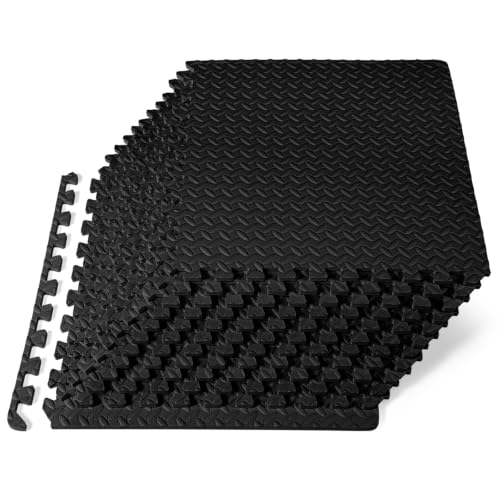
 Haulcove 18 Pcs EVA Foam Floor Tiles12.6" X 12.6" X 0.4"12.6 x 12.6 x 0.4 inches2.77 poundsCheck on Amazon


Top 3 picks at a glance
Why flooring matters in VR
Because you can’t see your feet, a tactile floor is a safety feature. A defined mat gives you a “home base” you can feel, cushioning reduces impact on knees and ankles during active games, and grip prevents slips during quick turns. Hard tile or a slick rug is the worst combination for fitness or shooter titles.
| Surface | Grip | Cushioning | VR suitability |
|---|---|---|---|
| Dedicated VR mat | High | Medium-high | Excellent |
| Foam interlocking tiles | Medium | High | Very good (active games) |
| Low-pile carpet | Medium | Low-medium | Good |
| Hardwood/laminate | Low-medium | None | Fair (use a mat) |
| Tile / high-gloss | Low | None | Poor |
Top options explained
Dedicated VR floor mats
Purpose-made VR mats use a textured center and a raised or differently textured border so your feet feel when you approach the edge — a physical backup to the software guardian. Round designs suit rotation-heavy games. Expect roughly $40-90 depending on size.
Interlocking foam tiles
The gym-style EVA foam tiles (often $20-40 for a set) add real cushioning for jumping and squatting games and are cheap to expand. They’re ideal for fitness VR, though the seams can be felt underfoot and heavy furniture can dent them.
Low-pile rug or carpet
A short, dense rug gives grip and a defined area without much cost. Avoid thick shag, which hides your footing and can trip you, and secure the edges so it doesn’t slide.
Sizing and safety
Most standing/room-scale games recommend a minimum of about 6.5 x 6.5 feet (2 x 2 m) of clear space, with more for fitness titles. Keep a buffer of a couple of feet to walls and furniture. Non-slip backing is essential on hard floors, and good socks or bare feet grip better than smooth slippers.
Frequently asked questions
Do I really need a special VR mat if I have carpet?
Not strictly, but a mat with a textured border adds a valuable feel-the-edge safety cue that carpet alone doesn’t provide. For fast or fitness games, that tactile boundary meaningfully reduces the risk of stepping into a wall.
Are foam tiles or a mat better for VR fitness?
Foam tiles win for cushioning during jumping and lunging, which protects your joints. A dedicated mat wins for edge awareness and rotation. Some players combine both: tiles underneath for cushion, a bordered mat on top for orientation.
Orientation cues and cable management
The best VR floors do more than cushion — they help you stay oriented. A mat with a distinct center texture or a directional feature under your feet gives you a reference point so you naturally return to the middle of your space between rounds, reducing drift toward walls. Some players add a small tactile marker at the “front” of the play area so they can always feel which way they started facing.
Flooring choices also interact with cables and furniture. If you run a wired PCVR headset, a floor mat helps anchor a cable management path and keeps the cord from tangling around your feet, while wireless setups can go fully open. Clear the perimeter of coffee tables, lamps and pets, and keep ceiling fans and low fixtures in mind for headsets swung overhead. For homes where the VR space doubles as a living room, roll-up mats and interlocking tiles let you deploy a safe surface for a session and pack it away afterward. The goal is a space where your feet, not just the software guardian, tell you where you are — because in fast games you react to what you feel long before you glance at a boundary.
Bottom line
Pick a surface with grip, some cushioning, and ideally a tactile edge you can feel with your feet. Dedicated VR mats and interlocking foam tiles are the standouts; low-pile carpet is a solid budget choice. Whatever you use, clear at least a 6.5-foot square, secure the edges, and let your feet become your backup guardian.