Our Short List of 3
All 4 Picks at a Glance
| Product | Specs | Action |
|---|---|---|
 ASUS ROG Swift OLED PG32UCDM | Check price on Amazon | |
 LG UltraGear 27GP950-B | Check price on Amazon | |
 Samsung Odyssey Neo G7 32 Inch | Check price on Amazon | |
 Gigabyte M32U | Check price on Amazon |
A 4K 144Hz monitor asks a lot from a gaming PC, and that is exactly why it appeals to so many players. At 3840 by 2160, games look far sharper than they do at 1440p, text stays crisp for work between sessions, and a refresh rate of 144Hz or higher keeps motion fluid in a way that a standard 60Hz 4K screen cannot match. The combination suits story games that reward detail, shooters that reward speed, and hybrid setups where one display has to handle play, streaming, and everyday productivity without compromise.
This guide focuses only on monitors that meet that core promise natively: a 4K resolution of 3840 by 2160 and a native refresh rate of at least 144Hz. The four picks below cover the main panel paths to that goal, including QD-OLED for the fastest response and deepest contrast, Mini LED for bright HDR on a curved screen, and IPS options that balance color, clarity, and practical features such as KVM switching and HDMI 2.1 for consoles.
As an Amazon Associate, we earn from qualifying purchases.
Our Top Picks
Top 3 picks at a glance
How to Choose a 4K 144Hz Monitor
Start with the graphics card, not the screen
Driving 4K at high frame rates is demanding. Competitive titles with scalable settings can reach high frame rates on a strong upper midrange card, but demanding open world and ray traced games usually need a high end graphics card, plus smart use of upscaling and quality settings. Before choosing a monitor, check the frame rates the current system actually reaches in the games played most often. If the system rarely approaches triple digit frame rates at 4K, the monitor can still make sense as a longer term upgrade, especially with variable refresh rate smoothing out fluctuations, but expectations should match the hardware behind it.
Panel type shapes contrast, color, and response
QD-OLED delivers per pixel light control, near instant response, and excellent contrast, which makes dark scenes and fast camera movement look especially clean. The trade off is care: static desktop elements shown for long periods call for sensible habits such as using the built in OLED care tools, varying content, and letting pixel cleaning run as directed. IPS and Nano IPS panels avoid that concern, offer strong viewing angles and color, and suit mixed gaming and creative work, though their contrast in a dark room is more modest. VA panels with Mini LED backlighting sit between those poles, with a curved shape, high contrast, and local dimming that can give HDR scenes real punch, at the cost of narrower ideal viewing angles than IPS.
Refresh rate above 144Hz is headroom, not a requirement
Every monitor in this guide runs at 144Hz or faster at 4K. Models at 165Hz and 240Hz add headroom for players whose hardware can push beyond 144 frames per second, and for future graphics card upgrades. What matters most day to day is stable delivery at the chosen rate over the right cable, plus variable refresh rate support that matches the graphics card. Look for G-SYNC compatibility for NVIDIA cards and FreeSync support for AMD cards, and note that many monitors here carry one or both forms of certification, which keeps gameplay smooth when frame rates rise and fall.
Ports decide whether the headline rate is reachable
A 4K 144Hz signal needs bandwidth. On PC, DisplayPort 1.4 with Display Stream Compression is the common route to full resolution and full refresh on most of these models, while HDMI 2.1 is the route that matters for consoles and for PCs with a suitable graphics card output. Check the exact port list before buying: the number of HDMI 2.1 ports, whether USB-C carries a display signal and how much power it delivers, and whether a built in KVM switch would simplify a desk shared between a gaming PC and a laptop.
Size and pixel density change how 4K feels
At 27 inches, 4K is extremely sharp and fits smaller desks. At 32 inches, the same resolution feels more immersive and gives more room for split screen work. Viewing distance, desk depth, and whether play is close keyboard and mouse work or controller play from farther back should drive the choice. A curved 32 inch model can feel enveloping for solo play, while a flat panel is simpler for shared viewing and color sensitive work.
ASUS ROG Swift OLED PG32UCDM
The ASUS ROG Swift OLED PG32UCDM is the flagship style pick in this group: a 32 inch QD-OLED panel running 4K at 240Hz, well above the 144Hz threshold, with an exceptionally fast response time on paper and a feature set aimed at both PC and console play. Its listing describes a custom heatsink, advanced airflow, and a graphene film intended to manage heat and reduce the risk of burn-in, alongside OLED care functions that can be managed through DisplayWidget Center.
The appeal is speed plus contrast. Per pixel OLED control means dark scenes retain depth without the raised blacks typical of many LCD panels, and the high refresh rate gives fast paced games room to feel fluid when the graphics card can supply the frames. Support for HDR10 and Dolby Vision according to the product information, plus a wide DCI-P3 gamut, makes it relevant for entertainment as well as play. Connectivity covers the bases a high refresh 4K setup needs, including DisplayPort 1.4 with compression, HDMI 2.1, and USB-C with power delivery.
Who It Suits
This monitor suits players building around a high end PC who want the strongest contrast and the highest refresh rate in this guide, and who also play HDR titles where OLED contrast shows clearly. It also suits console players who want HDMI 2.1 on a large, fast screen. Buyers whose desk is dominated all day by the same static spreadsheet or editing timeline should weigh the OLED care routine honestly, and buyers on a tighter hardware budget should note that getting the most from a 240Hz 4K panel requires a very capable graphics card.
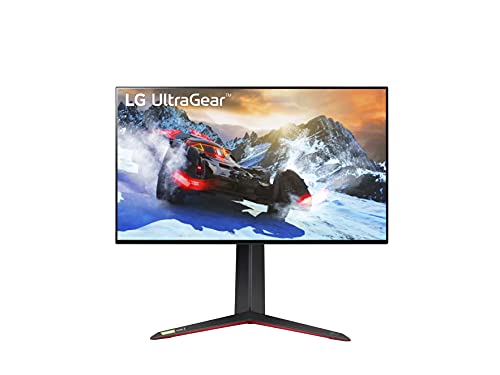
LG UltraGear 27GP950-B
The LG UltraGear 27GP950-B takes the classic 27 inch route to 4K 144Hz. Its Nano IPS panel delivers the headline combination exactly as the keyword describes, with a native 144Hz refresh rate that can be overclocked to 160Hz through DisplayPort using VESA Display Stream Compression, according to the listing. That smaller size gives very high pixel density, so game detail and fine text look very sharp.
Color is a central part of the pitch. The listing cites DCI-P3 coverage of 98 percent and VESA DisplayHDR 600, which places it a step above basic HDR IPS models for brightness and color volume, while still trailing OLED and Mini LED designs for true local contrast. Adaptive sync coverage is broad, with NVIDIA G-SYNC compatibility and AMD FreeSync Premium Pro, and HDMI 2.1 support means a console can use its high refresh and variable refresh features within the limits the console itself supports. For players who split time between fast games and color aware work such as photo or video editing, that balance is the reason to shortlist it.
Who It Suits
The 27GP950-B suits players with a smaller desk who want maximum sharpness, strong color, and a panel that handles both gaming and creative tasks without OLED care considerations. It is also a sensible pick for a mixed PC and console desk thanks to HDMI 2.1. Players who want a larger, more cinematic picture for controller play from farther back, or who prioritize deep HDR contrast in a dark room, will likely prefer one of the 32 inch models in this guide instead.
Samsung Odyssey Neo G7 32 Inch
The Samsung Odyssey Neo G7 in its 32 inch form pairs a curved VA panel with Quantum Mini LED backlighting, running 4K at 165Hz. The 1000R curve is pronounced, wrapping the picture more noticeably than a gentle curve would, and that shape is a defining part of the experience: solo players seated centrally tend to get the intended effect, while shared viewing from the side is less natural.
HDR is the other headline. Samsung lists Quantum HDR 2000 for this model, and the Mini LED design with local dimming is built to deliver bright highlights alongside much stronger contrast than a conventional edge lit LCD. The listing describes a 1 ms response time, AMD FreeSync Premium Pro, and G-Sync compatibility in its title, along with DisplayPort and HDMI connectivity and a height adjustable stand. For atmospheric games, racing titles, and HDR video, that combination of size, curve, and backlight control gives the Neo G7 a character quite different from the flat IPS models here.
Who It Suits
The Neo G7 suits a single player at the center of the desk who values immersion, strong HDR brightness, and contrast, and who likes the feel of a curved screen for simulation, racing, and open world games. It is less suited to buyers who need wide angle shared viewing, a flat panel for precise layout work, or a compact footprint. As with every high refresh 4K model, its 165Hz rate is only useful when the connected PC or console mode can actually feed it, so port and cable checks matter.
Gigabyte M32U
The Gigabyte M32U is the practical all rounder of the group: a 32 inch SuperSpeed IPS panel at 4K and 144Hz, with the kind of desk friendly features that matter when one monitor serves a gaming PC, a console, and a work laptop. Its listing highlights a built in KVM switch with USB Type-C connectivity, which lets peripherals and a display signal switch between machines with far less cable swapping.
Performance specifications cover the essentials for this class without chasing the highest numbers in the guide. The listing states a 1 ms MPRT response time, AMD FreeSync Premium Pro, DisplayHDR 400, and color coverage described for the model as 90 percent DCI-P3 and 123 percent sRGB in Gigabyte material. Ports include HDMI 2.1, DisplayPort, and Type-C, so PC, console, and laptop connections can coexist. The flat IPS panel also brings wide viewing angles and consistent color, which helps when the same screen is used for documents, browsing, and media alongside games.
Who It Suits
The M32U suits buyers who want one 32 inch 4K 144Hz screen to do everything reasonably well: fast enough for high refresh PC play, equipped with HDMI 2.1 for consoles, and convenient for laptop work through its KVM and USB-C connection. It will not match the OLED model here for contrast or the Mini LED model for HDR impact, and competitive players who want refresh rates well above 144Hz should look at the 240Hz pick instead. For a balanced desk, though, its feature mix is easy to justify.
FAQ
Do you need HDMI 2.1 for a 4K 144Hz monitor?
For a PC connected by DisplayPort 1.4 with compression, HDMI 2.1 is not required to reach 4K at 144Hz on the models that support that DisplayPort route. For a current console, HDMI 2.1 is the important connection, because it is how the console sends its high refresh 4K signal and variable refresh features. In both cases the cable, the port on the graphics card or console, and the port on the monitor all need to support the intended mode, so check each link in the chain rather than assuming the panel specification alone guarantees the result.
What graphics card is needed for 4K 144Hz gaming?
There is no single card that guarantees 144 frames per second at 4K in every game, because settings, ray tracing, and the game engine change the load dramatically. Esports and older titles can reach high 4K frame rates on strong upper midrange hardware with tuned settings, while the most demanding recent releases at maximum settings generally call for a high end card plus upscaling. A practical approach is to check frame rate results for the specific games and settings that matter, then choose the monitor as either a match for current hardware or a deliberate upgrade ahead of the next card.
Is 27 inches or 32 inches better for 4K gaming?
Both sizes show the same 3840 by 2160 image, so the difference is density and scale. A 27 inch screen is sharper per inch and fits a smaller desk or a closer viewing position, while a 32 inch screen feels larger and more immersive and gives more physical room for windows and interface elements. Players who sit close and play fast keyboard and mouse titles often prefer 27 inches, while players who lean back with a controller, play simulation titles, or work on the same screen all day often prefer 32 inches.
Can a 4K 144Hz monitor also be good for work?
Yes, provided the panel and features fit the work. The extra resolution makes text and detailed timelines, spreadsheets, and design canvases look crisp, and IPS models in particular offer wide viewing angles and consistent color for shared or color aware tasks. Useful work features to look for include USB-C with power delivery for a laptop, a KVM switch for sharing a keyboard and mouse between machines, and a stand with height and pivot adjustment. OLED models can also work well, but long hours with the same static interface elements make their care tools and habits worth considering.
Final Verdict
The best 4K 144Hz monitor depends on which strength matters most once the baseline of 4K resolution and at least 144Hz is met. The ASUS ROG Swift OLED PG32UCDM is the premium performance pick, combining 240Hz, QD-OLED contrast, and broad connectivity for players who want the fastest and richest picture in this guide. The Samsung Odyssey Neo G7 is the immersive HDR pick, with its curved Mini LED panel and 165Hz rate aimed at solo play that leans into atmosphere and brightness.
For balanced, no fuss choices, the LG UltraGear 27GP950-B delivers sharp 27 inch Nano IPS clarity with strong color and console ready ports, while the Gigabyte M32U offers the most practical 32 inch all round package with KVM switching and USB-C for a desk that mixes play and work. Whichever model is chosen, confirm the graphics card can feed it, use the right DisplayPort or HDMI 2.1 connection, and enable the full refresh rate in system settings after setup.
Product and ASIN Reference
| Product | ASIN |
|---|---|
| ASUS ROG Swift OLED PG32UCDM | B0CV26XVMD |
| LG UltraGear 27GP950-B | B094RWMN8K |
| Samsung Odyssey Neo G7 32 Inch | B09ZH1Q6TT |
| Gigabyte M32U | B083GRVFXN |
Related guides
More from Amazon
Programs that pair well with the guide above. Offers and eligibility are set by Amazon and may change.
Free shipping on eligible items, Prime Video and more. Eligible new members can start with a free trial.
Start a Prime free trialAd-free music streaming. Eligible new subscribers can start with a free trial.
Try Music Unlimited freeA Prime membership for ages 18-24 with a trial period. Eligibility is set by Amazon.
See Prime for Young AdultsAudiobooks and podcasts to listen to on the go. Eligible new members can start with a free trial.
Try Audible freeAs an Amazon Associate we earn from qualifying purchases.