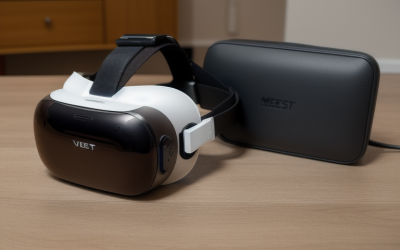
The honest question behind the Quest 3S is not whether it is a good headset, but which compromises you are actually paying less to accept. Meta built it around the same Snapdragon XR2 Gen 2 processor as the Quest 3, then trimmed the optics, the display and the storage to reach a lower cost. So the worth-it call comes down to how much you care about lens clarity and mixed reality detail versus raw gaming performance, because on performance the two headsets are effectively tied.
This verdict is for first-time VR buyers choosing their entry point, Quest 2 owners weighing an upgrade, and PC gamers who want a headset that also works untethered. It judges the 256GB Quest 3S using the specifications on its Amazon listing, and it compares those figures with the numbers Meta publishes for the Quest 3, so every claim below traces back to a spec sheet rather than to marketing language.
Quick Picks
As an Amazon Associate we earn from qualifying purchases.
| Product | Best for | Key spec from title |
|---|---|---|
| Meta Quest 3S 256GB | The full Quest library on the entry-level headset | Snapdragon XR2 Gen 2 with 256GB storage |
How to Choose
The Processor Sets the Performance Ceiling
Performance is the strongest part of the value case. The Quest 3S runs the Snapdragon XR2 Gen 2, the identical chip Meta puts in the Quest 3, backed by 8GB of RAM. That pairing decides which games a headset can run and how smoothly, and here nothing is held back: every title built for the Quest 3 runs on the 3S with the same frame rate targets. When you judge worth, weigh this first, because a cheaper headset with a weaker chip ages quickly, while this one shares the flagship’s processing headroom and should stay current for the same length of time.
The Display and Fresnel Lenses Are the Real Trade-Off
Everything you give up lives in the optics. The 3S uses a single LCD panel at 1832 x 1920 per eye behind Fresnel lenses, the older lens design from the Quest 2 generation. Fresnel optics concentrate sharpness in the center of the image and soften the edges, and the three fixed IPD positions at 58, 63 and 68 mm will not match every face exactly. If you read a lot of text in VR, watch films, or spend hours in virtual desktops, this is where the Quest 3 pulls ahead and where your money decision should focus.
The Library and Mixed Reality Come Included
A headset is only worth owning if there is plenty to play, and the 3S inherits the full Quest catalog rather than a cut-down store. The same games, apps and social spaces run here as on the Quest 3, and the listing includes a trial of Meta Horizon+, the subscription library. Full-color passthrough cameras bring mixed reality titles that place digital objects in your room, although the 3S has no depth sensor, so object placement is less precise than on the Quest 3. For game-first buyers, the shared library removes the biggest risk of choosing the lower-cost model.
Battery Life and Add-Ons Shape the Real Cost
The headset alone is not the whole purchase. Meta rates the 3S at up to 2.5 hours of average use, which covers most gaming sessions but not a long film plus play in one charge, and the Touch Plus controllers run on AA batteries. The soft stock strap is the part owners most often replace, and a battery head strap, a case and a Link cable for PC VR are common additions. None of this cancels the value case, but the gap to the Quest 3 narrows once two or three accessories join the basket, so count them before deciding.
The Best Options
Meta Quest 3S 256GB

The 256GB Quest 3S is the version that makes the value argument easiest to accept. You get the flagship processor, the complete game library and color passthrough in a headset that weighs 514 grams, and the doubled storage means large games stay installed instead of being rotated. It suits new VR players who want everything the platform has without paying for pancake lenses, and Quest 2 owners who care more about newer games and mixed reality than about a sharper picture. The compromises are visible but narrow, and they sit in the optics rather than in performance.
Specs
- Processor: Qualcomm Snapdragon XR2 Gen 2
- Memory: 8GB RAM
- Storage: 256GB, no expansion slot
- Display: single LCD panel, 1832 x 1920 per eye
- Lenses: Fresnel, three-position IPD adjustment at 58, 63 and 68 mm
- Field of view: 96 degrees horizontal, 90 degrees vertical
- Battery: up to 2.5 hours of average use (Meta figure), 4,324 mAh
- Weight: 514 g
- Controllers: two Touch Plus controllers, AA batteries
- Passthrough: full-color mixed reality cameras
- Connectivity: Wi-Fi 6E, USB-C, Bluetooth
- Included in the box: headset, two Touch Plus controllers, glasses spacer, power adapter and charging cable, plus a 3-month trial of Meta Horizon+ per the listing
Best for: first-time VR buyers and Quest 2 owners who want the full current library and mixed reality, with storage room to keep big games installed.
Watch out for: the Fresnel lenses are softer at the edges than the Quest 3’s pancake optics, and there is no storage expansion, so the capacity you pick is the capacity you keep.
ASIN: B0DDJZW3C9
Quest 3S vs Quest 3 on Paper
Meta publishes full specifications for both headsets, and placing the two sheets side by side shows how focused the 3S cuts are. The shared column is long: the same Snapdragon XR2 Gen 2 processor, the same 8GB of RAM, the same Touch Plus controllers, the same full-color passthrough cameras and the same store, which is why no game is exclusive to the more expensive model. Even the weight is a near tie, at 514 grams for the 3S against 515 grams for the Quest 3.
Everything that differs is about the image and the room around you. The Quest 3 uses pancake lenses over a 2064 x 2208 per eye display, reaching 25 pixels per degree with a 110 degree horizontal field of view. The 3S answers with 1832 x 1920 per eye, 20 pixels per degree and a 96 degree horizontal view through Fresnel lenses. For mixed reality, the Quest 3 adds a depth sensor the 3S lacks, so virtual objects anchor to your furniture more convincingly, and its continuous IPD wheel adjusts from 53 to 75 mm instead of three fixed steps.
Two rows favor the 3S. Its average battery figure is 2.5 hours against 2.2 hours for the Quest 3, and its storage tiers start lower, although the Quest 3 counters with a single 512GB configuration and a 3.5mm headphone jack the 3S omits in favor of USB-C audio. Read as a whole, the step up buys clarity, a wider view and more convincing mixed reality. It does not buy speed, extra games or longer sessions, and that is exactly why the 3S remains an easy recommendation for game-first buyers.
The Ownership Costs Nobody Mentions
Plan the purchase as a small bundle rather than a single box. The soft strap in the box works, but it is the first thing many owners replace with a rigid or battery-equipped strap, and a battery strap also answers the 2.5 hour session limit more gracefully than stopping to recharge. A hard case matters if the headset travels, and PC gamers should budget for a long USB-C cable even though wireless Air Link costs nothing to try.
Software spending arrives quickly too. The included Meta Horizon+ trial runs for three months, after which keeping the rotating library means a subscription, and flagship games are large enough that storage discipline matters even at 256GB. There is no memory card slot, so the capacity chosen at checkout is permanent. Glasses wearers get a spacer in the box, while prescription lens inserts are a separate purchase. Add two or three of these extras and the savings against the Quest 3 shrink, though they stay meaningful, and every accessory mentioned here fits the Quest 3 as well, so the comparison survives the additions.
Which One Fits Your Situation
You Are Buying Your First Headset
Buy the 3S without much hesitation. You receive the complete library, the current processor and mixed reality at the platform’s lowest entry point, and the money left over covers a better strap and several games. First-time players rarely miss pancake-lens clarity they have never seen, and if VR becomes a daily habit, the accessory ecosystem and your game library carry forward to any future Meta headset.
You Already Own a Quest 2 and Want a Sharper Picture
Think carefully before choosing the 3S. The processor jump is real and newer games will run better, plus you gain color passthrough, but the Fresnel lenses and similar per-eye resolution mean the image will not feel like the leap you are imagining. If visual clarity is the upgrade you crave, the Quest 3’s pancake optics deliver it, and the 3S will feel like a side step with faster loading.
Mixed Reality Is Your Main Reason to Buy
Judge the 3S as a gaming headset first. Its color passthrough handles room-scale mixed reality games well enough to enjoy them, yet the missing depth sensor and softer lenses make the real world look grainier than it does on the Quest 3. If blending digital objects into your room is the headline feature for you, save toward the Quest 3 instead of settling here.
Common Mistakes
- Assuming the Quest 3S is a slower headset: it shares the Quest 3’s processor and RAM, so game performance is not where the savings were taken.
- Choosing storage casually: there is no expansion slot, and large games fill the smaller capacity quickly, which is why this verdict covers the 256GB model.
- Expecting Quest 3 image quality: Fresnel lenses soften the edges of the picture and shrink the sweet spot compared with pancake optics.
- Forgetting the extras: a comfort strap, a case and games can narrow the savings faster than expected.
- Skipping the fit check: three fixed IPD positions and a glasses spacer work for most faces, but not all, so confirm your IPD range before ordering.
Frequently Asked Questions
Does the Quest 3S play every Quest 3 game?
Yes. Both headsets share the Snapdragon XR2 Gen 2 processor, 8GB of RAM and the same store, so the catalog is identical and no title is exclusive to the Quest 3. Games may render at the 3S panel’s lower native resolution, but features, modes and multiplayer all carry across, and purchases follow your Meta account between headsets.
How long does the battery last in real use?
Meta rates the Quest 3S at up to 2.5 hours of average use, with its published breakdown putting gaming near 2.7 hours and media viewing near 2.8 hours, while demanding mixed reality and productivity apps drain it faster. A full recharge takes roughly 1.9 hours with the included adapter, and a battery head strap is the common way to extend longer sessions.
Can the Quest 3S work with a gaming PC?
Yes, in two ways. Air Link streams PC VR games over your home Wi-Fi at no extra cost, while a USB-C Link cable gives a wired connection that also charges during play. Either route opens the SteamVR library alongside the native Quest store, and the XR2 Gen 2 handles decoding smoothly, so the 3S doubles as a capable PC VR headset.
Is the Quest 3S a good choice for kids and families?
It can be, with supervision. The headset is light at 514 grams, the Touch Plus controllers are simple, and Meta accounts for younger players include parental controls and casting to a phone or TV so others can watch. The three-step IPD range and soft strap fit smaller heads less precisely, though, so check comfort and set time limits early.
Related guides
More from Amazon
Programs that pair well with the guide above. Offers and eligibility are set by Amazon and may change.
Free shipping on eligible items, Prime Video and more. Eligible new members can start with a free trial.
Start a Prime free trialAd-free music streaming. Eligible new subscribers can start with a free trial.
Try Music Unlimited freeA Prime membership for ages 18-24 with a trial period. Eligibility is set by Amazon.
See Prime for Young AdultsAudiobooks and podcasts to listen to on the go. Eligible new members can start with a free trial.
Try Audible freeAs an Amazon Associate we earn from qualifying purchases.