The Quest 2 still earns its place in plenty of gaming rooms, but its internal battery sets a hard limit on every session, and long games, social VR nights and daily fitness workouts all run into the same wall. An external pack solves that, yet a single pack only moves the deadline: once it drains, you are back to waiting on a wall charger before the headset is fun again.
The KINWIN 2-Pack takes a different route. Instead of one larger battery, it bundles two identical 20000mWh clip-on packs made for the Quest 2, so one can power the headset while the other recharges on the side. This review looks at how that rotation works in practice: the added hours each pack delivers, how the swap feels mid-session, what the extra weight does to balance, and the checks worth making before you buy.
Quick Picks
As an Amazon Associate we earn from qualifying purchases.
| Product | Best for | Key spec from title |
|---|---|---|
| KINWIN 2-Pack Battery Pack for Oculus Quest 2 | Back-to-back Quest 2 sessions with a charged spare always in rotation | 2 × 20000mWh swappable packs, one in play and one on charge |
How to Choose
A two-pack only earns its keep if the rotation fits how you actually play, so judge any swappable Quest 2 battery set on the numbers that decide whether the spare is ready when you need it. Capacity per pack, swap effort, recharge time and on-head weight matter more here than headline totals, because the whole point of the format is continuity rather than one long discharge.
Capacity per pack, not per box
Read two-pack listings carefully, because the headline figure is usually per pack, not the pair combined. What matters for a rotation is how long one pack keeps the headset running: that window has to cover your typical session and, ideally, outlast the time the spare needs on the charger. KINWIN rates each of its packs at 20000mWh and credits each one with two to four extra hours of play, depending on the game and settings. If a single pack comfortably covers your longest normal session, the second pack becomes pure insurance. If it does not, you will feel the swap as an interruption rather than a formality, so match the per-pack figure to your habits first.
Swap time and mounting style
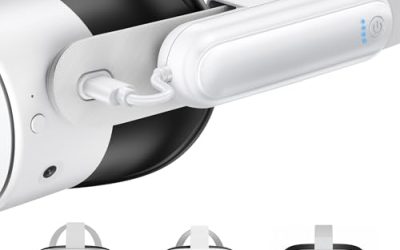
A rotation system lives or dies on how painless the changeover is. The best designs clip on and off in seconds without tools, straps or removing the headset’s facial interface, and they stay put during fast head movement. KINWIN uses a sliding buckle that locks the pack onto the Quest 2, and the listing notes the headset’s headphone jack stays exposed, so wired earbuds and audio accessories still work with a pack attached. Check that the mount suits your strap: packs shaped around the stock Quest 2 shell generally sit happily with the original strap and most elite-style straps, but bulky third-party straps with rear battery trays can clash, so confirm clearance before ordering.
Recharge speed and rotation rhythm
The hidden number in any two-pack is recharge time, because it decides whether the rotation is genuinely continuous. KINWIN lists a 10W input and roughly three hours to refill a pack. Set that against the two to four hours a pack delivers: in lighter games the spare finishes charging before the active pack runs dry, while in demanding titles the maths is tighter and a very long session can still catch up with you. The packs also support pass-through charging through a smart chip that tops up the headset first and then the pack itself, which simplifies overnight charging: plug in once and both the Quest 2 and the attached pack are ready by morning.
Weight, balance and safety protections
Every gram clipped to a headset is carried by your neck, so per-pack weight matters more than total kit weight. At 100 grams, roughly 3.5 ounces, each KINWIN pack is light for its capacity, and because it sits close to the headset rather than at the end of a cable, there is no dangling battery pulling at the strap. Balance is a fair trade: the pack adds a little rearward mass that many players find offsets the Quest 2’s front-heavy shell. On safety, the listing describes a low-temperature IC that monitors voltage and current and guards against over-charging, over-discharge, short circuits and high temperatures, the baseline protections any lithium pack worn on your head should carry.
The 1 Best Option
Because this is a review of one named product, there is a single entry below: the two-pack set itself. The verdict in short is that the format is the feature. Two modest packs in rotation suit Quest 2 owners better than one big pack whenever sessions run long or the headset is shared, provided you accept a Quest 2-only accessory that will not follow you to a newer headset.
KINWIN 2-Pack Battery Pack for Oculus Quest 2
The KINWIN 2-Pack gives the Quest 2 an endurance system: two 20000mWh packs that clip onto the headset with a sliding buckle and feed it through USB-C. Each pack is listed as adding two to four hours of play, and the pattern is one pack on the headset while the other charges, so a flat battery becomes a swap instead of the end of the session. A smart chip lets a pack charge the headset and itself simultaneously, prioritising the headset, and at 100 grams per pack the weight stays easy to ignore. The headphone jack remains exposed, and the box includes two USB charging cables and a user manual.
Specs
- Capacity: 20000mWh per pack, two packs included
- Added playtime: 2 to 4 hours per pack, per the listing
- Charging input: 10W, with a full charge in about 3 hours
- Weight: 100 g (3.5 oz) per pack
- Mount: sliding buckle clip-on fit for the Quest 2, headphone jack left exposed
- Charging behaviour: smart chip charges the headset and the pack together, headset first
- Safety: low-temperature IC with protection against over-charge, over-discharge, short circuit and high temperature
- Compatibility: Meta Quest 2; the packs can also charge other USB-C devices
- In the box: 2 battery packs, 2 USB charging cables, 1 user manual
Best for: Quest 2 owners whose sessions regularly outlast the internal battery and who want a charged spare ready instead of a longer single discharge.
Watch out for: Make sure you are looking at the two-pack listing before ordering, because KINWIN also sells a near-identical single pack for the Quest 2. Treat the USB-C connector gently when clipping and unclipping, as published roundups of Quest 2 packs flag the plug as the part most likely to suffer from rough handling, and remember these packs are shaped for the Quest 2 only, not the Quest 3 or 3S.
Availability note: This set is sold through Amazon US, but we could not verify the current listing’s exact product code at the time of writing, so no ASIN is shown here. Search the full product name on Amazon and confirm the listing shows two packs in the box contents before buying, since the single-pack version carries a very similar title.
Which One Fits Your Situation
With only one product under review, the real question is whether the two-pack rotation matches your routine. The situations below cover the patterns where two swappable packs beat a single larger battery, and where they do not.
You play long single-player sessions
Story games, sims and long rhythm sessions are where the rotation shines. One pack covers the first stretch, the swap takes seconds, and the second pack carries you to a natural stopping point while the first recharges. Across an evening, the pair can keep a Quest 2 running far longer than its internal battery alone, with the only discipline required being that you put the drained pack straight on charge instead of leaving it on the coffee table.
Your headset is shared by the household
Shared headsets die at the worst moments because nobody owns the charging routine. A two-pack fixes the social problem as much as the electrical one: whoever finishes playing clips the fresh pack on and puts the flat one on charge, so the next person always starts with power in reserve. It also smooths handovers between players, since a swap mid-game-night is faster and less disruptive than parking the headset on a charger while everyone waits in the kitchen.
You use the Quest 2 for fitness workouts
Fitness apps burn the internal battery fast because the tracking and display never rest, and a workout cut short by a low-battery warning rarely gets restarted. A 100-gram pack is light enough to keep on the headset through active sessions, and the sliding buckle stays seated during movement. Keeping the second pack charged means morning and evening workouts start fully powered, and the pack’s protections against overheating matter more here than in any other use.
You travel with your Quest 2
Two small packs sit flatter than one bulky battery bank and give you redundancy if a cable goes missing. Each pack can also top up other USB-C devices in a pinch, which earns its space in a carry-on. The honest limit is air travel admin: lithium packs belong in hand luggage, and having two of them simply means keeping both in the same pouch so neither gets left behind at security or in the seat pocket.
Common Mistakes
- Reading the headline capacity as the pair’s total, when the 20000mWh figure applies to each pack individually.
- Ordering the single-pack listing by mistake, since its title and photos look almost identical to the two-pack set.
- Leaving the drained pack off charge after a swap, which quietly breaks the rotation and leaves you with two flat packs.
- Forcing the USB-C connector in at an angle, instead of seating the pack on its buckle and letting the plug align naturally.
- Expecting the packs to fit a Quest 3 or 3S later; the shell shaping and mount are Quest 2 specific.
Frequently Asked Questions
How much extra playtime does each KINWIN pack add?
The listing credits each 20000mWh pack with two to four extra hours, and the spread is real rather than marketing padding. Lightweight games, video apps and social VR sit near the top of the range, while demanding titles with high brightness and refresh rates pull it toward the bottom. Treat three hours as a sensible planning figure for mixed use; the headset’s own internal battery adds its share on top.
Can a pack charge the Quest 2 while it is also charging itself?
Yes. The packs use a smart chip that supports charging the headset and the pack at the same time from one cable, and it prioritises the headset first before refilling the pack. A single overnight plug-in can leave both the Quest 2 and the attached pack full by morning. You can also play while everything tops up, although charging is at its slowest in that pass-through arrangement.
Will these packs work with an elite strap or other USB-C devices?
The pack is shaped for the Quest 2 shell and mounts with a sliding buckle, suiting the headset’s standard strap arrangements; very bulky third-party straps with their own rear battery systems are the ones to double-check for clearance. Away from the headset, it works as a small USB-C power bank for phones and similar devices, although its capacity and 10W pace suit top-ups rather than full refills.
How long does each pack take to recharge?
KINWIN lists about three hours for a full charge at the pack’s 10W input. That figure is the one to plan your rotation around: a pack emptied during an evening session will be ready again the next day, but not within the same short break. Pass-through mode, where the headset charges first, stretches the refill further, so use a dedicated charge when turnaround matters.
Related guides
More from Amazon
Programs that pair well with the guide above. Offers and eligibility are set by Amazon and may change.
Free shipping on eligible items, Prime Video and more. Eligible new members can start with a free trial.
Start a Prime free trialAd-free music streaming. Eligible new subscribers can start with a free trial.
Try Music Unlimited freeA Prime membership for ages 18-24 with a trial period. Eligibility is set by Amazon.
See Prime for Young AdultsAudiobooks and podcasts to listen to on the go. Eligible new members can start with a free trial.
Try Audible freeAs an Amazon Associate we earn from qualifying purchases.