The 9V battery is the awkward one in the drawer. It sits inside smoke alarms, guitar pedals, wireless microphones, multimeters and a surprising number of old toys, and it costs far more per use than an AA or AAA. Switching to a rechargeable cell saves money only if you pick the right chemistry for the job, because the two main families, lithium-ion with built-in USB-C charging and nickel-metal hydride in a traditional cell, behave very differently when you actually put them to work.
This guide is for people who go through 9V batteries regularly: musicians with several pedals, hobbyists with test gear, parents with battery-hungry toys, and homeowners who would like to stop buying disposables for the hallway alarm. We compare eight multipacks from the listing titles alone, covering lithium-ion packs with USB-C cables and NiMH sets with their own cells and trays. Read the capacities carefully, since the same sticker format hides a wide spread in what each pack really offers in 2026.
Our Top Picks
Top 3 picks at a glance
Quick Picks
As an Amazon Associate we earn from qualifying purchases at no extra cost to you.




| Product | Best for | Key spec from the title |
|---|---|---|
| Quzmo 4-Pack Lithium-ion | All-round household use | 1300mAh, USB-C, 2-in-1 charging cable |
| Quzmo 2-Pack Lithium-ion | Light users needing a pair | 1300mAh, USB-C, 2-in-1 cable |
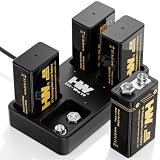
| HW 3600mWh 4-Pack with Charger | Heavy rotation with a dedicated dock | 3600mWh, 4-slot charger, 1000+ cycles |
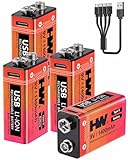
| HW 1400mAh USB-C 4-Pack | Smoke detectors and quick top-ups | 1400mAh, fast charge, 4-way protection |
| EBL 150mAh Ni-MH 4-Pack | Low-drain toys and gadgets | 150mAh Ni-MH, mercury-free, 1200 cycles |
| Quzmo 5-Pack Lithium-ion | Larger households and gear collections | 1300mAh, USB-C, five cells |
| TQTHL 4-Pack Lithium-ion | Straightforward lithium refill | 2-in-1 USB-C cable, 1000 cycles |
| RayHom 4-Pack Ni-MH | Equipment with a storage box | 280mAh Ni-MH, 4-slot storage box |
How to Choose
Pick the chemistry first
Lithium-ion 9V cells in these listings carry a USB-C port or are charged by a cable that splits into two connectors, which means you do not need a separate charger. They hold a steady voltage for most of the discharge and list capacities from 1300mAh upward. Nickel-metal hydride cells use a traditional charger, list far lower capacities (150mAh to 280mAh here) and sag in voltage as they drain. For anything that cares about a clean 9 volts, such as a pedal or a mic pack, lithium usually behaves better.
Compare capacity in the same unit
One listing quotes watt-hours in a small unit, mWh, while others use mAh; divide mWh by the nominal voltage to line them up. As a rule of thumb, 1300mAh to 1400mAh is meaningful for a guitar pedal that runs many hours, while 150mAh to 280mAh NiMH cells are sensible for a smoke alarm or a remote that draws almost nothing. Treat capacity claims that dwarf the competition with suspicion, because a physical 9V case has very little room for cells.
Check cycles, protection and charging method
Look for a stated cycle life: 1000 to 1200 cycles appears across the titles. Protection such as overcharge, short-circuit and over-discharge safeguards matters more for lithium cells, so favor listings that name them. The charging method also shapes convenience: built-in USB-C works with any charger you own, while a four-slot dock charges the whole set at once and may auto-shut off when full.
What to ignore, and one caution on smoke alarms
Ignore generic marketing about long-lasting power and mercury-free labels, which every competitor repeats. More important, many smoke alarm manufacturers specify non-rechargeable batteries, because a rechargeable can lose charge faster or deliver a different voltage. Read your alarm manual before swapping, and keep rechargeables for gear that tolerates them.
The 8 Best Options
Quzmo 4-Pack Lithium-ion
This set offers four 9V lithium-ion cells rated 1300mAh, recharged over USB-C with a 2-in-1 cable. The title names smoke alarms and multimeters among suitable devices, which signals a broad, general-purpose positioning.
- Strength: USB-C charging means no proprietary dock to lose.
- Strength: four cells give a sensible rotation for pedals or test gear.
- Trade-off: the 2-in-1 cable charges two cells at a time, so a full set takes two rounds.
For a musician, this is the kind of set that lets you keep one battery in the pedal while another sits on the cable; the 1300mAh rating is large enough to survive a rehearsal. Householders can also keep a pair aside for the smoke alarm only if the alarm manual allows rechargeable cells, and use the others for the multimeter and the wireless mic.
Skip it if you want one dock that fills every cell simultaneously.
Quzmo 2-Pack Lithium-ion
The smaller sibling uses the same 1300mAh lithium-ion cells and USB-C cable but includes only two batteries. It suits a household with a couple of devices rather than a full rotation.
- Strength: lowest entry cost within the lithium family.
- Strength: the 2-in-1 cable charges both cells at the same time.
- Trade-off: with only two cells, you have no spare while they charge.
It is a sensible starter purchase for someone who wants to try rechargeable 9V cells before committing to a bigger bundle. One pair is enough for a single guitar pedal and a spare, or for a multimeter and a wireless microphone, and the cable travels easily in a gig bag or a toolbox.
Skip it if you run more than two devices or need a rotating spare.
HW 3600mWh 4-Pack with 4-Slot Charger
The HW kit is the only one that bundles a four-slot charger, advertising a 2.5-hour charge, auto shutoff with smart chip protection, 1000+ cycles and LED status lights. The 3600mWh figure is a power-energy rating that works out to a capacity in the mid-hundreds of mAh at 9V.
- Strength: the dock fills all four cells together and shuts itself off.
- Strength: 1000+ cycles and smart protection are named in the title.
- Trade-off: the energy rating reads lower than the headline mAh figures of rivals, so compare units carefully.
A dedicated dock is the neat solution for people who dislike juggling cables. Drop in all four cells, walk away, and the auto shutoff handles the rest, which suits a workshop bench or a studio shelf where several 9V cells cycle through pedals, mics and meters each week.
Skip it if you prefer charging over USB-C with no extra hardware.
HW 1400mAh USB-C 4-Pack
A second HW listing, this one leaning on USB-C and a 1400mAh rating, with fast charge, 4-way protection and a four-in-one cable approach. Smoke detectors are named in the title.
- Strength: the highest mAh figure among the lithium packs listed.
- Strength: fast charging and four-way protection are called out.
- Trade-off: the title leans on smoke detectors, where rechargeable use may conflict with alarm manuals.
This is the pack for people who want the highest capacity figure without buying a dock, since a USB-C cable can charge from a wall adapter, a laptop or a power bank. It is a practical choice for a multimeter, a wireless microphone or a pedal where voltage stability matters, as long as an alarm manual does not prohibit its use.
Skip it if the cells are meant for a certified alarm that requires a non-rechargeable battery.
EBL 150mAh Ni-MH 4-Pack
EBL offers four Ni-MH 9V cells at 150mAh, described as mercury-free and good for roughly 1200 cycles. It positions itself for smoke detectors, toys and basic electronics.
- Strength: the Ni-MH chemistry is a familiar, forgiving option for low-drain gadgets.
- Strength: the 1200-cycle claim is the highest in the group.
- Trade-off: 150mAh is a small capacity, so heavy loads drain the cells quickly.
These suit children’s toys, small remotes and low-drain test gear, where a cell sits in a device for weeks and draws little. Nickel-metal hydride is also the chemistry many people already trust in AA cells, so the care routine feels familiar: charge fully, do not leave a flat cell sitting for months, and store spares in a cool place.
Skip it if you power a hungry pedal or radio mic.
Quzmo 5-Pack Lithium-ion
This is the largest Quzmo bundle: five 1300mAh lithium-ion cells with USB-C and the same 2-in-1 cable. The extra cell makes rotation easier across several devices.
- Strength: five cells cover a pedalboard with a spare.
- Strength: same USB-C convenience as the smaller kits.
- Trade-off: an odd count means one cell charges alone on the second cable.
This is the set to own if you run a pedalboard, a wireless mic and a multimeter in the same week. With five cells, you can charge two while three work and still have a spare, and the shared cable keeps your kit tidy compared with juggling a different charger for every battery.
Skip it if you only need one or two cells.
TQTHL 4-Pack Lithium-ion
The TQTHL set gives four lithium-ion cells with a 2-in-1 USB-C charging cable and a stated 1000 cycles. The listing does not show a capacity in the visible title, so buyers should check it before purchase.
- Strength: familiar USB-C workflow with a four-cell set.
- Strength: the stated 1000 cycles is in line with the rest of the field.
- Trade-off: the capacity is not in the title, which makes comparison harder.
Treat it as a mainstream lithium option for those who do not mind confirming the details on the product page. The 1000-cycle figure and USB-C cable suit the same jobs as the other lithium sets, from test gear to wireless audio.
Skip it if you want clearly stated mAh up front.
RayHom 4-Pack Ni-MH
RayHom ships four Ni-MH cells rated 280mAh together with a four-slot storage box. It lists smoke alarms, multimeters and microphones among uses.
- Strength: 280mAh is the largest of the two Ni-MH options.
- Strength: a storage box keeps spares organized and protected.
- Trade-off: the title does not mention a charger, so confirm what is included.
It fits people who like organized storage and who already own a compatible charger, since the storage tray is the stand-out extra. Slightly more capacity than the other Ni-MH pack makes it better suited to a wireless microphone or a meter that you use weekly.
Skip it if you need a bundled charging solution or lithium-level capacity.
Which One Fits Your Situation
You run a pedalboard or wireless mics
Choose the Quzmo 5-Pack. Five 1300mAh cells let you rotate without pausing a rehearsal.
You want a single dock that handles everything
The HW 4-Pack with the four-slot charger fits. It fills every cell, shuts off by itself and keeps cables simple.
You need cells for low-drain household gadgets
Pick the EBL 4-Pack or the RayHom 4-Pack. Their Ni-MH chemistry and modest capacity suit remotes and toys.
You want strong capacity on a simple USB-C routine
Go with the HW 1400mAh set. It lists the highest mAh figure among the lithium kits and charges over USB-C.
Common Mistakes
- Putting rechargeable cells in a smoke alarm without reading the manual.
- Comparing mWh and mAh figures as if they were the same unit.
- Expecting a Ni-MH 150mAh cell to power a hungry device for hours.
- Buying a two-pack when you need a spare cell during charging.
- Assuming every USB-C cell charges at the same speed.
Related guides
- How To Clean Quest 3 Lenses And Facial Interface
- Micro Sd Cards For Samsung Galaxy Phones
- Vr Facial Interfaces For Glasses Wearers
Frequently Asked Questions
Are rechargeable 9V batteries worth it?
If you replace disposables often, yes, since the cost is spread across hundreds of cycles. For a device you open once a year, a standard battery is simpler.
Can I use these in a smoke detector?
Only if the alarm manual allows rechargeable cells. Many manufacturers specify non-rechargeable batteries, so follow that guidance first.
Why are Ni-MH 9V capacities so low?
The case holds a stack of tiny cells, so Ni-MH versions end up at 150mAh to 280mAh, while lithium designs list far higher numbers.
Do I need a separate charger?
Not for the USB-C lithium cells, which charge through a cable. The HW kit and Ni-MH packs rely on a dock or standard charger, so check what the box includes.