The moment you want to charge a laptop on a long drive, run a small fan on a roadside stop, or keep a camera battery topped up from the passenger seat, a car power inverter earns its place in the glovebox. It converts the 12 volt DC from your vehicle into the 110 volt AC that wall-style plugs expect. The catch is that wattage numbers on the box can mislead. A plug-in unit that fits a cigarette lighter socket has a hard limit, and a bigger unit may need a different connection altogether.
This guide is for commuters, road trippers, remote workers who sometimes work from the car, and anyone building an emergency kit. It compares seven distinct inverters by the figures stated in their listing titles: continuous wattage, AC outlet count, USB and Type-C ports, and fast-charging output. It deliberately skips repeat versions of the same model so you see real alternatives, and it explains how to match the wattage of the inverter to the device you actually plan to run.
Our Top Picks
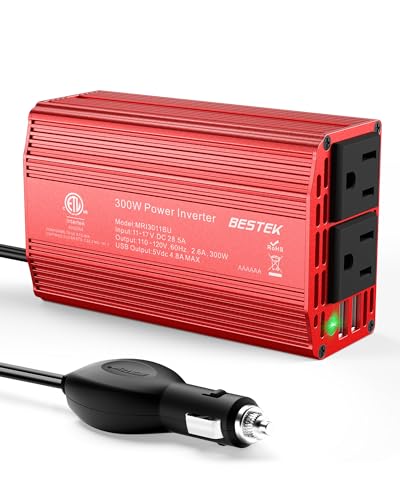 BESTEK Power Inverter DC 12-17V to AC 110V1 - Power Inverter4.8 x 3.1 x 1.9 inches0.9 poundsCheck on Amazon
 300W Portable Charger Car Power Inverters for vehicle300W5.43 x 2.75 x 1.4 inches0.6 poundsCheck on Amazon
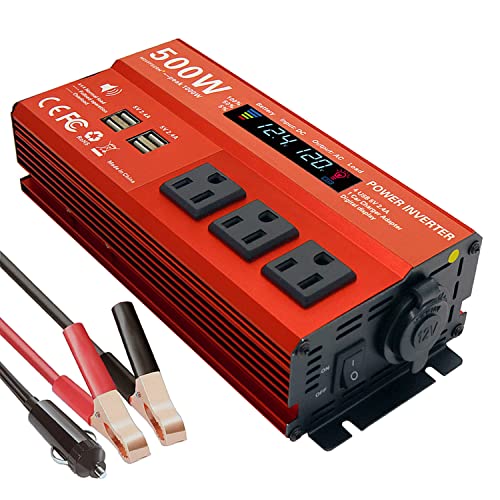 MOVFFGGRM 500W Peak 1000W Power Inverter for Vehicles500W8.27 x 4.33 x 2.36 inches2.18 poundsCheck on Amazon


Top 3 picks at a glance
Quick Picks
As an Amazon Associate we earn from qualifying purchases at no extra cost to you.


| Product | Best for | Key spec from the listing |
|---|---|---|
| BESTEK 300W | Laptop and camera charging | 300W, 4.8A dual USB, 12-17V DC input |
| VANSOET 400W | Simple plug-in power | 400W, 12V to 110V |
| TWING 1000W | Trucks and heavier loads | 1000W, dual AC outlets, USB and Type-C |
| PiSFAU 200W | Light devices and phones | 200W, dual AC, 4.8A 24W USB-A/C |
| MOVFFGGRM 500W | Many USB gadgets at once | 500W, 4 USB ports, lighter port |
| BESTEK 400W PD | Phones and tablets with USB-C | 400W, PD 30W USB-C, USB-A 3.0 |
| FOVAL 150W | Occasional small loads | 150W, 3.1A dual USB |
How to Choose
Match wattage to the device
Add up what you plan to plug in. A phone or tablet charger draws very little, most laptop adapters need 45 to 100 watts, and a small fan or camera battery charger fits comfortably under 150 watts. Heating appliances such as hair dryers, coffee makers, and kettles can pull well over 1000 watts and are not realistic for a car inverter. Choose an inverter with a continuous rating at least 20 percent above your largest device. Look for the label on the device’s power brick, which lists the watts or the volts and amps you can multiply, instead of guessing from the size of the charger.
Lighter socket versus battery clamps
Many vehicle outlets are fused at around 10 to 15 amps, which puts a practical ceiling near 150 to 180 watts of draw. Inverters that plug into the socket are convenient for small loads. Larger units, including those marked at 500W to 1000W, often need to connect directly to the battery with clamps, so read the listing carefully and inspect the cable or connector type before buying. If the title shows only a lighter plug, assume its practical output is limited by the vehicle fuse, whatever the headline wattage says. Installing clamps correctly takes a few minutes, but a poor connection can overheat.
Outlets, USB, and fast charging
Two AC outlets let you charge a laptop and run a small device together. USB-A ports handle phones, while a USB-C port with Power Delivery, such as 30W, can charge modern phones and some tablets quickly. Ignore bulky outlet counts if you only have one or two devices. Count the plugs you will use together, and leave one spare for a passenger. The printed amps on a USB port are a combined total in many models, so two phones can split the output rather than each getting the full figure.
Safety features and where budget units cut corners
Look for overload, short-circuit, over-temperature, and low-voltage protections, plus a cooling fan on units that run warm. Cheaper models may skimp on cable quality, build a loud fan, or exaggerate peak wattage versus continuous output. A modified sine wave output works for most chargers and laptops but can hum or run hot with sensitive electronics, so check the waveform if you plan to run medical gear or audio equipment. Wires should feel thick and the plug should fit snugly in the socket, because a loose connection heats up under load.
The 7 Best Options
BESTEK 300W
This 300W unit takes a 12 to 17V DC input and plugs into the cigarette lighter, with a 4.8A dual USB fast-charging port alongside the AC outlet. It is meant for a laptop and a couple of phones at once, which covers the typical commuter or road trip passenger. The USB side is rated at 4.8A total, so two phones can charge together without needing their own wall adapters.
- Strength: Dual USB ports charge two phones while the AC outlet runs a laptop.
- Strength: Lighter-plug design needs no battery clamps for light use.
- Trade-off: A 300W rating exceeds what a typical lighter socket can supply.
Skip it if you want a USB-C port with Power Delivery, or if you need it to run anything much above a laptop charger from a single lighter socket.
VANSOET 400W
The VANSOET listing is brief: a 400W power inverter for vehicles converting 12V to 110V. It is a straightforward converter for buyers who prefer a no-frills model and already know what they plan to power. With 400W on paper, it leaves headroom for a laptop plus a small device, provided the connection to the vehicle can actually supply that much current.
- Strength: High wattage rating gives headroom for a laptop plus small devices.
- Strength: Simple description suggests a basic, easy-to-use product.
- Trade-off: The title lists no USB or Type-C ports, so charging a phone needs an AC adapter.
Skip it if you need built-in USB charging or want details on protections before you buy.
TWING 1000W
Marketed for vehicles and trucks, this 1000W inverter has dual AC outlets plus a 3.0A USB port and a Type-C port. The wattage points to heavier use than a lighter-socket unit, such as running a power tool charger or a small appliance during a job. Pairing the AC outlets with a Type-C port also keeps a modern phone charging at the same time.
- Strength: Two AC outlets and two USB-style ports cover many devices.
- Strength: Higher wattage supports tools and larger chargers.
- Trade-off: A 1000W inverter typically needs direct battery connection, which adds installation effort.
Skip it if you only need to charge a phone and a laptop.
PiSFAU 200W
A 200W inverter with dual AC outlets and a 4.8A, 24W USB-A and USB-C charging output, plugged into the cigarette lighter. The balanced outlet count suits a commuter who charges a laptop on one outlet and a phone through the USB port. It also works for a rideshare driver or salesperson who keeps a laptop and phone powered through a long day.
- Strength: Dual AC outlets and USB-A/C in a small device.
- Strength: 200W is closer to what a lighter socket can handle.
- Trade-off: Low ceiling means no room for power-hungry gadgets.
Skip it if you want to run anything bigger than a laptop charger.
MOVFFGGRM 500W
This unit is listed at 500W with a 1000W peak, four 2.4A USB ports, and one cigarette lighter port. It is a charging hub for families traveling together, with enough USB sockets for phones and tablets for the entire back seat. A family heading out on a long drive can plug in every screen, and the AC side remains available for a laptop charger when needed.
- Strength: Four USB ports charge many devices simultaneously.
- Strength: Extra lighter port adds flexibility.
- Trade-off: A 500W rating will likely require a battery connection for full power.
Skip it if you want USB-C Power Delivery.
BESTEK 400W PD
This model lists 400W with a 30W Power Delivery USB-C port and a USB-A 3.0 port for fast charging, using a cigarette lighter connection. The PD port is the main reason to choose it, since newer phones and tablets charge quickly through USB-C. A single unit can then handle a phone through the fast port, an older device through USB-A, and a laptop through the AC outlet.
- Strength: 30W PD charges modern phones and tablets quickly.
- Strength: USB-A 3.0 port keeps older gadgets covered.
- Trade-off: Lighter-socket limits still cap the real output.
Skip it if you only care about AC outlets for appliances, or if you do not own any device that uses USB-C charging.
FOVAL 150W
A 150W inverter with a 12V DC to 110V AC conversion and a 3.1A dual USB car charger, aimed at laptop use. The low wattage fits within what most lighter sockets can safely deliver, so it plugs in without fuss. It is a reasonable choice for the occasional user who keeps one in the glovebox for emergencies, a laptop battery top-up, or a camping trip.
- Strength: Wattage matches what typical car sockets support.
- Strength: Dual USB ports charge phones.
- Trade-off: Too small for anything beyond a laptop and light gear.
Skip it if you plan to run a power tool or a larger appliance.
Which One Fits Your Situation
You commute and charge a laptop and phone
The PiSFAU 200W gives you an AC outlet for the laptop plus USB-A and USB-C for the phone, all in a size that suits a lighter socket.
You haul tools in a truck
Pick the TWING 1000W. It is the only model here rated for heavier loads and designed with trucks in mind. Expect to connect it to the battery rather than the lighter socket.
You travel with kids and many gadgets
The MOVFFGGRM 500W has four USB ports for tablets and phones, which saves arguments over the one charging cable. Keep the unit within reach and keep an eye on the cable routing so nothing snags a child’s foot.
Your phone supports fast USB-C charging
Go for the BESTEK 400W PD, whose 30W USB-C port takes advantage of faster charging standards. It saves you from carrying a separate USB-C car charger on top of the inverter.
Common Mistakes
- Trusting a high wattage number while plugging into a lighter socket that can only deliver a fraction of it.
- Running a heater, kettle, or hair dryer from a car inverter.
- Leaving the inverter on with the engine off, which can drain the car battery.
- Ignoring ventilation by burying the inverter under bags or seats.
- Assuming every USB port charges at the same speed.
Related guides
- How To Check Motherboard Vrm Temperature In Hwinfo
- How To Clean Quest 3 Lenses And Facial Interface
- Vr Facial Interfaces For Glasses Wearers
Frequently Asked Questions
Can I leave an inverter plugged in all the time?
It is better to unplug it when not in use, because even idle units draw a small current and can slowly drain the battery over days.
Do I need the engine running?
For short phone charging, not always, but for laptops or anything beyond brief use, run the engine to protect the battery and keep the alternator supplying power.
What is the difference between continuous and peak watts?
Continuous is what the inverter can supply steadily, while peak is a brief surge for starting a motor. Size your choice by the continuous figure.
Is an inverter worth carrying in 2026?
If you often work or travel by car, yes, since it covers any device that only comes with a wall plug. For phones alone, a USB charger is enough.
Related guides
More from Amazon
Programs that pair well with the guide above. Offers and eligibility are set by Amazon and may change.
Free shipping on eligible items, Prime Video and more. Eligible new members can start with a free trial.
Start a Prime free trialAd-free music streaming. Eligible new subscribers can start with a free trial.
Try Music Unlimited freeA Prime membership for ages 18-24 with a trial period. Eligibility is set by Amazon.
See Prime for Young AdultsAudiobooks and podcasts to listen to on the go. Eligible new members can start with a free trial.
Try Audible freeAs an Amazon Associate we earn from qualifying purchases.