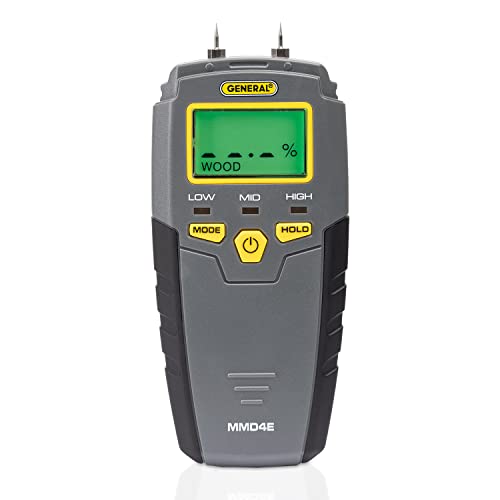
For most people burning firewood, the best moisture meter for firewood is the General Tools MMD4E. It is a pin-type meter, and pin type is the only design that reads the inside of a split log rather than a thin skin of surface, so it answers the question you actually have: is this wood dry enough to burn tonight? It also covers wood, building materials and water-leak detection in one tool and ships with spare pins, the one part that decides how many seasons a meter stays useful. It suits anyone who splits their own wood, checks a few logs before each load, and wants a single meter that also handles a damp patch on a wall. If you would rather not push pins into anything, the Povlen pinless meter is the best pinless pick for flat, planed faces such as lumber and drywall — but on rough split firewood it is a compromise, not a replacement. The rest of this guide compares nine currently listed meters on range, calibration, temperature behaviour and how easy each one is to read inside a split.
Our Top Picks


Top 3 picks at a glance

Quick Comparison
The table below covers every meter in this roundup. Specs are given as the class each meter is sold in, plus the figures a listing actually states. Where a listing name does not say whether the meter is pin or pinless, the row says so — confirm the probe type on the listing before you order, because that one detail decides whether the tool works on split firewood at all.
| Product | Best for | Key specs | Price tier |
|---|---|---|---|
| General Tools MMD4E | Best overall for split firewood and mixed DIY | Pin probe; wood moisture + building-material mode that doubles as a water-leak detector; digital LCD; spare pins included; handheld single-piece body | Premium |
| RDINSCOS Replaceable Pins Moisture Meter | Best for daily use where pins wear out | Pin probe; user-replaceable pin tips; digital wood moisture readout; LCD; handheld | Mid-range |
| TopTes TS-630 | Best for reading outdoors in poor light | 2.25-inch LCD — the largest display in this group; handheld digital wood moisture meter with humidity-tester function | Premium |
| Mecurate Digital Pin Type Wood Moisture Meter | Best for species correction on a mixed woodpile | Pin type; 2 modes; 8 calibration groups; 3 coloured moisture indicators alongside the numeric readout | Mid-range |
| coczow wood and water-leak detector | Best for a second meter kept in a shed or garage | Pin type; wood moisture content plus water-leak detection in one unit | Budget |
| CHIME EOLIAN Firewood Moisture Meter | Best firewood-first budget pick | Pin type; wood moisture readout aimed at firewood and lumber; LCD | Budget |
| Povlen Pinless Moisture Meter | Best pinless option for lumber and drywall | Pinless (capacitive/dielectric); lumber and drywall modes; scan depth in the 20–40 mm class; no pins to replace | Premium |
| QYQRQF Digital Wood Moisture Meter | Best large-display readability at the lowest spend | Large LCD; timber damp readout; orange housing; pin-type class | Budget |
| coczow moisture meter with battery and LCD | Best grab-and-go first meter | LCD display; battery included; wood moisture readout; pin-type class | Budget |
Prices are deliberately not listed per product: listing prices move daily, so the tier is the durable comparison. A premium meter in this group is the one you buy when you want the brand’s support, the wider material coverage or the bigger display; a budget meter is the one you buy when the job is firewood and nothing else.
Before the individual reviews, it helps to see the two designs side by side with numbers attached, because the differences are not cosmetic — they change what you can physically measure.
| Attribute | Pin meter (resistance) | Pinless meter (capacitive / dielectric) |
|---|---|---|
| Reading depth | At the pin tips — roughly 6–8 mm with the 8–10 mm pins typical of this class | Roughly 20–40 mm, averaged over a sensing field about 50 mm across |
| Wood moisture range | About 6–40% MC, with some meters reaching 50–60% | About 4–40% MC, but often capped near 30% on wood |
| Display resolution | 0.1% MC | 0.1% MC |
| Typical accuracy | ±1–2% MC in the 6–30% band | ±2–4% MC, more sensitive to density and surface condition |
| Surface preparation | None — drive the pins into the wood | Flat, clean, dry surface and steady pressure required |
| Species sensitivity | Corrected by a species group or calibration setting | Corrected electronically, but still density-sensitive |
| Temperature effect | Large — frozen wood can read several points drier than it is | Moderate, but cold surfaces skew the reading too |
| Best surface | Split logs, thick stock, genuinely wet wood | Planed lumber, drywall, finished boards |
Then map your own situation onto the list:
| Your situation | What to pick |
|---|---|
| You split your own firewood and check logs before every load | A pin meter — General Tools MMD4E |
| You burn three or four cords a year and pins wear out | A pin meter with replaceable tips — RDINSCOS |
| Your woodpile mixes oak, ash, maple, pine and fruitwood | Mecurate, with 8 calibration groups |
| You read the meter outdoors at dusk or under a lean-to | TopTes TS-630 and its 2.25-inch LCD |
| You also chase damp patches on walls and ceilings | coczow wood and water-leak detector |
| You burn firewood only and want the lowest spend | CHIME EOLIAN |
| You are checking planed lumber or drywall, not splits | Povlen pinless |
| You want the biggest display for the least money | QYQRQF |
| You want a meter that works the moment it arrives | coczow with battery and LCD |
How We Chose
This roundup was assembled from published product documentation, manufacturer specifications and the well-established behaviour of the two meter designs, not from bench work. Four criteria did the sorting. First, category fit: does the meter actually do the job the page is about — reading moisture inside split firewood — which immediately separates pin meters from pinless ones. Second, specification depth: range, resolution, calibration options and temperature behaviour, because those are the numbers that change a reading rather than decorate a box. Third, use case: whether the meter is built for a woodshed, a workshop, a renovation or a general-purpose toolbox, since a tool that suits one rarely suits all four. Fourth, upgrade path and consumables: how long the meter stays accurate, whether the pins can be replaced, and what you would move up to if you outgrow it. Price tier was treated as a tiebreaker rather than a starting point, and no meter was credited for features that its listing does not claim.
1. General Tools MMD4E — Best for Split Firewood and Mixed DIY Use
As an Amazon Associate we earn from qualifying purchases at no extra cost to you.
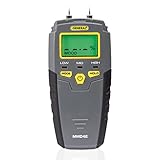
The MMD4E is the meter to buy if you want one instrument that handles firewood first and everything else second. General Tools has been making hand measurement instruments for decades, and this model is the one that shows up in the widest range of settings — a woodshed, a basement after a leak, a renovation where you need to know whether a stud is damp before you close a wall. Its two-mode design is the reason: one mode reads moisture content in wood, the other reads moisture in building materials and works as a water-leak detector. For firewood specifically, the pin probe is what matters, and it is the design that reads inside a split rather than across its surface.
Key specs (as listed, plus class-typical detail):
- Probe type: pin — two metal pins driven into the wood, reading electrical resistance between them
- Modes: wood moisture content plus a building-materials mode that doubles as a water-leak detector
- Display: digital LCD with a numeric readout at 0.1% resolution
- Range: pin-meter class, roughly 6–40% MC on wood, which covers everything from freshly split green wood down to well-seasoned stock
- Consumables: replacement pins included; pins are the wear item on every pin meter
- Format: single-piece handheld body with a captive probe and a protective cap
Strengths. The wood mode is the one you will use most, and it does the job the way firewood demands: drive the pins into a freshly exposed split face and read the interior in a couple of seconds. Because the meter is pin type, it is not fooled by the dry skin that forms on the outside of a log that has been sitting in the sun — a surface reading can say 12% on wood whose core is still at 30%. The building-materials mode is a genuine second tool, not a marketing line: it lets you check a ceiling stain, a sill plate or a basement wall for elevated moisture, which is the same measurement in a different material. The included spare pins matter more than they sound. Pins blunt, bend and corrode, and a pin meter with worn tips reads low, which is the worst kind of error because it tells you the wood is ready when it is not.
Pros
- Pin type, so it reads inside a split log rather than across the surface
- Two modes cover firewood and building materials, replacing two separate tools
- Leak-detection capability is useful well beyond the woodpile
- Spare pins included, so the meter’s accuracy is not a dead end
- Established brand with documented specifications and long-run availability
- Simple enough to hand to a family member without a briefing
Cons
- Premium tier — you pay for the brand and the second mode even if you only burn wood
- Pins leave small holes, which rules it out on finished furniture or visible trim
- No pinless scanning mode, so large flat panels take longer to survey
- Pin readings need a species correction to be strictly accurate on unusual woods
How it compares. The nearest alternative in this list is the RDINSCOS Replaceable Pins meter, and the choice between them comes down to scope versus focus. Both are pin meters, both read split firewood correctly, and both let you replace the pins. The RDINSCOS is a firewood-and-lumber tool with a mid-range price and a straightforward wood readout; the MMD4E adds the building-materials mode and leak detection, and charges a premium for it. If your meter will only ever touch logs, the RDINSCOS does the same core job for less. If you also own a house with a basement, the MMD4E earns its tier. Against the pinless Povlen, the comparison is even clearer: the Povlen wins on planed lumber and drywall because it never touches the surface, and the MMD4E wins on rough split firewood because pins reach the interior that a capacitive field can only average.
2. RDINSCOS Replaceable Pins Moisture Meter — Best for Daily Use Where Pins Wear Out
The RDINSCOS meter is built around a single insight: on a pin meter, the pins are the part that fails, so make them replaceable and the meter lasts as long as you keep spares. That is exactly the right priority for someone burning three or four cords a year, because a meter used daily on rough split wood blunts its tips far faster than a meter used twice a season on planed boards. It sits in the mid-range tier and does the firewood job without the extra modes, extra cost or extra menu depth of the premium options.
Key specs (as listed, plus class-typical detail):
- Probe type: pin — the listing’s headline feature is that the pins are replaceable
- Display: digital LCD with a numeric wood moisture readout at 0.1% resolution
- Range: pin-meter class, roughly 6–40% MC on wood, with the useful resolution concentrated between 12% and 25%
- Consumables: user-replaceable pin tips — the reason to choose this model over a sealed-body pin meter
- Format: handheld, single-piece, with a probe cover
- Modes: wood moisture; no separate building-materials mode
Strengths. Replaceable pins are not a gimmick, they are a maintenance plan. A pin that has been driven into hundreds of splits develops a rounded tip that contacts the wood over a smaller area, and contact resistance climbs, so the meter drifts low. A meter that reads low on wet wood is actively dangerous advice: you load the stove with 28% wood, the fire struggles, the flue cools and creosote deposits in the chimney. Swapping in fresh pins restores the reading instead of forcing you to replace the whole instrument. Beyond that, the RDINSCOS is deliberately plain — one number on an LCD, no calibration menu to get lost in, no mode you will never use. On a cold morning with an armful of splits, that simplicity is a feature. The mid-range price also means you can buy two, keep one in the woodshed and one in the house, and still spend less than a single premium pin meter.
Pros
- Replaceable pins extend the working life of the meter at very low cost
- Pin type reads inside split logs, which is the only reading that matters for firewood
- Mid-range price makes a second meter for the shed practical
- Simple single-number readout with no menus to navigate
- Straightforward wood moisture range covering green through seasoned stock
Cons
- No building-materials or leak-detection mode
- No pinless scanning for large flat panels
- Species correction is limited compared with meters offering multiple calibration groups
- Pins still leave marks on finished surfaces
How it compares. Against the General Tools MMD4E, the RDINSCOS trades the second mode and the brand premium for the same core capability at a lower tier — and it matches the MMD4E on the feature that keeps a pin meter honest, replaceable pins. If your only question is “is this split ready to burn”, the RDINSCOS answers it and keeps answering it for years. Against the Mecurate, the difference is calibration depth: the Mecurate offers 8 calibration groups, which matters if your pile mixes dense oak with light pine and you want the meter to account for the difference rather than apply one curve to everything. If you burn one or two species, that advantage largely disappears and the RDINSCOS is the more focused buy.
3. TopTes TS-630 — Best for Reading Outdoors in Poor Light

The TopTes TS-630 is the meter in this group built around a display. Its listing leads with a 2.25-inch LCD, which is roughly twice the diagonal of the small screens on most budget meters, and that single specification changes how the tool behaves in real use. Firewood gets checked in a woodshed at dusk, in a garage under a single bulb, or outdoors in winter when your eyes are streaming and your hands are cold. A big, high-contrast number is the difference between a two-second check and a squint.
Key specs (as listed, plus class-typical detail):
- Display: 2.25-inch LCD — the largest screen in this roundup
- Format: handheld digital moisture meter with a humidity-tester function
- Resolution: 0.1% readout, class-typical for a digital meter of this type
- Range: wood moisture class range, roughly 6–40% MC, covering green splits through seasoned firewood
- Probe: the listing title does not state pin or pinless — confirm this before ordering, because it decides whether the meter suits split logs
- Power: battery-powered handheld format
Strengths. Readability is the whole point, and it matters more than most buyers expect. When you are sampling a cord, you are not taking one reading — you are taking thirty, across a dozen logs, and you are comparing them against each other. Small digits on a dim screen slow that process down and, worse, invite you to accept a reading you did not quite see. The 2.25-inch display removes that friction. The humidity-tester function extends the meter’s usefulness to general damp checking around the house, which is the same category of measurement applied to a different problem. TopTes prices this at the premium tier, which reflects the display and the build rather than any exotic measurement capability — you are paying for the interface, and if you check wood regularly in poor light, the interface is what you interact with.
Pros
- 2.25-inch LCD is markedly easier to read than the small screens on budget meters
- Handheld format with a humidity-tester function for general damp checking
- 0.1% resolution, so readings are comparable between logs rather than rounded into buckets
- Premium build and display at a tier that reflects the interface, not hidden features
Cons
- The listing title does not specify pin versus pinless — verify before buying for firewood
- Premium tier for a display-led advantage that does not improve measurement accuracy
- No documented species calibration groups, so mixed woodpiles need manual judgement
- A big screen costs battery life compared with a small one
How it compares. The nearest alternative is the QYQRQF, which also sells on a large LCD display but at a budget tier. The trade is straightforward: the QYQRQF gives you the big number for much less money, while the TopTes adds the humidity-tester function and a premium build. If the only thing you want from a display is legibility in a dim shed, the QYQRQF covers most of that gap for a fraction of the spend — and the money you save buys a spare meter for the truck. Choose the TopTes if the meter lives in your hand and you want the better screen every time you pick it up. Against the Mecurate, the split is display versus calibration: the TopTes wins on reading the number, the Mecurate wins on making the number correct for the species in front of you.
4. Mecurate Digital Pin Type Wood Moisture Meter — Best for Species Correction on a Mixed Woodpile

Mecurate’s pin meter is the one to buy if your woodpile is a mix. Its listing advertises 2 modes, 8 calibration settings and 3 coloured moisture indicators, and the calibration count is the interesting number. Pin meters work by measuring electrical resistance between two pins, and resistance depends not only on how much water is in the wood but on how dense the wood is. Oak, ash and hickory conduct differently from pine, spruce and poplar at identical moisture content. A meter with one fixed curve will be close on some species and off by several points on others; a meter with multiple calibration groups lets you tell it what it is looking at.
Key specs (as listed, plus class-typical detail):
- Probe type: pin type, as the listing states
- Modes: 2 measurement modes covering wood and a second material category
- Calibration: 8 calibration settings — the headline differentiator at this tier
- Indicators: 3 coloured moisture indicators that give an at-a-glance verdict alongside the numeric readout
- Range: pin-meter class, roughly 6–40% MC on wood
- Display: digital LCD with numeric readout at 0.1% resolution
Strengths. The calibration groups are the reason to choose this over a cheaper pin meter, and the coloured indicators are the reason to choose it over a fussier one. Coloured status lights let you skip the interpretation step: if you have set a threshold of 20% in your head, a colour tells you pass or fail without you doing arithmetic on a number. That matters when you are working through a stack of splits and want to sort them into “burn now” and “leave another month”. The pin design keeps the meter honest on split logs, reading the interior of a freshly opened face rather than the dry outer shell. The 2 modes extend coverage beyond pure firewood, so the tool is not single-purpose. At the mid-range tier, you get more adjustment than the budget meters and a lower price than the premium ones — the sweet spot for someone who has realised that species matters.
Pros
- 8 calibration settings give real species correction across a mixed pile
- 3 coloured indicators turn a reading into an instant pass/fail judgement
- Pin type reads inside split logs, which is the correct method for firewood
- 2 modes extend the meter beyond firewood to a second material category
- Mid-range price with more adjustment than budget meters offer
Cons
- Calibration groups must be set correctly to be useful — a wrong group is worse than none
- No replaceable-pin feature highlighted in the listing
- No pinless scanning mode
- More controls to learn than a single-button meter
How it compares. Against the RDINSCOS, the Mecurate trades replaceable pins for calibration depth. If you burn mostly one or two species, the RDINSCOS’s replaceable tips will serve you longer and cost less; if your pile is genuinely mixed, the Mecurate’s 8 groups will give you better numbers on the denser species, where an uncorrected pin meter tends to read wetter than the truth. Against the General Tools MMD4E, the Mecurate is cheaper and offers more species adjustment, but gives up the building-materials and leak-detection mode. Against the TopTes TS-630, the Mecurate gives up the large display and gains the calibration menu. For a firewood-first buyer with a varied woodpile, the Mecurate is the most technically appropriate mid-range pin meter in this list.
5. coczow Wood and Water-Leak Detector — Best for a Second Meter in the Shed or Garage

This coczow unit is sold as a combined wood moisture meter and water-leak detector, which is the same dual-purpose brief the premium General Tools MMD4E fills — at a budget tier. That makes it the obvious second meter: one for the house, one for the woodshed, one for the truck. If you have ever carried a meter out to a stack of splits, set it down, and never found it again, you already understand the case for owning two.
Key specs (as listed, plus class-typical detail):
- Probe type: pin class — the listing pairs wood moisture measurement with water-leak detection
- Functions: wood moisture content plus water-leak detection in one unit
- Range: wood moisture class range, roughly 6–40% MC, covering green through seasoned firewood
- Display: digital LCD with numeric readout at 0.1% resolution
- Format: handheld, battery-powered
- Intended use: rapid determination of moisture content — the listing frames it as a quick-check tool
Strengths. The value here is coverage per dollar. You get a wood moisture function that does the core firewood job and a leak-detection function that covers the same damp problems a homeowner runs into — a stain on a ceiling, a musty smell at a sill plate, a patch of wall that feels cold. For firewood, the pin approach is what you want: drive the pins into a freshly split face and read the interior. Because the price is at the budget tier, you can treat it as a consumable rather than an heirloom. That changes how you use it. You keep it in the shed where it belongs, you do not worry about it getting rained on, and you do not hesitate to hand it to a neighbour. The “rapid determination” framing in the listing is accurate to its purpose — this is a meter for deciding whether tonight’s load is ready, not for laboratory work.
Pros
- Two functions — wood moisture and leak detection — at a budget price
- Pin design reads inside split logs rather than across the surface
- Low enough cost to keep a second unit in the shed or vehicle
- Simple operation suited to quick checks before loading the stove
- Coverage of the general damp-checking jobs a homeowner actually has
Cons
- Budget build and finish compared with the premium meters here
- No documented species calibration groups
- No replaceable-pin feature highlighted in the listing
- Accuracy expectations should be modest — budget pin meters typically deliver ±2–3% MC rather than ±1%
How it compares. The nearest alternative is the other coczow meter in this list, the version sold with a battery and LCD display. Both are budget pin-class meters aimed at rapid moisture determination, and the practical difference is what comes in the box and how the listing frames the tool: this one is pitched as a wood-and-leak dual-purpose unit, the other as a ready-to-run meter with the battery included. If leak detection is part of why you are buying, take this one. If you simply want the cheapest thing that reads a split and works out of the box, the battery-included version is the easier purchase. Against the CHIME EOLIAN, this coczow adds leak detection but is not marketed specifically at firewood, so the CHIME EOLIAN reads as the more firewood-focused budget choice.
6. CHIME EOLIAN Firewood Moisture Meter — Best Firewood-First Budget Pick

The CHIME EOLIAN meter is named for exactly one job. Its listing title repeats “wood moisture meter” and “firewood moisture meter” and adds lumber, which tells you the manufacturer is aiming at people who burn wood and want a single-purpose tool at the lowest sensible price. If you have no interest in drywall, no interest in leak detection, and no interest in lumber grading — you just want to know whether the split in your hand is ready — this is the straightforward answer.
Key specs (as listed, plus class-typical detail):
- Probe type: pin class, consistent with the firewood and lumber framing of the listing
- Intended materials: firewood and lumber, as stated in the listing title
- Range: wood moisture class range, roughly 6–40% MC, spanning green splits to seasoned stock
- Display: LCD with numeric moisture readout at 0.1% resolution
- Format: handheld, battery-powered
- Price tier: budget
Strengths. Focus. Because the tool is not trying to be a leak detector or a materials tester, there is nothing between you and the number. Push the pins into a freshly exposed split face, read the value, decide. That is the entire workflow, and it takes about three seconds once you have the log open. For a household that burns two or three cords a year, this is enough meter — the accuracy band that matters is between about 15% and 25% MC, and a budget pin meter in this class will reliably tell you which side of 20% a split sits on, even if its absolute number drifts a point or two from a laboratory value. The lumber coverage in the listing means it also works if you mill or buy rough boards. And because the spend is small, the risk is small: if it lives in the shed and gets abused, you are not writing off a premium instrument.
Pros
- Named and framed specifically for firewood, so the workflow is uncluttered
- Pin design reads inside a split rather than across the surface
- Covers lumber as well as firewood
- Budget tier keeps the outlay low for a seasonal tool
- Simple LCD readout with no menus to misconfigure
Cons
- No leak detection or building-materials mode
- No species calibration groups documented in the listing
- No replaceable-pin feature highlighted
- Budget build means the display and housing are basic compared with premium options
How it compares. Against the QYQRQF, both are budget pin-class meters, and the difference is emphasis: the QYQRQF sells on a large LCD in an orange housing, the CHIME EOLIAN sells on being a firewood meter. If you read the meter in a dim shed, the QYQRQF’s larger display is the more useful advantage. If you read it in daylight and want the clearest statement of purpose, the CHIME EOLIAN is the more direct buy. Against the coczow wood-and-leak unit, the CHIME EOLIAN gives up the leak-detection function and keeps the firewood focus. Against the RDINSCOS at mid-range, the CHIME EOLIAN saves money and gives up replaceable pins — the one upgrade worth considering if you expect to use the meter hard for years.
7. Povlen Pinless Moisture Meter — Best Pinless Option for Lumber and Drywall

The Povlen meter is the only pinless design in this roundup, and it exists because pinless meters solve a real problem: no holes. A capacitive pinless meter presses a sensing pad against the surface and reads the dielectric properties of the material underneath, which varies with moisture content. Nothing penetrates the wood. That makes it the right tool for planed lumber, finished boards, drywall and anything where a pair of pin holes would be visible or damaging. Its listing names lumber and drywall as the target materials, which is exactly the pinless sweet spot.
Key specs (as listed, plus class-typical detail):
- Probe type: pinless — capacitive/dielectric sensing pad, no pins
- Intended materials: lumber and drywall, as stated in the listing
- Reading depth: pinless class, roughly 20–40 mm below the pad depending on wood density
- Sensing field: about 50 mm across, so the reading is an average rather than a point
- Range: pinless class, about 4–40% MC, frequently capped
Related guides