The best dust collectors for workshops are determined by your tools’ CFM requirements, filtration level, and how far your ducting has to run, not just the horsepower rating on the motor. A small single-tool shop needs a high-pressure compact unit, while a multi-machine shop with 4-inch or 6-inch ducting needs high airflow and low static pressure loss to keep fine dust out of the air.
As an Amazon Associate we earn from qualifying purchases at no extra cost to you.

Our Top Picks
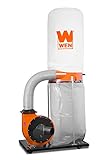
 VEVOR Dust Collector36.22 x 29.13 x 75.59 inch36.22 x 29.13 x 75.59 Inches68.12 PoundsCheck on Amazon

Top 3 picks at a glance
How to Choose the Right Class of Collector
Ignore the peak HP number and look at two curves: airflow (CFM) at a given static pressure, and filtration rating. Manufacturers advertise free-air CFM with no hose attached, but once you add 10 feet of flex hose and two elbows, real airflow can drop 30-50%. Your collector is only effective if it can maintain the required capture velocity at the tool port after those losses.
- Single-stage collectors: Motor and impeller pull chips directly into a bag or canister filter. Affordable and powerful for chips, usually $300–$600 for 1-1.5HP models, but fine dust can pass through 5-micron or 30-micron bags unless upgraded.
- Two-stage / cyclone collectors: A cyclone separates 95-99% of chips and coarse dust into a drum before air hits the filter. Keeps suction consistent and filter clean far longer. Usually $900–$2,200 for 1.5-3HP units.
- High-pressure / wall-mounted collectors: Compact impellers designed for high static pressure rather than high CFM. Ideal for long runs of 4-inch hose or small shops where you move one hose between tools. Usually $400–$1,700.
- Dust extractors (HEPA vacuums): Not true dust collectors. They produce very high static pressure (90+ inches of water lift) but low CFM (130-150 CFM) for handheld power tools, sanders, and track saws with 27-36mm ports. Essential if you do a lot of sanding or use Festool, Mirka, or similar tools.
Decision Matrix: Match Your Workshop to the System
Use this to narrow the category before comparing specific models.
| Workshop Situation | Recommended System | Ducting | Filtration Target |
|---|---|---|---|
| 1-car garage, 1-2 machines at a time, move hose manually | 1-1.5HP wall-mounted or single-stage canister | One 4-in flex hose, under 12 ft | 1 micron canister or better |
| 2-car garage, 3-5 stationary tools, fixed duct along wall | 1.5-2HP cyclone (e.g., 1300-1500 CFM class) | 4-in main with 4-in drops, or 6-in main with 4-in drops | 0.5 micron canister, MERV 15+ |
| Large shop / small pro shop, table saw + planer + jointer running often | 2-3HP cyclone with 6-in ducting | 6-in main trunk, minimal flex | 0.2-0.5 micron HEPA-grade canister |
| Handheld sanders, routers, miter saw focus, finished space | HEPA dust extractor + compact collector for stationary tools | 36mm anti-static hose + 4-in hose for big tools | HEPA (99.97% at 0.3 microns) |
Airflow, Static Pressure, and a Worked Calculation
A tool needs both CFM and velocity. General capture velocities for woodworking are 3,500-4,000 FPM in the duct to keep chips suspended. CFM = Velocity x Duct Area.
For a 4-inch duct: Area = pi x (radius)^2 = 3.14 x (2 in)^2 = 12.56 sq in = 0.087 sq ft. At 4,000 FPM, you need 0.087 x 4,000 = 348 CFM at the tool after losses. For a 6-inch duct: Area = 28.27 sq in = 0.196 sq ft. At 4,000 FPM, you need 785 CFM.
Worked example: 2-car shop with a 13-inch planer and a table saw.
Your planer has a 4-inch port rated for 400 CFM, your table saw needs 350 CFM at the cabinet and 150 CFM at an overarm guard (500 CFM total if collecting both). You plan a 24-foot run with a 6-inch main, three 90-degree elbows, and 6 feet of flexible hose per drop.
- Estimated static pressure loss: 6-inch smooth pipe loses about 0.08 inches per foot, flex hose about 0.3 inches per foot, each 90-degree elbow adds ~3-4 feet of equivalent length. Total equivalent length is roughly 45 feet.
- Total loss at 700 CFM is approximately 4.5 – 6.0 inches of static pressure. A 1HP single-stage collector that peaks at 6 inches max static pressure will have almost no CFM left at that resistance.
- A 1.5-2HP cyclone rated for 1,300 CFM free-air and 10-11 inches max static pressure will still deliver 650-750 CFM at 5-6 inches, which covers one large tool at a time. If you want to run two gates open at once at 700+ CFM each, you need a 3HP system with a 14-15 inch impeller and a true 11+ inch static pressure rating and a 6-inch main stepped to 7-inch.
This is why a 2HP cyclone with 6-inch ducting outperforms a 2HP single-stage with 4-inch ducting on long runs, even if their free-air CFM numbers look similar on the spec sheet.
Comparison of Proven Models for 2026
All of the following are established platforms still in production in 2026. Specs are manufacturer-rated free-air values; expect 35-50% less at the tool with realistic ducting.
| Model | Class | Motor | Rated Airflow | Filtration | Footprint | Noise (at 10 ft) |
|---|---|---|---|---|---|---|
| JET DC-1100VX-CK | Single-stage canister | 1.5 HP, 115/230V | 1,100 CFM | 1 micron canister (0.5 micron optional) | 30 x 35 in floor | 78-82 dB |
| Grizzly G1029Z2P | Single-stage canister | 2 HP, 240V | 1,550 CFM | 1 micron canister | 33 x 57 in floor | 80-84 dB |
| Laguna P|Flux:1 | Cyclone | 1.5 HP, 120V | 1,502 CFM | 0.5 micron MERV 15 canister | 36 x 36 in floor + drum | 76-79 dB |
| Powermatic PM1300TX-CK | Cyclone | 1.75 HP, 115/230V | 1,300 CFM | 0.5 micron canister | 34 x 34 in floor | 74-78 dB |
| Oneida Air Systems Supercell | High-pressure wall-mount | 5 HP (universal motor) | ~320 CFM at high static pressure | HEPA, 0.3 micron, 99.97% | Wall mount, 16 x 30 in | 82-86 dB |
| Festool CT 26 E HEPA | Dust extractor | 1,200W | 137 CFM | HEPA, 99.97% at 0.3 microns | 22 x 15 in mobile | 68-72 dB |
What the Table Tells You
The JET and Grizzly single-stage units offer the most raw CFM per dollar for small shops where the collector can sit within 6-10 feet of the tool. The Laguna and Powermatic cyclones cost more, usually $1,200–$1,900, but maintain usable CFM over longer ducting and keep filters from blinding because chips never reach the canister. The Oneida Supercell is an outlier: it trades high CFM for very high static pressure (up to ~90+ inches in blower mode), so it pulls hard through a single 4-inch or even 2.5-inch hose but is not designed to feed a 6-inch trunk with multiple open gates. The Festool CT 26 is included because many hybrid shops need both: a collector for stationary machines and an extractor for sanders and routers.
Filtration, Noise, and Footprint Trade-offs
Filtration
For health protection, filtration matters more than CFM. A 30-micron bag will visibly collect chips but recirculates the respirable 0.5-10 micron dust that stays airborne for hours. In 2026, any collector for an enclosed workshop should have at least a 1-micron canister, ideally 0.5-micron or HEPA-rated with a MERV 15 or higher rating. Cyclones extend filter life dramatically because only the finest dust reaches the filter. Look for models with a paddle or crank to clear the canister and a plastic collection bag below the filter for fine dust, plus a large steel drum for chips.
Noise
Single-stage collectors with open impellers are the loudest, typically 80+ dB at 10 feet. Two-stage cyclones with enclosed filter stacks and larger, slower impellers are often 3-6 dB quieter despite higher power, which is perceived as roughly half as loud. If your shop shares walls with living space, a cyclone in a separate closet or outside lean-to with return air filtered back in will do more for comfort than any low-dB rating. Wall-mounted high-pressure units are quiet at the hose but loud at the motor due to universal motor whine.
Footprint and Ducting Needs
Measure before you buy. A 2HP single-stage with bag stands over 80 inches tall and needs 3-4 feet of wall. A 1.5HP cyclone has a similar height but adds a 20-30 gallon drum in front that must be pulled out for emptying. Wall-mounted units free up floor space but require solid wall blocking and place the motor at ear height. For ducting, use smooth-wall metal pipe for mains, reserve flexible hose only for final drops (under 5 feet where possible), ground metal ducting, and use 45-degree wyes instead of 90-degree tees to cut losses by ~30%. Step down from a 6-inch main to 4-inch drops at the blast gate; never step up from 4-inch to 6-inch mid-run.
How to Finalize Your Choice
Pick based on your worst-case tool and layout, not your average use:
- If you own a 15-inch planer, 8-inch jointer, or 3HP cabinet saw and plan to duct more than 20 feet, choose a 1.5-2HP cyclone with a 6-inch inlet and run a 6-inch main. Budget usually $1,200–$1,900 plus $300–$600 for ducting and blast gates.
- If you work in a single-car garage and roll tools to a single hose, a 1-1.5HP canister collector or a high-pressure wall-mounted unit with a 4-inch hose and good 1-micron filtration will capture chips and save floor space. Budget usually $400–$800.
- If you sand a lot, build cabinets, or work with MDF, add a HEPA dust extractor for sanders and routers regardless of which collector you choose. It is the only way to capture dust at the tool with small ports that a large collector cannot serve due to low pressure.
- For fine dust control, pair any collector with ambient air filtration or a ceiling-mounted air cleaner rated for your shop volume (CFM = shop cubic feet x air changes per hour / 60; six air changes per hour is a common target) and always wear a P100 or N95 respirator during machining and for 10-15 minutes after.
When sizing electrical, most 1.5HP units run on a dedicated 120V 20A circuit, while 2HP and larger require 240V. Check full-load amps, not just HP, and keep the run from panel to outlet under 50 feet on 12AWG for 120V models to avoid voltage sag that reduces impeller speed and CFM.
FAQ
Can I use a shop vacuum instead of a dust collector?
For handheld tools with 1- to 2.5-inch ports, a high-pressure shop vacuum or HEPA extractor is actually better than a dust collector. For stationary tools with 4-inch ports, a shop vacuum does not move enough air volume to keep chips airborne and will clog and overheat.
Is 6-inch ducting always better than 4-inch?
For systems over 1,000 CFM and runs longer than 15 feet, 6-inch mains reduce friction and allow needed CFM without excessive velocity loss. For short single-tool runs under 12 feet, 4-inch is simpler and maintains higher velocity to prevent settling, especially with a 1-1.5HP collector.
Do I need to vent outside?
Venting outside eliminates filter backpressure and fine dust recirculation but wastes conditioned air and may violate codes. In most attached shops, a high-quality 0.5-micron canister that returns filtered air to the shop plus a dedicated makeup air path is more practical.