Our Top Picks
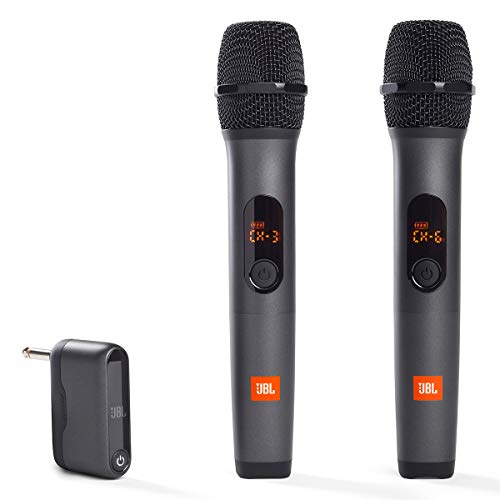 JBL Wireless Two Microphone System with Dual-Channel Receiver1.95 x 1.95 x 9.16 inches1.2 poundsCheck on Amazon


Top 3 picks at a glance
Quick Comparison
The table below maps every system in this roundup to the job it does best. Prices are given only as broad market tiers, because street prices on wireless audio gear move constantly with bundles, sales and stock.
| Product | Best for | Key specs | Price tier |
|---|---|---|---|
| Phenyx Pro PTU-71-2H | Two-host shows, gigging duos, no-menu setup | Dual-channel UHF, 2 handhelds, auto scan, metal receiver, rack-mountable | Mid-range |
| JBL Wireless Two Microphone System | Home parties, karaoke, casual streaming | Dual-channel receiver, 2 handheld mics, XLR + 1/4″ outputs | Budget |
| Aveek 4 Pack | Four-person panels, classrooms, group podcasts | 4 handheld mics, long-range UHF, low-latency claim, single receiver | Budget |
| TONOR Headset/Lavalier UHF System | Presenters, fitness, hands-free gaming chat | UHF bodypack, headset + lavalier capsules, quoted ~295 ft range | Premium |
| Phenyx Pro PTU-5000-4H | Fixed-venue installs, four-mic stages | 4-channel UHF, fixed frequency, four handhelds, rack ears | Premium |
| MELONARE 4×10 UHF | Budget four-mic kits with channel options | 4 handhelds, multiple selectable frequencies, quoted ~200 ft range | Budget |
| Phenyx Pro PTU-7000-4H | Roaming presenters, interference-prone venues | 4-channel UHF, auto scan, metal chassis, multiple mic options | Premium |
| TONOR Handheld Set with Headset/Lapel | Hybrid streaming setups needing both mic types | Handheld mics plus headset/lapel bodypack options, UHF | Mid-range |
| TONOR UHF Bodypack System (4×10) | Multi-presenter kits with interchangeable capsules | Bodypack transmitter, headset/lavalier mics, receiver, channel options | Mid-range |
| Kaschun Dual UHF Handheld | Plug-and-play two-mic setups on a tight budget | Fixed frequency, dual handhelds, quoted ~200 ft range, plug and play | Budget |
| Phenyx Pro PTU-6000-8H | Eight-mic events, conferences, worship teams | 8-channel UHF, auto scan, rack-mountable multi-channel receiver | Premium |
| JBL PartyBox Wireless Mic | PartyBox owners, singer-songwriters, rechargeable convenience | 2 digital wireless mics, rechargeable battery rated up to 20 hrs (700 mAh cells) | Mid-range |
How We Chose
Every system here earned its place by being a real, currently listed product from a recognisable brand or a well-established budget manufacturer, so you can actually buy it rather than chase a discontinued model. We sorted candidates into four categories that match how people actually use wireless mics: two-mic handheld kits (the karaoke, duo-gig and two-host streaming case), four-mic kits (panels, classrooms, small worship teams), bodypack systems with headset and lavalier capsules (presenting, fitness, hands-free chat), and large multi-channel systems (events and installs that need six or more channels).
Within those categories, the selection criteria were concrete rather than cosmetic. Does the system use UHF rather than VHF or 2.4 GHz, since UHF generally gives more channel choice and cleaner coexistence with Wi-Fi? Does it have a scan or channel-selection mechanism that lets you dodge interference, or is it locked to fixed frequencies? Is the receiver metal or plastic, and does it have rack ears for permanent installs? Are the transmitters battery-powered by AA cells or rechargeable, and does that match the way you will actually use them? Does it output both a balanced XLR and an unbalanced line-level connection, so it can feed a mixer, camera interface or streaming setup without adapters? And finally, is there an upgrade path, meaning a bodypack, extra capsules or additional channels in the same family, so the system can grow with your use case rather than being thrown out when your needs change.
We deliberately did not rank by branding alone. A budget four-mic kit that handles a panel of guests cleanly is a better purchase than a premium system whose features you will never touch. Likewise, an eight-channel auto-scan rack unit is the correct answer for a worship team and the wrong answer for a bedroom streamer who needs one microphone and zero menus. The category fit and the upgrade path matter more than the badge on the front panel. Specs quoted in the product names, such as quoted range figures of roughly 200 to 295 feet, are taken as the manufacturer’s own claims and treated as spec-class descriptors rather than measured guarantees, because real-world range depends on obstacles, RF noise and antenna placement.
1. Phenyx Pro PTU-71-2H — Best for Two-Host Shows and Gigging Duos
As an Amazon Associate we earn from qualifying purchases at no extra cost to you.
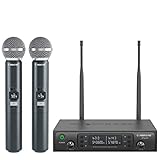
The PTU-71-2H is the two-mic kit that gets out of your way. It is a dual-channel UHF handheld system with an auto scan function, which means the receiver hunts for a clean frequency on its own rather than asking you to dial through channels and listen for static. For a two-person podcast, a comedy duo, a wedding MC team or a small band with two vocalists, that is the entire workflow: power on, scan, sync the handhelds, and start talking. The metal receiver and rack-mountable chassis push it a step above the all-plastic budget kits, and the pricing usually sits in the mid-range band, typically well under what a single premium channel costs.
Who it suits
Buy this if you have exactly two people who need handheld mics and you want the setup to be repeatable in different rooms. It also suits a small venue that wants a permanent two-channel solution without paying for four channels you will never use. If you are torn between a handheld and a headset, this kit sticks to handhelds, so it is the wrong choice for a fitness instructor or anyone who needs hands free.
Key specs
- Type: dual-channel UHF wireless handheld system
- Microphones: two handheld transmitters included
- Frequency management: auto scan on the receiver
- Receiver: metal chassis, rack-mountable with included hardware class
- Outputs: balanced and unbalanced connection options typical of this class
- Power: AA-battery transmitters (this family uses standard AA cells)
Strengths
Auto scan is the headline feature and it is genuinely useful. In a room crowded with Wi-Fi, LED lighting and other wireless gear, manual channel selection is where most budget systems fail, and a scan button removes that failure mode. Charging or swapping AA cells in a handheld is also a practical advantage over built-in rechargeable packs, because you can carry spares and never stop a show to wait for a charge. The metal receiver takes the abuse of being packed and unpacked, and the rack-mount option means it can live in a small rack at a venue rather than getting lost behind a desk.
Pros
- Auto scan removes most interference guesswork in shared rooms
- Two handhelds included, so no separate capsule purchase
- Metal receiver with rack-mount potential suits installs and gigging
- Standard AA batteries mean fast swaps and no charging downtime
Cons
- No bodypack or headset option, so it is handhelds-only
- Two channels caps your growth at two simultaneous speakers
- Auto scan is convenient but still not the same as a wide-band tunable system
How it compares
Against the JBL Wireless Two Microphone System, the PTU-71-2H trades brand familiarity for RF flexibility: both give you two handhelds, but the Phenyx Pro’s auto scan makes it the more reliable pick in unpredictable rooms, while the JBL kit tends to be the simpler, cheaper plug-in-and-go option for home parties. Against the Kaschun dual-handheld kit, the PTU-71-2H costs more but replaces fixed frequencies with a scanning receiver, which is the difference between a system you can trust at a venue and one you hope works. If your two-microphone needs are occasional and at home, the budget options are fine; if they are frequent and in public, this is where the extra spend pays off.
2. JBL Wireless Two Microphone System — Best for Home Parties and Casual Karaoke
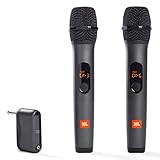
The JBL Wireless Two Microphone System is a dual-channel handheld kit in a black finish, aimed squarely at the person who wants music, two mics and a good time without reading a manual. JBL’s brand presence in consumer audio means the receiver is designed to slot into a home setup as easily as it would into a small PA, and the budget tier pricing makes it one of the least painful ways to add two wireless voices to a party. It is not a pro RF tool, and it does not pretend to be.
Who it suits
This is for karaoke nights, birthdays, family gatherings, casual streaming commentary and anyone whose wireless needs are indoor, occasional and low-stakes. It also suits a streamer who wants a second voice in the room without running cables across the floor. If you need long-throw range, channel scanning or hands-free operation, look further down this list.
Key specs
- Type: dual-channel wireless handheld system
- Microphones: two handheld transmitters included
- Receiver: dual-channel, with standard audio outputs for mixing into a speaker or interface
- Finish: black
- Power: battery-powered handhelds
- Brand class: consumer audio brand with wide retail support
Strengths
The biggest strength is simplicity. There is no scan procedure to learn, no channel spreadsheet and no menu tree, which means a guest can hand a mic to a friend and it keeps working. JBL’s consumer heritage also means the handfeel and the general ergonomics are pleasant, which matters more than raw specs when a microphone spends its life being passed around a room. And because it is a mainstream product, accessories and replacements are easy to source, so a lost handheld is not a dead system.
Pros
- Very easy to set up and hand to a non-technical guest
- Recognisable brand with dependable consumer support
- Two handhelds included at a budget-tier price
- Fine for indoor home use where RF congestion is mild
Cons
- No auto scan or advanced frequency management
- Handheld-only design rules out headsets and lavaliers
- Not built for the RF pressure of crowded venues or long distances
How it compares
The nearest alternative is the Phenyx Pro PTU-71-2H, and the choice comes down to environment. In a living room, the JBL is cheaper and friendlier. In a rented hall full of other wireless gear, the PTU-71-2H’s auto scan is worth the extra tier. Compared with the Kaschun dual handheld kit, the JBL offers a stronger brand and likely better long-term support, while both remain fixed-simple systems that work best indoors. If your use case never leaves the house, the JBL is the sensible spend; if it might, pay for scanning.
3. Aveek Wireless Microphone System 4 Pack — Best for Four-Person Panels on a Budget

Aveek’s four-pack is one of the cheapest ways to get four people talking wirelessly at once. The listing describes a four-microphone system with long-range capability and low-latency transmission, which is exactly the feature set a panel show, a classroom or a four-person podcast needs. Latency is the underrated spec here: for streaming and live discussion, a mic that lags makes overlapping conversation feel wrong, so a low-latency claim is more than marketing filler in this category.
Who it suits
This is for four-person roundtables, teaching, group streams, quiz nights and small worship or community gatherings where four handheld voices at once is the requirement and the budget is tight. It is also a reasonable starter kit for a growing channel that expects to add guests. It is not the right pick for a solo creator who wants a bodypack or a lavalier.
Key specs
- Type: multi-microphone wireless handheld system
- Microphones: four handheld transmitters included
- Range: manufacturer quotes long-range operation in the ~260 ft class
- Latency: advertised as low latency, which matters for live speech
- Receiver: single multi-channel receiver unit
- Power: battery-powered handhelds
Strengths
Four channels for a budget-tier price is the whole pitch, and it is a good one. Most budget systems stop at two, which means a four-person panel either needs two kits (and therefore two receivers and twice the RF coordination problem) or a wired solution. A single receiver handling four mics keeps the desk clean and the setup simple. The long-range claim gives you room to put speakers around a space rather than clustered near the receiver, and the low-latency design keeps lip-sync and conversational overlap natural for streaming.
Pros
- Four handhelds at a budget price, unusual in this tier
- Single receiver keeps cabling and desk space minimal
- Low-latency design suits live streaming and discussion
- Long quoted range allows flexible mic placement in a room
Cons
- Budget-tier RF performance will not match premium multi-channel systems
- No headset or lavalier option in this configuration
- Channel management is typically simpler and less flexible than auto-scan systems
How it compares
Against the MELONARE four-mic kit, both target the same budget four-channel buyer; the Aveek leans on its long-range and low-latency claims, while the MELONARE highlights multiple selectable frequencies and a shorter quoted ~200 ft range. If you expect interference and want frequency agility, the MELONARE’s selectable channels may serve you better; if you want reach and low latency for streaming, the Aveek is the stronger fit. Against the Phenyx Pro PTU-7000-4H, the Aveek gives up metal construction, auto scan and long-term reliability, and in exchange costs a fraction as much. For a hobby panel, that trade is often correct.
4. TONOR Headset/Lavalier UHF System — Best for Hands-Free Presenting and Fitness

TONOR’s UHF headset and lavalier system is the odd one out in a good way: instead of handhelds, it uses a bodypack transmitter feeding either a headset or a clip-on lavalier capsule, with the listing quoting a UHF range in the 295 ft class. That design choice changes everything about who should buy it. The microphone lives on your head or lapel, your hands stay free, and the audio stays at a consistent distance from your mouth instead of drifting as you move.
Who it suits
This is for fitness instructors, presenters, teachers, tour guides, stage performers who need their hands, and gamers or streamers who want a headset mic with a proper wireless transmitter rather than a cabled headset. It is also a strong pick for anyone whose content involves movement, because a handheld mic only works when you are holding it.
Key specs
- Type: UHF bodypack wireless system
- Microphone options: headset capsule and lavalier/lapel capsule included
- Range: manufacturer quotes a UHF range in the ~295 ft class
- Transmitter: belt-worn bodypack
- Receiver: single-channel desktop receiver in this class
- Power: bodypack battery-powered
Strengths
The interchangeable capsule design is the standout. A headset capsule stays positioned no matter how much you move, while a lavalier clips to a shirt for a less conspicuous look, and having both in one system means one purchase covers presenting, teaching and performance. UHF transmission also gives this system the same general interference advantages as the other UHF kits here, which matters when you are moving through a room rather than standing still. The quoted range is among the longest in this roundup, useful for large rooms where the receiver sits at the back.
Pros
- Hands-free operation via headset or lavalier capsules
- Two capsule types included, covering presenters and performers
- UHF transmission with a long quoted range
- Bodypack design stays consistent in level as you move
Cons
- No handheld microphone, so it is wrong for karaoke and audience participation
- Single-channel receiver means one speaker at a time
- Bodypack adds a belt clip and cable to your wardrobe, which some users dislike
How it compares
Against the TONOR handheld set with headset and lapel mics, the difference is focus: that kit gives you handhelds plus bodypack options in one box, making it more versatile for mixed events, while this system specialises in hands-free work with a longer quoted range. If your priority is one great hands-free channel, buy this. If you might need a handheld for a guest who stands up to speak, the hybrid TONOR set covers both. Against the Phenyx Pro PTU-71-2H, this system wins for movement and loses for audience interaction, since you cannot pass a bodypack around a room.
5. Phenyx Pro PTU-5000-4H — Best for Fixed-Venue Four-Mic Installs

The PTU-5000-4H is a four-channel UHF handheld system built around fixed frequencies. That phrase deserves explanation rather than dismissal: fixed frequency means the receiver and transmitters are factory-tuned to specific channels, so there is no scanning or tuning step. The upside is simplicity and consistency; the downside is that if your venue happens to have interference on one of those channels, your options are limited compared with an auto-scan system.
Who it suits
This is for permanent or semi-permanent installations where the RF environment is known and stable: a small venue, a church, a conference room, a school hall or a rehearsal space. Four channels of handheld mics cover a panel, a band’s vocalists or a teaching team. It is also a sensible purchase for a venue that wants rack-mounted reliability and does not want staff fiddling with menus.
Key specs
- Type: four-channel UHF wireless handheld system
- Frequency management: fixed frequency, factory-set channels
- Microphones: four handheld transmitters included
- Receiver: multi-channel unit with rack-mount capability
- Construction: metal chassis class typical of this series
- Power: battery-powered handheld transmitters
Strengths
Fixed frequency is genuinely a strength in a controlled room, because it removes a failure point. Staff cannot accidentally leave the receiver on the wrong channel, and there is no scan that might settle on a marginal frequency. The four-channel rack-mountable receiver keeps a permanent install tidy, and the metal construction is built for a life in a rack rather than a life in a gig bag. Because it is part of Phenyx Pro’s broader UHF family, it also fits naturally into a venue that already uses that ecosystem.
Pros
- Four channels in one receiver for panel and band use
- Fixed frequencies mean no menus and no accidental misconfiguration
- Rack-mountable metal receiver suits permanent installs
- Simple, repeatable power-on-to-talking workflow
Cons
- No scan, so interference on a fixed channel is hard to escape
- Handhelds only, with no bodypack or lavalier in this configuration
- Less flexible than auto-scan systems if you move between venues
How it compares
The obvious alternative is the PTU-7000-4H, which also runs four UHF channels but adds auto scan. That single feature is the whole decision: if your venue is stable, the PTU-5000-4H is a simpler, dependable install and often the better value; if you travel or your RF environment changes, the PTU-7000-4H’s scanning is worth the premium. Against the TONOR four-mic bodypack family, the PTU-5000-4H is a handheld system for standing speakers, while the TONOR kits are for presenters who move and need hands-free capsules. Neither replaces the other.
6. MELONARE 4×10 UHF System — Best for Budget Four-Mic Kits With Channel Options

MELONARE’s four-channel UHF system is described with a quoted range around 200 feet and multiple selectable frequencies across four handheld microphones. The “4×10” naming in this class usually signals four microphones with a set of ten selectable frequency options, which is the important detail: unlike a pure fixed-frequency kit, you have some ability to move channels if one misbehaves.
Who it suits
This is for four-person events on a tight budget where you still want a little frequency flexibility: community theatre, small classes, parties with multiple speakers, budget panel streams. It suits someone who understands that they may need to change a channel occasionally and is willing to do so.
Key specs
- Type: four-channel UHF wireless handheld system
- Microphones: four handheld transmitters included
- Frequency management: multiple selectable frequencies (ten-option class)
- Range: manufacturer quotes approximately 200 ft
- Signal: advertised as stable at its rated range
- Power: battery-powered handhelds
Strengths
Selectable frequencies at a budget price is the appeal. When a channel gets noisy, you can step to another rather than living with it, which is a meaningful capability that fixed-frequency budget kits lack. Four handhelds in one kit covers a whole panel without buying two systems, and the quoted 200-foot range is plenty for a typical hall or classroom, since most users sit well within that distance anyway.
Pros
- Four handhelds at a budget-tier price
- Selectable frequencies give an escape route from interference
- Range adequate for classrooms, halls and home studios
- Single receiver keeps setup compact
Cons
- Manual channel selection, not automatic scanning
- 200 ft quoted range is shorter than premium systems in this list
- Handheld configuration offers no headset or lavalier path
How it compares
Against the Aveek four-pack, the MELONARE’s advantage is frequency choice while the Aveek’s advantage is a longer quoted range and a low-latency emphasis. If your room is RF-noisy and you expect to hop channels, MELONARE is the safer budget four-mic kit; if you need reach and stream-friendly latency, the Aveek edges ahead. Against the Phenyx Pro PTU-7000-4H, the MELONARE gives up metal build and automatic scanning and saves a substantial amount of money, which is the correct trade for a hobbyist and the wrong one for a working venue.
7. Phenyx Pro PTU-7000-4H — Best for Roaming Presenters in Crowded RF Rooms

The PTU-7000-4H is the four-channel version of Phenyx Pro’s auto-scan approach, and it is the system to pick when your wireless reliability actually matters and the room is not under your control. Four UHF channels, automatic frequency scanning, a metal rack-mountable receiver and support for multiple microphone options make it the most flexible four-channel handheld-class system in this roundup.
Who it suits
This suits mobile entertainers, MCs, hotels and venues that host different events in different rooms, bands with four vocalists, and anyone who has been burned by a cheap system cutting out mid-sentence. If you set up somewhere new every weekend, auto scan is not a luxury, it is insurance.
Key specs
- Type: four-channel UHF wireless system with auto scan
- Microphones: four channels, with handheld and other capsule options in this family
- Frequency management: automatic scan to find clean channels
- Receiver: metal, rack-mountable multi-channel unit
- Outputs: balanced and unbalanced options typical of this series
- Power: battery-powered transmitters
Strengths
Auto scan across four channels is the core value. Scanning one clean frequency is easy; finding four clean, mutually compatible frequencies is where manual systems fall apart, and an automatic scan solves that coordination problem for you. The metal chassis and rack ears mean it survives transport and installs cleanly, and the option of different capsule types within the family means you are not locked into handhelds forever. For a working entertainer, the time saved at every setup compounds into real money.
Pros
- Automatic scanning across four channels simplifies coordination
- Metal rack-mountable receiver built for transport and install
- Multiple microphone options within the family
- Reliable in RF-congested rooms where budget kits struggle
Cons
- Premium tier pricing is overkill for occasional home use
- Four channels is still a hard ceiling for large events
- More features mean more to learn than a plug-and-play kit
How it compares
Against the PTU-5000-4H, the difference is exactly one feature — auto scan — and that feature justifies the price gap for anyone who moves between venues. Against the PTU-6000-8H, this system is the right size for four speakers while the 8H is for events that genuinely need eight channels; buying eight when you need four wastes money and adds RF coordination burden. Against the TONOR bodypack system, this is a handheld system for standing speakers, while TONOR’s is hands-free for movers. Match the tool to how your speakers behave.
8. TONOR Handheld Set with Headset/Lapel Mics — Best for Hybrid Streaming Setups

This TONOR kit is the generalist of the roundup: a UHF wireless microphone system that ships with handheld mics plus headset and lapel options, so one purchase covers both a person standing at a mic and a person moving with a bodypack. For a streamer, podcaster or small event host, that versatility removes the need to buy two systems and coordinate two receivers.
Who it suits
Buy this if your content mixes formats: an interview where one guest holds a handheld while the host wears a lavalier, a stream where you sometimes stand and sometimes sit, a small workshop with a presenter who paces. It suits mid-range budgets and users who want one box to cover most situations.
Key specs
- Type: UHF wireless system with handheld and bodypack options
- Microphones: handheld transmitters plus headset and lapel capsules
- Transmission: UHF
- Receiver: desktop receiver supporting the included transmitters
- Power: battery-powered transmitters
- Tier: mid-range
Strengths
Flexibility is the point. Handheld mics are ideal for singing and for guests who want to hold something; a lapel or headset is ideal for a host who needs hands free for a keyboard, guitar or mouse. Having both in a single UHF system means consistent RF behaviour and one receiver on the desk, rather than two competing systems. The mid-range tier also means better components than the cheapest kits while staying well below premium pricing, which is a sensible sweet spot for a creator who is upgrading from a wired USB mic.
Pros
- Handheld plus headset and lapel options in one kit
- UHF transmission for better coexistence with Wi-Fi than 2.4 GHz
- One receiver simplifies desk and cable management
- Mid-range pricing with a clear upgrade path from wired mics
Cons
- Jack of all trades: a dedicated system will beat it at either extreme
- Channel count limits how many simultaneous speakers you can host
- Capsule quality on included headsets and lavaliers is rarely the equal of the handhelds
How it compares
Against the TONOR bodypack system with the 4×10 channel options, this kit gives you handhelds as well, making it more versatile but arguably less specialised for pure presenting work. Against the TONOR headset/lavalier system, this one adds handheld mics at the cost of some quoted range. Within the TONOR range, the decision is simple: if you only ever need hands-free, buy the dedicated bodypack system; if your format varies, buy this hybrid kit and stop thinking about it.
9. TONOR UHF Bodypack System (4×10) — Best for Multi-Presenter Kits With Interchangeable Capsules

This TONOR system packages a UHF bodypack transmitter, headset and lavalier capsules, a receiver and a set of selectable channels — the 4×10 style configuration. It is built for presenters, instructors and performers who need hands-free audio and want the ability to move channels when a room turns hostile.
Who it suits
Fitness instructors with classes in different studios, teachers, worship leaders, workshop facilitators and streamers who prefer a headset or lavalier over a handheld. The multiple frequency options make it more adaptable than a fixed-frequency bodypack system when you cannot control the RF environment.
Key specs
- Type: UHF wireless bodypack system
- Microphones: headset and lavalier/lapel capsules included
- Transmitter: belt-worn bodypack
- Channels: multiple selectable frequencies in the ten-option class
- Receiver: desktop receiver
- Tier: mid-range
Strengths
Selectable channels plus a bodypack is a combination that usually costs more than this tier, and it directly addresses the two things that ruin a hands-free setup: RF interference and a single fixed channel. The inclusion of both a headset and a lavalier capsule means you can match the mic to the room — headset for high-movement fitness work where a lavalier cable would swing, lavalier for discreet presenting where a headset looks too sporty. UHF transmission keeps it reliable around venue Wi-Fi.
Pros
- Bodypack design with both headset and lavalier capsules included
- Multiple selectable frequencies for interference management
- UHF operation suits venues with heavy Wi-Fi traffic
- Mid-range price for a hands-free system with channel flexibility
Cons
- No handheld microphone included
- Single bodypack means one speaker per receiver
- Manual channel selection rather than automatic scanning
How it compares
Against the TONOR headset/lavalier system with the longer quoted range, this kit trades some reach for selectable frequencies, which is usually the better trade in urban venues where interference is more likely than a very long distance. Against the hybrid TONOR handheld set, this one is the specialist — pure hands-free, no handhelds. If your work is entirely presenting or instructing, the specialist wins; if you sometimes hand a mic to an audience member, the hybrid kit is safer.
10. Kaschun Dual UHF Handheld — Best for Plug-and-Play Two-Mic Budget Setups

The Kaschun system is the simplest thing in this roundup: two fixed-frequency UHF handheld microphones, a quoted range around 200 feet, and a plug-and-play setup that asks nothing of you beyond power and connection. It is a budget-tier answer to the question “I just need two wireless mics that work.”
Who it suits
Home karaoke, small parties, a two-person stream on a tight budget, a school project, a hobbyist testing whether wireless is worth it. It is also a reasonable spare-pair purchase for someone who already has a main system and wants backup mics for guests.
Key specs
- Type: dual UHF wireless handheld system
- Microphones: two handheld transmitters included
- Frequency management: fixed frequency
- Range: manufacturer quotes approximately 200 ft
- Setup: plug and play
- Tier: budget
Strengths
There is real value in a system with no decisions. Two mics, one receiver, power on and talk. The quoted 200-foot range covers essentially every home and small-room scenario, and fixed frequencies mean there is nothing to misconfigure. For a first wireless purchase or a cheap backup pair, the low cost of entry makes sense, especially if it lives in one room where you can confirm it works before an event.
Pros
- Very low cost for a two-mic UHF kit
- Genuinely plug and play, with no channel setup
- Range is adequate for homes, classrooms and small halls
- Simple enough for non-technical users to operate
Cons
- Fixed frequencies leave no escape from interference
- Budget build and components compared with premium tiers
- No headset, lavalier or expansion options
How it compares
Against the JBL two-mic system, the Kaschun is the cheaper, more generic option while the JBL brings brand support and consumer-friendly ergonomics; both share the fixed-simple philosophy. Against the Phenyx Pro PTU-71-2H, the Kaschun saves meaningful money but gives up auto scan and metal construction. If you will only ever use these mics in one room you can test beforehand, the Kaschun is a smart budget buy; if reliability away from home matters, spend up to a scanning system.
11. Phenyx Pro PTU-6000-8H — Best for Eight-Mic Events and Worship Teams

The PTU-6000-8H scales the Phenyx Pro auto-scan approach to eight channels in a single rack-mountable UHF receiver. Eight wireless handhelds at once is a serious coordination problem to solve manually, and that is precisely why automatic scanning matters most at this end of the range.
Who it suits
Worship teams, conference organisers, panel events, awards ceremonies, theatre productions and any venue that regularly needs six to eight simultaneous speakers. It is not for a solo streamer, and buying it for two speakers would waste both money and rack space.
Key specs
- Type: eight-channel UHF wireless system with auto scan
- Channels: eight simultaneous handheld channels
- Frequency management: automatic scanning across channels
- Receiver: rack-mountable multi-channel metal unit
- Outputs: multiple balanced and unbalanced outputs typical of this class
- Tier: premium
Strengths
Eight clean channels found automatically is the entire reason to buy this system. Manually finding eight interference-free frequencies that all coexist is genuinely difficult, and doing it before every event is impractical. Auto scan turns a technician’s job into a button press. The rack-mount metal receiver suits permanent installation, and the channel density means one receiver handles a whole stage rather than a stack of two- and four-channel units with their own antennas fighting each other.
Pros
- Eight channels in one rack unit with automatic scanning
- Simplifies frequency coordination at a scale manual tuning cannot handle
- Metal, rack-mountable construction for permanent installs
- Scales to real events without stacking multiple receivers
Cons
- Premium pricing is hard to justify for fewer than six speakers
- Overkill for streaming, podcasts and home use
- Requires more careful antenna placement than a two-channel kit
How it compares
Against the PTU-7000-4H, this is simply twice the channels with the same scanning philosophy — choose by headcount, not by features. Against any stacked pair of four-channel systems, the 8H wins because one receiver with one antenna system is easier to manage and less prone to intermodulation problems than two separate units in the same rack. If you genuinely host eight speakers, this is the correct tool. If you host four with occasional guests, the 4H plus a wired spare is the more economical path.
12. JBL PartyBox Wireless Mic — Best for PartyBox Owners and Rechargeable Convenience

The JBL PartyBox Wireless Mic is a two-microphone digital wireless set designed to pair naturally with JBL’s PartyBox speaker ecosystem. Its defining feature is the rechargeable battery in each microphone, rated by the manufacturer at up to 20 hours from 700 mAh cells, plus a focus on clear vocal pickup. For anyone who already owns a PartyBox, it is the least friction path to wireless vocals.
Who it suits
PartyBox owners, party hosts, singer-songwriters who perform through a portable speaker, and anyone who hates buying AA batteries. It suits people who value convenience and integration over RF configurability.
Key specs
- Type: two-microphone digital wireless system
- Microphones: two wireless handhelds included
- Battery: rechargeable, quoted up to 20 hours from 700 mAh cells
- Audio focus: clear vocal reproduction
- Ecosystem: designed for JBL PartyBox speakers
- Tier: mid-range
Strengths
Rechargeable microphones are a lifestyle improvement. Twenty hours of quoted runtime from 700 mAh cells means you charge before the weekend and forget about it, with no drawer of half-dead AAs and no scramble at a party. Integration with the PartyBox ecosystem means less fiddling with pairing and levels, and for a singer running through a portable speaker, the convenience is the product. Digital wireless in the 2.4 GHz band also tends to be stable in the specific environment these mics live in: a house or garden party, not a stadium.
Pros
- Rechargeable mics with long quoted runtime, no AA purchases
- Designed to integrate cleanly with JBL PartyBox speakers
- Two mics included for duets and party use
- Clear vocal tuning suits karaoke and singing
Cons
- Ecosystem-oriented: less useful outside a JBL speaker setup
- Digital wireless offers less channel flexibility than UHF scanning systems
- Not a headset or lavalier solution
How it compares
Against the JBL Wireless Two Microphone System, the PartyBox Mic is the more modern, rechargeable, integration-focused pick, while the older kit is a simpler generic receiver. If you own a PartyBox, the PartyBox Mic is clearly the better fit. Against the Phenyx Pro PTU-71-2H, the JBL offers convenience and charging while the Phenyx Pro offers UHF scanning and rack-mount reliability. For parties, buy JBL; for gigs, buy Phenyx Pro. That one sentence answers most of the two-mic decision tree.
How to Choose
Choosing a wireless microphone system is really four decisions stacked on top of each other: frequency band, channel count, microphone type and power. Get those right and the brand almost does not matter. Get one wrong and you will be fighting the system forever, no matter how much you paid.
Start with the band: UHF versus 2.4 GHz versus VHF
Most systems in this roundup are UHF, and that is not an accident. UHF offers more available channels and generally better behaviour in venues crowded with Wi-Fi, Bluetooth and other wireless gear. The 2.4 GHz band, used by the JBL PartyBox Mic and many consumer systems, is extremely crowded because Wi-Fi routers, mice, keyboards and headsets all live there, but 2.4 GHz digital systems can still be very stable at short range in a home because they hop frequencies rapidly and are designed for exactly that environment. VHF is largely legacy at this point and rarely the right buy. Practical rule: if the receiver and transmitters will stay within roughly 30–50 feet in a domestic setting, 2.4 GHz digital is fine and often more convenient. If you are covering a hall, moving between rooms, or sharing the air with dozens of other wireless devices, choose UHF.
Decide how many simultaneous channels you need — then add one
Count the maximum number of people who will speak or sing at the same moment, not the number who might ever use a mic. That number is your channel requirement. A two-host podcast needs two. A four-person panel needs four. A worship team with a pastor and four vocalists needs five, and buying a four-channel system would be a mistake. The rule of thumb: buy the channel count you need plus one spare, because guests appear, mics fail and having a spare channel is cheaper than buying a second system later. Systems like the PTU-6000-8H exist for events where the count genuinely reaches six or eight. Do not buy eight channels for a two-person stream; the extra RF coordination is a cost, not a feature.
Frequency management: fixed, selectable or auto scan
This is the single most underrated spec in the category, and it is usually what separates a system that works from a system that cuts out. Fixed frequency systems such as the Kaschun dual handheld and the Phenyx Pro PTU-5000-4H are factory-set to specific channels. They are perfectly reliable in a stable, known room, and they are the cheapest and simplest options. Selectable-frequency systems such as the MELONARE four-mic kit and the TONOR bodypack system let you move to another channel when one gets noisy, which is a meaningful upgrade for a modest cost. Auto-scan systems such as the PTU-71-2H, PTU-7000-4H and PTU-6000-8H do the searching for you, which matters most when you have multiple channels to coordinate and least when you have one. A useful calculation: the difficulty of finding clean frequencies grows far faster than the channel count does, because every additional channel must be clean not just on its own but alongside all the others. One channel is trivial to find manually. Four is tedious. Eight is genuinely hard without a scan function. That is why auto scan appears at the top of the range and why it is worth paying for above four channels.
Handheld, headset or lavalier — match the mic to the person
Handheld microphones are best for singing, for guests who expect to hold something, and for audience participation where the mic gets passed around. They also give the most consistent level because the capsule stays at a fixed distance from the mouth. Headsets are best for movement: fitness, dance, teaching and anyone whose hands are busy. A headset capsule stays near the mouth no matter what, which means a consistent level and no cable to manage. Lavaliers are best for discreet, professional-looking presenting where a headset would look too sporty; the trade-off is that a lapel mic is more prone to clothing rustle and its position is easier to get wrong. If your needs span two of these, buy a system that includes both mic types — the TONOR hybrid handheld-plus-bodypack kit and the TONOR headset/lavalier system both solve this. If you are purely one type, buy the specialist and get better value for the same money.
Range is a spec you should mostly ignore — placement is what matters
Every manufacturer quotes an impressive line-of-sight range, and quoted figures of roughly 200 to 295 feet appear across this roundup. Those numbers assume clear line of sight and no interference, which almost never describes a real room. Walls, bodies, metal structures and Wi-Fi all reduce effective range, sometimes dramatically. The practical implication is that you should not choose between two systems based on whether one quotes 200 feet and the other 295 feet. Instead, plan your receiver placement. Keep the receiver high and in line of sight with the performance area, away from metal racks, away from Wi-Fi routers, and — crucially — away from the transmitters’ own stage position, because putting the receiver directly under the performers is a common mistake. If you need more reach, an antenna relocation or a receiver reposition will do more than any quoted-footage upgrade.
Battery strategy: AA versus rechargeable
AA-powered transmitters, used by most of the UHF systems here, have one big advantage: you can carry spares and swap in seconds without waiting for a charge. A rechargeable system, such as the JBL PartyBox Mic with its quoted 20-hour runtime from 700 mAh cells, has one big advantage: you never buy batteries and you never think about it. Do a quick power budget for your event. If a handheld draws enough to run roughly 8–10 hours on a set of AAs, a four-hour event leaves generous margin, but a two-day festival does not. Rechargeable systems rated around 20 hours comfortably cover a full day, but charging takes time, so a rechargeable mic that dies mid-event is out of action until it charges, whereas an AA mic is back in 30 seconds. For gigging and events, AA is more forgiving. For home and party use, rechargeable is more convenient.
Receiver build, outputs and the upgrade path
Ask three questions about the receiver before you buy. First, is it metal or plastic? Metal receivers survive being packed and racked; plastic ones survive a shelf. Second, does it have a balanced output, usually on XLR, in addition to an unbalanced line output? A balanced XLR output is the clean way to feed a mixer or interface, especially over any cable distance, and its absence will force you into adapters. Third, can it be rack-mounted? If the system will live in a venue rack, rack ears matter. Then, separately, look at the upgrade path. Systems in the Phenyx Pro UHF family let you stay within the ecosystem and add channels or capsule types; the TONOR hybrid kits give you handhelds and bodypacks in one box. A system that can grow — extra capsule, extra channel, an additional bodypack — is worth more than a slightly better-specified one that is a dead end.
A compatibility matrix for common situations
| Your situation | Channel count | Frequency management | Mic type | Suggested pick |
|---|---|---|---|---|
| Two-host podcast or duo gig in public venues | 2 | Auto scan | Handheld | Phenyx Pro PTU-71-2H |
| Home party or karaoke night | 2 | Fixed or digital | Handheld | JBL PartyBox Wireless Mic or Kaschun |
| Four-person panel or group stream | 4 | Selectable | Handheld | Aveek 4 Pack or MELONARE 4×10 |
| Fitness instructor or roaming presenter | 1 | Selectable | Headset / lavalier | TONOR bodypack system |
| Streamer mixing standing and seated formats | 2 | Fixed or selectable | Handheld + bodypack | TONOR hybrid handheld set |
| Permanent venue install, stable RF room | 4 | Fixed | Handheld | Phenyx Pro PTU-5000-4H |
| Touring MC or venue with unpredictable RF | 4 | Auto scan | Handheld | Phenyx Pro PTU-7000-4H |
| Worship team or eight-speaker event | 8 | Auto scan | Handheld | Phenyx Pro PTU-6000-8H |
Connection stability: what actually causes dropouts
Almost every complaint about a wireless microphone is really one of four problems, and each has a different fix. First, interference: another transmitter, a Wi-Fi access point or a badly shielded LED dimmer is sitting on your frequency. The fix is to move channels, which is only possible on a selectable or scanning system. Second, obstruction: a body or a wall between transmitter and receiver is absorbing RF. The fix is to raise the receiver and shorten the line-of-sight path. Third, receiver placement too close to transmitters, which overwhelms the front end of the receiver; the fix is to move the receiver at least several feet away from the performance position. Fourth, weak batteries, which reduce transmitter output long before the mic actually dies. The practical diagnostic order is: replace batteries, move the receiver, then change channel. Doing those three in that order resolves the large majority of dropouts, and knowing this in advance is why channel flexibility is worth paying for.
Frequently Asked Questions
Is UHF better than 2.4 GHz for a wireless microphone system?
For venues and anything involving multiple systems, UHF is generally the better choice because it has far more usable channels and coexists more gracefully with Wi-Fi. For a home party within a short distance, 2.4 GHz digital systems can be excellent and are often more convenient. The deciding factor is not the band alone but how crowded your environment is and how many channels you need to run at once.
How many wireless microphones can I run at the same time?
The practical limit is the number of channels your receiver supports, and the harder constraint is finding that many clean frequencies. One to two channels are easy to manage manually; four starts to require care; six to eight realistically calls for automatic scanning. If you need more simultaneous mics than a single system offers, buy the larger system rather than stacking two small ones, because stacked receivers add intermodulation problems.
What is auto scan and do I really need it?
Auto scan means the receiver searches for a clean, usable frequency and locks onto it, usually at the press of a button. You need it most when you are running several channels or when you perform in rooms you do not control. For a single-channel setup in one fixed room, manual or fixed frequency is perfectly adequate and cheaper.
How long do wireless microphone batteries actually last?
It depends on the transmitter and the battery. AA-powered handhelds commonly run through an event on a fresh set, and rechargeable systems in this roundup are quoted at up to around 20 hours. Always do the arithmetic for your own event: if the transmitter runs roughly 10 hours on a set of cells, a four-hour show leaves a comfortable margin, but a two-day event does not. Carry spares either way.
Why does my wireless mic cut out even at short range?
Short-range dropouts are almost never about distance. The usual causes are frequency interference, the receiver being placed too close to the transmitters, a physical obstruction between them, or failing batteries. Check batteries first, then reposition the receiver into clear line of sight and a few feet away from the performance area, then change channel if your system allows it.
Can I use a wireless microphone system with a PC for streaming?
Yes, provided the receiver has an output that your audio interface or PC can accept. A balanced XLR output into an audio interface is the cleanest route; a line-level output into a USB interface or a 3.5 mm input works but is more prone to noise and ground-loop hum. For streaming, choose a system with proper outputs rather than relying on adapters, and prefer UHF if your space is full of wireless devices.
Are handheld or headset microphones better for gaming and streaming?
For streaming where you sit at a desk and need your hands free, a headset or a lavalier is usually the better ergonomic choice. For singing, for guests, and for anything where the mic gets passed around, handhelds win. Many creators end up wanting both, which is why hybrid kits that include handhelds plus a bodypack with headset and lavalier capsules cover the widest range of formats.
Do fixed-frequency systems still make sense in 2026?
They do, in exactly one situation: a stable, known room where the system will live permanently and the RF environment will not change. In that case a fixed-frequency system is cheaper, simpler and less prone to user error. If you move between venues or share the air with other wireless equipment, selectable or auto-scan frequencies are worth the extra cost.
Which One Should You Buy?
If you want one answer: the Phenyx Pro PTU-71-2H is the best overall pick for most people who need two wireless microphones in public, because auto scan and a metal rack-mountable receiver solve the problems that actually break wireless audio. If your use is purely at home, the JBL Wireless Two Microphone System or the Kaschun dual handheld kit will do the job for less, and the JBL PartyBox Wireless Mic is the clear choice if you already own a PartyBox and want rechargeable convenience.
For four speakers, choose the Aveek four-pack if you want reach and low latency on a budget, the MELONARE kit if you want selectable frequencies on a budget, the Phenyx Pro PTU-5000-4H if your room is fixed and stable, and the PTU-7000-4H if you move between venues and need scanning. For hands-free work, the TONOR headset and lavalier system is the specialist pick for movement, and the TONOR bodypack system with selectable channels is the better choice if interference is a concern. Streamers who mix formats should buy the TONOR hybrid handheld-and-bodypack set so one box covers every way you might appear on camera. And if your event genuinely needs eight simultaneous speakers, the Phenyx Pro PTU-6000-8H is the only sensible answer — anything smaller means stacking systems and inviting the very interference you are trying to avoid.