Our Top Picks
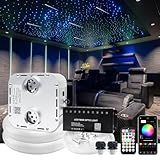
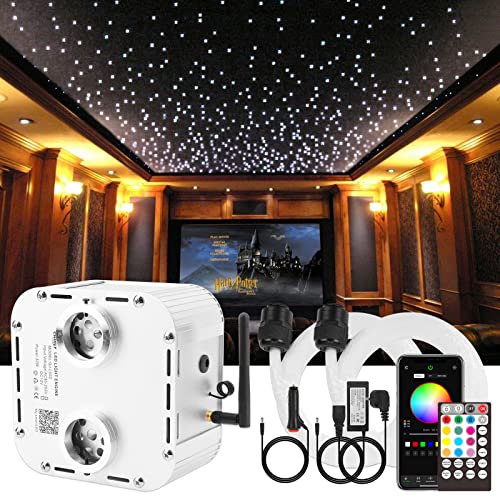 CHINLY 32W Twinkle 1600pcs 13.1ft 0.03in Fiber Optic1600pcs*0.03in*13.1ft5.9 x 3.1 x 5.9 InchesCheck on Amazon
 AMKI Dual Color 32W Twinkle 2300pcs 0.03in 16.4ftMeteor+2300pcs*0.03in*16.4ft5.9 x 3.5 x 5.9 inchesCheck on Amazon
Best Fiber Optic Star Ceiling Kits for Home Theaters
The best fiber optic star ceiling kits for home theaters are usually the ones with 400–800 fiber strands, a remote-controlled RGBW light source, enough fiber to cover your actual ceiling area, and a separate driver that can be installed where its fan noise will not reach the seats.
There is no single best kit for every theater. A small 10-by-12-foot room may look convincing with 300–500 stars, while a 20-by-25-foot room can require 1,000–1,500 points for comparable density. The important specifications are fiber count, fiber length, strand diameter, light-source control, ceiling coverage, and how much access you have above the ceiling.
As an Amazon Associate we earn from qualifying purchases at no extra cost to you.

Quick comparison of the main kit types
| Kit class | Typical fiber count | Typical coverage | Light-source features | Best room fit | Installation difficulty |
|---|---|---|---|---|---|
| Compact 3-point kit | 100–300 | Up to 120 sq. ft. | Basic white or RGB effects, remote control | Small media rooms, alcoves | Low to moderate |
| Mid-size RGBW kit | 400–800 | 120–250 sq. ft. | RGBW color mixing, twinkle, dimming, timer | Most dedicated home theaters | Moderate |
| Large multi-port kit | 800–1,500 | 250–500 sq. ft. | Multiple channels, remote or app control, brighter output | Large theaters and game rooms | Moderate to high |
| Custom commercial-style system | 1,500 or more | 500 sq. ft. and above | Programmable scenes, DMX or network control | Luxury theaters and multipurpose rooms | High |
What to choose for your ceiling size
Fiber count matters more than the advertised maximum area. A manufacturer may describe a kit as suitable for 300 square feet, but the result can look sparse if those fibers are spread evenly across the entire ceiling. For a theater, a practical target is about two to four visible stars per square foot.
Use this calculation before buying:
Required fiber count = ceiling area × desired star density.
For example, a 12-by-16-foot theater has 192 square feet of ceiling area. At three stars per square foot:
192 × 3 = 576 fiber ends.
A 600-fiber kit is therefore a sensible minimum. A 300-fiber kit would produce only 1.6 stars per square foot, which may be acceptable for a sparse “night sky” design but will not create a dense planetarium effect. If you want a denser central area, buy a kit with 700–800 fibers and leave some strands unused around speakers, vents, and the projector mount.
Allow for unusable ceiling space
Do not calculate from the room footprint alone. A ceiling-mounted projector, HVAC grille, recessed lights, speakers, soffits, and acoustic panels all consume space. If those features occupy 15 percent of the ceiling, multiply the usable area by 0.85 before choosing the kit—or simply add 10–20 percent to the required fiber count.
For a 192-square-foot room with 15 percent blocked by fixtures, the usable area is approximately 163 square feet. At three stars per square foot, 489 fibers would be enough mathematically, but a 600-fiber kit gives you better spacing flexibility and spare strands for mistakes.
Fiber diameter and visual appearance
Most kits combine several fiber diameters rather than using one size throughout. Thin fibers around 0.5–0.75 mm produce subtle, distant-looking stars. Fibers around 0.75–1 mm create brighter points that remain visible during dark scenes. Larger fibers can resemble small glowing planets, but too many of them can make the ceiling look decorative rather than cinematic.
- Mostly 0.5 mm fibers: best for a fine, realistic star field and low visual distraction.
- Mostly 0.75 mm fibers: a balanced choice for typical home theaters.
- Mixed 0.5, 0.75, and 1 mm fibers: best for varied star sizes and a more natural pattern.
- Large 1 mm or thicker fibers: useful as occasional bright stars, not usually ideal as the entire ceiling.
Fiber length is equally important. Measure the route from the farthest planned star to the light engine, then add slack for bends and service access. For many rooms, a 10–16-foot fiber bundle is adequate. A kit can have enough strands but still be unsuitable if its longest fibers cannot reach the engine without tight bends or extensions.
Light-source features that matter in a theater
RGB versus RGBW
RGB systems mix red, green, and blue LEDs to create colors. They can produce attractive effects, but their “white” often looks tinted. RGBW systems add a dedicated white LED, making neutral white stars and low-brightness scenes easier to achieve. For a home theater, RGBW is usually the better choice because it can provide a restrained white sky rather than forcing you to use blue or purple.
Twinkle control
A good light engine should let you adjust twinkle speed, brightness, and the proportion of fibers that twinkle. A fast, uniform flash across every star looks artificial and can become distracting during a film. Look for independent speed and intensity controls, or use a very slow effect with low brightness. If the controls offer a percentage scale, start around 10–20 percent twinkle intensity and increase gradually.
Dimming and memory
Dimming is more important than maximum brightness. The ceiling should support a nearly invisible setting for movie playback and a brighter setting for cleaning or social use. A memory function is useful if the engine returns to the same color and brightness after power is restored.
Noise, heat, and placement
Some light engines contain a cooling fan. Do not install a fan-cooled unit directly above the seating position unless the ceiling is heavily isolated. A better location is outside the theater, inside an adjacent equipment cabinet, or near the rear of the room with vibration isolation. Leave ventilation space around the engine and make sure the fiber bundle can be removed later for service.
Decision matrix: which kit fits your project?
| Your situation | Recommended specification | Why |
|---|---|---|
| 10-by-12-foot room, simple star field | 300–500 fibers, mixed diameters, RGBW | Enough density without excessive installation work |
| 12-by-16-foot dedicated theater | 500–700 fibers, 0.5–1 mm mix, dimmable RGBW | Good coverage with varied star sizes |
| 20-by-25-foot room | 1,000–1,500 fibers or multiple engines | A single small bundle will look sparse and may have uneven brightness |
| Finished drywall ceiling with no access above | Preplanned panel system or removable acoustic panels | Reduces repair damage and makes fiber routing possible |
| Drop ceiling or removable acoustic tiles | 400–800 fiber kit with modular light engine | Much easier to drill, route, and service |
| Smart-home controlled theater | Engine with app, dry-contact, DMX, or network compatibility | Allows movie, gaming, and cleaning scenes to be automated |
Installation demands and the least painful method
Fiber optic star ceilings are easier to install before the ceiling finish is permanently closed. If your theater uses fabric-wrapped acoustic panels, install the fibers through the panels rather than drilling a finished drywall ceiling. This also allows the panels to be removed if a fiber breaks or the light engine needs replacement.
- Draw the ceiling plan. Mark speakers, lights, HVAC, projector mounts, access panels, and the intended light-engine location.
- Create an irregular star pattern. Avoid a grid. Cluster some areas lightly and leave larger gaps elsewhere, while keeping enough spacing around fixtures.
- Drill or pierce the panel surface. Use the fiber manufacturer’s recommended hole size. A hole that is too large can allow the fiber to move or fall back through the panel.
- Route each strand with a broad curve. Do not kink fibers. Keep bends above the minimum bend radius specified by the kit; if no value is given, avoid tight bends and aim for curves of at least several inches.
- Leave service loops. Keep 12–24 inches of extra fiber near the light engine so the bundle can be disconnected and repositioned.
- Secure the rear of each fiber. Use compatible adhesive or retaining clips, not excessive heat. Some adhesives can cloud or damage the fiber jacket.
- Trim the visible ends last. Cut fibers flush only after the panel is installed and the light engine is operating. Poorly trimmed ends can look dim or uneven.
Plan on more time for a finished drywall ceiling than for removable panels. A 500-fiber installation may involve hundreds of individual routing decisions, and the optical work is only part of the job. Electrical work for the light engine should follow local code; use a properly rated outlet or have an electrician install one if needed.
How bright should the stars be?
Start with the room completely dark and set the projector to its normal movie mode. Adjust the star engine until the fibers are visible when you look up but do not pull attention away from the screen. If the stars are obvious during dialogue or bright scenes, lower the brightness. A ceiling that looks impressive at full output can become tiring over a two-hour film.
For a theater that also hosts gaming, create at least three scenes:
- Movie: neutral white or very pale blue, 10–25 percent brightness, slow or minimal twinkle.
- Gaming: moderate blue, purple, or RGB color, 25–45 percent brightness, restrained motion.
- Room use: brighter neutral white, 50–100 percent brightness, twinkle disabled.
Common buying mistakes
- Choosing by room-size claim alone: compare fibers per square foot instead.
- Ignoring fiber length: the farthest stars may not reach the engine.
- Buying RGB when neutral white is important: RGBW usually gives a more natural theater setting.
- Installing the engine above the main seats: fan noise can be noticeable during quiet scenes.
- Using a perfectly even grid: random spacing looks more like a real sky.
- Leaving no access route: a removable panel or service opening can prevent major ceiling repairs later.
Frequently asked questions
Can a fiber optic star ceiling be installed over an existing finished drywall ceiling?
It can be installed, but it is more difficult than installing fibers before the ceiling is permanently closed. A finished drywall ceiling offers less access for routing and may suffer repair damage. A preplanned panel system or removable acoustic panels can make installation and future servicing easier, especially when the light engine or individual fibers may need attention.
Should the stars be arranged in a regular grid?
No, an irregular pattern usually looks more natural and cinematic. Avoid a grid by clustering some areas lightly and leaving larger gaps elsewhere. Before drilling, mark speakers, lights, HVAC, the projector mount, access panels, and the light-engine location. This helps keep stars away from fixtures while preserving enough spacing for a convincing night-sky effect.
What should be done with extra fiber strands?
Leave some strands unused when the ceiling includes speakers, vents, a projector mount, recessed lights, soffits, or acoustic panels. Extra strands also provide flexibility for spacing and allow for installation mistakes. A kit with more fibers than the mathematical minimum can be useful because the entire room footprint is not always available for visible stars.
How can the light engine remain accessible after installation?
Place the light engine outside the theater, in an adjacent equipment cabinet, or near the rear of the room with vibration isolation. Leave ventilation space around it and keep the fiber bundle removable for service. Also leave service loops near the engine so the bundle can be disconnected or repositioned without putting stress on the fibers.
Can the stars remain visible without distracting from a movie?
Yes. Use a dim setting and keep twinkle intensity low rather than choosing maximum brightness. A good light engine should allow brightness and twinkle adjustments, including control over twinkle speed and the proportion of fibers that twinkle. Start around 10–20 percent twinkle intensity and increase gradually if the effect remains comfortable during movie playback.
Bottom line
For most dedicated home theaters, the best fiber optic star ceiling kits for home theaters are mid-size RGBW systems with roughly 500–800 fibers, mixed fiber diameters, dimming, adjustable twinkle, and fiber bundles long enough to reach a remotely placed light engine. Choose 300–500 fibers for a small room, move toward 1,000 or more for a large ceiling, and prioritize installation access over flashy lighting modes. Correct density, quiet placement, and low movie-mode brightness will affect the final result more than the maximum color count advertised on the box.