“Solid state hard drive” is the phrase many shoppers still use, but everything in this guide is a true SSD with no spinning platters. The real decision is which kind of solid state drive fits your machine: a fast M.2 NVMe stick that loads games in seconds, or a 2.5-inch SATA drive that drops into an older desktop or laptop bay. Picking the wrong interface is the most common and most expensive mistake, because an M.2 drive cannot fit a SATA-only board and a SATA drive leaves most of a modern slot’s speed unused.

This guide is for gaming PC builders choosing a main system drive, players expanding a VR library that has outgrown its current storage, and owners of older PCs who want a solid state upgrade without replacing the motherboard. The five picks below come from the names and specifications on their Amazon product pages, and they split into two camps: three M.2 NVMe drives led by the Samsung 990 PRO and WD_BLACK SN850X, and two 2.5-inch SATA drives, the Samsung 870 EVO and Crucial MX500, for machines without an M.2 slot.
Our Top Picks
Quick Picks
As an Amazon Associate we earn from qualifying purchases.
| Product | Best for | Key spec from title |
|---|---|---|
| Samsung 990 PRO 2TB | Fastest all-round gaming drive | PCIe 4.0 NVMe, read speeds up to 7,450 MB/s |
| WD_BLACK SN850X 2TB | Gaming PCs and PS5 expansion | PCIe 4.0 NVMe, read speeds up to 7,300 MB/s |
| Crucial P3 Plus 1TB | Gen4 speed on a tighter budget | PCIe 4.0 NVMe, read speeds up to 5,000 MB/s |
| Samsung 870 EVO 1TB | SATA bays and older laptops | SATA III 2.5-inch, read speeds up to 560 MB/s |
| Crucial MX500 1TB | Value SATA upgrade | SATA III 2.5-inch, read speeds up to 560 MB/s |
How to Choose
Interface and form factor come first
Every solid state drive in this guide connects one of two ways. M.2 NVMe drives plug into a small slot on the motherboard and talk over PCIe lanes, which is how the fastest models here reach several thousand megabytes per second. SATA drives use the older cable-and-bay layout and top out near the interface limit of roughly 560 MB/s. Check your motherboard or laptop manual before ordering: an M.2 slot may support NVMe, SATA, or both, and a 2.5-inch bay needs SATA power and data cables. Matching the drive to the slot you actually have matters more than any speed figure printed on the box.
Capacity for a growing game library
Modern games routinely install at sizes that fill a small drive after only a handful of titles, and VR libraries add up the same way. A 1TB drive is the practical floor for a main gaming drive, and 2TB is the comfortable size for players who keep several large games installed at once. Bigger capacities in the same model line usually carry higher endurance ratings too, since the terabytes-written figure scales with capacity. Buy for the library you expect to have in two years, not the one you have today, because moving a boot drive later means cloning or reinstalling everything.
Sequential speed, random speed and endurance
Headline read and write figures describe large sequential transfers, which is why PCIe 4.0 NVMe drives post numbers more than ten times higher than SATA models. Everyday snappiness also depends on random read and write performance, listed in IOPS, and on whether the drive has a DRAM cache to keep track of where data sits. Endurance, listed as TBW or terabytes written, tells you how much writing the warranty covers over the drive’s life. A high TBW matters for drives that record gameplay, cache video projects or host frequently patched games, while a light-use games drive can live comfortably with a lower rating.
DRAM, NAND type and heatsinks
TLC NAND stores three bits per cell and generally sustains writes better than QLC, which trades endurance for capacity at a lower cost. DRAM-equipped drives such as the 990 PRO and SN850X keep a map of stored data on the drive itself, while DRAM-less designs like the P3 Plus borrow a small slice of system memory through host memory buffer instead. Neither approach is automatically better for gaming loads. Heatsinks matter mainly in consoles and cramped laptops: the bare M.2 models here rely on a motherboard heatsink or open airflow, and the PS5 requires a heatsink fitted before an internal drive goes in.
The 5 Best Options
Samsung 990 PRO 2TB
Samsung’s 990 PRO is the flagship pick for a main gaming drive, pairing a PCIe 4.0 interface with the highest rated speeds in this guide. Its listing rates sequential reads at up to 7,450 MB/s, close to the practical ceiling of a PCIe 4.0 x4 link, and the 2TB model carries a dedicated 2GB LPDDR4 DRAM cache and a 1,200 TBW endurance rating. That combination suits a boot drive that also holds a large, frequently updated game library. This is the bare-drive version with no factory heatsink, so plan on a motherboard heatsink or the separate heatsink model for console use.
Specs
- Capacity: 2TB
- Interface: PCIe 4.0 x4, NVMe
- Form factor: M.2 2280
- Sequential read: up to 7,450 MB/s
- Sequential write: up to 6,900 MB/s
- NAND: Samsung V-NAND TLC
- Cache: 2GB LPDDR4 DRAM
- Endurance: 1,200 TBW
- Model: MZ-V9P2T0B/AM
- Warranty: 5-year limited
Best for: A primary gaming and system drive where top PCIe 4.0 speed and high endurance both matter.
Watch out for: This ASIN is the version without a heatsink, and a PCIe 3.0 slot will cap its speeds well below the rated figures.
ASIN: B0BHJJ9Y77
WD_BLACK SN850X 2TB
The SN850X is Western Digital’s gaming-focused flagship, rated at up to 7,300 MB/s reads on a PCIe 4.0 connection and built around TLC NAND with a DRAM cache. Its listing highlights Game Mode 2.0 in the WD_BLACK Dashboard software, and the 2TB capacity carries a 1,200 TBW endurance rating that matches the 990 PRO. For PC builders it is a direct alternative to the Samsung with a long track record in gaming rigs, and the same model line is widely used for PS5 expansion in its heatsink version. This ASIN is the standard drive without the factory heatsink fitted.
Specs
- Capacity: 2TB
- Interface: PCIe 4.0 x4, NVMe
- Form factor: M.2 2280
- Sequential read: up to 7,300 MB/s
- Sequential write: up to 6,300 MB/s as listed
- NAND: TLC
- Cache: DRAM cache
- Endurance: 1,200 TBW
- Model: WDS200T2X0E
- Warranty: 5-year limited
Best for: Gaming PCs that want flagship Gen4 speed and a gaming-tuned drive dashboard.
Watch out for: This version ships without a heatsink, so use a motherboard M.2 heatsink, especially under sustained write loads.
ASIN: B0B7CMZ3QH
Crucial P3 Plus 1TB
The P3 Plus brings PCIe 4.0 speeds to a much lower tier of the market. Its listing rates sequential reads at up to 5,000 MB/s, which is far beyond any SATA drive even though it sits below the two flagships here. To reach its positioning, Crucial uses QLC NAND and a DRAM-less design that relies on host memory buffer support, and the 1TB model carries a 220 TBW endurance rating. That trade suits a games drive or a second storage drive in a midrange build, where reads dominate and long sustained writes are rare. It also works in PCIe 3.0 slots at reduced speed.
Specs
- Capacity: 1TB
- Interface: PCIe 4.0 x4, NVMe
- Form factor: M.2 2280
- Sequential read: up to 5,000 MB/s
- Sequential write: up to 4,200 MB/s
- NAND: Micron 3D QLC
- Cache: DRAM-less, host memory buffer
- Endurance: 220 TBW
- Model: CT1000P3PSSD8
- Warranty: 5-year limited
Best for: A budget Gen4 games drive or secondary drive in a desktop or laptop with an M.2 slot.
Watch out for: QLC NAND slows down on very long continuous writes, and the 220 TBW rating is well below the TLC flagships in this guide.
ASIN: B0B25NXWC7
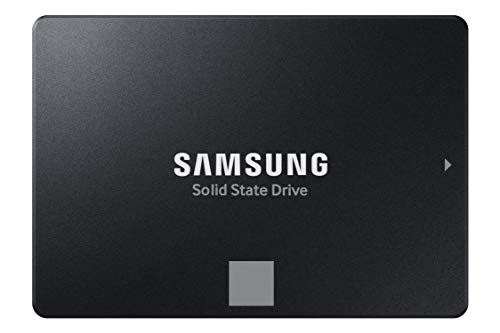
Samsung 870 EVO 1TB
The 870 EVO is the pick when the machine has no M.2 slot. It uses the standard 2.5-inch SATA form factor that fits older desktops, many laptops and external enclosures, and its listing rates reads at up to 560 MB/s, essentially the ceiling of the SATA III interface. Samsung pairs V-NAND TLC with a 600 TBW endurance rating on the 1TB model, which is strong for the SATA class and double the rating of the MX500 below. As a boot-drive replacement for a spinning hard drive, it transforms startup and loading behaviour on hardware that cannot accept an NVMe stick at all.
Specs
- Capacity: 1TB
- Interface: SATA III 6 Gb/s
- Form factor: 2.5-inch, 7mm
- Sequential read: up to 560 MB/s
- Sequential write: up to 530 MB/s
- NAND: Samsung V-NAND TLC
- Endurance: 600 TBW
- Model: MZ-77E1T0B/AM
- Warranty: 5-year limited
Best for: Upgrading an older PC or laptop with only a 2.5-inch SATA bay.
Watch out for: SATA caps speeds near 560 MB/s no matter the drive, and a similar world-region variant exists under a different model suffix, so check the listing matches MZ-77E1T0B/AM.
ASIN: B08QBJ2YMG
Crucial MX500 1TB
The MX500 has been a default SATA recommendation for years because it includes the features budget SATA drives often drop: a DRAM cache, TLC-class 3D NAND and a five-year warranty. The 1TB listing rates sequential reads at up to 560 MB/s and writes at up to 510 MB/s, with random performance up to 95,000 IOPS read and 90,000 IOPS write, so it behaves much like the 870 EVO in everyday use. Its endurance rating of 360 TBW is lower than the Samsung’s, which is the main spec-sheet gap between the two. It fits any 2.5-inch bay and includes a spacer for taller laptop bays.
Specs
- Capacity: 1TB
- Interface: SATA III 6 Gb/s
- Form factor: 2.5-inch, 7mm
- Sequential read: up to 560 MB/s
- Sequential write: up to 510 MB/s
- Random read/write: up to 95,000 / 90,000 IOPS
- NAND: Micron 3D NAND
- Endurance: 360 TBW
- Model: CT1000MX500SSD1Z
- Warranty: 5-year limited
Best for: A value SATA upgrade for an older gaming PC, laptop or console hard drive replacement.
Watch out for: Micron has wound down the Crucial consumer brand, so current stock is remaining inventory; buy from a reputable seller and keep the receipt for warranty support.
ASIN: B077SF8KMG
Which One Fits Your Situation
You are building a new gaming PC
Start with an NVMe drive, because every current motherboard offers at least one M.2 slot. The Samsung 990 PRO 2TB gives the strongest all-round spec sheet for a combined system and games drive, while the WD_BLACK SN850X 2TB matches it closely with a gaming focus. Either leaves a second M.2 slot free for a cheaper capacity drive later, which is an easier upgrade path than replacing the boot drive.
Your PC or laptop only has a SATA bay
Skip the M.2 models entirely and choose between the two 2.5-inch drives. The Samsung 870 EVO 1TB carries the higher endurance rating and slightly faster rated writes, while the Crucial MX500 1TB counters with a DRAM cache and a long track record as a value upgrade. Both are dramatic improvements over a spinning hard drive for boot times, game loading and general responsiveness on older hardware.
You want a second drive just for games and VR
A dedicated library drive can be a step down in endurance without hurting the experience, because games are mostly read once installed. The Crucial P3 Plus 1TB fits that role in a spare M.2 slot, and its Gen4 speeds keep installs and updates quick. If your library is large, the 2TB SN850X is the better single purchase, since moving hundreds of gigabytes between drives later is slow, tedious work.
You are expanding a PS5 as well as a PC
Only the NVMe picks apply, and the console adds two conditions: the drive must be a fast PCIe 4.0 model and it needs a heatsink fitted inside the expansion bay. Both the 990 PRO and SN850X lines meet the speed requirement, but the ASINs in this guide are the bare PC versions. For console use, choose the heatsink variant of the same model or add a compatible low-profile heatsink before installation.
Common Mistakes
- Buying an M.2 drive for a motherboard whose slot only supports SATA M.2 drives, or the reverse, without checking the manual.
- Judging drives only by sequential read speed and ignoring endurance ratings, NAND type and DRAM cache.
- Ordering the bare version of a drive for a PS5, which requires a heatsink inside the expansion bay.
- Cloning an old drive and forgetting to change the boot order, leaving the PC starting from the old disk.
- Filling an SSD almost completely, which leaves the drive no room for wear levelling and slows sustained writes.
Frequently Asked Questions
Is a solid state hard drive the same as an SSD?
Yes. “Solid state hard drive” is an older shopping term for an SSD, a drive that stores data on flash memory chips with no moving parts. It is not a hybrid drive and it is not a mechanical hard drive. Every product in this guide is a true solid state drive, in either M.2 NVMe or 2.5-inch SATA form.
Will an NVMe SSD make my games run at higher frame rates?
No. A faster SSD shortens loading screens, speeds up game installs and updates, and can reduce texture streaming hitches in games built to stream assets from storage. Frame rates are set by the graphics card and processor. Where an SSD does change the feel of a gaming PC is in how quickly you get into a game and how responsive the system stays while games patch in the background.
Can I use one of these drives in a laptop?
The M.2 2280 models fit laptops with a matching NVMe M.2 slot, and the two SATA models fit laptops with a 2.5-inch bay. Check the laptop’s service manual for the slot type and any thickness limits before ordering, and note that some thin laptops are sealed designs with soldered storage that cannot be upgraded at all. Back up your data before any swap.
How long does an SSD last compared with a hard drive?
SSD lifespan is measured in terabytes written rather than years. The drives here range from 220 TBW for the P3 Plus 1TB to 1,200 TBW for the 2TB flagships, and all carry five-year warranties. A typical gaming PC writes far less than those limits in normal use, so most drives are replaced for capacity reasons long before the endurance rating runs out.
Related guides
More from Amazon
Programs that pair well with the guide above. Offers and eligibility are set by Amazon and may change.
Free shipping on eligible items, Prime Video and more. Eligible new members can start with a free trial.
Start a Prime free trialAd-free music streaming. Eligible new subscribers can start with a free trial.
Try Music Unlimited freeA Prime membership for ages 18-24 with a trial period. Eligibility is set by Amazon.
See Prime for Young AdultsAudiobooks and podcasts to listen to on the go. Eligible new members can start with a free trial.
Try Audible freeAs an Amazon Associate we earn from qualifying purchases.