Our Short List of 3

- Best for: Buyers who want the strongest listed configuration in the guide and have a permanent desk for it.
- Processor: Intel Core i9-14900HX (24 cores)
- Graphics: NVIDIA GeForce RTX 4090 Laptop GPU, up to 175W
- Memory: 32GB DDR5-5600
- Storage: 2TB PCIe NVMe SSD

- Best for: Players who travel with their laptop and still want the RTX 4090 tier.
- Processor: Intel Core i9-14900HX (24 cores, up to 5.8 GHz)
- Graphics: NVIDIA GeForce RTX 4090 Laptop GPU
- Memory: 32GB DDR5
- Storage: 2TB SSD

- Best for: Buyers who want full-power RTX 4080 performance in a standard 16-inch chassis.
- Processor: Intel Core i9-14900HX (24 cores, up to 5.8 GHz)
- Graphics: NVIDIA GeForce RTX 4080 Laptop GPU, 12GB GDDR6, up to 175W
- Memory: 32GB DDR5-5600
- Storage: 2TB NVMe SSD (1TB + 1TB)
All 5 Picks at a Glance
| Product | Specs | Action |
|---|---|---|
| ASUS ROG Strix Scar 18 |
| Check price on Amazon |
| Razer Blade 16 |
| Check price on Amazon |
| Lenovo Legion Pro 7i Gen 9 |
| Check price on Amazon |
 Alienware m18 R2 |
| Check price on Amazon |
 MSI Katana 15 HX |
| Check price on Amazon |
Choosing an i9 gaming laptop is really a decision about how much processor you are willing to carry. Every machine in this guide pairs an Intel Core i9-14900HX with a high-power NVIDIA graphics card, so the real differences sit in screen size, GPU tier, cooling design and how much the chassis asks of your desk and your bag. The processor is rarely the bottleneck in games, which makes the supporting hardware the thing you are actually shopping for.
The five picks below suit different buyers. Desktop-replacement players get two 18-inch RTX 4090 and RTX 4080 machines, competitive players who travel get a 16-inch OLED option, value-focused buyers get a full-power RTX 4080 in a 16-inch chassis, and anyone priced out of the flagship tier gets an i9-14900HX paired with an RTX 5070. Every configuration named here is the exact configuration its Amazon listing sells, checked against a second source.
Our Top Picks
Top 3 picks at a glance
Quick Picks
As an Amazon Associate we earn from qualifying purchases.
| Product | Best for | Key spec from title |
|---|---|---|
| ASUS ROG Strix Scar 18 | Maximum performance on a desk | i9-14900HX, RTX 4090, 18-inch 240Hz |
| Razer Blade 16 | Flagship power you can carry | i9-14900HX, RTX 4090, 16-inch OLED 240Hz |
| Lenovo Legion Pro 7i Gen 9 | Full-power RTX 4080 balance | i9-14900HX, RTX 4080 175W, 16-inch 240Hz |
| Alienware m18 R2 | Big screen with RTX 4080 | i9-14900HX, RTX 4080, 18-inch 165Hz |
| MSI Katana 15 HX | Entry point to the i9 tier | i9-14900HX, RTX 5070, 15.6-inch 165Hz |
How to Choose
Start with the graphics card, not the processor
Every laptop in this guide uses the same Core i9-14900HX, which is the point: once the processor is fixed, the graphics card decides your frame rates. An RTX 4090 or 4080 holds high settings at QHD+ resolutions and feeds a 240Hz panel properly, while the RTX 5070 in the Katana targets smooth 1440p play at lower settings. Check the GPU’s listed power rating as well as its name. A full-power 175W RTX 4080, like the one in the Legion Pro 7i, is a different proposition from a low-power version of the same chip in a thinner laptop, and listings do not always make the wattage obvious.
Cooling decides how much performance you keep
An i9-14900HX only holds its boost clocks if the chassis can move the heat, and gaming laptops vary far more here than spec sheets suggest. Thick 18-inch bodies with dual fans and wide exhausts, like the Scar 18 and m18 R2, are built for long sessions at full power. Slim designs such as the Blade 16 rely on vapor chambers and run closer to their thermal limits, which usually means more fan noise for the same workload. If you play with the laptop on a desk for hours, favour the bigger cooling systems; if you carry the machine daily, accept the trade and favour the slim chassis.
Match the display to your games
All five picks use QHD+ panels, so the choice is about size, panel type and refresh rate. Competitive players should look at the 240Hz screens in the Scar 18, Blade 16 and Legion Pro 7i, and at response times: the Blade’s OLED answers in 0.2ms. Players who favour large, detailed worlds may prefer an 18-inch screen even at 165Hz, as in the m18 R2. OLED brings perfect blacks and fast response but needs care with static interface elements left on screen for long sessions, while the IPS panels here are brighter and less demanding to live with.
Memory, storage and what you can upgrade
Every configuration here ships with 32GB of DDR5 memory, which is the right amount for gaming alongside streaming or editing software, so memory should not drive your choice. Storage differs more: the Scar 18, Blade 16 and Legion Pro 7i carry 2TB, while the m18 R2 and Katana 15 HX carry 1TB, and modern game installs make that gap real within a year. Check whether the listing describes SO-DIMM memory slots and a spare M.2 bay if you plan to upgrade later, because soldered memory and a single filled drive bay close off the cheapest path to more capacity.
The 5 Best Options
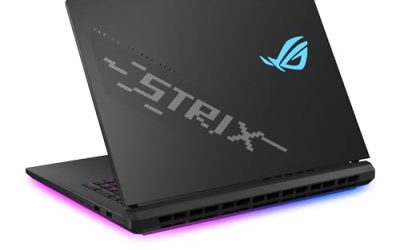
ASUS ROG Strix Scar 18
- Best for: Buyers who want the strongest listed configuration in the guide and have a permanent desk for it.
- Processor: Intel Core i9-14900HX (24 cores)
- Graphics: NVIDIA GeForce RTX 4090 Laptop GPU, up to 175W
- Memory: 32GB DDR5-5600
- Storage: 2TB PCIe NVMe SSD
Buyers who want the strongest listed configuration in the guide and have a permanent desk for it.
The chassis is large and heavy, and this 2024 configuration is sold through a shrinking pool of listings, so confirm the exact G834JYR-XS97 model name before ordering.
The Scar 18 is the maximum-hardware option in this guide. Its Core i9-14900HX drives an RTX 4090 Laptop GPU running at up to 175W, and the 18-inch Nebula HDR Mini-LED panel pairs a QHD+ resolution with a 240Hz refresh rate, so the big screen does not waste the graphics card behind it. ASUS cools the pairing with liquid metal on the CPU and GPU and a full-width rear exhaust design. The trade-offs are size and weight: at roughly 6.8 pounds before the power brick, this is a machine that lives on a desk and travels between rooms, not between cities.
Watch out for: The chassis is large and heavy, and this 2024 configuration is sold through a shrinking pool of listings, so confirm the exact G834JYR-XS97 model name before ordering.
Razer Blade 16
- Best for: Players who travel with their laptop and still want the RTX 4090 tier.
- Processor: Intel Core i9-14900HX (24 cores, up to 5.8 GHz)
- Graphics: NVIDIA GeForce RTX 4090 Laptop GPU
- Memory: 32GB DDR5
- Storage: 2TB SSD
Players who travel with their laptop and still want the RTX 4090 tier.
Slim flagship laptops run warm and loud under full load, and the battery is sized for short unplugged sessions rather than a workday.
The Blade 16 is the portability pick that gives up nothing on the spec sheet. It matches the Scar’s i9-14900HX and RTX 4090 pairing but wraps them in a slim CNC-milled aluminium chassis, and swaps the big Mini-LED for a 16-inch OLED panel with a 240Hz refresh rate and a 0.2ms response time. That makes it the natural choice for players who carry their laptop daily and still want flagship frame rates at native resolution. Razer lists a vapor chamber cooling system for the slim body, and the per-key Chroma RGB keyboard and Snap Tap feature come from the listing as well.
Watch out for: Slim flagship laptops run warm and loud under full load, and the battery is sized for short unplugged sessions rather than a workday.
Lenovo Legion Pro 7i Gen 9
- Best for: Buyers who want full-power RTX 4080 performance in a standard 16-inch chassis.
- Processor: Intel Core i9-14900HX (24 cores, up to 5.8 GHz)
- Graphics: NVIDIA GeForce RTX 4080 Laptop GPU, 12GB GDDR6, up to 175W
- Memory: 32GB DDR5-5600
- Storage: 2TB NVMe SSD (1TB + 1TB)
Buyers who want full-power RTX 4080 performance in a standard 16-inch chassis.
This is a 2024 model, so listings and configurations change hands between sellers; check that the listing names the RTX 4080 and 2TB storage before ordering.
The Legion Pro 7i is the balanced flagship of the group. The i9-14900HX is paired with an RTX 4080 Laptop GPU that Lenovo rates at up to 175W, the full power class for that chip, and storage is split across two 1TB NVMe drives for 2TB in total. Its 16-inch QHD+ IPS panel runs at 240Hz with G-SYNC and a 500-nit rating, which suits fast games without giving up brightness for daytime rooms. Of the five picks here, this is the one that reads as a straightforward recommendation: top-tier parts, a mainstream size, and no single spec that lags the group.
Watch out for: This is a 2024 model, so listings and configurations change hands between sellers; check that the listing names the RTX 4080 and 2TB storage before ordering.
Alienware m18 R2
- Best for: Players who want the 18-inch screen size with an RTX 4080 rather than the flagship 4090.
- Processor: Intel Core i9-14900HX
- Graphics: NVIDIA GeForce RTX 4080, 12GB GDDR6
- Memory: 32GB DDR5
- Storage: 1TB SSD
Players who want the 18-inch screen size with an RTX 4080 rather than the flagship 4090.
The 165Hz panel is a step down for esports-focused buyers, and the 1TB drive is the smallest storage allocation in this guide.
The m18 R2 gives the 18-inch class a second option, built around the same i9-14900HX and an RTX 4080 with 12GB of GDDR6. Its 18-inch QHD+ panel runs at 165Hz rather than the 240Hz of the Scar 18, which matters mostly to competitive players chasing the highest refresh rates; for story-driven and simulation titles the larger screen and lower panel speed make little practical difference. Storage is a single 1TB SSD where the Scar carries 2TB, so heavy game libraries will fill it sooner. Dell sells this configuration in the Dark Metallic Moon finish with Windows 11 Home.
Watch out for: The 165Hz panel is a step down for esports-focused buyers, and the 1TB drive is the smallest storage allocation in this guide.
MSI Katana 15 HX
- Best for: Buyers who want the i9-14900HX and current RTX 50-series graphics in the most portable chassis here.
- Processor: Intel Core i9-14900HX (24 cores, up to 5.8 GHz)
- Graphics: NVIDIA GeForce RTX 5070, 8GB GDDR7
- Memory: 32GB DDR5
- Storage: 1TB NVMe SSD
Buyers who want the i9-14900HX and current RTX 50-series graphics in the most portable chassis here.
The RTX 5070 has less VRAM and less headroom than the 4080 and 4090 picks, so it suits 1440p play better than maxed-out 4K settings.
The Katana 15 HX is the entry point to the i9 tier in this guide, and it keeps the important part: the same Core i9-14900HX with 24 cores that the flagship picks use. The savings come from the graphics card, an RTX 5070 with 8GB of GDDR7, and from the smaller 15.6-inch chassis. The screen still runs at QHD+ resolution and 165Hz, and the configuration includes 32GB of DDR5 memory and a 1TB NVMe SSD, so nothing outside the GPU feels cut down. For 1080p and 1440p play this is the sensible way to buy an i9 laptop.
Watch out for: The RTX 5070 has less VRAM and less headroom than the 4080 and 4090 picks, so it suits 1440p play better than maxed-out 4K settings.
Which One Fits Your Situation
Your laptop lives on one desk and never travels
Take the Scar 18. The 18-inch Mini-LED screen, RTX 4090 at full power and 2TB of storage make it the closest thing here to a desktop, and its weight stops mattering when it never leaves the room. The m18 R2 is the alternative if you prefer the same screen size with an RTX 4080 and can live with 1TB of storage and a 165Hz panel.
You carry your gaming laptop every day
Take the Blade 16. It is the only pick that pairs the RTX 4090 with a chassis designed to be carried, and the OLED screen keeps it competitive at home as well. Budget for a sleeve and expect the fans to be audible in quiet rooms when you play at full settings.
You play competitive titles at high refresh rates
Look at the Legion Pro 7i or the Scar 18. Both pair a 240Hz QHD+ panel with a full-power graphics card, so the screen is not the limiting factor in fast games. The Legion’s 16-inch size suits smaller desks and LAN setups, while the Scar’s 18-inch panel gives a bigger picture for the same refresh rate.
You want the i9 tier at the lowest entry point
Take the Katana 15 HX. It keeps the i9-14900HX, 32GB of memory and a QHD+ 165Hz screen, and puts the savings into the graphics card instead. It is the right shape of compromise if your games run at 1080p or 1440p and you would rather spend the difference on a monitor, headset or extra storage later.
Common Mistakes
- Buying the i9 badge and ignoring the graphics card: the processor is identical across this guide, so a weak GPU pairing wastes the chip.
- Comparing GPU names without power ratings: a low-wattage RTX 4080 can trail a full-power card from the tier below.
- Assuming every configuration under one model name matches: sellers list the same laptop family with different memory, storage and screens, so check the exact listing.
- Forgetting the power brick: flagship i9 laptops ship with large adapters that add real weight to a bag.
- Filling a 1TB drive in the first month: check storage against your current library size before choosing a 1TB configuration.
Frequently Asked Questions
Is a Core i9 necessary for gaming, or is it overspending?
For gaming alone, a modern Core i7 or Ryzen 7 with the same graphics card usually reaches similar frame rates, because games lean on the GPU first. The i9 earns its place when the laptop also handles streaming, video editing, compiling or heavy multitasking, and it holds value longer as games use more threads. Buy it for the whole workload, not for gaming bragging rights.
What is the difference between the i9-14900HX and Core Ultra 9 chips?
The i9-14900HX is a Raptor Lake chip with 24 cores designed for maximum sustained power in thick gaming chassis. Core Ultra 9 processors are newer designs that trade some of that all-out approach for efficiency and AI features, and they appear in thinner laptops. Neither is automatically faster in games; the graphics card and its power rating matter more in most titles.
How much RAM and storage should an i9 gaming laptop have?
Thirty-two gigabytes of DDR5 is the comfortable point for gaming alongside streaming or editing tools, and every pick in this guide ships with it. For storage, 2TB suits large libraries without constant uninstalling, while 1TB works if you rotate a handful of games. Prefer models with a spare M.2 slot if you expect to grow into the machine.
Do these laptops work well for VR headsets?
The RTX 4080 and 4090 configurations have the graphics headroom current PC VR headsets ask for, and the i9-14900HX is well beyond headset minimum processor requirements. Check the ports on the exact listing before buying, because tethered headsets need the right video output, and confirm the headset maker’s own requirements for the model you own. Wireless headsets lean on your router more than the laptop.
Related guides
More from Amazon
Programs that pair well with the guide above. Offers and eligibility are set by Amazon and may change.
Free shipping on eligible items, Prime Video and more. Eligible new members can start with a free trial.
Start a Prime free trialAd-free music streaming. Eligible new subscribers can start with a free trial.
Try Music Unlimited freeA Prime membership for ages 18-24 with a trial period. Eligibility is set by Amazon.
See Prime for Young AdultsAudiobooks and podcasts to listen to on the go. Eligible new members can start with a free trial.
Try Audible freeAs an Amazon Associate we earn from qualifying purchases.