Our Short List of 3

- Best for: all-day typists moving from a flat keyboard for the first time
- Layout: full-size curved split frame with number pad
- Connection: Bluetooth and USB receiver
- Wrist rest: integrated pillowed rest with memory foam layer
- Tilt: adjustable feet at 0, -4 and -7 degrees

- Best for: gamers who want a true split with mechanical switches and macros
- Layout: two-piece split, modules separate up to 20 inches
- Switches: hot-swappable linear mechanical switches
- Lighting: per-key RGB backlighting
- Palm support: detachable supports included

- Best for: users who want each half exactly where their shoulders want it
- Layout: two separate halves, up to 9-inch separation on this version
- Connection: wired USB
- Switches: low-force membrane keys
- Layout details: Windows key layout with embedded hotkeys
All 5 Picks at a Glance
| Product | Specs | Action |
|---|---|---|
| Logitech Ergo K860 Wireless Ergonomic Keyboard |
| Check price on Amazon |
| Kinesis Freestyle Edge RGB Plus Split Mechanical Keyboard |
| Check price on Amazon |
| Kinesis Freestyle2 Ergonomic Keyboard for PC |
| Check price on Amazon |
 Logitech Wave Keys Wireless Ergonomic Keyboard |
| Check price on Amazon |
 Perixx Periboard-512B Wired Ergonomic Keyboard |
| Check price on Amazon |
A flat keyboard forces your hands together, bends your wrists outward and rolls your forearms flat, and after a few hours of play or work that posture shows up as aching wrists and tight shoulders. Ergonomic keyboards attack the problem three different ways: a one-piece curved or split frame, a gentle wave layout, or two separate halves you position yourself. The right choice depends on how much change your hands actually need.
This guide serves three kinds of buyers: desk workers whose wrists hurt by mid-afternoon, gamers who want mechanical switches without giving up comfort, and anyone testing a split layout for the first time. Every pick below was chosen from its Amazon listing title and stated specs, and each one changes hand position in a real, structural way rather than adding a soft rest to a flat board.
Our Top Picks
Top 3 picks at a glance
Quick Picks
As an Amazon Associate we earn from qualifying purchases
| Product | Best for | Key spec from title |
|---|---|---|
| Logitech Ergo K860 | Easiest switch from a flat board | Split keyboard with wrist rest, Bluetooth and USB |
| Kinesis Freestyle Edge RGB Plus | Gaming with mechanical switches | Hotswap linear switches, lift kit included |
| Kinesis Freestyle2 | Halves placed at shoulder width | Two-piece split, 9-inch separation |
| Logitech Wave Keys | Small desks and several devices | Cushioned palm rest, Bluetooth and Logi Bolt |
| Perixx Periboard-512B | A first split layout on a budget | Wired USB split with wrist rest |
How to Choose
Split, wave or two separate halves
The three shapes solve different problems. A wave board like the Wave Keys keeps every key in its usual place and only curves the rows, so it suits mild discomfort and anyone who cannot afford a learning curve. A fixed split frame such as the Ergo K860 angles the two key clusters apart inside one shell, opening the chest and straightening the wrists. Two loose halves, like the Freestyle2, go furthest: each hand sits exactly at shoulder width, and the mouse can live between them.
Tenting and tilt keep forearms neutral
Splay alone is only half the fix. When a keyboard lies flat, your forearms rotate palms-down, which twists the two forearm bones over each other for hours. Tenting raises the middle of the board so the hands rest at a more natural angle, closer to a handshake position. Some boards build in fixed tilt feet with negative angles, others add lift kits with several tenting positions, and some ship flat and expect an accessory. Decide before buying which approach you are getting, because adding tenting later costs extra on boards that treat it as an add-on.
Switch feel changes how hard your fingers work
Most mainstream ergonomic boards use membrane or scissor switches, which are quiet and light but can feel mushy at the bottom of the stroke. Mechanical switches give a cleaner actuation point, so your fingers can stop pressing once the key registers instead of mashing through to the desk. Hot-swappable mechanical models let you change switch weight later without replacing the whole board. If you share a room or stream with an open microphone, weigh noise as seriously as feel, because tactile and clicky switches carry across a room.
Connection, numpad and desk footprint
Ergonomic boards are wide, and a full-size frame with an attached number pad pushes your mouse hand far to the right, which can trade wrist strain for shoulder strain. A separate or left-side numpad, or a tenkeyless split, keeps the mouse closer to your body. Connection matters too: wired boards never drop out mid-match and never need charging, while Bluetooth and receiver models clear cable clutter and switch between a PC, laptop and tablet. Measure your desk tray before ordering, since several of these frames are deeper than a standard keyboard.
The 5 Best Options
Logitech Ergo K860 Wireless Ergonomic Keyboard
- Best for: all-day typists moving from a flat keyboard for the first time
- Layout: full-size curved split frame with number pad
- Connection: Bluetooth and USB receiver
- Wrist rest: integrated pillowed rest with memory foam layer
- Tilt: adjustable feet at 0, -4 and -7 degrees
all-day typists moving from a flat keyboard for the first time
the fixed one-piece frame is wide, so measure your desk or keyboard tray before ordering
The Ergo K860 is the gentlest full step into ergonomic typing: the keys sit roughly where your fingers already expect them, but the curved split frame angles each cluster outward and the pillowed rest supports your palms along the whole front edge. It fits office workers and hybrid players who type as much as they game and want one board that fixes posture without a week of mistyped passwords. The full-size layout keeps the number pad, and the tilt feet let you fine-tune wrist angle.
Kinesis Freestyle Edge RGB Plus Split Mechanical Keyboard
- Best for: gamers who want a true split with mechanical switches and macros
- Layout: two-piece split, modules separate up to 20 inches
- Switches: hot-swappable linear mechanical switches
- Lighting: per-key RGB backlighting
- Palm support: detachable supports included
gamers who want a true split with mechanical switches and macros
this listing is the linear-switch version, so confirm the switch type on the page before ordering if you prefer tactile
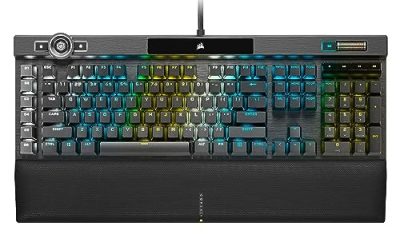
The Edge RGB Plus is the pick for players who refuse to give up mechanical switches to get a split layout. Its two modules separate widely enough to park a microphone, stream deck or controller between them, the included lift kit adds real tenting, and per-key RGB plus full programmability cover the gaming side of the desk. Hot-swappable linear switches keep keystrokes smooth and consistent, and detachable palm supports come in the box instead of selling as an accessory.
Kinesis Freestyle2 Ergonomic Keyboard for PC
- Best for: users who want each half exactly where their shoulders want it
- Layout: two separate halves, up to 9-inch separation on this version
- Connection: wired USB
- Switches: low-force membrane keys
- Layout details: Windows key layout with embedded hotkeys
users who want each half exactly where their shoulders want it
the board ships flat, and tenting requires the VIP3 lift accessory sold separately
The Freestyle2 strips the split idea down to its essentials: two light halves joined by a cable, with nothing forcing them into a fixed angle or distance. Slide them out to shoulder width, angle each one to match your arms, and park your mouse or a notepad in the gap. It suits broad-shouldered users and anyone whose desk setup changes between sitting and standing, because the halves reposition in seconds. The low-force membrane keys stay quiet, and the wired link means no pairing or charging routine.
Logitech Wave Keys Wireless Ergonomic Keyboard
- Best for: small desks and anyone switching between several computers
- Layout: compact wave-shaped keyframe
- Palm rest: integrated cushioned palm rest
- Connection: Bluetooth and Logi Bolt USB receiver
- Switching: Easy-Switch keys pair with up to 3 devices
small desks and anyone switching between several computers
the wave shape is a gentle curve rather than a true split, so it will not give you shoulder-width separation
Wave Keys takes the mildest route: a compact frame with a wavy key deck that nudges hands into a more natural position while leaving every key where a lifetime of typing expects it. It fits small desks, laptop docks and shared workstations where a wide split frame would crowd out everything else. The cushioned palm rest runs the full width, and Easy-Switch pairing moves the board between up to three computers, which makes it a strong second keyboard for a work laptop and gaming PC sitting side by side.
Perixx Periboard-512B Wired Ergonomic Keyboard
- Best for: a first split keyboard for a fixed desk on a tight budget
- Layout: one-piece split design with 3D curved rows, 111 keys
- Connection: wired USB with 6 ft cable
- Switches: membrane, rated up to 20 million keystrokes
- Palm rest: integrated wrist rest
a first split keyboard for a fixed desk on a tight budget
the footprint is larger than the photos suggest, so check your tray depth first
The Periboard-512B is the low-risk experiment: a genuine split layout with an integrated wrist rest at the lowest price in this guide, so you can learn whether split typing helps your wrists before spending real money. The one-piece frame splays the key clusters and curves the rows in three dimensions, and the wired USB connection keeps it lag-free and maintenance-free for a fixed desk. Membrane keys with long travel feel closer to an older office board than to a gaming deck, which many touch typists actually prefer.
Which One Fits Your Situation
You type all day and your wrists ache by lunch
Start with the Logitech Ergo K860. Its curved split changes your wrist angle the most among the one-piece boards here, the memory foam rest supports your palms through long documents, and the familiar key positions mean your typing speed survives the switch. The adjustable negative tilt feet let you flatten or angle the board as your desk height changes.
You game for hours and want mechanical switches
Take the Kinesis Freestyle Edge RGB Plus. It is the only mechanical board in this guide, with hot-swappable switches, per-key RGB and onboard programming, and the two modules spread far enough to fit a microphone or controller between them. The included lift kit and palm supports mean the ergonomic parts are not extra purchases.
You want to test split typing without spending much
The Perixx Periboard-512B gives you a real split layout and wrist rest for the least money here, and its wired connection removes batteries and pairing from the experiment. If a month with it convinces you, the Freestyle2 is the natural upgrade, since its loose halves add the placement freedom the fixed Perixx frame cannot.
Your desk is small or shared between computers
Choose the Logitech Wave Keys. Its compact wave frame takes less room than any split board in this guide, the cushioned rest is built in, and Easy-Switch moves it between a work laptop, a gaming PC and a tablet with one key press. It is also the easiest board here to hand to a partner or housemate without a lesson.
Common Mistakes
- Buying a gentle wave board when your real problem needs full separation, then concluding ergonomic keyboards do not work
- Leaving a split board flat on the desk and typing with bent wrists anyway, instead of setting up the tilt or tenting it supports
- Keeping a wide full-size board and letting the number pad push your mouse far right, which moves the strain into your shoulder
- Judging a split layout after one afternoon, when most typists need one to two weeks before their speed and accuracy recover
- Picking a switch type by habit without checking actuation force, then bottoming out every keystroke with more effort than the switch needs
Frequently Asked Questions
Will an ergonomic keyboard slow me down in games?
For most players, no. The keys still register the same inputs, and split boards like the Freestyle Edge RGB Plus keep standard gaming features such as per-key RGB and macros. Expect an adjustment period for movement keys if your hand position changes, then your usual speed returns once the new angles feel normal.
How long does it take to get used to a split keyboard?
Most touch typists need about one to two weeks of regular use before accuracy returns, and hunt-and-peck typists often adapt faster because they already watch their hands. Start with the halves close together and widen them gradually. If a layout still feels wrong after a month, a wave board is the softer fallback.
Is a wave keyboard enough, or do I need a true split?
A wave board helps if your discomfort is mild and mostly about wrist height, since the curved rows and palm rest improve position without moving keys. If your shoulders feel pulled inward or your wrists bend outward sharply on a flat board, only a split frame or two separate halves will open your posture enough to matter.
Can I use one ergonomic keyboard with both my PC and laptop?
Yes, if you pick a model with multi-device pairing. The Logitech Ergo K860 and Wave Keys connect over Bluetooth or a USB receiver and switch between computers, while the Kinesis boards and the Perixx are wired to one machine at a time. Check the connection list in the specs before buying for a two-computer desk.
Related guides
More from Amazon
Programs that pair well with the guide above. Offers and eligibility are set by Amazon and may change.
Free shipping on eligible items, Prime Video and more. Eligible new members can start with a free trial.
Start a Prime free trialAd-free music streaming. Eligible new subscribers can start with a free trial.
Try Music Unlimited freeA Prime membership for ages 18-24 with a trial period. Eligibility is set by Amazon.
See Prime for Young AdultsAudiobooks and podcasts to listen to on the go. Eligible new members can start with a free trial.
Try Audible freeAs an Amazon Associate we earn from qualifying purchases.