Our Short List of 3

- Best for: RV and boat owners who want Bluetooth monitoring and a long warranty, with a 30-amp controller that suits a modest array and a phone app for watching the charge from anywhere on board without a separate display.
- Brand: Victron
- Model: SmartSolar MPPT 100/30
- Model number: SCC110030210
- Charge current: 30 A

- Best for: Owners who want a clear LCD display and automatic voltage detection, with a controller that is easy to read and easy to set up in an RV or a cabin without needing a phone for daily checks.
- Brand: Renogy
- Model: Rover 30A
- Charge current: 30 A
- Battery voltage: 12/24 V auto
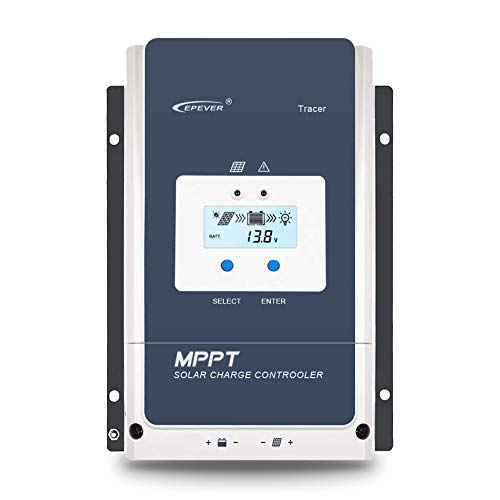
- Best for: Larger off-grid systems where a 60-amp controller is needed, with a 150-volt PV input and remote monitoring for a large panel array across 12, 24, 36, and 48-volt battery banks with headroom to grow.
- Brand: EPEVER
- Model: Tracer 6415AN
- Charge current: 60 A
- Battery voltage: 12/24/36/48 V auto
All 4 Picks at a Glance
| Product | Specs | Action |
|---|---|---|
| Victron SmartSolar MPPT 100/30 |
| Check price on Amazon |
| Renogy Rover 30A |
| Check price on Amazon |
| EPEVER Tracer 6415AN |
| Check price on Amazon |
 EPEVER Tracer 3210 |
| Check price on Amazon |
An AGM battery is a sealed lead-acid battery, and it needs a charge controller that treats it gently, since overcharging a sealed battery dries out the electrolyte and shortens its life. A maximum power point tracking controller, known as an MPPT controller, takes the most power it can from the solar panels and converts it to the voltage the battery needs. The wrong controller will charge an AGM battery at the wrong voltage, or fail to adjust for temperature, and the battery will pay for it.
This guide is for RV owners, boat owners, and off-grid users who charge AGM batteries from solar panels, and for anyone comparing MPPT controllers before choosing one. Each controller below was picked from the names and specifications on its Amazon page, with attention to voltage, current, battery profiles, and monitoring. AGM batteries use the sealed-battery profile on these controllers, stated plainly for each pick.
Our Top Picks
Top 3 picks at a glance
Quick Picks
As an Amazon Associate we earn from qualifying purchases
| Product | Best for | Key spec from title |
|---|---|---|
| Victron SmartSolar MPPT 100/30 | Smart monitoring with Bluetooth | 30 amp output |
| Renogy Rover 30A | Clear LCD display and auto voltage | 30 amp output |
| EPEVER Tracer 6415AN | Large systems with high current | 60 amp output |
| EPEVER Tracer 3210 | Small systems with temperature sensing | 30 amp output |
How to Choose
Match the controller to the panel and battery voltage
The controller must match both the solar panel array and the battery bank, and the two voltages are checked separately. The maximum PV input voltage is the ceiling for the panel array, and the array should be wired so its open-circuit voltage stays below that ceiling with room to spare. The battery voltage is the other match: most controllers here handle 12-volt and 24-volt banks automatically, while larger ones also handle 36-volt and 48-volt banks. Check the panel array’s voltage and the battery bank’s voltage before buying, and choose a controller whose ratings cover both with headroom.
Current rating and system size
The current rating sets how much solar power the controller can pass to the battery, and it should be sized to the panel array with room for growth. A 30-amp controller suits a modest array on an RV or a small cabin, while a 60-amp controller suits a larger array on a boat or an off-grid home. Divide the array’s wattage by the battery voltage to find the current the controller must handle. A 440-watt array on a 12-volt battery needs about 30 amps, while a 750-watt array on the same battery needs about 60 amps.
Battery profiles for AGM
An AGM battery is a sealed lead-acid battery, and the controller must have a battery profile that charges it at the right voltage. Most MPPT controllers offer a sealed-battery profile, which is the profile used for AGM batteries, alongside gel, flooded, lithium, and user-defined profiles. The sealed profile sets the absorption and float voltages for a sealed battery, which protects the electrolyte from drying out. Check the listing for the battery types the controller supports, and confirm that sealed is among them before buying. Some controllers set the profile by hand, so check how it is chosen.
Safety, wiring, and temperature
A charge controller handles real power, and safe installation matters as much as the controller itself. The controller should be mounted where air can move around it, since it generates heat while converting power, and it should be wired with the correct wire size for its current rating. A fuse or breaker on the battery side protects the wiring if a fault occurs, and the manual will state the size needed. Temperature compensation matters for AGM batteries, since a cold battery needs a higher charge voltage and a hot one needs a lower one, and a sensor adjusts the voltage automatically.
The 4 Best Options
Victron SmartSolar MPPT 100/30
- Best for: RV and boat owners who want Bluetooth monitoring and a long warranty, with a 30-amp controller that suits a modest array and a phone app for watching the charge from anywhere on board without a separate display.
- Brand: Victron
- Model: SmartSolar MPPT 100/30
- Model number: SCC110030210
- Charge current: 30 A
RV and boat owners who want Bluetooth monitoring and a long warranty, with a 30-amp controller that suits a modest array and a phone app for watching the charge from anywhere on board without a separate display.
The 30-amp rating suits a modest array, so check it against a larger panel setup before buying and confirm the array wattage will not exceed the controller on the brightest days of the year when output peaks.
The Victron SmartSolar MPPT 100/30 is a 30-amp controller with Bluetooth monitoring, and its smart features are its main strength. It handles 12-volt and 24-volt battery banks, with a maximum PV input voltage of 100 volts and a maximum PV power of 440 watts on a 12-volt battery. The listing states a conversion efficiency of 98 percent, and the built-in Bluetooth lets the owner watch the charging from a phone. The model number is SCC110030210, and the listing states a five-year warranty. It suits RV and boat owners who want to watch their system from a phone.
Renogy Rover 30A
- Best for: Owners who want a clear LCD display and automatic voltage detection, with a controller that is easy to read and easy to set up in an RV or a cabin without needing a phone for daily checks.
- Brand: Renogy
- Model: Rover 30A
- Charge current: 30 A
- Battery voltage: 12/24 V auto
Owners who want a clear LCD display and automatic voltage detection, with a controller that is easy to read and easy to set up in an RV or a cabin without needing a phone for daily checks.
The sealed profile covers AGM batteries, so confirm the profile is set to sealed during setup and check the display after the first sunny day to confirm the battery is charging as expected on the sealed profile.
The Renogy Rover 30A is a 30-amp controller with a clear LCD display, and its ease of use is its main strength. It detects 12-volt and 24-volt battery banks automatically, and the LCD shows the charging state and the settings without needing a phone. The listing states it supports gel, sealed, flooded, and lithium battery types, with the sealed profile covering AGM batteries, and the parameters can be adjusted on the display. It weighs 4.4 pounds and measures 9.37 by 6.81 by 2.85 inches, which suits a wall mount.
EPEVER Tracer 6415AN
- Best for: Larger off-grid systems where a 60-amp controller is needed, with a 150-volt PV input and remote monitoring for a large panel array across 12, 24, 36, and 48-volt battery banks with headroom to grow.
- Brand: EPEVER
- Model: Tracer 6415AN
- Charge current: 60 A
- Battery voltage: 12/24/36/48 V auto
Larger off-grid systems where a 60-amp controller is needed, with a 150-volt PV input and remote monitoring for a large panel array across 12, 24, 36, and 48-volt battery banks with headroom to grow.
The 60-amp rating needs heavier wiring and a larger fuse, so check the manual for the wire and fuse sizes and plan the installation before buying rather than after the controller arrives on site with the panels already mounted.
The EPEVER Tracer 6415AN is a 60-amp controller for larger systems, and its capacity is its main strength. It handles 12-volt, 24-volt, 36-volt, and 48-volt battery banks automatically, with a maximum PV input voltage of 150 volts and a rated power of 750 watts on a 12-volt battery. The listing states a tracking efficiency of at least 99.5 percent and a maximum conversion efficiency of 98.6 percent, and it supports sealed, gel, flooded, and user-defined battery types. An RS485 port allows remote monitoring, and temperature compensation adjusts the charge voltage.
EPEVER Tracer 3210
- Best for: Small RV and marine systems where temperature compensation matters, with an included sensor that adjusts the charge voltage as the battery temperature changes through the day on a 30-amp controller with an LCD display for easy reading.
- Brand: EPEVER
- Model: Tracer 3210
- Charge current: 30 A
- Battery voltage: 12/24 V
Small RV and marine systems where temperature compensation matters, with an included sensor that adjusts the charge voltage as the battery temperature changes through the day on a 30-amp controller with an LCD display for easy reading.
Confirm the battery type is set to the sealed profile for AGM batteries during setup, and check the sensor is mounted on the battery before the first charge so the controller can adjust the voltage correctly in hot and cold weather.
The EPEVER Tracer 3210 is a 30-amp controller with a remote temperature sensor, and its temperature compensation is its main strength. It handles 12-volt and 24-volt battery banks, with a negative ground design and an LCD display. The listing states it supports lead-acid and lithium battery types, with the sealed lead-acid profile covering AGM batteries. The sensor adjusts the charge voltage as the temperature changes. It suits small RV, marine, and boat systems where the battery temperature changes through the day. The temperature sensor is the feature that sets it apart from a basic 30-amp controller.
Which One Fits Your Situation
A small RV with a modest panel array
For a small RV with a modest panel array, the Renogy Rover 30A is the right pick. Its 30-amp rating covers a small array, its LCD display shows the charging state without a phone, and its sealed profile covers AGM batteries. Mount it where the display is easy to read, set the battery type to sealed, and check the display after the first sunny day.
A boat that needs phone monitoring
A boat owner who wants to watch the system from a phone should choose the Victron SmartSolar MPPT 100/30. Its Bluetooth monitoring shows the panel voltage, the battery voltage, and the charge state on a phone, and its five-year warranty gives long cover. Mount it where air can move around it and check the charging state before leaving the boat.
A large off-grid system
A large off-grid system needs the EPEVER Tracer 6415AN, since its 60-amp rating and 150-volt PV input cover a large panel array with headroom for growth. Its sealed profile covers AGM batteries, and its RS485 port allows remote monitoring of the system. Check the manual for the wire and fuse sizes, since a 60-amp controller needs heavier wiring than a 30-amp one.
A small system in changing temperatures
A small system where the battery temperature changes through the day should use the EPEVER Tracer 3210, since its included temperature sensor adjusts the charge voltage for the battery temperature. Mount the sensor on the battery, set the battery type to the sealed profile for AGM batteries, and let the controller adjust the voltage as the temperature changes. That protection matters most where temperatures swing daily.
Common Mistakes
- Buying a controller whose maximum PV voltage is below the panel array’s open-circuit voltage, so the array cannot be connected safely, and the owner must rewire the panels or buy a different controller before the system can run at all, so check the array voltage against the controller rating first.
- Choosing a current rating below the panel array’s output, so the controller clips the power on sunny days, wasting the panels’ output at exactly the time the sun is strongest and the battery could use the charge most, so size the rating with headroom for the whole array and any future panel.
- Setting the battery type to flooded for an AGM battery, which charges at the wrong voltage and shortens the battery’s life, since a sealed battery cannot replace the electrolyte that overcharging drives off, so set the profile to sealed during setup and check it twice before the first charge.
- Ignoring temperature compensation, so a cold battery is undercharged and a hot battery is overcharged, which shortens the life of an AGM battery that would otherwise last for years with gentle charging, so use the sensor whenever the controller supports one, and mount it on the battery itself.
- Wiring the controller without a fuse or breaker on the battery side, which leaves the wiring unprotected if a fault occurs, and a short in an unfused wire can damage the controller, the battery, and the wiring around it, so follow the manual for the fuse size and fit it first.
Frequently Asked Questions
What is an MPPT charge controller?
An MPPT charge controller tracks the maximum power point of the solar panels and converts the panel voltage to the voltage the battery needs. It takes the most power it can from the panels, which makes the system more efficient than a simpler controller. It also manages the charging stages and protects the battery from overcharging.
Can an MPPT controller charge AGM batteries?
Yes, an MPPT controller is a good choice for AGM batteries, since it charges them efficiently on the sealed-battery profile. An AGM battery is a sealed lead-acid battery, so the sealed profile sets the absorption and float voltages that suit it. Check the listing and confirm that sealed is among the battery types supported.
What size MPPT controller do I need?
The size depends on the panel array’s total wattage and the battery bank’s voltage. Divide the array’s wattage by the battery voltage to find the current, and choose a controller whose rating covers it with headroom. A 440-watt array on a 12-volt battery needs about 30 amps, while a 750-watt array needs about 60 amps.
Does an MPPT controller need a temperature sensor?
A temperature sensor is worth having, since a cold battery needs a higher voltage and a hot battery needs a lower one. A controller with a sensor adjusts the voltage automatically, protecting an AGM battery from overcharging in the heat and undercharging in the cold. Some include a remote sensor, while others need one bought separately.
Related guides
More from Amazon
Programs that pair well with the guide above. Offers and eligibility are set by Amazon and may change.
Free shipping on eligible items, Prime Video and more. Eligible new members can start with a free trial.
Start a Prime free trialAd-free music streaming. Eligible new subscribers can start with a free trial.
Try Music Unlimited freeA Prime membership for ages 18-24 with a trial period. Eligibility is set by Amazon.
See Prime for Young AdultsAudiobooks and podcasts to listen to on the go. Eligible new members can start with a free trial.
Try Audible freeAs an Amazon Associate we earn from qualifying purchases.