As an Amazon Associate we earn from qualifying purchases at no extra cost to you.


Buying a VR gunstock sounds simple until you realize how much variation exists between a $30 strap-and-tube setup and a $150 modular rig. Most people skip the research, order something that looks right in product photos, and then discover one of three problems: the stock doesn’t fit their headset and controllers, it’s so heavy their arms give out after 20 minutes, or it’s built so loosely that their aim drifts every time they shoulder it.
The biggest mistake buyers make is treating all gunstocks as interchangeable. A stock designed around the Quest 2 controller geometry may technically “work” with Quest 3 controllers but sit at the wrong angle or block the tracking ring’s view. The second mistake is assuming heavier equals more realistic. In VR, weight that exceeds roughly 1.5 pounds (about 680 grams) total per side tends to cause fatigue long before it adds immersion, especially in fast-paced shooters where you’re repositioning constantly. The third mistake is ignoring adjustability entirely — then discovering the fixed-length tube forces an awkward shoulder weld because the stock was designed for someone with different arm measurements.
This guide breaks down what actually matters when comparing adjustability and weight, with the numbers you need to make a call.
Our Top Picks


Decide These 3 Things First
Before comparing any specific model, settle these questions, because they eliminate half the market immediately:
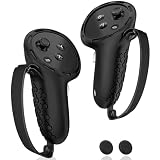
1. Which headset and controllers do you own? Controller shape dictates everything. Quest 2 controllers have large tracking rings; Quest 3 and 3S controllers have smaller rings; Quest Pro is different again. Check the product’s explicit compatibility list — a listing that says “fits Quest 2/3/3S/Pro” with adapter cups for each is a safer bet than one that only mentions one headset. Universal magnetic-cup designs like the kind used on adjustable models in the $50–70 range handle multiple controller types by swapping the attachment cup rather than the whole stock.
2. What games do you actually play? Long-game players (contractors-style military sims, hunting titles) benefit most from weighted stocks and cheek pads. Fast arcade shooters punish heavy rigs — fatigue sets in and accuracy collapses. If your sessions run under 30 minutes, a lighter stock around 0.8–1.1 pounds (360–500 grams) is the better buy.
3. Solo or shared use? If multiple people in your household share the headset, adjustable length-of-pull (the distance from trigger to shoulder pad) is non-negotiable. Look for at least 2 inches (5 cm) of adjustment range. A fixed stock tuned for a 6’2″ adult is unusable for a teenager.
Adjustability: Length, Angle, and Attachment
Adjustability is where cheap and mid-tier stocks separate themselves. Evaluate three distinct dimensions:
Length adjustment. The shoulder-to-grip distance should adjust across at least 2–4 inches (5–10 cm). Growing teens and adults sharing one rig need this. Cheaper models use friction-fit tubes with a locking collar; better ones use indexed click stops that hold position under recoil-style movement. If the listing doesn’t state an adjustment range, assume it has little.
Attachment method. This is the most underrated spec. Elastic strap-and-hook systems take 30–60 seconds to mount controllers and shift position during play, which ruins tracking consistency. Magnetic quick-attach systems — like those on the around $59 adjustable model referenced above — let you dock controllers in under 5 seconds and keep them at a fixed orientation. Check the magnet claim: neodymium magnets rated to hold at least 2 pounds (900 grams) of pull force per cup prevent controllers from popping loose during fast reloads.
Angle and cup position. The controller cups should sit so the stock’s barrel points where your controller points. Some modular stocks offer cup rotation of ±10–15 degrees or fore-aft cup placement. If you play two-handed rifle-style games only, a fixed angle is fine. If you switch between pistol and rifle grips, modular wins.
Weight: The Number That Makes or Breaks Comfort
VR gunstocks range from roughly 7 ounces (200 grams) for basic foam-and-strap designs to over 2 pounds (900 grams) for fully weighted steel-and-polymer builds. Here’s the practical breakdown:
– Under 12 oz (340 g): Nearly invisible on your arms. Ideal for sessions over 45 minutes and fast movement games, but you lose the “does this feel like a rifle” feedback.
– 12–20 oz (340–570 g): The sweet spot for most buyers. Enough mass to feel substantive without wrecking endurance.
– 20–28 oz (570–800 g): Realistic rifle feel. Fine for stationary or slow-paced games; expect arm fatigue by the 25–30 minute mark.
– Over 28 oz (800 g): Only worth it for sim-heavy players who deliberately train with it, and only if the weight is adjustable.
Adjustable weighting is the premium feature to seek. Models with removable weight inserts (typically 4 oz / 113 g increments) let you run 14 oz for a long session and 22 oz for a short immersive one. The CYBVR weighted grip approach — weights concentrated at the grip rather than the barrel — also matters for feel: grip-weighted designs fatigue your wrists less than barrel-weighted ones because the load sits closer to your hands. Note that weighted grip systems typically weigh less overall (the referenced around $37 model focuses on weighted grips rather than a full stock) while delivering most of the immersion benefit.
Material and Build Construction
Three material families dominate:
EVA foam and fabric straps ($25–40): Lightest option at 7–10 oz. Straps stretch out after 3–6 months of regular use. Acceptable as a first gunstock; not a long-term purchase.
ABS or PETG plastic tubes with TPU joints ($35–80): The mainstream choice. Well-made ABS handles drops onto carpet and hardwood without cracking; look for wall thickness of at least 2 mm on the main tube. 3D-printed joints vary wildly — layered print lines are normal, but visible gaps or flex at the joint under 5 pounds of hand pressure means pass.
Aluminum or carbon fiber tubes ($80–150+): Overkill for most, but they eliminate flex entirely and last indefinitely. Worth it only if you play daily.
Check hardware too: screws should be steel with thread-locker applied, not self-tapping plastic threads, which strip after a handful of adjustments. Magnetic interfaces should use recessed magnet pockets, not surface-glued magnets.
Comfort and Real-World Performance
Adjustability and weight mean nothing if the contact points hurt. Focus on:
Shoulder pad. A rigid plastic butt plate against your shoulder bone becomes painful within 15 minutes. Look for a padded cheek rest or gel pad of at least 0.3 inch (8 mm) thickness. Removable/replaceable cheek pads are a bonus for hygiene — sweat degrades foam.
Grip coverage. Your controller handles should sit in cups lined with silicone or foam. Bare plastic cups let controllers twist microscopically during play, which the tracking system interprets as hand movement — this shows up as aim wobble.
Tracking interference. This is a hard requirement, not a nice-to-have. The stock must not occlude the controller’s tracking ring from the headset’s cameras. Bulky stocks that hug the ring too tightly cause controller drift or momentary tracking loss in certain stances. Any reputable listing states “no tracking interference” explicitly; test within the return window regardless.
Quick detach. If you switch between gunstock games and non-gunstock games in one session, magnetic quick-release saves you 2–4 minutes per swap versus elastic straps.
Price Tiers: What Each Budget Buys You
Budget ($25–45): Fixed-length or minimally adjustable foam/ABS designs, strap attachment, weights 7–12 oz. Expect elastic fatigue within a year. The CYBVR-style weighted grip approach sits here and is arguably the best value in the tier — you get the weight benefit without full-stock complexity.
Mid-tier ($45–80): Adjustable length (2+ inches of range), magnetic quick-attach, padded cheek rest, 12–20 oz weights. This tier covers the needs of roughly 80% of buyers, including the referenced around $59 magnetic-attach model.
Premium ($80–150+): Modular platforms with swappable cups for multiple controller generations, removable weight inserts, aluminum or reinforced polymer frames, and spare-parts availability. Buy here if the whole household plays or you’re committed to sim shooters long-term.
Warranty and Support
Most VR accessories carry 30–90 day warranties. Anything under 90 days on a plastic-jointed stock is a mild red flag — joint wear is exactly the failure mode that appears around month 3–6. Prefer sellers that stock replacement parts (extra magnetic cups, cheek pads, locking collars) rather than requiring full replacement. A company offering replacement cheek pads for $8–12 signals they expect long-term use. Check return terms separately from warranty: 30-day no-questions returns matter more than a 1-year “manufacturing defects only” warranty.
Delivery and Assembly
Most gunstocks ship in 2–4 pieces and assemble in 10–20 minutes with an included hex key. Before buying, confirm: (1) assembly requires no drilling or gluing — a few kit-style stocks ship as print-it-yourself or assemble-with-superglue, which forfeits returns; (2) the package includes spare screws and a hex key, since these are the most commonly lost parts; (3) shipping weight and box size if you’re buying internationally — full aluminum stocks can push 3 pounds (1.4 kg) boxed. By 2026 standards, expect free domestic shipping on orders over $35–50 from most major retailers, which conveniently covers both tiers of gunstock pricing.
Spec Checklist
| Spec | Budget ($25–45) | Mid ($45–80) | Premium ($80–150+) |
|---|---|---|---|
| Total weight | 7–12 oz (200–340 g) | 12–20 oz (340–570 g) | 14–28 oz, adjustable inserts |
| Length adjustment | Fixed or under 2″ | 2–3″ (5–8 cm) range | 3–4″ (8–10 cm), indexed stops |
| Attachment | Elastic straps | Magnetic quick-attach | Magnetic + swappable cups |
| Materials | EVA foam, basic ABS | ABS tube, TPU joints, 2 mm+ walls | Aluminum/carbon fiber, steel hardware |
| Cheek/shoulder padding | None or thin foam | 8 mm+ padded rest | Gel pad, replaceable |
| Controller compatibility | Single headset | 2–4 headset models | Multi-generation with cup swaps |
| Warranty | 30 days | 90 days | 6–12 months + parts |
Red Flags
- No stated weight. If a listing omits total weight in grams or ounces, the seller either doesn’t know or is hiding heft. Skip it.
- “Fits all VR headsets” with no adapter details. Controller geometries differ too much for a genuinely universal passive fit.
- Glued or printed-in-one-piece controller cups. When Quest controllers get redesigned, you’ll need new cups, not a new stock.
- Straps with no tension adjustment. Elastic that can’t be tightened will loosen within weeks.
- Photos only, no dimensions. No length range, no cup diameter, no weight = guesswork purchase.
- Over 28 oz with fixed weight. You cannot compensate for buyer’s-remorse fatigue.
- Surface-glued magnets. They detach; recessed magnet pockets are the standard on anything worth buying.
FAQ
Will a heavier gunstock actually improve my aim?
It improves stability, not aim — the added mass dampens hand tremor and gives your shoulder a reference point, so many players see steadier sights. But past roughly 20–24 oz, fatigue degrades accuracy faster than stability helps it. Weighted-grip designs capture most of the benefit at lower total weight.
Do gunstocks damage VR controllers?
Not if the cups are lined and the fit is secure. The risk comes from hard cups that let controllers twist, or straps that pressure the tracking ring. Inspect your controller bodies monthly for stress marks at the grip.
Is a magnetic attachment strong enough for fast games?
Quality magnetic systems with neodymium magnets (2 lb+ pull force per cup) hold through aggressive reloads and swings. Test deliberately in your first session: yank the stock downward and sideways. If a controller releases, tighten or return.
Can one gunstock work for a Quest 2 and a Quest 3?
Only if it has swappable or adjustable controller cups. Models advertising compatibility across Quest 2, 3, 3S, and Pro typically ship with two or more magnetic cup sizes; verify the specific cups are included, since some brands sell them as $10–15 add-ons.