Choosing a hard shell case for your Nintendo Switch sounds simple until you realize how many cases look protective but fail where it counts. The most common mistakes buyers make when figuring out how to choose a switch travel case with hard shell protection are assuming any hard exterior equals crush protection, buying a case that does not actually match their console generation, and prioritizing extra pockets over the core job of keeping the screen, sticks, and hinges safe in a backpack. A slim, stylish case is great until it flexes under a textbook, pops a zipper on the second trip, or lets the Joy-Con sticks grind against the lid. This guide cuts through the marketing and shows you what actually determines protection, fit, and everyday usability.
In 2026 the Switch family includes the original Switch, Switch OLED, Switch Lite, and Switch 2, and they do not share the same dimensions. A case that fits one perfectly will be loose or tight on another, and that looseness is what leads to rattling, scuffs, and stick drift from pressure. Focus on engineered protection first, then add convenience features.
As an Amazon Associate we earn from qualifying purchases at no extra cost to you.


Our Top Picks
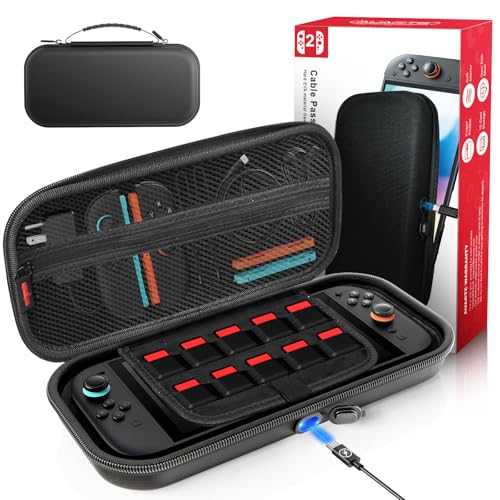
 Game Traveler Deluxe Licensed Travel Case for NintendoL 300 x H 172 x P 58 mm6.75 x 2.25 x 11.75 inches1.04 PoundsCheck on Amazon


Top 3 picks at a glance
Decide These 3 Things First
Before you compare materials or card slots, lock in these three decisions. They narrow the field instantly and prevent the most expensive mistake: owning a case you cannot trust to toss in a bag.
1. Which console are you actually carrying? Measure or confirm your model. The original Switch and OLED are close at about 4.0 x 9.5 x 0.55 inches without Joy-Con, while the Switch 2 is larger at roughly 4.5 x 10.7 x 0.55 inches and will not seat properly in cases molded for the older generation. Switch Lite at 3.6 x 8.2 x 0.55 inches needs its own dedicated compact shell. If you plan to carry a Switch 2, only consider cases explicitly listed for Switch 2 with interior length of at least 11 inches.
2. How will you travel with it? A commute in a crowded bag or suitcase demands true crush resistance and a low-profile shape under 2.5 inches thick. A case that lives on a desk or in a car console can be larger with more game storage. If you fly often or check luggage, prioritize a hard EVA shell with a reinforced lid that does not deform when pressed with palm pressure.
3. What has to fit inside besides the console? Decide if you need the console with Joy-Con attached, a charger and cable, 8 to 20 game cards, thumb grips, and maybe an AirTag or earbuds. Every extra item adds bulk and changes weight from about 7 ounces for a minimalist shell to 14 ounces for a fully loaded deluxe case. Knowing your must-carry list keeps you from overbuying bulk or underbuying storage.
Size and Fit: The Difference Between Protected and Just Contained
Size is not about the outer footprint alone, it is about interior clearance. A proper hard shell case should hold the console snug with 0.2 to 0.4 inches of clearance on each side for the protective lining, and a lid that closes without pressing on the thumbsticks.
Look for these numbers: Interior length 10.2 to 10.6 inches for original Switch/OLED, 11.0 to 11.4 inches for Switch 2, and 8.6 to 9.0 inches for Switch Lite. Interior depth should be 1.8 to 2.4 inches to clear sticks capped with thumb grips, which add about 0.15 to 0.25 inches of height. Exterior dimensions for a travel-friendly case typically run 11.5 x 5.5 x 2.5 inches or smaller; anything over 12 x 6 x 3 inches starts to feel bulky in a daypack.
Fit features matter as much as dimensions. A molded cradle or elastic strap keeps the console from shifting, a soft divider flap prevents the screen from touching game cards or zippers, and a recessed stick cutout in the lid prevents constant pressure on the sticks. If the console rattles when you shake the closed case gently, it is too loose. If you have to force the zipper closed, it is too tight and will stress the hinge.
Material: What Hard Shell Really Means
Not all hard shells are equal. Most quality Switch travel cases use an EVA (ethylene-vinyl acetate) hard shell with a textured outer skin. EVA offers the best balance of rigidity, weight, and shock absorption for this category.
On the outside, expect 1680D polyester, 600D Oxford, or polyurethane-coated fabric over a 3 to 5 mm EVA core. This construction resists scuffs, light rain, and daily abrasion without adding much weight. A fully rigid polypropylene or ABS shell offers more crush resistance but adds 3 to 5 ounces and often costs $10 to $20 more. Avoid cases that are just padded fabric with a thin plastic insert advertised as hard shell; press the lid with your thumb, a true hard shell will spring back without creasing.
Inside, look for soft velvet, microfiber, or short-pile fleece lining. It should feel smooth, not scratchy, and cover all contact points including the divider. Mesh pockets should be backed with soft fabric so a charger or cable cannot rub the screen through the mesh. Zippers should be YKK-grade or equivalent with large teeth, size #8 or #10, for smooth closure around the curved shell.
Construction and Protection Details
Construction determines whether that hard shell actually protects. Pay attention to how the case is built, not just what it is made of.
A protective case should have a semi-rigid or reinforced lid that holds its shape when empty. Double-stitched binding around the zipper line prevents separation after repeated opening, and a 270-degree zipper that opens flat makes it easier to seat the console without dragging it across the zipper teeth. Water resistance is usually water-repellent coating, not waterproof; expect light splash protection but not submersion. If you need true water sealing, look for a gasketed, hard plastic case which will be heavier and more expensive.
Shock absorption comes from the interior, not just the shell. A case with 6 to 10 mm of molded foam or egg-crate padding around the console absorbs drops from coffee table height better than a thin-walled hard box with empty space. For screen protection, a built-in felt flap at least 2 mm thick between the console and accessories is non-negotiable. Without it, game cards and chargers will eventually mark the screen.
Extra features like a pass-through charging port or cutout for charging inside the case are convenient, but check the opening size. The USB-C port needs about 0.6 inches of clearance to plug in without bending the cable. Cases advertising charge-inside design should still allow the lid to close fully with the cable connected and should not press the cable against the shell edge.
Comfort, Carry, and Everyday Performance
A case you hate to carry will get left behind. For daily use, comfort equals how it feels in hand, in a bag, and during play breaks.
Weight is a key factor. Empty weights range from 7 to 9 ounces for slim EVA shells, 10 to 12 ounces for standard hard shells with game storage, and 13 to 16 ounces for deluxe or fully rigid models. Add a console at about 10.5 ounces for OLED or 12 ounces for Switch 2, plus games and a 65W charger at 3 to 4 ounces, and your total travel weight can hit 1.5 to 2 pounds. If you walk or bike commute, stay under 11 ounces empty.
Carry style should match your bag. A built-in handle is useful if you carry the case alone; a slim case without a handle slides more easily into a backpack sleeve. Rubber feet on the base prevent sliding on tables, and a low-profile zipper pull that tucks flat reduces snagging. Some mid-range options include an AirTag or tracker pocket, typically a 1.5 x 1.5 inch slip pocket on the interior lid, which is handy if you travel frequently.
Game storage affects performance too. Most cases hold 10 game cards in a翻页 folio, deluxe versions hold 18 to 24, and large travel cases may add 2 to 4 microSD card slots. More is not always better; a folio that is too thick adds pressure on the console when the lid closes. Test the lid close: with 10 games loaded, the case should still zip without bulging.
Price Tiers: What You Get for Your Money
Hard shell Switch cases cluster into three clear price bands, and understanding them prevents overpaying for branding or underpaying for protection.
Budget $14 to $20: You get genuine EVA hard shell protection, soft lining, a screen flap, and 8 to 12 game slots. These cases are light at 7 to 10 ounces and do the core job well. Examples in this range include compact shells and licensed small-form cases that prioritize protection over extra pockets. Finish and zipper smoothness may be basic, but crush resistance is often solid. Expect a simple interior without a dedicated charger compartment.
Mid-Range $21 to $32: This is the sweet spot for most buyers. You get thicker EVA, better stitching, smoother zippers, dedicated charger and cable mesh pockets, and 12 to 20 game slots. Many include additions like thumb grip storage, an AirTag holder, or a larger accessory compartment while staying under 12 ounces. Slim carrying designs with a soft-touch exterior often sit here. Build quality and fit consistency improve noticeably over budget.
Premium $33 to $55: Premium means either a fully rigid ABS/polypropylene shell, a licensed deluxe interior with custom-molded cradles, or extra organizational engineering. You get maximum drop and crush resistance, premium linings, and refined details like molded stick reliefs and reinforced handles. Weight climbs to 13 ounces or more, and the case may be slightly larger. Worth it if you check bags, travel weekly, or carry the Switch alongside other expensive gear.
Warranty and Support
A case is a protection product, so the warranty signals manufacturer confidence. Budget cases often offer 30 to 90 days against defects, mid-range cases typically offer 6 to 12 months, and premium or licensed brands often extend to 12 months or limited lifetime on manufacturing defects. Licensed products from established travel-case makers usually have clearer warranty processes and replacement part availability.
Check what is covered: zipper failure, seam separation, and shell deformation should be included; cosmetic wear, misuse, and water damage usually are not. Keep your receipt and order number, and inspect the case immediately on arrival. Test the zipper for 10 to 15 open-close cycles, press the lid and corners to check for soft spots, and verify the console seats without pressure on the sticks. A defect is easiest to address within the first 14 to 30 days.
Delivery and Assembly
The good news is there is no assembly. Every Switch hard shell case ships ready to use. Delivery is straightforward, but a few details help you avoid fit surprises.
Shipping weights are light at 0.6 to 1.2 pounds, so most sellers ship via standard parcel in 3 to 7 business days, with expedited 2-day options often available for $6 to $12 extra. Because cases are not fragile, they often ship in a poly mailer or simple box without extra padding; inspect the shell for dents on arrival, especially at the corners. If ordering for Switch 2, verify the listing title explicitly says Switch 2, OLED, or original Switch as needed, and double-check interior dimensions in the product details, not just the headline. A quick fit test at home is more reliable than any photo.
Spec Checklist
| Spec | Budget | Mid | Premium |
|---|---|---|---|
| Shell Type | 3 mm EVA + 600D fabric | 4-5 mm EVA + 1680D / coated fabric, reinforced lid | Rigid ABS/Polypropylene or thick EVA with molded cradle |
| Empty Weight | 7 – 10 oz | 10 – 12 oz | 13 – 16 oz |
| Exterior Size (L x W x H) | 10.5 x 5.0 x 2.0 in | 11.0 x 5.5 x 2.3 in | 11.5 x 6.0 x 2.8 in |
| Game Storage | 8 – 12 cards | 12 – 20 cards + 2 microSD slots | 20 – 24 cards + 4 microSD slots, labeled folio |
| Screen Protection | Soft fabric flap | Padded fleece divider, stick relief | Molded padded lid with stick cutouts |
| Accessory Space | Single mesh pocket | Mesh charger pocket + cable strap, AirTag pocket | Multiple compartments, elastic straps, handle |
| Zipper | Standard #8 zipper | Smooth #8 or #10, double-stitched | #10 YKK or equivalent, 270-degree opening |
| Price Range | $14 – $20 | $21 – $32 | $33 – $55 |
| Warranty | 30 – 90 days | 6 – 12 months | 12 months to limited lifetime |
Red Flags
Watch for these warning signs that a case prioritizes looks over protection. First, no interior dimensions listed, only exterior photos. Without interior length and depth you cannot confirm Switch 2 versus OLED fit. Second, a hard shell claim with no EVA or rigid material specified, often described only as hard bag or protective sleeve, which usually means thin padding. Third, no screen divider flap, or a mesh pocket that sits directly against the screen when closed. Fourth, zipper that stops halfway or uses small #5 teeth that snag on the shell curve; this fails quickly with daily use. Fifth, exaggerated capacity claims like 30 game cards in a slim 1.5-inch case, which guarantees lid pressure on the console. Sixth, stock photos that show a different console generation than the title describes. If the image shows a Switch Lite but the title says universal for all models, fit will be compromised.
FAQ
Will a Switch OLED case fit a Switch 2?
In most cases, no. The Switch 2 is about 1.2 inches longer and slightly taller than the OLED, so a case molded for OLED will be too short and too tight. Some soft pouch-style cases labeled universal may stretch to fit, but a hard shell with a molded cradle will not. Always buy a case that specifically lists Switch 2 support and shows interior length of at least 11 inches. If you own both consoles, look for a case that lists both OLED and Switch 2 with a slightly larger interior.
How hard does a hard shell need to be for everyday backpack carry?
For backpack and commute use, a 4 to 5 mm EVA shell with a reinforced lid is sufficient. It should resist palm pressure without creasing and spring back immediately. You do not need a heavy Pelican-style rigid box unless you check luggage or pack the case under heavy gear. Test it by pressing the center of the closed empty lid; if it flexes more than 0.25 inches or stays dented, it will not protect against a book or water bottle pressing in your bag.
Do I need a case with a built-in charger compartment?
Only if you regularly charge away from home. A dedicated charger pocket keeps the 65W adapter and cable from touching the screen and stops them from rattling. If you mostly play at home and just need transit protection, a slimmer case without charger storage saves weight and bulk. If you do want charge-inside access, confirm the case has a proper cable cutout that allows the lid to close with the USB-C plugged in and does not pinch the cable at the shell edge.
What is the best way to test fit and protection at home?
Place the console with Joy-Con attached into the case, add any thumb grips you use, and close the lid without forcing the zipper. The case should zip smoothly with one hand, the console should not shift when you shake it gently, and you should be able to slide a finger between the lid and the thumbsticks with the divider flap in place. Press the closed case firmly on all sides; there should be no contact between the sticks and the lid. Finally, load your typical game cards and charger and re-test; if the lid bulges, you are overpacked.
Related guides
- Best Free MMOs on Steam: Subscription Limits, Pay-to-Win and Time Cost (2026)
- Best Free Horror Games on Steam: How to Pick One That Fits Your PC and Your Nerves (2026)
- Black Frame Insertion vs VRR: Which Smoothness Feature Should You Use?
- Best Webcams for Streaming: 11 Listings Compared by Resolution, Focus and Light (2026)