
If you have ever wondered “what is a vpn router,” the short answer is a network device that encrypts all traffic from every connected client at once. That matters the moment you plug into hotel Wi-Fi, a convention center LAN, or any shared network where you cannot trust the infrastructure. Gamers, travelers, and privacy-focused streamers all hit the same wall: a VPN app protects one laptop, but your phone, console, smart TV, and tablet stay exposed. A VPN router closes that gap by pushing the tunnel to the gateway itself, so every device inherits the protection without needing individual configuration.
Not every router that advertises VPN support handles it well. A device with a single-core CPU and outdated crypto engine can turn a 300 Mbps connection into a stuttering 25 Mbps crawl, which is useless for competitive play or 4K streaming. Conversely, a modern Wi-Fi 6 or Wi-Fi 7 travel router running WireGuard can sustain several hundred megabits of encrypted throughput in a package that fits in a jacket pocket. In 2026 the hardware floor has risen enough that even sub-$50 routers ship with hardware acceleration, but the spread between “functional” and “genuinely capable” remains enormous. This roundup compares published specs, listed prices, and recurring owner complaints to separate the two groups.
As an Amazon Associate we earn from qualifying purchases at no extra cost to you. Product prices and availability are accurate as of the date shown and are subject to change.



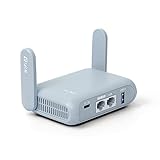


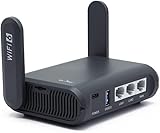
Top 3 picks at a glance
Quick Picks
| Product | Best for | Price |
|---|---|---|
| TP-Link ER605 | Wired-only small office | $49.98 |
| GL.iNet Opal | Ultra-budget travel | $39.99 |
| GL.iNet Slate 7 | Wi-Fi 7 future-proofing | $144.49 |
| GL.iNet Beryl AX | Balanced travel VPN | $98.99 |
| Omada ER707-M2 | Multi-gig wired routing | $99.99 |
| GL.iNet Flint 2 | Home gaming with VPN | $169.99 |
| TP-Link AXE5400 | Wi-Fi 6E home coverage | $99 |
| GL.iNet Slate AX | Pocket-sized OpenWrt | $119.99 |
How We Picked
Four criteria drove the selection. First, VPN protocol breadth: devices that support OpenVPN and WireGuard natively score higher than those stuck on PPTP or IPSec alone, because protocol choice directly affects speed and security. Second, real-world throughput at encryption load, inferred from published CPU specifications and owner-reported numbers rather than vendor marketing ceilings. Third, form factor versus use case—a travel router with a 2.5G WAN port solves a different problem than a desktop Gigabit VPN router. Fourth, firmware openness: OpenWrt or equivalent custom-firmware support extends a device’s useful life by years, which is critical for anyone who changes VPN providers frequently.
The 8 Best What Is A Vpn Router in 2026
TP-Link ER605
The ER605 is a dedicated wired Gigabit VPN router aimed at small offices or home setups where every device sits on Ethernet and wireless is handled by a separate access point. At under $50 it is the cheapest entry into hardware-accelerated IPSec and OpenVPN on this list, and TP-Link’s Omada management layer lets you push firmware updates across multiple sites from one dashboard.
- Pro: Hardware crypto offload keeps encrypted throughput high on all four Gigabit ports
- Pro: Central Omada management is rare at this price point
- Con: No Wi-Fi radio at all; you must supply your own AP or mesh system
Skip it if you need wireless in the same box, or if you travel and require a pocketable form factor.
GL.iNet GL-SFT1200 Opal
The Opal is a dual-band AC1200 travel router that doubles as a wired extender or Wi-Fi bridge, with OpenVPN and WireGuard baked into the firmware. Owner feedback consistently highlights the ease of initial VPN setup and the compact size that slides into a laptop sleeve alongside a power bank. For anyone asking “what is a vpn router” who wants the simplest possible starting point, the Opal answers with a $39.99 price tag and a one-click client install.
- Pro: Lowest cost on this list while still offering WireGuard support
- Pro: Three-in-one operation (travel router, access point, repeater) reduces what you pack
- Con: AC1200 ceiling means Wi-Fi throughput lags even when the VPN tunnel is fast
Pass if you stream 4K locally or need a 2.5G uplink for a fiber connection.
GL.iNet GL-BE3600 Slate 7
The Slate 7 is the first Wi-Fi 7 travel router in this roundup, pairing the 2.5G WAN port with a touchscreen for quick on-device configuration. Its MLO-capable radio is relevant to owners who already carry Wi-Fi 7 phones or laptops and want to avoid buying a separate mesh node for the home. The OpenWrt base means you can add packages like AdGuard Home or custom VPN scripts without losing official support.
- Pro: Wi-Fi 7 with Multi-Link Operation gives a genuine headroom advantage over Wi-Fi 6 travel models
- Pro: Touchscreen removes the need to open a browser for basic settings changes
- Con: At $144.49 it costs roughly triple the Opal while the Wi-Fi 7 client ecosystem is still maturing
Skip it if none of your devices support Wi-Fi 7 yet; the premium will not pay off immediately.
GL.iNet GL-MT3000 Beryl AX
The Beryl AX occupies the sweet spot for most travelers: Wi-Fi 6, a 2.5G WAN port for gigabit-plus fiber, and WireGuard/OpenVPN support via OpenWrt firmware. The $98.99 price puts it within a few dollars of the Omada ER707-M2, but the Beryl adds a wireless radio and a smaller footprint. Owner threads frequently note the aluminum-look shell dissipates heat well during extended VPN sessions, which matters when you are routing traffic through a congested conference network.
- Pro: 2.5G WAN removes the Gigabit bottleneck on fiber plans without reaching Wi-Fi 7 pricing
- Pro: OpenWrt base gives package-level control over DNS, firewall rules, and VPN scripts
- Con: Touch-free plastic body attracts fingerprints and looks less premium than the Slate 7
Skip it if you need a multi-user office router with VLAN segmentation instead of a personal travel unit.
Omada ER707-M2
The ER707-M2 is a multi-gigabit VPN router designed for small offices or power-user home labs that already run Omada switches and access points. Unlike the wired ER605 above it, the ER707-M2 includes 2.5G and 10G SFP+ ports, so you can route encrypted traffic at multi-gigabit rates to a NAS or a second router without hitting a port ceiling.
- Pro: 10G SFP+ uplink future-proofs a wired backbone for under $100
- Pro: Omada SDN integration lets you manage it alongside existing ER-series or switch hardware
- Con: No Wi-Fi; it exists only as a routing layer and assumes a separate wireless solution
Skip it if you need an all-in-one travel device or lack the PoE injectors and APs Omada assumes.
GL.iNet GL-MT6000 Flint 2
The Flint 2 targets gamers and households that want a primary Wi-Fi 6 router with dual 2.5G Ethernet ports and always-on VPN routing. Owner reviews praise the ability to push specific devices—your gaming PC or streaming box—through the VPN tunnel while leaving others on a direct connection, a policy-routing feature that is awkward to configure on many stock firmwares. At $169.99 it is the most expensive home-unit option here, but it replaces a router plus a separate VPN appliance.
- Pro: Per-device VPN policies let you split-tunnel by MAC address or IP group
- Pro: Dual 2.5G ports handle a gigabit-plus WAN and a 2.5G LAN without a port conflict
- Con: Desktop form factor makes it impractical for hotel or conference-room use
Skip it if you primarily travel and need pocket size; choose the Beryl AX or Opal instead.
TP-Link AXE5400
The AXE5400 is a tri-band Wi-Fi 6E router that earned a PCMag Editors’ Choice distinction in its original review cycle. It supports OpenVPN and PPTP client/server modes through TP-Link’s firmware, giving households a familiar consumer interface rather than an OpenWrt control panel. At $99 it undercuts most Wi-Fi 6 travel routers on this list while offering a dedicated 6 GHz band for latency-sensitive gaming or backhaul.
- Pro: 6 GHz band eliminates Wi-Fi congestion in dense apartment buildings
- Pro: Simple TP-Link Tether app interface lowers the VPN configuration barrier for non-technical users
- Con: Lacks a 2.5G Ethernet port, capping wired throughput at 1 Gbps regardless of your ISP plan
Skip it if you need WireGuard or OpenWrt flexibility; TP-Link’s stock firmware does not natively support either.
GL.iNet GL-AXT1800 Slate AX
The Slate AX is a pocket-sized Wi-Fi 6 travel router positioned above the Opal but below the Beryl AX. It ships with OpenWrt and native WireGuard/OpenVPN support, plus a USB 3.0 port that can serve files or tether a phone as a backup WAN. Owner feedback calls it the “Goldilocks” GL.iNet model for people who want the latest Wi-Fi 6 radios without paying the Slate 7 premium.
- Pro: USB 3.0 port doubles as a failover WAN or local file server in a travel scenario
- Pro: OpenWrt firmware with an active package repository extends its usefulness well past factory support
- Con: No 2.5G WAN port, so it cannot take full advantage of multi-gig fiber while traveling
Skip it if your home fiber plan exceeds 1 Gbps and you want a single router that never bottlenecks; the Beryl AX or Flint 2 solve that.
Buying Guide
VPN Protocol Support and Crypto Offload
Before comparing throughput numbers, confirm the router supports WireGuard or OpenVPN rather than legacy PPTP or IPSec alone. WireGuard’s modern cryptography is dramatically faster on the same hardware, and crypto offload engines found in recent SoCs further reduce CPU load during tunnel establishment. A router without hardware acceleration may report 900 Mbps on an unencrypted link yet drop below 150 Mbps once WireGuard is active, which is the single most common complaint in travel-router reviews.
Ethernet Speed and WAN Port Configuration
A Gigabit WAN port cannot exceed 1 Gbps regardless of how fast your VPN tunnel is. If your home or hotel connection runs above 1 Gbps—now common on mid-tier fiber plans—look for at least one 2.5G WAN port so the router is not the bottleneck. For multi-user environments, also check whether the device supports link aggregation or a 10G SFP+ uplink to keep your NAS or switch traffic at full speed outside the tunnel.
Firmware Ecosystem and Update Longevity
Travel routers live a punishing life: repeated plug-ins, firmware changes, and shifting VPN provider configurations. OpenWrt-based devices from GL.iNet or community-forkable Omada units let you install security patches, new VPN packages, and DNS filters for years after the manufacturer’s official support window closes. A proprietary firmware with a two-year update promise, by contrast, may leave your router running a vulnerable codebase while you still use it daily.
Our Verdict
The top pick is the GL.iNet Beryl AX. At $98.99 it balances Wi-Fi 6 speeds, a 2.5G WAN port, WireGuard and OpenVPN support, and OpenWrt flexibility in a size that still fits a carry-on pouch. The budget pick is the GL.iNet Opal: $39.99 buys you the same protocol support in an AC1200 shell that is ideal for short trips and modest bandwidth needs. The condition that flips the answer: if your primary goal is always-on home VPN for a gaming setup with per-device routing, the Flint 2 wins regardless of the price difference because its desktop antennas and dual 2.5G ports are built for that exact workload.
FAQ
What is a VPN router used for?
A VPN router encrypts all outbound traffic at the gateway level, protecting every connected device simultaneously—phones, consoles, smart TVs, and laptops—without requiring a VPN app on each one. It is most useful on untrusted networks like hotel Wi-Fi or when you want to appear in a different country on a device that cannot run a VPN client.
Can I use any router as a VPN router?
Not reliably. Many consumer routers advertise “VPN passthrough,” which only forwards existing VPN connections from a single device rather than encrypting traffic themselves. True VPN router functionality requires the firmware to terminate an OpenVPN or WireGuard tunnel on the router itself, which demands CPU resources and protocol support that budget routers often lack.
Does a VPN router slow down my internet?
Encryption adds processing overhead, so throughput inside the tunnel is always lower than an unencrypted connection. The extent depends on the CPU and whether hardware crypto offload is present; a modern travel router with WireGuard may lose only 10-20% of peak speed, while an older device without acceleration can halve your bandwidth.
Is OpenWrt required for a good VPN router?
No. Several options on this list handle VPN without OpenWrt, including the TP-Link ER605 and AXE5400 through their stock interfaces. However, OpenWrt or GL.iNet’s derived firmware gives you package-level control—custom DNS, split-tunnel policies, AdGuard Home—that proprietary software rarely matches, making it the better long-term choice for power users.


