A turntable does not make sound on its own. It sends a tiny signal that needs a phono stage, an amplifier, and speakers, and the most common reason a new record player sounds disappointing is that one of those links is missing. The keyword “speakers for vinyl” really asks one question: which speakers let you plug a record player in with the fewest extra boxes? For most beginners the answer is a pair of powered bookshelf speakers, where the amplifier lives inside one cabinet and the inputs are on the back.
This guide is for people setting up a first vinyl corner in 2026, whether that is a shelf in a studio apartment or a desk next to a laptop. Every pick below is a powered or self-amplified design built around inputs such as RCA, optical, or auxiliary, so you can skip a separate receiver. We judge them only on what the listings state, so use the spec lines as a checklist against your own turntable.
Our Top Picks
 Saiyin Powered Bluetooth Bookshelf Speakers3.5 Inch Woofer6.5 x 10.6 x 8.5 Inches8.5 PoundsCheck on Amazon
 Marshall Acton III Bluetooth Home SpeakerOne Size5.91 x 10.24 x 6.69 inches6.28 PoundsCheck on Amazon


Top 3 picks at a glance
Quick Picks
As an Amazon Associate we earn from qualifying purchases at no extra cost to you.


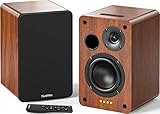


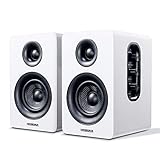

| Product | Best for | Key spec from the title |
|---|---|---|
| Saiyin 30W x2 | Compact turntable setup | 3.75 inch woofer, RCA and optical inputs |
| OHAYO 60W | Desk plus record player | Bluetooth 5.3, wooden enclosure, RCA input |
| Marshall Acton III | Living room style piece | Bass and treble controls, 3.5mm aux |
| RIOWOIS 40W | TV and turntable combo | TV-ARC and optical support |
| Saiyin 40W x2 | Adding a subwoofer later | 4 inch woofer, sub out |
| Elimavi 30W RMS | Simple vinyl-first buyers | 4 inch drivers, RCA cables included |
| Electrohome Huntley | Retro look with streaming | 3 inch drivers, built-in amplifier |
| Sanyun SW208 | Small desks | 3 inch drivers, 24bit DAC, 60W |
| Edifier R1280DB | Most complete input list | 42w RMS, optical input, 4 inch |
How to Choose
Check the input that matches your turntable
Look at the back of your player first. If it has a built-in preamp (many modern models do), any speaker with RCA or a 3.5mm aux jack will work. If it outputs a raw phono signal, the speakers need a phono input or you need an inexpensive external preamp between the two. Listings that say “for record players” usually mean a line-level RCA input, not a true phono stage, so confirm which one before buying.
Driver size and power are about room size
Woofers in this group run from about 3 inches to 4 inches. A 3 inch driver is fine for a desk or a bedroom shelf, but bass from vinyl benefits from a 4 inch unit or a subwoofer output. Wattage figures on a listing are often peak numbers, so a stated RMS rating, as on the Edifier and Elimavi, is the more useful comparison. For a room around 150 square feet, 30 to 40 watts RMS is a sensible floor.
Connectivity beyond RCA
Bluetooth lets you stream when you do not feel like flipping a side, and optical is useful if the speakers will double as TV audio. Bluetooth 5.0 or newer pairs more reliably than older versions. If you plan to add a TV, favor a model that lists optical or HDMI-ARC rather than only Bluetooth, since wireless audio can lag behind video.
What to ignore and where budget models cut corners
Ignore “3D surround” and “carbon fiber” labels, which describe marketing or cone material rather than how the speaker will sound. Budget models usually cut on cabinet material, on the quality of the volume knob, and on included cables. Check that RCA cables are in the box, because a short or missing cable is a common first-day annoyance, and note whether the remote is included.
One more practical point is placement. Bookshelf speakers sound best when they sit a few feet apart, angled slightly toward the listening spot, and away from the wall behind them if the cabinet has a rear port. A pair squeezed onto the same shelf as the turntable may also pass vibration into the stylus, so a separate stand or a different shelf is worth the effort whichever model you choose.
The 9 Best Options
Saiyin 30W x2 Powered Bookshelf Speakers
These suit someone who wants a straightforward pair for a turntable on a dresser or desk. The listing names Bluetooth, optical, auxiliary, and RCA inputs, which covers nearly any source you might add later.
- Strength: four input types on a modest pair of speakers.
- Strength: 3.75 inch woofer gives a little more body than 3 inch rivals.
- Trade-off: the 30W figure per side is the lowest in the Saiyin range, so large rooms may feel underpowered.
Skip it if you want a subwoofer output or if your room is bigger than a bedroom.
OHAYO 60W Computer Speakers
The OHAYO pair is aimed at desk listeners who also own a record player. It lists Bluetooth 5.3, a wooden MDF enclosure, carbon fiber drivers, and 3.5mm, RCA, and USB inputs.
- Strength: Bluetooth 5.3 is the newest version in this group.
- Strength: MDF cabinets tend to resonate less than thin plastic shells.
The trade-off is that it is marketed as a computer speaker first, so verify it fits a vinyl workflow. Skip it if you want optical for a TV.
Marshall Acton III Bluetooth Home Speaker
This is a single-unit stereo speaker for people who care how the object looks next to a record shelf. The listing mentions bass and treble controls, plug-in power, and a 3.5mm aux input.
- Strength: tone controls let you shape the sound for a room without a receiver.
- Strength: an all-in-one body saves space and cabling.
The trade-off is the aux-only wired input, so you need a turntable with a built-in preamp and an adapter cable. Skip it if you want separate left and right speakers for real stereo imaging.
RIOWOIS 40W Powered Bookshelf Speakers
RIOWOIS targets people whose speakers will serve both a turntable and a television. It lists a 2.75 inch woofer, a silk dome horn tweeter, and TV-ARC, optical, AUX, and Bluetooth inputs.
- Strength: TV-ARC support allows one remote for the television and the speakers.
- Strength: silk dome tweeters are generally associated with smoother treble.
The trade-off is the smallest woofer here, so low bass will be limited. Skip it if deep bass for electronic or hip-hop pressings matters.
Saiyin 40W x2 Powered Bookshelf Speakers
This step-up Saiyin adds a 4 inch woofer and a sub out, which makes it the best expandable option for a growing vinyl system. Inputs include Bluetooth, optical, auxiliary, and RCA.
- Strength: the sub out lets you add a subwoofer for turntable bass later.
- Strength: larger woofer and higher wattage than the 30W sibling.
The trade-off is a larger footprint on a small desk. Skip it if you will never add a subwoofer and want the smallest possible pair.
Elimavi Powered Bookshelf Speakers for Record Players
Elimavi describes itself as a vinyl speaker, with 4 inch drivers, a 30W RMS Class D amp, and RCA cables included. It is a good match for first-time record buyers who want fewer decisions.
- Strength: RMS rating is stated, so the power claim is easier to trust.
- Strength: cables in the box mean you can plug in right away.
The trade-off is a narrower input list than the Saiyin or Edifier. Skip it if you need optical for a television.
Electrohome Huntley Powered Bookshelf Speakers
The Huntley leans on a retro appearance, with 3 inch drivers and a built-in amplifier for turntable, TV, PC, and wireless streaming. It fits shelves where looks matter.
- Strength: styled to look at home beside vintage-style players.
- Strength: handles turntable, TV, PC, and wireless sources.
The trade-off is the 3 inch driver, which limits low-end weight. Skip it if you value performance per dollar over appearance.
Sanyun SW208 Active Bookshelf Speakers
The SW208 lists 3 inch drivers, Bluetooth 5.0, a 24bit DAC, 60W, and USB and 3.5mm AUX inputs. It suits compact desks and listeners using a turntable with a built-in preamp.
- Strength: the 24bit DAC helps when streaming from a computer.
- Strength: small drivers keep the pair compact.
The trade-off is that the visible listing shows USB and 3.5mm inputs but no RCA, so a turntable will need an adapter. Skip it if you want a direct RCA connection.
Edifier R1280DB Powered Bluetooth Bookshelf Speakers
The R1280DB is the best-equipped pair for buyers who want near-field studio monitor behavior from a wood grain cabinet. It lists optical input, Bluetooth, 4 inch drivers, and 42w RMS.
- Strength: a stated RMS rating and optical input make it versatile.
- Strength: wood grain finish suits living room shelves.
The trade-off is that it sits at a higher price tier than the simplest pairs. Skip it if you only need a quiet bedroom setup.
Which One Fits Your Situation
You have a beginner turntable and a small bedroom
The Elimavi is the least complicated route, with RCA cables included and a clear RMS figure. The Saiyin 30W is a solid alternative if you also want optical.
You want one pair for records and television
The RIOWOIS with TV-ARC is built for this job. The Edifier R1280DB also covers optical and Bluetooth if you want a stronger driver.
You plan to grow the system
The Saiyin 40W with its sub out leaves room to add bass later without replacing the speakers.
You listen mostly at a desk, close up
The Sanyun SW208 and OHAYO pairs are sized for near-field listening, and both list computer-friendly connections, so they double as everyday desktop speakers between records. Because you sit close, small drivers are less of a handicap than they would be across a living room.
If style matters as much as sound, the Marshall Acton III and the Electrohome Huntley are the picks where the look is part of the reason to buy. If you simply want a safe, low-cost start, the Elimavi or the 30W Saiyin keep the connection list short and leave room to upgrade later, once you know whether you prefer a bigger woofer, a subwoofer, or a TV connection.
Common Mistakes
- Skipping the preamp question: a turntable without a built-in preamp needs one or a speaker with a phono input.
- Trusting peak wattage instead of an RMS rating.
- Putting speakers on the same surface as the turntable, which feeds vibration back into the needle.
- Buying Bluetooth-only models for TV use and then noticing audio lag.
- Ignoring cable length and placement, so the speakers end up too close together for stereo separation.
Related guides
- How To Check Motherboard Vrm Temperature In Hwinfo
- How To Clean Quest 3 Lenses And Facial Interface
- Vr Facial Interfaces For Glasses Wearers
Frequently Asked Questions
Do I need a separate amplifier for these speakers?
No. Powered speakers include an amplifier in one cabinet, so you connect the turntable straight to the speaker inputs. You still need a phono preamp if the turntable lacks one.
Is Bluetooth good enough for vinyl?
Records are played over a wired connection, so Bluetooth only matters for streaming. Wired RCA or aux keeps the signal from the turntable simple.
How big should the woofer be?
For small rooms, 3 to 4 inches is workable. If you love bass-heavy records, favor a 4 inch driver or a model with a subwoofer output.
Why does my record player hum through new speakers?
Hum usually comes from a missing ground wire or a cable running near power cords. Check the ground connection and separate audio and power cables.
Related guides
More from Amazon
Programs that pair well with the guide above. Offers and eligibility are set by Amazon and may change.
Free shipping on eligible items, Prime Video and more. Eligible new members can start with a free trial.
Start a Prime free trialAd-free music streaming. Eligible new subscribers can start with a free trial.
Try Music Unlimited freeA Prime membership for ages 18-24 with a trial period. Eligibility is set by Amazon.
See Prime for Young AdultsAudiobooks and podcasts to listen to on the go. Eligible new members can start with a free trial.
Try Audible freeAs an Amazon Associate we earn from qualifying purchases.