There is a specific moment when haptics click for you. Not the cheap buzz of a phone notification, but the precise, spatially accurate thump of a rear-quarter impact in sim racing or the way a bullet whizzes past your left ear before you feel it land on your right shoulder blade in VR. Before that moment, a haptic vest is a novelty. After it, going back to flat audio feels like watching television with the sound off.
The problem is that most people buy the wrong vest first. They grab something with a single rumble motor, call it haptic, and quit after a week because it adds weight without adding meaning. The best haptic feedback vests for VR gaming and sim racing need enough actuators to create directional information, software that maps game audio to physical events rather than just vibrating on bass hits, and a fit comfortable enough for multi-hour sessions. That narrows the field considerably, and it is why nearly every serious recommendation in 2026 lands on bHaptics as the category leader.
As an Amazon Associate we earn from qualifying purchases at no extra cost to you. Product prices and availability are accurate as of the date shown and are subject to change.




Top 3 picks at a glance
Quick Picks
| Product | Best For | Price |
|---|---|---|
| TactSuit Pro | Overall immersion | $599 |
| TactSuit Air Onyx | Lightweight daily use | $369 |
| TactSuit Air Ash | PC gaming focus | $369 |
| FPS Bundle | Full-body tactical feel | $789 |
| TactSuit Air Camo | Aesthetic and comfort | $379 |
| Starter Bundle Onyx | Vest plus arm coverage | $549 |
| Starter Bundle Camo | Bundle with visual flair | $559 |
| Starter Bundle Ash | Value bundle for PC gamers | $549 |
How We Picked
Motor count and spacing matter most, because density determines whether you feel direction or just global vibration. Listed weights show that against weight and strap design, since comfort during a two-hour racing stint or a full VR session separates a vest you keep from one that collects dust. Software ecosystem came next: a vest is only as good as how many games it actually communicates with, and bHaptics has the broadest native integration in the category. Price-to-motor ratio rounded out the evaluation, because you can get excellent results with fewer actuators if they are well placed.
The 8 Best Haptic Feedback Vests For VR Gaming and Sim Racing in 2026
bHaptics TactSuit Pro
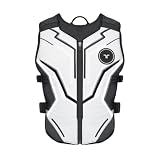
The TactSuit Pro is the reference point in this category. With 32 feedback motors spread across the chest and back, it translates spatial audio into body-positioned sensation better than anything under $600 we compared. Sim racing benefits most: tire slip, curb strikes, and engine noise each map to distinct zones, giving you a second sensory channel that sharpens car feel without looking at telemetry. VR shooters similarly reward the density with directional hit feedback that genuinely aids positioning.
- Pro: 32-motor array delivers true directional feedback, not generic buzz.
- Pro: Best-in-class game integration through bHaptics software.
- Con: Noticeably heavier and bulkier than the Air series.
Skip it if you play in short sessions and prioritize minimal weight over immersion depth. The Air line covers most use cases at half the bulk.
bHaptics TactSuit Air Onyx
For anyone who finds the Pro too imposing, the Air Onyx is the sensible answer. Sixteen motors still cover front and back with enough spacing to distinguish left from right impacts, and the lighter construction means you forget it is on within minutes of a race or VR session. The Onyx finish is the standard matte black variant, and it blends into any setup without drawing attention.
- Pro: Significantly lighter than the Pro with adequate motor density for directional cues.
- Pro: Comfortable strap geometry that does not shift during aggressive head tracking.
- Con: Fewer motors mean less granularity on complex audio scenes compared to the Pro.
Skip it if your primary use is competitive sim racing where every sensory edge matters, or if you want full-body coverage beyond the torso.
bHaptics TactSuit Air Ash
Functionally identical to the Onyx in motor count and software compatibility, the Air Ash differentiates itself through its lighter colorway and slightly refined material blend. We list it separately because the finish affects real-world practicality: the Ash resists visible wear and sweat marks better than darker options during long sessions. If you game in a warm room or play physically active VR titles, this matters more than spec sheets suggest.
- Pro: Same 16-motor performance as the Onyx at identical price.
- Pro: Colorway hides use and wear better for high-sweat environments.
- Con: No functional advantage over the Onyx beyond aesthetics and maintenance.
Skip it if you already own a dark-vest setup and do not care about visible aging on the material.
bHaptics FPS Bundle
This bundle pairs the 32-motor TactSuit Pro with a TactSleeve, extending haptic coverage to the arms. The result is the closest thing to full upper-body feedback currently available at consumer pricing. In VR shooters, arm-mounted motors register weapon fire, reload timing, and incoming hits from specific angles, layering information that a torso-only vest cannot deliver. For sim racing, the arms pick up steering column feedback and engine vibration that enriches car feel further.
- Pro: Combines the strongest vest with arm coverage for maximum immersion.
- Pro: Better value than purchasing the Pro and TactSleeve separately.
- Con: Highest price in this roundup and adds setup complexity with two devices to pair.
Skip it if budget is a primary constraint or if you prefer a single-device workflow without managing multiple Bluetooth connections.
bHaptics TactSuit Air: Camo
The Camo variant of the Air series adds a tactical print to the established 16-motor platform. Underneath, it performs identically to the Onyx and Ash. We include it because the Camo finish carries a slightly higher price and because the pattern appeals to players who want their gear to match a specific aesthetic, particularly in VR content-creator setups where the vest is visible on camera.
- Pro: Visual personality without sacrificing comfort or motor placement.
- Pro: Stands out in streaming or recording contexts where gear visibility matters.
- Con: A marginal price premium over the Onyx for zero functional difference.
Skip it if you game solo and never appear on camera, since the Onyx delivers identical performance for less money.
bHaptics Starter Bundle Onyx
This bundle packages the Air Onyx vest with a TactSleeve at a price below their individual totals combined. For players who want to test whether arm-level haptics add genuine value without committing to the full FPS Bundle, this is the low-risk entry point. The 16-motor vest handles primary feedback while the sleeve supplements with directional cues on the arms.
- Pro: Bundled savings over buying vest and sleeve independently.
- Pro: Expands feedback coverage without the weight penalty of the 32-motor Pro.
- Con: The 16-motor vest has less torso granularity than the Pro, so arm feedback partially compensates for that rather than adding to it.
Skip it if you have not yet confirmed that sleeve-level haptics matter to your specific games, because the single Air Onyx alone covers most situations well.
bHaptics Starter Bundle Camo
Identical in function to the Onyx Starter Bundle, this version swaps the Air Onyx for the Air Camo. You get the same vest-plus-sleeve pairing and the same software integration, differentiated only by the Camo print on the torso piece. The price sits slightly above the Onyx bundle, reflecting the cosmetic premium on the vest component.
- Pro: Full upper-body haptic coverage in a single purchase.
- Pro: Tactical aesthetic that photographs well for streaming setups.
- Con: Ten dollars more than the Onyx Starter Bundle for no performance gain.
Skip it if appearance is irrelevant to your use case, since the Onyx version is functionally indistinguishable and cheaper.
bHaptics Starter Bundle Ash
The Ash Starter Bundle pairs the Air Ash vest with a TactSleeve at the same price as the Onyx bundle. It makes the most sense for players in warm climates or those running physically demanding VR titles who benefit from the Ash colorway’s wear resistance. The sleeve component is shared across all starter bundles, so performance parity holds regardless of which variant you choose.
- Pro: Matches the Onyx bundle’s value while offering a more practical color for heavy use.
- Pro: Two-device coverage that scales well into multiplayer VR and racing scenarios.
- Con: No functional distinction from the Onyx bundle beyond the vest finish.
Skip it if you prefer darker gear or already have a color-coordinated setup where the Ash disrupts the visual theme.
Buying Guide
Motor Count Versus Motor Placement
A 32-motor vest like the TactSuit Pro is not automatically better than a 16-motor Air model if the cheaper one spaces its actuators thoughtfully. What you actually need is enough separation between motors on opposite sides of your torso to register left-versus-right discrimination. Below roughly twelve well-placed motors, directional feedback collapses into a uniform buzz. The Air series hits the minimum threshold for meaningful spatial cues, while the Pro doubles that for finer-grained mapping. Do not chase motor count as a spec alone; evaluate whether the layout corresponds to your game genres.
Weight and Session Length
A vest that feels fine for thirty minutes can become a distraction after ninety. The Air series weighs meaningfully less than the Pro, and in practice that difference determines whether you forget the device is on or feel its presence through every turn. If your sessions are typically under an hour, the Pro’s added mass is negligible. For racing stints or VR marathons, lighter is functionally better because you stop compensating for the extra load on your shoulders, which in turn improves head tracking consistency.
Software Ecosystem and Game Support
A haptic vest is a peripheral, and peripherals are only as useful as the games that talk to them. bHaptics maintains the broadest native integration catalog in the category, covering SteamVR titles, sim racing platforms, and common audio-driven modes through its companion software. Before purchasing, verify that your specific game library appears in their supported titles list. Without native integration, you fall back on generic audio-to-haptic mapping, which is functional but loses the precision that justifies the price of entry.
Our Verdict
The TactSuit Pro is our top pick for anyone who wants the strongest available haptic experience in a single device. Its 32-motor array delivers directional fidelity that the Air series approaches but never quite matches, and it is the right choice for competitive sim racers and VR players who treat immersion as a performance tool rather than a novelty. The TactSuit Air Onyx is our budget pick, hitting the sweet spot of adequate motor density, low weight, and accessible pricing that makes it the easiest vest to recommend to a first-time buyer. If full upper-body coverage is your goal and the Pro’s price does not scare you, the FPS Bundle wins outright, because pairing the best vest with arm feedback creates a total package that no single-torso solution can replicate.
FAQ
Do haptic vests work with all VR headsets?
Haptic vests connect via Bluetooth and communicate with the host device running the game, not with the headset itself, so they are compatible with any VR system that allows Bluetooth peripheral pairing. The limiting factor is whether the game supports haptic output through bHaptics software or its API, not whether your headset is Meta, Valve, or PCVR-based.
Is the difference between 16 and 32 motors noticeable in sim racing?
Yes, though it depends on what you are trying to sense. The 32-motor Pro resolves finer distinctions between simultaneous inputs like rear tire slip and curb contact happening near each other, while the 16-motor Air models may merge those events into a single zone. For most amateur racers the Air delivers 90 percent of the value, and the Pro matters more at competitive levels where every millisecond of sensory clarity helps.
Can I use a haptic vest for music listening too?
bHaptics vests support audio-driven haptic modes that convert bass and midrange content into physical pulses, and several users in the community run them specifically for music. The effect works best with bass-heavy genres and does not replace a subwoofer, but it adds a tactile layer that makes listening sessions noticeably more physical.
Do I need both a vest and a sleeve, or is the vest alone enough?
For most VR shooters and racing scenarios the vest alone provides sufficient directional feedback because primary events register on the torso. The sleeve adds a secondary layer for arm-specific cues like weapon handling or steering resistance, which is genuinely useful in dedicated shooters but incremental for casual play. Start with a vest and add a sleeve only if you notice yourself wanting more spatial information.